

Mohd Arbaaz is an Editor and Writer at Fitnessison.com with 5 years of experience in SEO and digital content creation. He creates informative, reader-focused content covering fitness, workouts, nutrition, health, healthy lifestyle, technology, and computers.

Shashi Teja is a Reviewer at Fitnessison with over 6 years of experience in SEO, content strategy, digital publishing, and content optimization. He reviews content for clarity, research quality, topical relevance, readability, structure, and overall usefulness to readers.
Last Updated: September 9, 2026
We can make nutrition easier or a lot more complicated. Search on the ‘best diet’ and you are spoiled for choices. One recommends cutting down on carbohydrate. One encourages plant-eating. One advocates meal-timing switching. One promotes high protein intake. Some boast ‘quick results’; others work around heart health, blood pressure or blood-sugar levels.
So which I‘ll stand with?
Rather than being based on a broad range of information, the answer is quite more personal.
The current Dietary Guidelines for Americans (2025–2030) recommends more flexible dietary pattern focusing on the nutrient dense foods (whole foods) such as protein, dairy, vegetables, fruits, healthy fats, and whole grains, and limiting heavily processed foods, added sugars and refined carbs. The guidelines are intended to fit varied lifestyles, preferences, and cultural backgrounds.
That is a good rule-of-thumb to keep in mind when studying diet plans. A sound eating pattern will support your goal, be nutritionally appropriate, be compatible with your lifestyle and be sustainable. This leaflet covers the common types of diet plans, what they are intend to do and how to decide what to followup.
Diet Plans Resource Center
Explore our complete collection of guides covering keto, Mediterranean, intermittent fasting, vegan, paleo, and DASH diet plans, including how each approach works and important considerations.
What Is a Diet Plan?
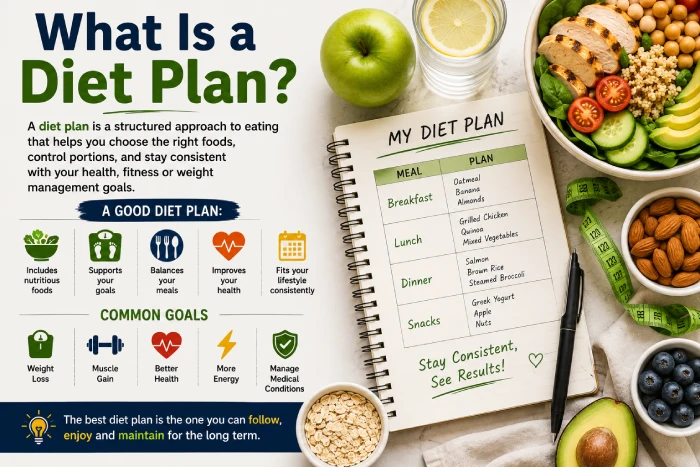
A diet plan has a different meaning to each individual, but it’s essentially the pattern of eating for an individual, whether that be what, how much, when or simply how they eat. Some diet plans are targeted for a particular health concern.
Other most concern about an eating pattern.
For example:
- The Mediterranean diet is rich in vegetables, fruits, legumes, whole-grains, fish, nuts, and unsaturated oils.
- The basis of DASH was to focus on lowering blood pressure and the heart health.
- A vegetarian diet, which is generally, else considered to include lacto-ovo-vegetarianism, is one in which meat is eliminated but a variety of plant foods and dairy products, and in one case, eggs are included.
- Vegan Diet A diet consisting of no animal products of any kind.
- A ketogenic diet is severely carbohydrate restricted along with high fat.
- Intermittent fasting is more of a ‘when to eat’ rather than ‘what to eat’ plan.
They are not interchangeable. What is more, they are not equally suited to all individuals, or all objectives.
The simplest definition
A diet plan is a formation of a eating pattern so that foods choices can be directed toward the achievement of a health, fitness, lifestyle or personal objective.
The key is the objective. A blood pressure controlling diet is not necessarily the most effective muscle gaining diet. Taking off a lot of weight quickly may not be the best choice when it comes to keeping the weight off for years to come.
Key takeaway
Begin with the diets. Begin what you want to achieve. And then, find the eating pattern that can sustain it.
Next step: Refer to our planned guide to Popular Diet Plans Compared for a more direct comparison of individual diets.
Why Are There So Many Different Diet Plans?
Nutrition is complex because everyone has their own needs, own goals, own health conditions, own likes and dislikes, own financial situation and own style of living. A college student, a competitive athlete, a parent of three children, and an individual with a medical condition could benefit from very different strategies.
Of course, there isn‘t a dearth of diet fads nor to they ever tend to wonder out of fashion. The current diet review on Harvard Health considers 39 of the most popular nutrition and weight-loss regimens including low carbohydrate diets, paleo diets, plant based diets, fasting regimes, Mediterranean regimens, disease specific diets and commercial weight loss plans.
That variety can be beneficial. It also can be confusing. A plan could be successful, due to social media, celebrity endorsement, or sensational testimonials, despite not being supported by good long-term evidence.
That‘s why choosing a diet should involve more than asking:
Is this diet fashionable?
Ask:
- Is it nutritionally sufficient?
- Does it fit my purpose?
- Is there evidence of it?
- Am I able to afford it?
- Can I maintain this approach with my family and while socialising?
- Am I able to retain it?
- Is that potentially medical supervision?
Mini summary
That‘s why there‘s a lot of diet plans, because there‘s a lot of ways to set foods. It is not intended to come up with the hottest/hippiest plan. Is to establish an appropriate pattern for your situation.
The Foundation: What Does a Healthy Diet Plan Have in Common?
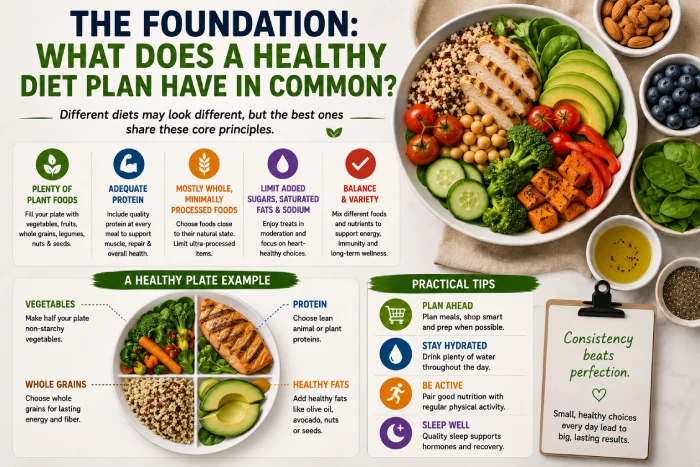
Several diets can vary widely in appearance but have many features in common. The current U.S. Dietary Guidelines promote consumption of whole, nutrient-dense foods and a variety of flexible dietary patterns.
Harvard Health similarly highlights five broad principles found across healthy eating patterns:
- Much fruit and vegetables.
- Adequate protein.
- Purely and mostly minimally processed foods.
- Few added sugars, saturated fat, and sodium.
- Multiple varieties.
It just means you have to be careful when comparing, not that each meal must be on its best behavior.
What is your general trend?
A typical healthy meal might include:
Protein + vegetable or fruit + carbohydrate source + healthy fat
For example:
- Salmon, vegetables, potatoes and olive oil
- Turkey or chicken with sautéed or raw vegetables12 12 1 LifeChoice36 and pmt. avocado.
- Lentils, vegetables,wholegrain bread and yogurt
- Tofu + vegetables + rice + sesame or other healthy fat.
The optimum you get can vary. Then, the same principle established by those arguments obviously does not still hold.
Key takeaway
Your diet won‘t have to be full of rules and complicated formulas. It can come from good selection; nourishing foods, sufficient protein and diversity, everything supporting a pattern you are able to follow.
Next step: The future supporting article on Healthy Eating Patterns can go into this in detail.
Popular Diet Plans at a Glance
Here are major classifications of goals before proceeding with the individual ones.
| Diet plan | Main focus | Potential fit |
| Mediterranean | Plant foods, fish, grains, healthy fats | In general health and heart health. |
| DASH | Fruits, vegetables, whole grains, lower sodium | Blood pressure and the cardiovascular system |
| Flexitarian | Almost entirely veg 0 flex ftw | People eating less meat. |
| Vegetarian | Plant-foods without any inclusion of meat | Plant-forward eating |
| Vegan | Fully plant-based | Individuals who abstain from animal foods |
| Keto | Extremely carbohydrate. Very high fat | Specific goals; requires careful planning |
| Low-carb | Carbohydrate reduction | Some weight or metabolic goals |
| Paleo | Minimally processed foods relative to ancestral dietary patterns | Individuals who favor a particular nutritional approach |
| MIND | Mediterranean + DASH. | Brain-health-oriented eating |
| Intermittent fasting | Food intake during pre-determined periods | Time-structured individual. The individual favoring a Time-Structured can be characterized as follows: has high need for security and prefers stabil-ity over variety. |
| Volumetrics | Food volume and lower energy density. | Individuals emphasizing fullness |
| High-protein | Higher protein consumption | Muscle support and controlling appetite |
This table is for orientation, it is not rankings. The same plan can be useful for one and uncomfortable for the other.
Mini summary
The names of diets will tell you the framework. Whether the framework makes sense depends on your individual goal.
Next steps: Our set up Planned Popular Diet Plans Compared cluster should give the detailed side-by-side comparison.
Diet Plans for Weight Loss
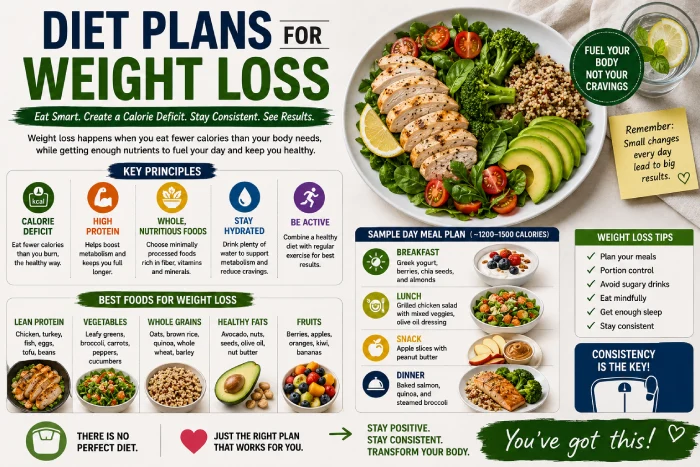
In principle, weight-loss diets usually are successful because they tend to produce an energy deficit that is, on average you are consuming fewer calories each day than you are burning.
But there may be many different ways of creating that deficit.
Some people prefer:
- A Mediterranean-style pattern
- A reduced carbohydrate diet:
- A plan with a higher protein intake
- Portion-controlled eating
- Intermittent fasting
- An organized commercial scheme such as:
- A suggested flexible calorie controlled diet instruction.
According to Mayo Clinic, “Studies comparing various diets frequently find that many are effective for short-term weight loss, and the differences between diets tend to be modest. The real long-term question is whether the individual can stick with the program.
NIDDK also recommends finding a weight-loss program that includes a reasonable goal, a healthy, low-calorie eating plan, physical activity at an appropriate level, behavioral support, and a plan for keeping the weight off.
What makes a weight-loss diet more practical?
Look for meals that are:
- Filling
- Nutrient-dense
- Rich in vegetables and fruit
- Provides the right amount of protein for:
- Calories are reasonable.
- Enjoyable
- Repeat as often as needed:
You don‘t need to give up every food you love.
Create instead a scheme that makes easy for you the choices that you normally make.
Example
A restrictive approach might say:
“Dessert is a special thing. Never eat it.”
A sustainable approach might say:
Offer a small treat now and then and include it as part of the calorie pattern.
That may not seem like much of a difference, but can go a long way to making the plan seem more realistic.
Key takeaway
The bottom line about weight loss, in my opinion, is: the more extreme the diet, the less likely it is to be the one. It‘s the one that produces a reasonable calorie deficit that maintains Nutrition and Compliance.
Next step: Explore our Future Diet Plans for Weight Loss guide for specific strategies, sample Meals and typical errors.
Diet Plans for Muscle Gain
Just consuming tons of protein does not achieve muscle gain. The stimulus for muscle growth comes from resistance training and is supported by food and protein to promote recovery and muscle protein synthesis.
The NIH Office of Dietary Supplements states the role of protein in building, maintaining and repairing muscle; and sports nutrition advice considers the relationship between resistance exercise and protein intake.
According to a position stand by the International Society of Sports Nutrition, “Most exercising individuals should consume 1.4–2.0 g of protein per kilogram body weight per day to maximize the building or retention of muscle.”
This ändert aber nicht, dass sich jeder jedes Gramm abwiegen muss.
It indicates that protein is important as muscle is the objective.
A muscle-supporting eating pattern can include
- Lean meat
- Fish
- Eggs
- Dairy
- Soy
- Beans
- Lentils
- Nuts
- Seeds
- Whole grains
Carbohydrates matter too because they are an important source of training fuel. Good fats help with general nutrition and satisfied eating.
What about bulking?
This is a simple definition, but what does it really mean? Well a “bulk” is simply eating at a caloric surplus so that while bulking you gain muscle. But a very large calorie excess isn‘t necessity better.
We can take a more controlled approach to minimize excess fat gain as:
Think:
Muscle training + high quality protein in sufficient quantities + calorie intake slightly above maintenance + rest and recovery
rather than:
Eat everything + lift weights.
Key takeaway
A muscle-gain diet should be supportive of training, recovery and protein, not just volume of food intake.
Next step: Our future Diet Plans for Muscle Gain cluster can be expanded by going into more detail in:• Protein• Calorie Surplus• Meal Timing• Sample Meal Structure
Medical Diet Plans: When Nutrition Has a Specific Job
Medical diets are entirely different from common lifestyle diets. A diet prescribed for a disorder may be implemented in conjunction with clinical management or advised by a healthcare practitioner for a specific condition.
Examples include:
- Blood pressure and DASH-style diet. As part of the American Heart Association (1999) plan a custom-made DASH diet was given to participants. The focus was not as much on the specific composition of the diet but more on keeping a working knowledge of the dietary plan and giving relevant examples.
- Diabetes centered eating behavioral patternsQ. What specific eating behavioral patterns characterize disorder?
- Gluten free eating for celiac disease.
- How to address some digestive complaints with low-FODMAPs
- Kidney-friendly diets
- Heart-healthy diets
- Special diets for different diseases.
This does not imply that one type of “medicine diet” is effective for all individuals diagnosed with the same ailment. The needs of some individuals will vary. For example, some one with kidney disease may require diet modifications based on kidney function, medications, lab values and other factors.
Andjust as diabetes is unique for each person, one person‘s care plan would be tailored to meet their medication, blood sugar levels, lifestyle, food choices, and health and well-being needs. Healthline‘s recommendations on nutrition for diabetes, for example, consider the various diet options available, such as Mediterranean; DASH; vegetarian or vegan; moderate low-carb and keto, but also stress the importance of personalized advice from a healthcare team.
When should you involve a professional?
Consider professional nutrition guidance if you:
- Be chronically ill.
- Take medications that are food-dependent.
- Have big food allergies.
- If the patient has disease of the kidney, liver or gastrointestinal system.
- Are diagnosed with celiac disease.
- Are pregnant or breast-feeding.
- Hold a history of eating disorder(s).
- Needs a medication prescribed diet.
A registered dietician can develop an individualized diet that meets your health needs and goals.
Key takeaway
Medical diets are not simply diet fads. They are usefully linked to the health state of the person.
Next step: Check out our Medical Diet Plans cluster which covers condition specific nutrition topics.
Sustainable Long-Term Diets
This could be considered the most significant part of the whole topic.
Must be sustainable, too.
Mayo Clinic The focus is on selecting a diet that can be sustained for the rest of your life (crash diets are not encouraged). Cleveland Clinic also points out that extremely restrictive plans are hard to sustain and suggests considering if a diet is practical for months and years instead of only weeks.
Signs of a sustainable plan
A sustainable diet usually allows:
- Variety
- Flexibility
- Social meals
- Foods that you like
- Raw enough to leave you feeling full
- Nutritional adequacy
- Economical shopping price
- Authentic lead time.
Signs of an unsustainable plan
Be cautious if a diet:
- Promises dramatic results overnight.
- Demands very low calorie intake.
- Exceptions to the elimination of foods without rationale.
- Relies extensively on costly products.
- That‘s what makes you afraid of everyday foods.
- Has no maintenance plan.
- Claims all should follow identical plan.
The “five-year test”
Here‘s a useful thought experiment:
Would this be an acceptable diet for me five years from now?
You don‘t have to keep the same days of meals. You need to consider if the habits in question could feasibly persist.
Mini summary
The most effective long-term diet doesn‘t have to be the most rigorous. This is one you can continue to do.
Next step: Our Sustainable Long-Term Diets cluster may investigate flexibility, compliance, diet breaks, maintenance and habit formation.
How to Choose a Diet Plan Based on Your Goal
Rather than asking which diet is ‘best’, develop a straightforward decision tree.
If your primary goal is weight loss
Find a balanced eating pattern that results in a reasonable caloric deficit and that feels satisfying enough to stick with.
If your goal is muscle gain
Ensure sufficient calories, protein, carbohydrate for training and resistance training.
If your goal is heart health
Mediterranean- and the DASH-style patterns also seem worthwhile to study.
If your goal is blood-pressure management
DASH is target-focused on blood-pressure friendly dieting, where fruits and vegetales, whole grains, lean protein and limiting sodium intakes are key.
If your goal is general healthy eating
Begin with an adaptable framework based on whole, nutrient-rich foods instead of an overly restrictive eating plan.
If you have a medical condition
Consult a qualified healthcare professional about any significant changes to your diet.
Key takeaway
Goal first. Diet second. Goal always comes before dietary changes. If we are not working to help the patient achieve their goals, we are not working at all!
This brief shift in perspective can clear up an incredible amount of nutrition confusion.
How to Compare Diet Plans
Just because one person reports having lost weight faster shouldn‘t be the only way that people are compared.
Have a bigger scorecard.
| Question | What it means (impact): Significant awareness is associated with using tobacco for many years, having a myopic vision. |
| However, does it have all of the nutrients? | Blocks nutritional deficiencies |
| Require that it go hardest to achieve I seek? | Maintains the relevance of the plan. |
| Do I have the ability to pay? | Improves consistency |
| Am I allowed to make the meal? | Practical makes it practical: This means the thing should be easy to use, both functionally and in its general operation. |
| Is it possible to manage eating around others? | Enhances adherence to treatment in the long term |
| Am I at all pleased with the foods? | Shared made word stretching a practical tool for accuracy and ease of transcription. Makes repetition more convenient |
| Is there reliable evidence? | Diverts attention from hyped, pseudo-experts to the scientific underpinnings |
| Does it meet my health needs? | Lowers preventable risks |
| Is the manner of its existence…retainable? | Supports long-term results |
Harvard Health suggests taking into account a variety of considerations. including: how well an eating pattern is nutritionally balanced; if it is flavorful and good tasting; to what extent it is convenient to prepare; if it suits the individual schedule; affordability; and the sustainability of the diet in the long term.
A practical scoring system
Give each diet a score from 1–5 for:
- Nutrition
- Enjoyment
- Convenience
- Cost
- Flexibility
- Evidence
- Long-term sustainability
Top total is not necessarily the “best”.
It just helps to show you which scheme suits your lifestyle.
Common Diet Planning Mistakes
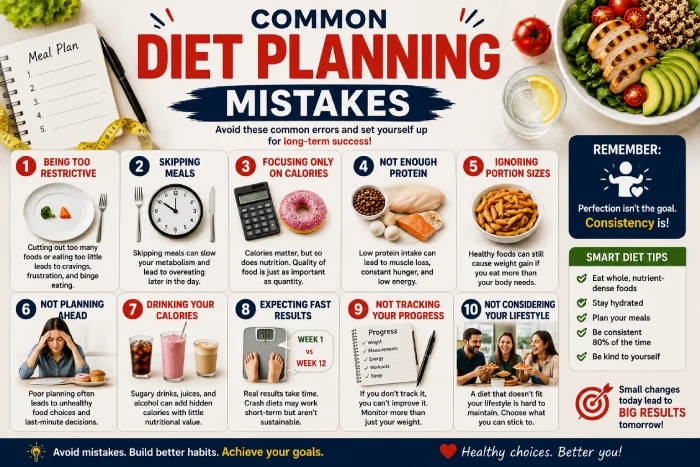
Mistake 1: Choosing a diet because it is trending
You cannot judge by popularity.
Mistake 2: Starting with extreme restrictions
Transitioning from your usual diet to one that is extremely restrictive overnight can prove to be quite a challenge.
Mistake 3: Ignoring protein
Protein supports muscle maintenance, strength recovery and post-meal satiety.
Mistake 4: Treating carbohydrates as automatically bad
Carbohydrate laden foods provide fiber and training food. The quality and overall consumption needs to be watched.
Mistake 5: Forgetting calories completely
Food quality is important, but energy consumed still affects body weight.
Mistake 6: Ignoring food preferences
It‘s not going to last if you don‘t like most the foods on the plan.
Mistake 7: Copying someone else’s diet
Your favorite influencer‘s diet was built around their life not yours.
Mistake 8: Trying to change everything at once
Begin with several small habits.
Mistake 9: Having no maintenance strategy
A diet should answer: What are the consequences of achieving my goal?
Mistake 10: Ignoring medical considerations
Some diets may be inappropriate or should be done with specific guidance from a health care professional.
Diet Plans: Myth vs. Fact
| Myth | Fact |
| One diet is the best that is, the best one for everyone. | Goals and situations need different solutions. |
| Weight loss is faster, and thus ‘better’ diet. | Quick results may not always equate to lasting results |
| Carbs are always bad | Carohidrate rich foods provide a source of many nutrients and energy. |
| Building muscle is achieved through high protein alone. | Combining resistance training with proper nutrition |
| Healthy diets have to be great value. | A number of healthy, filling staples are what I would consider cheap such as pasta. |
| A diet has to be quite perfect. | Overall consistency is more important than being perfect |
| Keto us healthier automatically | Keto is one way to eat and not a necessity for all |
| Mediterranean is a weight-loss diet only. | It is a broader eating pattern linked to several health findings. |
| The diets are interchangeable. | Medical nutrition requirements should be condition-related. |
| To prevent this is you have to stick to a diet for the rest of your life. | Long term healthy habits are more important than permanently following a branded program |
What Does a Realistic Diet Day Look Like?
A good diet plan doesn suffer from being difficult.
For example:
Breakfast
Greek yogurt, with a handful of berries, oats and a few nuts.
Lunch
Chicken or Tofu bowl + Vegetables + Rice + Healthy dressing
Snack
Apple + yoghurt or a small handful of nuts
Dinner
Fish or beans, with roasted vegetables and potatoes or something whole grain
Optional snack
Depending on appetite and necessity, for example fruit, yogurt or perhaps additional meals with high protein naturally. This is not a one-size-fits-all recommendation. It‘s an example of various food combinations with a meal, without a complex diet rule.
The bigger picture
Across the day, you can think about:
Protein, fruits & vegetables, healthy carbohydrates, healthy fats, and something different each day.
This approach is a bit more elastic than simply knowledge that a lengthy list of forbidden foods.
Can Diet Plans Work Without Exercise?
Yes, it is possible to alter body weight by diet alone, without any physical activity, since diet can alter the energy balance.
Though I am not saying: However, nutrition and physical activity aren‘t the same which I am not saying:
NIDDK points out that most weight-management programs focus on calorie restriction and physical activity and sleep, while recognizing the health benefits of regular physical activity even when weight remains unchanged. Resistive training is critically important for muscle development. However for someone attempting to increase cardiovascular health, aerobic training will be beneficial.
So rather than asking:
2. “Diet or exercise?”
a better question is:
Possible questions for nutrition and activity to address my goal:
What About Intermittent Fasting?
What sets intermittent fasting apart from most typical diet plans is that it is based on when you eat rather than what you eat.
Examples include:
- Time-restricted eating
- Alternate-day fasting
- The 5:2 method
Some find that fasting can be helpful in give their day a structure. Others struggle with hunger, social schedules or training requirements. The real problem is whether the students will adhere. If, for instance, a fasting interval helps you organize food intake conveniently, and you can cover your nutritional requirements that way, it might be a good idea. A different method might work if it causes too much hunger or is too hard to cope with in everyday life.
Key takeaway
Fasting is not a rule for eating well, it is a tool.
The Role of Protein in Different Diet Plans
Protein seems to be a feature of virtually every important nutrition discussion because: it..
It contributes to:
- Muscle maintenance
- Muscle growth
- Tissue repair
- Satiety
- Recovery
The time origin can be.
Animal-based sources
- Fish
- Chicken
- Turkey
- Eggs
- Dairy
- Lean meat
Plant-based sources
- Beans
- Lentils
- Tofu
- Tempeh
- Soy foods
- Nuts
- Seeds
Most athletes should be able to meet their protein requirements from food however supplements may be helpful in some circumstances. The NIH (2000) states that protein powders are a useful supplement when optimal intake of protein is not achieved by diet alone.
Mini summary
High-protein as a diet plan doesn‘t have to be adopted because it happens to be a fashionable trend. Average protein requirements are I gram per kilogram of bodyweight, but this varies greatly.
The Role of Calories
Calories are another case where diet talk gets needslessly complicated. When you want to manage body weight, what matters is an energy balance. If you spend more energy than you eat, your body weight will go down. If you spend less energy than you eat, your body weight will go up. But that doesn‘t mean calories are the only thing that matter.
Food quality influences:
- Nutrient intake
- Hunger
- Satiety
- Fiber intake
- Protein intake
- Food enjoyment
- Overall health
Two diets both have the same calorie count, yet these contain vastly different amounts of nutritional goodness.
That‘s why a good diet plan considers both:
Volume of intake Weights are for the next part, how much you eat.
and
What you‘re eating.
How Diet Plans May Evolve in the Future
Personalization is a key direction for the future of nutrition.
Instead of one-size-fits-all meal plans, people increasingly have access to:
- Nutrition tracking applications: These are specialist applications that allow you to record the amounts of different nutrients consumed. Their main advantage is helping to ensure a balanced diet by making you more aware of your intake levels.
- Customized meal schedules
- Wearable data
- AI-assisted food recommendations
- Grocery-list automation
- Virtual coaching provided by dietitians.
- Individualized training programs and nutritional programs
But technology can not take away the necessity for the principles of sound nutrition. A well balanced plan will also still have to supply enough nutrition and be compatible with the individual‘s state of health, way of life, and taste.
Indeed, the flexibility of the American diet is already somewhat acknowledged by the current American Dietary Guidelines which describes a dietary pattern “approach that can be adapted to individual preferences and food traditions.”
The probable future isn‘t one perfect diet. It is a more personal application of established nutrition principles.
When You Shouldn’t Choose a Diet Plan on Your Own
Sometimes you need more than you can get from the general web advice.
Speak with a healthcare professional or registered dietitian if you:
- Diabetics who regularly consume glucose lowering drugs.
- Suffer from renal disease.
- Possess substantial gastrointestinal pathology.
- Have celiac disease.
- Should have a proven or suspected severe food allergy.
- Provide information on people who are pregnant or breast-feeding.
- Suffer from being underweight or unable to eat sufficiently.
- Must have suffered from an eating disorder in the past.
- Requires a diet applied and managed from a medical perspective.
- May be using, which is an extremely limited diet.
A registered dietitian could assist in aligning dietary recommendations with your past medical history, nutritional needs and goals.
A Simple 7-Step Way to Choose Your Diet Plan
If you are feeling lost even with all the options go through this process.
Step 1: Define the goal
Weight loss?
Muscle gain?
General health?
Blood pressure?
Medical nutrition?
Step 2: Identify your non-negotiables
Consider:
- They are the foods you like.
- How you change your dietary intake by yourself You may choose to exclude certain foods from your diet.
- Budget
- Cooking ability
- Work schedule
- Family preferences
Step 3: Choose two or three approaches to investigate
So don‘t pit 30 diets against each other all at one time.
Step 4: Check the evidence
Please check reputable medical organizations, government guidances, systematic reviews and experts.
Step 5: Look for nutritional adequacy
Question if the plan has enough protein, fiber, vitamins, and minerals and overall energy.
Step 6: Test practicality
Can you keep up with him at work?
At restaurants?
While traveling?
Did you have discussions with your family?
Step 7: Think beyond the first month
Ask:
Am I really able to keep up with this?
If not, continue.
FAQs
Q1) What is the best diet plan?
No diet plan is suitable for all. The most suitable plan is the one that matches your goal, health needs, food likes and dislikes, lifestyle and due to these factors is able to be followed regularly.
Q2) Which diet is best for weight loss?
There are many dietary approaches that can promote weight loss. It is easier and more practical to adopt a dietary pattern that maintains an appropriate calorie deficit, is nutritionally balanced and easy to maintain long term.
Q3) What is the healthiest diet plan?
The best eating habits usually focus on nutrient dense foods such as vegetables, fruits, proteins, whole grains and healthy fats while avoiding highly processed foods with excess sugar and sodium or saturated fat.
Q4) Is the Mediterranean diet good for long-term health?
Mediterranean dietary pattern is among the best studied dietary pattern and focuses on the consumption of vegetables, fruits, whole grains, legumes, nuts, fish along with better sources of fat. It is also considered as a flexible pattern of eating rather than a short-term rigid diet.
Q5) Is keto better than other diet plans?
Keto may be a perfect fit for a certain individual and their specific goals, but it is a restrictive diet in comparison to many others. It is not an “every person–every time” diet and one‘s long term future should be taken into consideration.
Q6) What diet plan is best for muscle gain?
A muscle-building diet should provide sufficient overall calories and protein to enable, the demands of, resistance training and recovery. There is evidence to support the need for sufficient protein intake in conjuction with resistance activity to increase lean body mass.
Q7) Are medical diet plans safe to follow without a doctor?
Maybe not always. Certain therapeutic diets should be modified for specific drugs, lab tests, disease state, and individual nutritional requirements. Professional advice could be needed.
Q8) Can I lose weight without following a specific diet?
Yes. Weight loss can be achieved through various eating patterns provided they are associated with an energy deficit. A branded diet is not necessary.
Q9) How long should I follow a diet plan?
It will depend on the kind of plan and what you are trying to achieve. A long term eating plan needs to be nutritionally complete and sustainable, not just aimed at fast short term results.
Q10) How do I know if a diet plan is sustainable?
You have to consider if you can afford it, if you can prepare the food, if you can eat with other people, if you can meet your nutritional needs and keep going like that for months or years.
Q11) Are high-protein diets good for everyone?
Protein is important but different people have different requirements. If you have medical conditions then you may need a particular recommendation for protein, therefore professional advice can be important.
Q12) Should I count calories?
Calorie counting can work for some individuals for certain weight-management objectives, but it is not required for everyone. Portion control and assessing nutrition quality can also be effective strategies.
The Bottom Line: The Best Diet Plan Is the One That Fits the Person
None of the diets are a single Utopian winner.
Mediterranean, DASH, plant based, low carb, ketogenic, high protein, intermittent fasting etc. all can be attractive for different people and several purposes. The key difference is between selecting a diet because it is trendy and selecting because it fits.
U.S. dietary guidance today promote a pattern of eating that consists of whole,nutrient dense foods and that allows for variety and is individualized. For weight loss, concentrate on an eating pattern that can provide energy in a calorically appropriate manner while maintainingnutritive benefit and sustainability. To build muscle, combine any as well as with resistance training. Consult the physicians, on an case-by-case bases. And for the long term, settle on behaviors that you can to realistically do.
A diet plan should enhance your life, not dominate it.
Begin with this pillar, then delve into the info on more detailed guides on popular diet plans compared, diet plan for weight loss, diet plan for muscle gain, medically supervised diet plans and sustained long term diets.