



Mohd Arbaaz is an Editor and Writer at Fitnessison.com with 5 years of experience in SEO and digital content creation. He creates informative, reader-focused content covering fitness, workouts, nutrition, health, healthy lifestyle, technology, and computers.

Shashi Teja is a Reviewer at Fitnessison with over 6 years of experience in SEO, content strategy, digital publishing, and content optimization. He reviews content for clarity, research quality, topical relevance, readability, structure, and overall usefulness to readers.
Last Updated: September 9, 2026
If you‘ve ever been curious about what makes “eat less, move more” actually work (or how it might sometimes not), it all tends to boil down to this principle: the calorie deficit. It‘s the underlying principle behind almost every weight loss strategy be it a calorie tracking app, an intermittent fasting schedule, or a strict meal plan. Knowing it inside and out and being able to explain it to others is what makes sustainable fat loss possible.
A calorie deficit refers to when you are regularly consuming less calories than the amount that your body is burning in a day. It is at that point that your body then draws from stored energy (mostly fat) to compensate.., thus creating a calorie deficit.
The nuts and bolts of a calorie deficit. What it is, how much it should be, what to be aware of in one page without a full food list, 7 day meal plan and 5 day workoutprogram thrown in. If you‘d like to dive deeper into each section, visit the accompanying pages.
A quick heads up: this is a general education piece. If you have a medical condition, are pregnant, or have a history of disordered eating, consult with a doctor or registered dietitian before making changes to your diet.
Calorie Deficit Resource Center
Explore our complete collection of calorie deficit guides covering calculations, meal plans, food choices, exercise, common mistakes, and creating an appropriate deficit for different goals.
What Is a Calorie Deficit, Exactly?
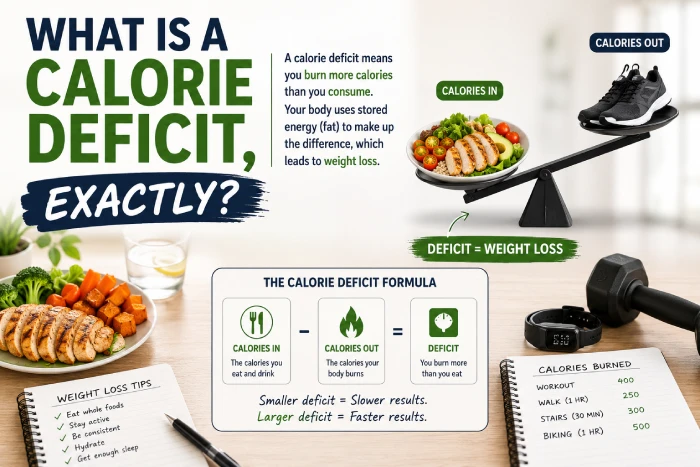
You are burning a set amount of calories a day just for everyday activities breathing, blood flow, eating, working, moving about. That total is known as your TDEE (Total Daily Energy Expenditure). The amount eaten below your TDEE is your deficit and above it is your surplus. There‘s your maintenance.
Key takeaways:
- A calorie deficit is relative to your TDEE, not a fixed number that applies to everyone
- TDEE includes your resting metabolism (BMR) plus activity, digestion, and exercise
- A deficit only produces meaningful fat loss when it’s consistent over time — a single low-calorie day doesn’t move the needle much
Mini summary: you can’t know your ideal deficit without first estimating your maintenance calories — which is exactly what the calculation process below (and our dedicated calculator guide) walks through.
Ready to find your exact numbers? See our full guide on how to calculate calorie deficit, including BMR, TDEE, and deficit formulas.
How Big Should Your Calorie Deficit Be?
This is where most people make mistakes either not creating a big enough deficit or going too hard and ending up doing yourself more harm than good.
Most other large health bodies, from the NHS to the CDC, will tell you essentially the same thing: a daily deficit of around 500 to 750 calories, leading to a weight loss of 0.5 to 1 lb (roughly 0.25—0.5 kg) a week. This rate of weight loss is slow enough to be manageable and to not deplete muscle mass, but still would be significant enough to appear impressive over the weeks.
Key takeaways:
- A 500 calorie/day deficit is a reasonable starting point for most adults
- The old “3,500 calories = 1 pound of fat” rule is a rough approximation, not an exact formula — your results will vary and typically slow down over time as your body adapts
- Going well below maintenance (very low-calorie diets, often under 800 calories a day) is associated with muscle loss, nutrient deficiencies, and other health risks, and should only be done under medical supervision
- As a general safety floor, intake usually shouldn’t drop below roughly 1,200 calories a day for women or 1,500 for men without professional guidance
Practical tip: Instead of going with the most aggressive number a calculator gives you, consider a slightly less aggressive, balanced number (say, 500 calorie/day deficit). This will be far easier to adhere to over time.
A Real-World Example
Numbers make more sense with a concrete example. For example, imagine a woman who is moderately active and her TDEE has been estimated at about 2,000kcal a day. Then selecting a baseline of 500kcal deficit delivers the following daily intake: which is well under the general safety threshold and (arguably) safely sustainable by most healthy individuals.
At this rate, she can probably expect to lose approximately 0.5- 1 lb a week; provided she measuring steady and her activity levels are approximately the same. Achieving a one stone weight loss in 12 weeks will be noticeable and visible, but she will not be experiencing the fatigue and hunger levels associated with ‘more than’ 2 stone weight loss loss cut. This is the ideal ‘boring-on-purpose’ rate that generally works for sustainability, as opposed to the crash diet which achieves results faster initially but can hardly be maintained past week three!
Mini summary: the “math” behind a calorie deficit, is simple, but turning it into a number that is manageable for yourself in the “real world” is what will truly be the deciding factor in whether or not it works long term.
Tracking Your Calorie Deficit Accurately
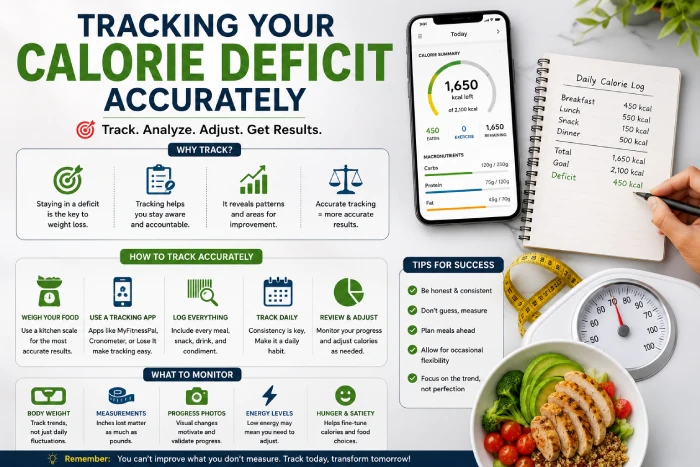
A deficit only works if the numbers going into it are reasonably accurate. This is where a lot of well-intentioned plans quietly fall apart.
Key takeaways:
- Food logging apps are the most common way to track intake, but accuracy depends on measuring portions rather than eyeballing them — research consistently shows people underestimate what they eat, sometimes significantly.
- A kitchen scale for a few weeks, even if you stop using it later, dramatically improves your sense of what a real portion looks like.
- Exercise calorie burn estimates from fitness trackers and gym equipment tend to run high — treating them as a rough guide rather than an exact number prevents “eating back” more calories than you actually burned.
- Weekly averages matter more than daily perfection. One higher-calorie day doesn’t undo a deficit, and one very low day doesn’t accelerate it much either — consistency across the week is what counts.
Practical tip: Record your intake for a minimum of 2 weeks even if you don‘t intend to monitor for the long term. It is a quick way of discovering which of your everyday ingredients and snacks are innocuously higher in calories than you expect.
Why Weight Loss Isn‘t Always a Straight Line
If you‘ve dieted, you already know the annoying part. The scale jumps around erratically, even when you‘re in a fairly good calorie deficit.
What’s actually happening:
- Water weight fluctuates daily by 1–2 kg due to sodium intake, hormones, and hydration — this isn’t fat gain or loss, and it’s the biggest reason day-to-day weigh-ins feel confusing
- Metabolic adaptation means your TDEE gradually drops as you lose weight (a smaller body burns fewer calories), so a deficit that worked in week one may shrink by week eight
- Plateaus are normal, not a sign that a calorie deficit “stopped working” — they usually mean it’s time to recalculate your TDEE based on your new weight
Practical tip: Weigh yourself at the same time each day, a couple of times a week, and monitor your weekly average rather than overreacting to any single reading.
If you‘ve hit a stall in your weight loss or are getting conflicting results, see our article on the most common reasons for pitfalls in calorie deficit– and how to fix them.
What Calorie Calculators Get Right (and Wrong)
Online calculators are undoubtedly helpful as a first step, but it‘s useful to be aware of their limitations before assuming the number it produces is infallible.
What they get right:
- Formulas like Mifflin-St Jeor are well-validated and give a reasonably accurate BMR estimate for most people based on age, sex, height, and weight
- They’re a fast, free way to get a starting number instead of guessing
What they get wrong:
- Activity level is usually self-reported and overestimated. Most people select a more active category than their actual daily movement reflects, which inflates the TDEE estimate and the resulting calorie target.
- They don’t account for individual variation. Two people with identical stats can have meaningfully different metabolisms due to genetics, muscle mass, medical conditions, or medications.
- They give a snapshot, not a moving target. As covered above, the number changes as your weight changes, but a calculator won’t remind you to recalculate.
Practical tip: Don‘t treat the calculator‘s answer as gospel. If you stick to your predicted deficit for two or three weeks and don‘t see the weight change it predicts, modify the number relative to how much your body actually responds.
What to Eat in a Calorie Deficit
You could technically go into a calorie deficit by eating whatever you want, but the types of food you‘re eating will affect how easy it is to do this and how much of the lost weight will be fat versus muscle.
Key takeaways:
- Protein is the priority. Research generally supports roughly 1.2–1.6 grams of protein per kilogram of body weight during a deficit to help preserve lean muscle mass.
- High-volume, lower-calorie foods (vegetables, fruits, lean proteins) help you feel full on fewer calories than calorie-dense, low-volume foods.
- Fiber slows digestion, which helps manage hunger — an underrated tool for sticking with a deficit long-term.
- Nothing is strictly “off-limits” — sustainable deficits generally work better when they don’t feel like total deprivation.
Practical tip: To make changes ‘stick’, rather than shange everything at once, add a palm size of protein and throw in some vegetables to a meal you normally have. Little changes seem to be easier to ever tend to stay with rather than more drastic changes.:
For a detailed list of what to have in your kitchen, check out our foods for calorie deficit.
Structuring Your Meals Around a Deficit
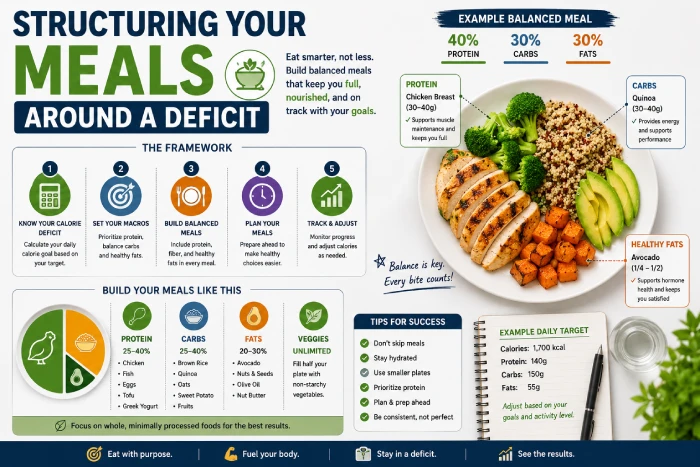
Knowing your calorie target is only half the equation — the other half is turning that number into meals you’ll actually eat and enjoy for weeks or months, not just a few days.
Key takeaways:
- Splitting your day into 3 meals plus 1–2 snacks tends to work well for hunger management, though there’s no single “correct” meal frequency
- Front-loading protein earlier in the day can help with satiety and reduce evening snacking
- Meal prepping a few days at a time removes decision fatigue, which is one of the biggest reasons deficits fall apart mid-week
Practical tip: Build 3–4 go-to meals you actually love that hit your calorie goal and stick with them. Change is fun, but a reliable rotation of a few meals is generally what helps a deficit last longer than two weeks.
Looking for ready made sentences? find our complete calorie deficit meal plans with samples days at various calorie levels.
Exercise‘s Role in a Calorie Deficit
The diet creates the deficit while exercise alters the factors over which the weight is lost and thus the effect on fat distribution and appearance as the pounds come off.
Key takeaways:
- Strength training during a deficit helps preserve muscle mass, which is what keeps your metabolism from dropping as sharply and what gives you a leaner, more toned appearance as fat comes off
- Cardio increases your total calorie burn, which can let you eat slightly more while maintaining the same deficit — useful for people who find restrictive eating harder than being active
- Exercise alone, without addressing diet, is a very inefficient way to create a meaningful deficit — it’s much easier to under-eat 500 calories than to burn them off
Practical tip: If you need to do just one thing, do 2-3weights sessions a week during a deficit. They do way more to safeguard your long-term anabolic profile and looks than any amount of extra cardio.
For a more in-depth deep dive into “training smart” during a deficit, check out our primer on calorie deficit and exercise.
Calorie Deficits Aren‘t One-Size-Fits-All
What a 25-year old male athlete who wants to cut fat and maintain muscle requires is quite different from a 55-year-old woman with a slower metabolism, or someone who is just getting back into training after a long period of being sedentary.
Key takeaways:
- People carrying more muscle generally tolerate a slightly larger deficit without losing strength as noticeably
- Deficits often need to be smaller and paired with more strength training for people prioritizing muscle retention or body composition over speed
- Hormonal factors (including menopause, thyroid conditions, and certain medications) can change how someone responds to the same deficit — this is a good reason to loop in a doctor if progress doesn’t match expectations
My tip here: Don‘t think of the default 500 calorie recommendation as a rule. Think of it as a suggestion to monitor your body for 2-3 weeks and then make changes accordingly. If progress is faster than 2-3 weeks without feeling drastically different, then don‘t change anything. If it feels unsustainable or results are far slower than expected, that’s useful information for adjusting the plan rather than a reason to abandon the deficit approach altogether.
See our page on the appropriate calorie deficit for your goal for tailored advice.
Calorie Deficit vs. Other Weight Loss Approaches
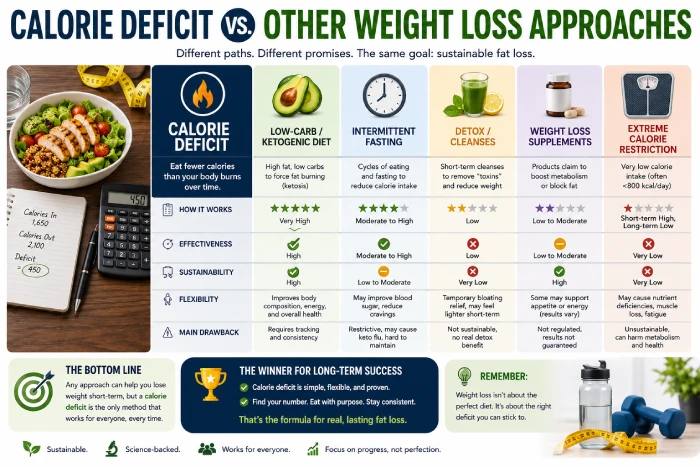
It‘s also interesting to put this concept of calorie deficits alongside a couple of other common methods that people tend to see as stand-alone ‘techniques’, as the calorie deficit concept can usually elucidate why they deliver results.
Key takeaways:
- Intermittent fasting doesn’t have any special fat-burning effect on its own — it tends to work for people because restricting the eating window naturally reduces how much they eat overall, creating a deficit indirectly.
- Low-carb and keto diets often produce fast early results partly from water loss and partly because cutting an entire food category naturally reduces total calorie intake for many people — the deficit is still the underlying mechanism.
- GLP-1 medications work in part by reducing appetite, which again leads to eating in a deficit, just through a different pathway than willpower-based restriction.
- None of these approaches “bypass” the need for a deficit — they’re different tools for reaching the same underlying state, and the best one is whichever a person can realistically sustain.
Practical tip: “what diet is best for weight loss” is not always what you should be asking. asking “what approach helps me most easily keep in a calorie deficit” will have people pointing you to a sustainable approach instead of a fad.
Signs Your Deficit Is Too Aggressive
Cutting calories too hard often backfires — not just physically, but by making the whole process harder to sustain. Watch for:
- Constant fatigue or difficulty concentrating
- Losing strength rapidly in the gym
- Persistent, intense hunger that doesn’t ease after a couple of weeks
- Hair thinning, feeling cold often, or missed menstrual cycles
- Mood changes, irritability, or a preoccupation with food that feels out of character
If several of these show up, it’s a sign to ease the deficit — not push through it — and worth a conversation with a healthcare provider, especially if symptoms persist.
Common Mistakes People Make
- Guessing calories instead of measuring or tracking them, which usually leads to underestimating intake — studies on self-reported food intake consistently find people undercount by a meaningful margin, often without realizing it.
- Cutting too aggressively, leading to muscle loss, fatigue, and burnout within a few weeks. A deficit that feels impossible to sustain past day ten is a sign it’s too large, not a sign of insufficient willpower.
- Ignoring protein, which makes the deficit harder to sustain and increases muscle loss. It’s one of the simplest, highest-leverage changes available and is often the first thing to slip when someone is focused only on hitting a total calorie number.
- Not adjusting the deficit as weight drops, since TDEE decreases as body weight decreases — sticking with the same calorie target for months without reassessing is one of the most common causes of a stalled plateau.
- Judging progress by the scale alone, instead of also tracking measurements, photos, or how clothes fit. Water retention, hormonal cycles, and digestion can all move the scale independent of actual fat loss.
- Eliminating entire food groups unnecessarily, which often makes a deficit harder to sustain socially and nutritionally without providing any extra fat-loss benefit beyond the calorie reduction itself.
- Restarting from scratch after a single off-plan day, rather than simply returning to the plan at the next meal. One higher-calorie day has a minimal impact on weekly averages, but the all-or-nothing mindset around it derails far more progress than the extra calories ever do.
Myth vs. Fact
- Myth: “A bigger deficit means faster, better results.”
- Fact: Beyond a certain point, larger deficits mostly increase muscle loss, fatigue, and the odds of quitting — not the amount of fat lost per week beyond what a moderate deficit already achieves.
- Myth: “You need to cut carbs or a specific food group to be in a deficit.”
- Fact: A calorie deficit is about total calories in versus out. You can achieve one eating carbs, following a low-carb approach, or anything in between — what matters most is the total, not the specific macronutrient split, though protein does matter for muscle preservation.
Sleep, Stress, and Your Calorie Deficit
Diet gets most of the attention, but two often-overlooked factors can quietly make a deficit feel much harder than it needs to be — or stall results even when the numbers on paper look right.
Key takeaways:
- Poor sleep increases hunger hormones (ghrelin) and reduces the hormone that signals fullness (leptin), which is a big part of why a rough night’s sleep so often leads to overeating the next day.
- Chronic stress raises cortisol, which can increase cravings for high-calorie foods and make it harder to stick with a plan, independent of willpower.
- Under-recovery from stress or poor sleep can also affect how much you move throughout the day (NEAT), subtly lowering your TDEE without you noticing.
Practical tip: If a deficit that used to feel manageable suddenly feels much harder, it’s worth checking sleep quality and stress levels before assuming the diet itself is the problem — sometimes the fix isn’t fewer calories, it’s more rest.
Adjusting Your Deficit Over Time
A calorie deficit isn’t something you set once and leave alone for months. As your weight changes, your maintenance calories change with it, which means the plan that worked in week one often needs a check-in by week six or eight.
Key takeaways:
- Recalculate TDEE roughly every 10–15 lbs lost, since a lighter body burns fewer calories at rest and during activity than it did at a higher weight
- Expect to eat somewhat less over time to maintain the same size deficit as your weight drops — this is normal and expected, not a sign that something’s gone wrong
- Diet breaks at maintenance calories, taken periodically during a longer weight-loss journey, can help with both adherence and metabolic health, and are worth discussing with a professional if your goal involves losing a significant amount of weight
Practical tip: Set a recurring reminder to reassess your calorie target every few weeks rather than assuming your original number stays accurate for the whole journey.
How Long Should You Stay in a Deficit?
Extended, uninterrupted dieting isn’t usually the healthiest or most effective approach. Many nutrition professionals recommend structuring longer weight loss journeys with periodic breaks at maintenance calories — often every 8–12 weeks — to support metabolic health, mental recovery from dieting, and long-term adherence. How long any individual should stay in a deficit depends on their starting point and goals, which is exactly the kind of personalized question worth bringing to a doctor or registered dietitian rather than following a generic timeline.
The Bottom Line
A calorie deficit is simple in concept — eat less than you burn — but getting it right involves more than picking a number and cutting your portions. Calculating your maintenance calories accurately, choosing a moderate and sustainable deficit, prioritizing protein and strength training, and adjusting as your body changes are what separate people who lose weight and keep it off from those stuck in a frustrating cycle. Use the guides linked throughout this page to go deeper into calculating your numbers, building your meal plan, choosing your foods, structuring your workouts, and adjusting the approach to your specific goals.
FAQs
Q1) What is a calorie deficit?
A calorie deficit is when you consistently eat fewer calories than your body burns in a day, which causes your body to draw on stored energy (mainly fat) and results in weight loss over time.
Q2) How do I create a calorie deficit?
Estimate your maintenance calories (TDEE), then eat roughly 500–750 calories below that number each day. This typically produces about 0.5–1 lb of weight loss per week for most adults.
Q3) Is a 500 calorie deficit enough to lose weight?
Yes — a 500 calorie/day deficit is one of the most commonly recommended starting points and typically leads to about 1 lb (0.45 kg) of weight loss per week, based on the standard approximation that roughly 3,500 calories equals a pound of fat.
Q4) What is the minimum calories I should eat in a deficit?
General safety guidelines suggest not going below roughly 1,200 calories a day for women or 1,500 for men without medical supervision, since very low-calorie diets carry health risks.
Q5) Why has my weight loss stalled even though I’m still in a deficit?
This is usually metabolic adaptation — as you lose weight, your TDEE drops, so a deficit that worked initially may shrink or disappear over time. Recalculating your TDEE based on your current weight usually resolves it.
Q6) Do I need to exercise to be in a calorie deficit?
No — a deficit is created through calories in versus out, and diet alone can produce one. Exercise, especially strength training, helps preserve muscle and shape your results, but it isn’t required to be in a deficit.