


Mohd Arbaaz is an Editor and Writer at Fitnessison.com with 5 years of experience in SEO and digital content creation. He creates informative, reader-focused content covering fitness, workouts, nutrition, health, healthy lifestyle, technology, and computers.

Shashi Teja is a Reviewer at Fitnessison with over 6 years of experience in SEO, content strategy, digital publishing, and content optimization. He reviews content for clarity, research quality, topical relevance, readability, structure, and overall usefulness to readers.
Last Updated: September 8, 2026
If your goal is to shed fat one of the most effective ways to do this is to go into a calorie deficit. Unfortunately most people don‘t recognize that they are making very basic errors that keep fat loss from happening effectively or just make it a lot more difficult than it needs to be. Knowing about some of the commonest calorie deficit errors to avoid can allow you to lose more fat more quickly without negatively affecting your health, muscles or energy levels.
A calorie deficit is just actually mean that you‘re taking in less calories that what you are burning. But remember it is not just about dieting for a certain period, it is also making the right lifestyle choices: smart nutrition choices, staying active, sleeping a lot and remaining consistent.
In this document we‘ll be covering the some of the biggest missteps people make when sticking to a calorie deficit, and how to prevent them for the duration of your goals.
What Is a Calorie Deficit?
Calorie deficit: means that you consume fewer calories than your body requires.
Your body burns calories through:
- Breathing
- Digestion
- Daily movement
- Exercise
- Muscle recovery
- Maintains the body‘s basic functions.
And this deficit is kept constant, the body will utilize fat stores for energy and gradually lose fat.
Why Avoiding Common Mistakes Matters
Many people give up on weight loss because they:
- Stop seeing progress
- Always hungry in general.
- Los muscular en lugar de grasa
- Negative reinforcement 2: becoming tired or unmotivated
- To break the spell Follow unrealistic plans
As far as we know, there is no harm in fat loss so the wise choice is to avoid these errors and to drop the fat without compromising your health and function.
15 Calorie Deficit Mistakes to Avoid
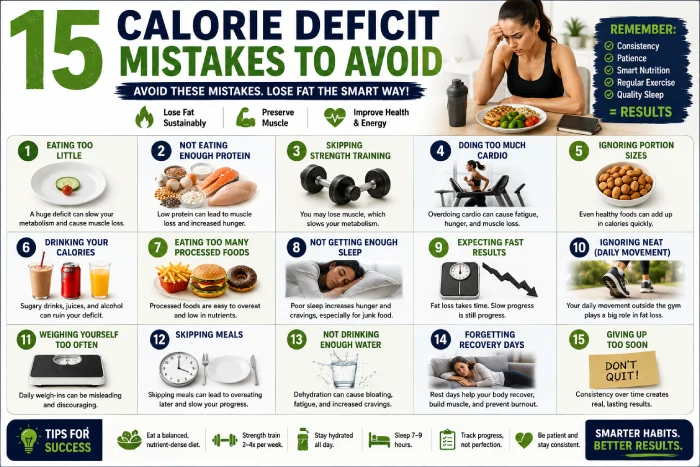
1. Creating an Extremely Large Calorie Deficit
Reducing your intake significantly below what you require may appear to be the most effective way of reaching the weight that you want, however it can cause you to become more tired, hungrier, increase muscle deterioration and is harder to maintain.
Start with a slight calorie deficit to give yourself room to improve more slowly.
2. Not Eating Enough Protein
Protein helps hold onto lean muscle as well as keep you feeling satisfied.
Good protein sources include:
- Chicken
- Fish
- Eggs
- Greek yogurt
- Tofu
- Lentils
- Beans
In general, aim to include some protein into each meal.
3. Skipping Strength Training
We find that a lot of people just do cardio.
Strength training helps:
- Preserve muscle
- Improve body composition. Common with bodybuilders and athletes, achieving an improved body composition is in most cases uppermost. If you can‘t see the muscles through a fat body, what use will they be?
- Support metabolism
- Increase strength
STR should be performed at least 2–4 times a week.
4. Doing Too Much Cardio
Too much cardio without proper recovery can result in fatigue leading to muscle loss.
Cardio is combined with weights seems to work best.
5. Ignoring Portion Sizes
Even good foods have calories.
The use of measuring devices or to keep portion sizes occasionally can also help identify how food should be prepared, how much should be eaten and the consistency required.
6. Drinking Your Calories
More calories from less satiety can be obtained by drinking. For example:
Limit:
- Soda with added sugar1.3.1.12. Find the amount of sugars in sugars.3. Check the numbers collected (number of points of sugars).4. Calculate the ratio (number of points of sugars) (number of points of sugars).5. If the ratio is greater than 0.7 find the soda consumption.1.3.1.13. Sodas filled with sugar Find the number of points gathered (number of points of sugars).2.3. Substitute the number in the equation (number of points of sugars).3. Study the ratio (number of points of sugars) (number of points of sugars).4. If the comparison number is superior than 0.7 then drink soda.
- Includes naturally or artificially sweetened coffee drinks.
- Fruit juices
- Alcohol
Drink water, black coffee, or unsweetened tea more frequently.
7. Eating Too Many Processed Foods
Most highly processed foods are very easily over consumed and less satiating than unprocessed foods.
Prioritize:
- Vegetables
- Fruits
- Whole grains
- Lean proteins
- Healthy fats
8. Not Sleeping Enough
Sleep is a significant factor in the body’s control of appetite, recovery and the performance of physical activity.
Sleep at night. Try for 7–9 hours of sleep per night.
9. Expecting Fast Results
Healthy fat loss is a slow process.
As a normal occurrence, weight fluctuates on a daily basis. Body weight can fluctuate due to various reasons on a day to day basis, such as hydration levels and food.
Don‘t look for a solution that will work overnight. Prioritize steady routines.
10. Ignoring Daily Movement
The exercise is significant but also the frequent activity throughout the day in the excessive high.
Increase your daily movement by:
- Walking more
- Using the stairs.
- Standing regularly
- Stretching between breaks if not too lengthy: Even a few minutes of stretching during the breaks is good for you. It will help relax the muscles in your legs in particular during a time when they are in constant use.
11. Weighing Yourself Too Often
It is natural for weight to fluctuate from day to day.
Instead of focusing on daily numbers, monitor progress over several weeks using:
- Weekly weigh-ins
- Progress photos
- Measurements
- Clothing fit
12. Skipping Meals to Save Calories
Not eating during the middle of the day will leave you very hungry later on.
Ensure you opt for a meal plan that is enjoyable and something that you can consistently stick to.
13. Not Drinking Enough Water
Hydration supports:
- Exercise performance
- Digestion
- Energy
- Appetite management
Consume consuming water regularly throughout the day.
14. Forgetting Recovery Days
It takes time for your body to recover:
Recovery helps:
- Build muscle
- Reduce the risk of injury
- Improve performance
- Prevent burnout
Make sure you take at least 1 or 2 light activity/rest days each week.
15. Giving Up Too Soon
One of the biggest mistakes in all works out is to give up after a few weeks.
Fat loss is really a slow process and is one that you really need to be patient with and consistent!
I think those little, sustainable habits are likely to give us the biggest bang in the long run.
Signs Your Calorie Deficit Is Working
Healthy progress may include:
- Slow fat reduction
- Improved energy levels2
- Increased strength
- Improved fitness
- Clothes that are more comfortable to wear.
- Improved eating habits Specifically, changing eating habits through diet would lead to an improvement in eating habits.
Keep in mind that the scale is only one indicator of progress, show me the other.
Tips for Staying Consistent
To improve your chances of success:
- Pre-plan the meals.
- Consume sufficient protein.
- Stay hydrated.
- Exercise regularly.
- Get plenty of sleep.
- Monitor the progress of every student on weekly basis.
- Emphasize small achievements.
Sample Daily Routine
| Time | Activity |
| Morning | High-protein breakfast and water Protein is important to how, and how well, the body performs, but the the body will always balance up, so it is vital to not only focus on consuming or avoiding certain foods such as the high-protein breakfast and water but also be aware of the overall nutritional balance. |
| Mid-Morning | Walk or a bit of moving around |
| Lunch | Healthy meal with vegetables |
| Afternoon | Healthy snack, if necessary |
| Evening | A bulking program consisting of maintaining strength training or doing cardio |
| Dinner | Lean protein and vegetables. Whole grains Whole grains; Green; Yellow and orange, other red |
| Night | The ability to relax and get good rest |
Frequently Asked Questions
What’s the biggest calorie deficit mistake?
Creating too great of a calorie deficit is perhaps the most common misconception; it leads to more hunger and fatigue while at the same time causes muscle wasting and is unsustainable in the long-term.
Can I lose weight without exercising?
Yes. Though weight loss mainly occurs because of calorie deficit, I do think that there are many benefits to exercising such as muscle maintenance, fitness gains and continued weight loss.
Should I count calories forever?
Absolutely not. Some people end up obsessing about calories and others who eventually do things in moderation. They learn about proper nutrition and become more mindful of what they eat.
Why am I not losing weight in a calorie deficit?
Some things that could be the cause are, Calories eating were.. Less, Calories burnt were… More, tracking wasn‘t consistent, there was less activity that day or just a fluctuation of weekly weight changes. Maybe reviewing things over a couple of weeks will enable you to see where improvements need to be made.
Is it okay to have occasional treats?
Yes. If you‘re consistently craving your favorite foods (assuming reasonable portions), allowing yourself some will make you more likely to adhere to your plan over the long haul.
Conclusion
Removing these calorie deficit errors can contribute to a healthier, more sustainable and successful weight-loss program. Rather than crash dieting and over-exercising, try a balanced diet with higher protein, strength-training, water, sleep, and consistency. Remember that fat loss takes time and gradual changes, and you can incorporate good habits and they will stick around long after you‘ve reached your goal weight.