

Mohd Arbaaz is an Editor and Writer at Fitnessison.com with 5 years of experience in SEO and digital content creation. He creates informative, reader-focused content covering fitness, workouts, nutrition, health, healthy lifestyle, technology, and computers.

Shashi Teja is a Reviewer at Fitnessison with over 6 years of experience in SEO, content strategy, digital publishing, and content optimization. He reviews content for clarity, research quality, topical relevance, readability, structure, and overall usefulness to readers.
Last Updated: September 9, 2026
Each January and let‘s be honest, each Monday another group of people joins the millions of others who have set a goal to “get healthy.” They give up sugar, go all-in on the gym five days a week, start taking up meditation, drink a gallon of water a day, and take their 9 p.m. bed-time, all of this happening tomorrow. By week two, almost everyone has dropped it without much as a second thought.
The problem isn’t motivation. It’s that most healthy habits advice sets people up to fail by asking for too much, too fast, based on a timeline that isn’t even real. You’ve probably heard it takes 21 days to build a habit. It doesn’t. The actual research — a landmark study from University College London, since confirmed by a larger systematic review — puts the real average closer to 66 days, with individual habits ranging anywhere from 18 days to nearly a year depending on how complex they are and how you build them.
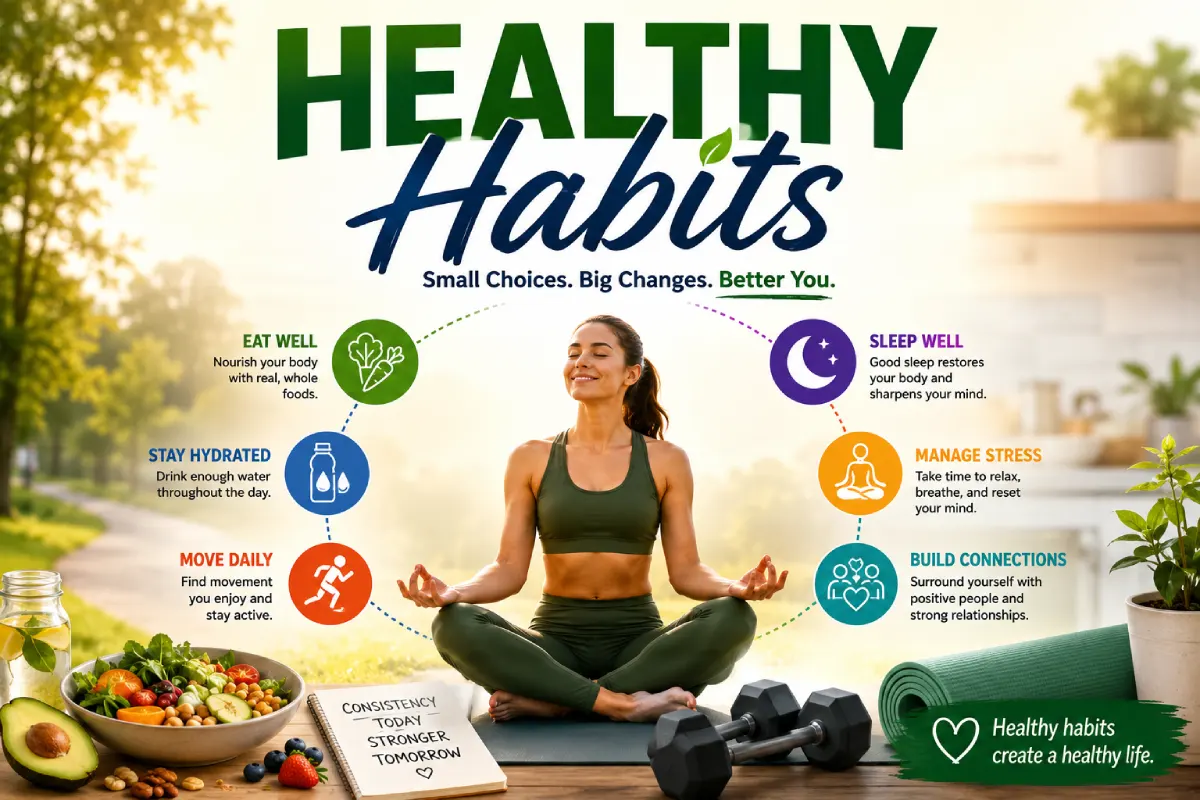
This guide is built around that more honest timeline. Instead of one overwhelming list, we’ll break healthy habits into six practical areas — your mornings, how you eat, how you sleep, how you move, how you manage stress, and how you hydrate — with a realistic starting point for each. Each section gives you enough to act on today, and points you to a deeper guide if you want the full routine for that area.
You don’t need to overhaul your entire life this week. You need one habit, in one area, that you can still be doing in March — not the version of you that exists on a highly motivated Sunday afternoon, but the version of you that shows up on an ordinary, slightly tired Wednesday. That’s the version this guide is written for.
Healthy Habits Resource Center
Explore our complete collection of guides covering healthy morning routines, eating, sleep, exercise, mental well-being, and proper hydration habits for everyday life.
Why Healthy Habits Feel Harder to Build Than They Used To
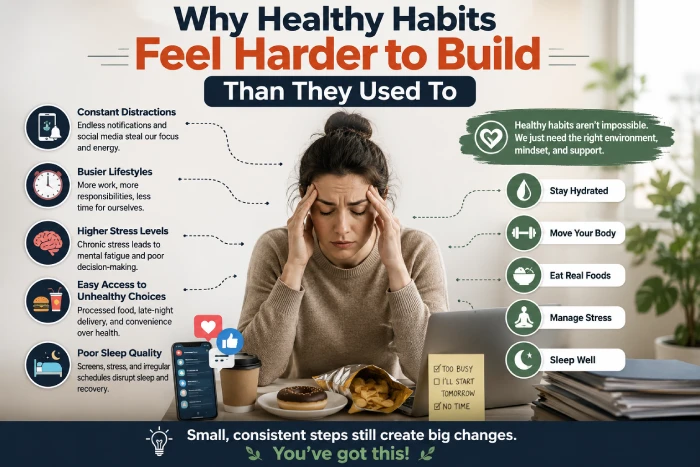
If you think a healthy habit willpower than a decade ago, then this may.
A few real shifts are working against you:
- Convenience is designed to beat consistency. Food delivery apps, streaming autoplay, and algorithmic feeds are all built to remove friction from the exact behaviors that compete with healthy habits — it now takes more deliberate effort to cook a meal or go to bed on time than to order in or keep scrolling.
- Attention is more fragmented. Constant notifications and context-switching make it harder to notice the small cues (hunger, tiredness, stress) that used to naturally prompt healthier choices.
- “All or nothing” fitness culture online sets an impossible bar. Social feeds are full of 5 a.m. workouts and perfect meal-prep photos, which can make an ordinary, sustainable habit feel not worth starting.
- Work and sleep schedules are less predictable for many people, especially with hybrid work and shift work, making the same-time-every-day habits that research favors harder to maintain.
None of this implies that surviving or thriving in 2026 having healthy habits for 2026 are not doable it just means that the pervasive small-and-specific approach in this guide is more essential now than it was when most daily routines were more naturally structured. Accepting and building upon these realities, instead of denying that they exist, is a key factor in why some habits hover about for a while and then fade away in February while others still seem to be thriving.
What Building a Healthy Habit Actually Requires
Before diving into specific habits, it helps to understand what actually makes one stick, because this is where most people go wrong.
It will require much, much more time than you think it will. The original, 2009 habit-formation research showed it takes an average of 66 days for a new behavior to become automatic, but the amount of variance was so high that some habits, such as drinking a glass of water, only took an average of 18 days to become automatic, while a more complex action, such as doing a new exercise routine every day, took, on average, 91 days but some habits took as long as 254 days at least. Since then, a 2025 systematic review of habits across sleep, diet, hydration, and activity needs, found a median of about 59-66 days for habits across the board.
Healthy Habit Actually Requires
- Missing a day doesn’t reset the clock. One of the more reassuring findings from that same research: occasionally missing a day did not meaningfully affect whether the habit eventually formed. The all-or-nothing thinking that causes people to give up after one bad day the mentality that a single missed workout or snuck-in bedtime “ruins” an entire streak and renders it null and void has no basis in the science, despite being one of the most prevalent declarations of quit.
- Small, specific beats big and vague. Eat healthier is a goal, not a habit. Add 1 piece of fruit to lunch is a habit small enough to live through a bad week, specific enough that you know right away if you did it.
- Morning-anchored and self-chosen habits tend to stick better. Research on habit strength has found that habits practiced in the morning and habits people choose for themselves — rather than ones imposed by someone else — tend to form more reliably than evening habits or externally assigned ones.
Important note: The objective is not to change everything in one weekend. The objective is to choose one tiny, specific, self-selected new habit per life domain and do not expect the habit to become automatic before 2-3 months and don‘t freak out if you skipped a day.
Morning Healthy Habits
How the first hour of your day goes tends to set the tone for everything after it — not because of some magic “morning person” quality, but because early decisions are usually made with the most willpower and the fewest competing demands you’ll have all day.
For whom it is: anyone who is already beginning his or her mornings staring at their phone screen before rushing out of the house which, let’s be honest, is probably most people.
An example that can be more believable: an actual sustainable version that is easier to do might be just saying the goals and brushing your teeth not watching your phone, but 1 glass of water, opening the blinds and writing one thing that is important today. That takes less than 5 minutes and it still isn‘t asking you to wake up earlier.
Key takeaways:
- Mummify yourself in a short, simple, unchanging routine (even 3 small steps) rather than a complex routine you give up after 2 weeks
- Starting the day with ample light exposure and exercise can reset your internal clock, allowing you to sleep better that night.
- Avoiding to check the phone/email… (even 20-30 minutes) will probably diminish the reactive, stressed feeling that co ats people throughout the rest of the day
Common limitation to watch for: an ambitious morning routine copied from social media rarely survives contact with a day that starts late, a sick kid, or a bad night’s sleep — build a “minimum version” of your routine (just the water, skip the rest) for those mornings so the habit doesn’t break entirely.
Practical suggestion: select one foundational morning ritual a glass of water, five minutes outside, or making a list of the day‘s priorities and associate it with an existing daily ritual. For example, combine it with brushing your teeth so you don‘t have to remember each separately.
Want a full, realistic morning routine you can actually stick to? → [Read our full guide to Morning Healthy Habits]
Healthy Eating Habits
Healthy eating isn’t one perfect diet — it’s a set of repeatable patterns. The American Heart Association frames it this way too: healthy eating is about building consistent habits, not eating one perfect meal and calling it done.
Is for: anyone who‘s succeeded for two weeks on a really strict diet, then fallen off the wagon completely and rapidly almost everybody who‘s done any dieting ever.
A realistic example: instead of trying to change one‘s entire diet at once, a sustainable habit may be to add in one vegetable or fruit to their lunch everyday or preparing one simple, high-protein breakfast on the Sunday for the week ahead- small enough to survive a hectic Tuesday, concrete enough to be actually measurable
Key takeaways:
- Focusing on wholesome foods-vegetables, lean meats and plant proteins, grains, fats-is much more important than cutting out one particular food[.]
- Planning in advance (even roughly) removes the decision fatigue that causes poorer food choices later in the day
- Portion awareness not restriction, is one of the most sustainable levers for weight and energy control
Common limitation to watch for: habits built around eliminating entire food groups tend to break down at the first social event, holiday, or stressful week — patterns built around addition (more vegetables, more protein) rather than elimination tend to hold up better under real-life pressure.
Practical tip: Instead of redesigning every meal, redesign one — most people find breakfast or lunch easiest to change consistently, since dinner is often shaped by other people’s schedules too.
Get specific meal patterns, timing tips, and a starter plan → [Read our full guide to Healthy Eating Habits]
Healthy Sleep Habits
Sleep is the least of the usual healthy habits you‘re trying to get into that quietly ruins everything else. According to hospital-system health guidelines, less sleep and chronic stress are associated with increased risk of weight gain, compromised immunity, and emotional instability.
Who it‘s for: if you lean back and forth between weekday and weekend bedtimes by more than an hour, or if you find yourself lying in bed and browsing until you only realize you‘ve fallen asleep with the light on.
A practical application: Rather than a grand “lights out by 9 p.m.” goal that we give up on after the first night that our favorite television program runs late, a longer-lasting habit might be a set wake-up time seven days a week, with a ten-minute, electronics-free winding-down period before bed involving sleep, stretching, or reading.
Key takeaways:
Prioritizing a regular schedule, even on the weekend, will improve sleep more than just about anything else.
– Reducing screens prior to sleep: diminishes the light source along with the mental stimulation which postpones natural sleepiness
Tail one (even as little as 10 minutes). Knowing that you are going to take some time to bring your body back to a state of homeostasis will help you begin the down-regulation process faster.
Watch out for a typical pitfall: many people try to fix their sleep only by fixing their bedtime. This doesn‘t work because your bedtime is downstream of the whole day‘s (and possibly night‘s) worth of stress, caffeine, activity, and screen time all of which subtly work against a regular early bedtime even if you really mean to go to bed on time.
Practical tip: Choose a consistent wake time before get serious about your bed time a steady wake time is usually easier to manage and will often draw your bedtime into its own regular rhythm in no time.
See our full sleep hygiene routine, and troubleshooting section, here:, Learn Healthy Sleep Habits [Learn Healthy Sleep Habits]
Healthy Exercise Habits
The most misleading notion in many people‘s minds is not that the “right” workout is the key, but rather consistency, because it takes a very long time to develop those habits into a default (closer to 91 days in the original UCL study for exercise compared to about 65 for drinking water).
What it is: An example of a lifestyle brand for anyone who purchased a gym membership in January and stopped using it in March a truly widespread experience, not a character flaw.
A practical example: rather than starting with the commitment of five 60-minute gym visits a week from the outset, a more sustainable initial habit might be a brisk 15-minute walk every day immediately following the midday meal, three days a week, with clear intention simply to “make it there” then extend time or suchonly once it starts to feel like breathing [or, for that matter, brushing one‘s teeth] a process the study indicates stretching nearer to three months than three weeks in the case of exercise alone.
Key takeaways:
- Frequency is more important than intensity in developing a habit three regular, easy walks you will go on regularly is more beneficial than one monster workout you won‘t want to repeat and will procrastinate the hell out of
- Linking exercise with a set time or current activity (such as the lunch-time walk) dispels the daily “when am I going to do this” dilemma.
- All-around cardiovascular, strength, and flexibility training is the most effective for overall health, but it is okay to begin with only one of these.
Watch out for this common downside: exercise is a notoriously slow one to become automatic, so you‘d expect to be discouraged with “I should be feeling motivated by now” at the very moment the habit was about to click in just where the 6-to-10-week (or longer) time frame outlined earlier in this guide is most crucial.
Small tip: For the first month, focus on “did I move today” instead of “was that a good workout” — the habit you establish will be the habit ofconsistency, the heaviness can come when the habit is second nature.
Retrieve a comprehensive beginner friendly exercise routine plan → [Read our comprehensive guide to adopting Healthy Exercise Habits]
Healthy Mental Habits
Healthy habits for your mind get less attention, but they can be just as vital to a healthy lifestyle as ones for your body; how you handle stress, your day-to-day perception, and one‘s general outlook all play a role in how successful all the other habits here are.
For whom it‘s useful: anyone who suddenly becomes aware of feeling stressed after having been stressed for several days, or anyone who has downloaded meditation apps and then not persisted for more than a week:};
A concrete example of this: it is easy to say ‘I will do 20-minutes of guided meditation each day,’ but the dismal success rate of this goal is due to the requirements of quiet time and space, time, and privacy that many people do not have. A more attainable, more sustainable option would be – say – a few words scrawled in a journal before falling asleep, or 3 deep breaths when other people send you stressful emails instead of leaping to reply.
Key takeaways:
… Daily short-again (a couple deep breaths and a note or two in the journal, a moment of appreciation) is better sustainable than occasional long-again and…The research on habit strength is [also] in favor of short repetitions.
- Known social support has correlated positively with improved mental health and increased lifespan “build(ing) up strong social connections” is a real growth practice to adopt proactively, not merely a luxury.
- Early recognition of stress as it begins to build instead of when it becomes unmanageable is just a matter of a simple daily ‘how am I doing really today?’
One of the frequent pitfalls: mental practices tend to be the first to fall away when under stress, which is exactly when you want to pull them out the most. Developing the habit in the gentle peaceful times is what makes it there for you in the rough times.
Another simple tip:If even five minutes seem like a stretch, just practice writing one sentence about your day each day, one single Line journaling habit. At first repetitions is what matters, not magnitude.
Dive into stress management & mentality habit routines→ [Access our complete guide to Healthy Mental Habits]
Healthy Hydration Habits
Easy to stick to a healthy habit: Hydration is by far the easiest healthy behavior to become habitual. In the first study on habit-formation we discovered that people settled their drinking water habit much more quickly than all but one of the other habits we asked them to develop.
For whom it‘s intended: for the person who “knows by 3 p.m. that he has had nothing but coffee that day,” a common situation for those who spend the morning at a desk or running about.
Here is a real-life example: instead of trying to measure out how many ounces of water are consumed each day, a simple and manageable level would be to drink a single glass of water, right away upon waking time, before doing anything else-this is a single reliable cue that is very easy to remember and according to research, becomes habitual in a matter of days.
Key takeaways:
- needs depend on body size, activity and climate so use “8 glasses a day” as an acceptable default rather than a strict rule
- Drinking up early in the day (e.g., beginning with a glass before your coffee in the morning) is probably easier to keep up with than having to play catch-up later in the day.
- Mild dehydration can impair concentration and energy levels this is often mistaken for fatigue or hunger
Watch for common pitfalls: depending on thirst as an indicator can backfire with many individuals because signals are such weak and easy to ignore during a busy day a pre-fixed behavior (that‘s the water after awakening) wins hands down in the end over just drinking more.
Practical tip: Have a waterbottle in a place where you will see it regularly (your desktop, your car) forgetting and willpower are some of the easiest evidence-based ways to get ourselves to do something more often.
Before you get started make sure to see our comprehensive hydrated my guide where we deep dive into those water needs → [Investigate effective hydration tips]
Healthy Habits by Lifestyle: Where to Start Based on Your Actual Schedule
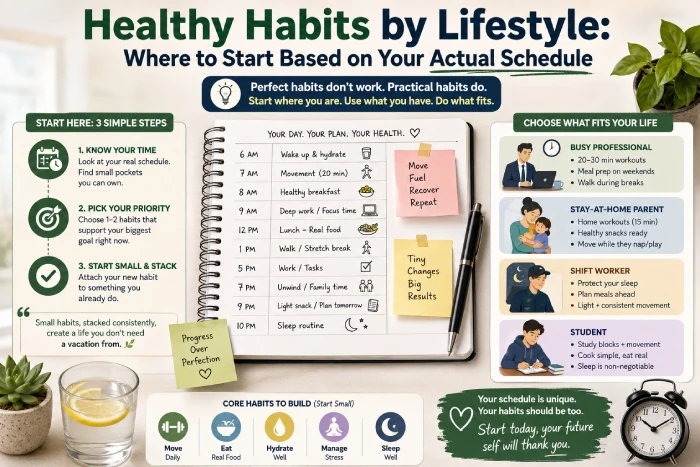
The six categories above are designed to work for everyone, but which to get rid of first is deeply connected to how things actually are in daily life. Here are some fairly popular points of entry:
If you work a typical sedentary desk job: then activity and fluids are weakest, since removed cues that are lost when one sits (walking for lunch, standing meetings) prevent both. A brief walk and a glass of water on awakening can be a decent initial change.
- If you have little kids: sleep and your own mental routines are often the first to go, and the most crucial to defend even minimally maintaining a fixed wake time (early or not) and a one-line journaling practice can fit more easily into short chunks of time than any practice that needs long, uninterrupted blocks.
- If you have irregular or shift work hours: it is unlikely that maintaining a fixed sleep schedule is achievable rather aim for maintaining a fixed sleep hygiene (the same bedtime routine each day or night irrespective of sleep time).
- If you are a frequent road warrior: drink plenty of water and accomplish a quick morning ring of fire. These are probably the most sustainable habits to bring along because they don‘t require a gym, kitchen, or time of day.
Healthy Habits
If you‘re coming back from a long hiatus to healthier habits ease back in more than you believe necessary. The habits that will stick out back the second time around are the ones where you felt like you could do them in your sleep.
None of these are rules, they‘re just suggestions, and most people will identify with more than one or two. The best first habit is the one that fits into the life you actually have this month, not the one you‘re imagining you‘ll have once this is all over and free up a little more time later. things don‘t tend to free up time on your schedule.
How to Build a Habit That Sticks: A Step-by-Step Approach
- Pick one habit, in one area, for the next 30 days. Not five habits across five areas — one. Use the six sections above to choose the area that would make the biggest difference to how you feel.
- Make it small enough to feel almost too easy. If your first instinct is “one glass of water,” don’t upgrade it to “a gallon a day.” Small habits survive bad weeks; ambitious ones don’t.
- Attach it to something you already do. Habit stacking — linking a new habit to an existing routine — removes the need to remember it separately.
- Expect 6 to 10 weeks before it feels automatic, not two or three. This single expectation shift prevents most people from quitting right before the habit would have clicked.
- Don’t let one missed day become two. The research is clear that missing a single day doesn’t derail habit formation — but the story you tell yourself about that missed day often does.
- Add your next habit only once the first feels automatic. Layering too many new habits at once is the most common reason people abandon all of them within a month.
Want a printable version of this process to track your own habits? → [See our Healthy Habits Checklist]
How to Know a Healthy Habit Is Actually Working
One reason people abandon good habits early is that they’re looking for the wrong kind of proof. A few realistic ways to tell a habit is working, even before it feels “automatic”:
- You do it without negotiating with yourself first. Early on, every habit involves an internal debate — should I really go for that walk, do I really need that glass of water right now. One sign of progress is when that debate gets shorter, even if it doesn’t disappear entirely.
- You know when you didn‘t do it, but it didn‘t trigger the spiral. A strong habit begins to become a habit in its own right: doing it feels a little weird to skip it, encourages you to skip it again the following day not shame that makes you feel like you‘ll want to stop altogether.
- The effects also appear in something other than the habit. Improving sleep habits will often first manifest as more steady energy in the afternoon, not some incredible change. Building a hydration habit will often first manifest as less afternoon headaches. Be aware of these secondary signals most of them will show up sooner than the habit does.
Healthy Habit Is Actually Working
You have missed three days and still return to the task. Regardless of how many days you‘ve managed to keep a streak intact, this is the real test of a sustainable habit. The evidence is clear: if the habit survives one or two missed days, it‘s probably being formed properly, but if it crumbles after one missed day, it was probably too much, inflexible, or reliant on motivation all along.
Unless all of those indicators are appearing in your tracking after 6-8 weeks, it isn‘t an indicator to throw in the towel – it‘s an indicator to condense the habit even more or to verify that it is attached to something that occurs on a daily basis rather than just on the good days.
Common Mistakes People Make with Healthy Habits
Starting too many new habits. Five new habits on the first day of the year almost always results in none by the second month.
. Selecting habits according to someone else‘s success rather than what actually works for your schedule and desires – habits that you select will be more likely to be incorporated.
– Assuming motivation will carry you through week two. Motivation dips right away, and your systems and small but specific habits do the rest.
- Looking at a missed day as a failure, rather than it being simply a normal, inevitable part of the process, which the research says won‘t set you back.
- Chasing intensity over consistency, e.g. with exercise a tough week then a burnout mo nth builds less endurance than a moderate routine for a year.
- judging whether or not it is working too soon. Being discouraged after three or four days and concluding “this isn‘t working” is premature by a factor of at least 6.10. This is 6 to 10 weeks that the habit can take before it begins to feel automatic.
- Failing to create a cue placing too much faith in remembering.. Habits tied to the cue of an existing routine (another moment, occasion, or action so ingrained that you do it daily) are vastly more reliable than those you just plan to ‘remember’ to do.
Habit Stacking: Combining Small Habits Without Overloading Yourself
When a habit reaches a point where it feels almost automatic, the quickest way to add more to it isn‘t starting another completely separate habit it‘s adding a little extra on top of it. Since you‘re building on something that‘s already become second nature, the extra activity feel at much less effort than beginning something new.
A few examples of what this looks like across the six areas in this guide:
- Morning + Hydration“Me after I have my wake-up glass of water “Stand at the window for 2 minutes” building a light-exposure-habit on top of an existing bit-of-hydration habit.
- Sleep + Mental habits: “Once I wrap up at work, I‘ll write one blank line in my journal” an additional reflection habit combined with a habit that would have otherwise involved screen-time.
- Exercise + Eating: “After my afternoon walk, I‘ll prep tomorrow‘s breakfast” to build meal prep into a habit as regular as your walk.
- Eating + Mental practices: “After I sit down for lunch, I‘ll name one thing that‘s going well today” add a quick gratitude practice to a meal you already eat every single day.
The principle is always the same: spot the existing behavior that already ‘on autopilot’ and then introduce the new one right before or right after, using the specific language (“after I do X, I will do Y”) rather than a vague statement of intent. This is also a natural way to ultimately address all six segments in this guide, one at a time, instead of trying to build in several behaviors simultaneously.
Myth vs. Fact: Healthy Habits
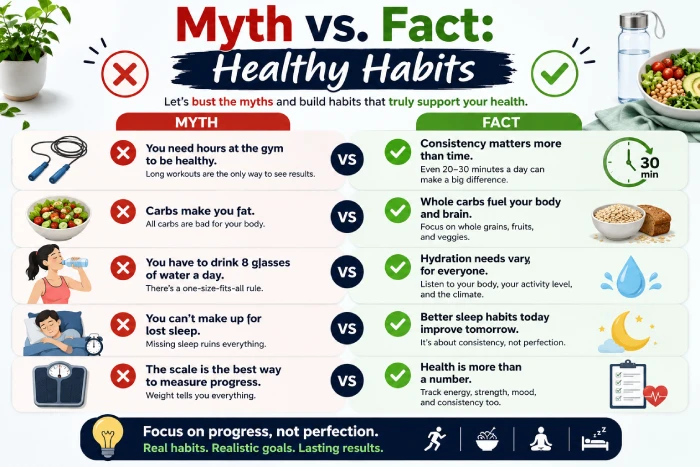
| Myth | Fact |
| It takes 21 days to form a habit. | The real average for the research in this experiment is about 66 days, with a real range of 18 to greater than 250 days, depending on the habit. |
| Missing a day completely destroys all your effort. | The study on habit formation showed that a single day break didn‘t have a significant effect on whether or not the habit was formed. |
| “You have to change everything immediately in order to get some benefits.” | Small single-habit changes, sustained over time, are much more likely to really stick than one big overhaul. |
| Healthy eating involves avoiding an entire food group. | Health organizations insist on patterns of clean eating, not restrictions diversity, simple foods and mindful portion sizes. |
| If a habit is difficult after one or two weeks, then there is no way it‘s going to work. | Feeling effortful 6–10 weeks is normal, and automaticity (habit feeling easy) comes later than you would think. |
Troubleshooting: When Healthy Habits Fall Apart
You went on vacation, you became ill, and you fell completely out of the routine. Begin again with the briefest facet of the habit, not the entire thing. Momentum is more important than the intensity of the beginning. Trying to “catch up” will cause a failed restart as one of the most common occurrences.
The slowness feels boring after a few weeks, which is usually a sign you are starting to do it unconsciously – not a cue to stop. Boredom may actually be a success marker, not a failure. Ifit remains truly uncomfortablerather than ultimately neutral in tone, that is a cue not to to give up on the goal behind it.
You‘re reliable Monday through Friday, but it crumbles on the weekends. Create a weekEnd version of the habit beforehand a shorter walk if you don‘t want to keep up the 20 min walk, or the water when you wake no matter what time you wake.
Troubleshooting
You inevitably end up quitting and having to start over from scratch. If you‘ve begun the same line of work over three times now, it is probably too time-consuming cut it back further than feels comfortable and start again. A habit you keep abandoning three separate times at a 30-minute commitment may work at a 5-minute commitment.
Other people around don‘t support the change. This is very common especially with eating and exercise trends. Habits related to a particular time and place that you alone control (like a morning walk before anyone else is awake, or a routine that happens at a time when no one else is around) are more likely to be immune to external forces than those based on what other people want.
You are doing everything “right” but not noticing results yet. Sticking to habits takes time. Think back to the timeline mentioned earlier most health behaviors take 6 to 10 weeks before it starts feeling second nature and effects on weight, energy, sleep, happen even later. Two weeks in, you can‘t expect to know what effect the habit will have.
Future Trends: Where Healthy Habits Are Headed
- that were Habit-tracking apps for real formation timelines (60+ days) instead of the debunked 21-day framing as the knowledge of the real research propagates
- Wearables that tell you when you are•hydrated•moving•sleeping in real time, so that the feedback on new habits is immediate rather than coming after the fact in comparison to the old paradigm of tracking them yourself
- Employer and healthcare driven habit programs, as health systems move from reactive treatment to prevention-based advice
- more focus on mental habits in addition to physical ones as research increasingly links stress reduction and social connection with health over the long term
Future Trends
A noticeable but certainly not immediate movement away from the “21 days” myth among library of mainstream health & fitness content, as increasingly more health services and credentialed sources update their information with the correct 66 day study, replacing misinformation in the various wellness content consumed each day
Healthy habits aren‘t built in a weekendand haren‘t built by willpower. They‘re built by small, specific, personal decisions done repeatedly for a duration longer than most advice suggests it‘s possible closer to two months than three weeks and sometimes considerably longer. The six topics above mornings, eating, sleep, exercise, mental health, and hydration cover everything but you don‘t need to do all six today.
If you only remember one thing from this guide, let it be this: The healthy habits version that is sold to us on Instagram the 5 a.m. wake-ups, the flawlessly labeled Tupperware containers, the sprawling hour-by-hour routines is not the version that survives in the long run for most people. The version that endures is modest, muted, and much less aesthetically pleasing: one bottle of water, one brief walk, one unchanging wake-up hour, repeat for two or three dull months until it doesn’t seem like it takes any effort anymore. That is not a substandard approach to establishing good habits; according to the research, it’s the approach that’s most likely to succeed.
Choose the one area from above which would affect you the most if it did change, decide on one tiny action within it and give it more time than it is frequently given. Two to three months of genuine effort is what such changes normally require.
FAQs
Q1) What are the best healthy habits for weight loss?
The most sustainable habits combine consistent, whole-food-based eating patterns with regular movement and adequate sleep — since poor sleep is linked to weight gain independent of diet. Small, repeatable changes (like a consistent breakfast pattern or a daily walk) tend to outperform short-term restrictive diets for long-term results.
Q2) How do I build healthy habits that actually stick?
Start with one small, specific, self-chosen habit rather than several at once, attach it to a routine you already have, expect it to take 6–10 weeks to feel automatic, and don’t treat a missed day as a failure — research shows a single missed day doesn’t meaningfully derail habit formation.
Q3) What should a healthy morning routine include?
A short, consistent sequence works better than an elaborate one — for most people that means some combination of hydration, brief movement or light exposure, and delaying phone/email checking for the first 20–30 minutes of the day.
Q4) Is it better to focus on one healthy habit at a time or several?
One at a time. Building several new habits simultaneously is one of the most common reasons people abandon all of them within a few weeks — layering in a second habit only after the first feels automatic leads to far better long-term consistency.