


Mohd Arbaaz is an Editor and Writer at Fitnessison.com with 5 years of experience in SEO and digital content creation. He creates informative, reader-focused content covering fitness, workouts, nutrition, health, healthy lifestyle, technology, and computers.

Shashi Teja is a Reviewer at Fitnessison with over 6 years of experience in SEO, content strategy, digital publishing, and content optimization. He reviews content for clarity, research quality, topical relevance, readability, structure, and overall usefulness to readers.
Last Updated: September 17, 2026
In order to be healthy, you need to get your needs met or take care of your mental health. Our mental wellbeing is also influenced by the decisions we make on a daily basis, as well as at other important turning points in our lives. Though it is not obvious, your sleep, exercise, diet, stress control, relationships and recreation schedule could be influencing your health and appearance.
Creating healthy mental habits does not mean having everything be positive, happy. You are going to have stress, frustration, setbacks and bad days. We are trying to establish effective ways of settling into normal lifestyle and the ability to stay healthy and the know when to ask for help.
WHO has conceptualized health as, ‘a state of well-being where everyone realises his/her own potential, can work productively and fruitfully and is able to contribute to his/her community. (who.int)
In you are looking to improve various aspects of your life, take a look at our comprehensive list of healthy habits.
Mental Wellness Starts With Everyday Choices
You don‘t just need to think about your mental health when you‘re stressed:
A general exercise, just as our daily habits can support and sustain the body, can also support and sustain the mind.
Sleep sufficiently, do any activity, maintain a social life, have breaks, eat healthy diets and minimize stress can also be applied to a healthy lifestyle.
There isn‘t a need to turn your whole world upside down.
However, this a lot to add to your daily routine, but here are some of habits you can add to your dayto-day’ life, just pick a few that are easy to maintain:
10 Healthy Mental Habits to Build Into Your Lifestyle
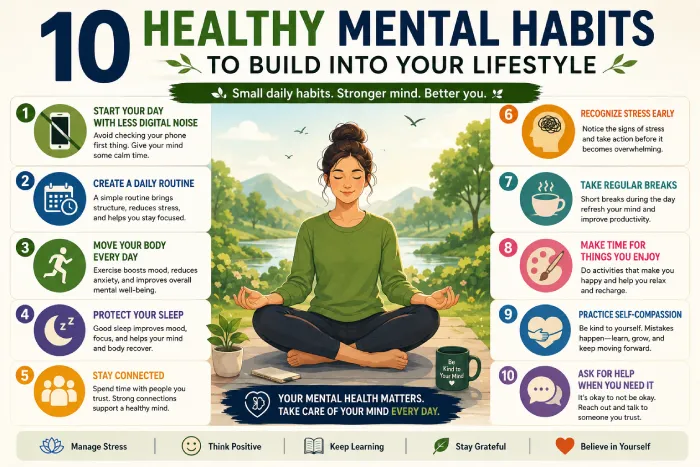
1. Start Your Day With Less Digital Noise
Some people wake up and check their phone before they even get out of bed.What is it that preoccupies you? Messages, Facebook notifications, tweets, work emails, reading the paper. Perhaps hold off for a while before checking your phone. Drink some water, absorb a tiny bit of natural light, stretch the arms and legs, eat breakfast, or simply remain still and silent for a few moments. You don‘t have to avoid technology entirely. The goal is to begin your day intentionally, not as a reaction to something instantaneous.
2. Create a Daily Routine
Assume a very simple routine in day to day life can add order to life. Having a predictable daily schedule can help reduce the amount of time spent contemplating your next activity. Make an attempt to keep our sleep, eating, working, exercising, relaxing, and sleeping habits on a daily schedule. It may not seem to you that you‘ve got to be rigid about your routine. Happening unexpectedly occurs so our self is important.Preview your routine in the perspective of a reference, not another command. WHO suggests that “one of the most practical thing you can do to cope with stress is to keep to your daily routine”.
3. Make Physical Activity Part of Your Day
You are inextricably linked body and mind. Exercise is one of the way that physical activity can benefit mental health through the promotion of good health There‘s no requirement to have hours in a gym. Anything that gets you moving–something like a walk after dinner, riding, swimming, dancing, yoga, playing a sport, even doing a little exercise at home–is useful. If you are not currently active, use a little bit first and progress from there.
4. Protect Your Sleep
You need to view sleep asan essential part of your mental health regime (not one to compromise on when your schedules gets hectic). It takes most adult around 7-9hours sleep per night, although this depends from individual to individual.Stick to a consistent sleep schedule. Develop a relaxing routine before bed and refrain from mentally challenging activities during this time.Having a good sleep can affect many portions of our life positively including our mood, our alertness and our concentration, our functioning and our memory. If you’d like to optimize this as an aspect of your lifestyle, check out our survival guide to sleep habits.
5. Stay Connected With People You Trust
Having human contact is important. Providing companionship and emotional support: can be achieved with a good support system of friends, family, work companions and community members. You can‘t always have the serious chat. A minute or two chat on the phone, sharing a meal, going for a walk or just chatting about your interests. If you‘ve been withdrawing, take baby steps. Text a close friend, or plan a little activity together. People sharing social connection are a bridge to physical and mental health.
6. Learn to Recognize Stress Early
Stress is the body‘s normal response to challenges. However, it can be a problem if it goes on for a long time at a high level or begins to interfere with your daily life. Identify your red flags.
You might notice:
- Irritability
- Difficulty concentrating
- Trouble sleeping
- Feeling overwhelmed
- Alteration of Appetite.
- Headache or muscle spasm(muscle tension)
- Difficulty relaxing
If you recognise the early signs of stress you can act before stress takes over completely. WHO recommends that we discover healthy strategies for coping with stress.
7. Give Yourself Regular Mental Breaks
Your brain needs rest, so take them just as you do your body. Hours of continuous work without any break can drain your mind. If you have a busy day, then it is wise to take frequent short breaks from whatever you are doing. Get on your feet, walk, stretch, get a drink, look out of the window, or just sit down somewhere quiet. If you can, try not to pack all breaks with reading more details from your phone. A way to disconnect, sometimes in a mental space as small as few seconds is a time without notifications, a video, or social media.
8. Make Time for Things You Enjoy
It can‘t only be about our lives, getting bombarded with work, chores and to-dos. Allow yourselves to be involved in things that are really relaxing or elevating to you.
You could:
- Read
- A) Listenmusic, B). The positive effect of JAMAUSIC!A on learning outcome is best achieved provided that music is listened to.
- Cook
- Garden
- Draw
- [5] A play a sport such as football.play an eat and drink 6]How often do you eat and drink?
- Spend time in the outdoor air
- Is so in look at your most loved film
- Engage in a hobby. Just as the ups and downs can cause anxiety in your life, it is also good for your life to know that you have something to anchor you that brings you pleasure and satisfaction. Pick something you enjoy and dedicate time to it, whether you are old or young.
- Be with friends and family in our free time.
Activities that are fun will allow you to take your mind off things for a while. It is not necessary for you to need to defend every moment of your day by making them productive. Relaxation and pleasure time are just as important.
9. Practice Self-Compassion
The way you communicate with yourself has an impact. Making a mistake. When this happens it is common to be your own worst enemy. Rather than telling yourself, “I‘m bad at this,” analyze what really went down.
Ask yourself:
What happened? Why did this happen? What can I learn from this? How can I do this differently in future?
Self-compassion is not used as a license to ignore or avoid making mistakes or taking responsibility. It is simply being nice to yourself, the way you‘d treat a friend. We all have our bad days. One mistake does not define your world.
10. Ask for Help When You Need It
The best mental health advice is to learn what you should not be alone to tackle. Sometimes you should talk to a trusted friend, other times you may require a doctor, psychologist, counsellor, or other healthcare professional. If these feelings (gloom, anxiousness, distress, despair or other issues) become a permanent feature or start to threaten your job, family life, sleep, or day-to-day activities, then see someone. Today there are physical as well as mental health issues. And there are solutions for them. You‘re not weak if you want or need outside support. It is normal and healthy to spend time looking after yourself.
A Simple Daily Mental Wellness Routine
You don‘t have to follow all 10 principles perfectly for every single day. Put together a simple order that techniques a few of.
Morning: take it easy and before you jump on your mobile add up your aims for the day.
During the daytime: Remain active, take frequent breaks, eat healthy foods regularly, and maintain social contact.
13:30-15:30 school room 15:30-18:00 home environment. Breathe more calmly and deeply. Less stressful and more activity. Do some enjoyable activity.
Before bed:, Take away all unnecessary technology, follow a relaxing routine and let yourself go to sleep!
Customize this however you want for your own schedule and life with children as you see fit!
What to Do When You Have a Difficult Day
Healthy mental habits don‘t make it so that everyday will be comfortable.
There will be days when you are under so much stress, there will be days when people disappoint you, there will be days when you fight with your best friends (or sometimes even your family), there will be days when you stay up late completing work, there will be days when you are simply tired.
On the rough days, go back to the fundamentals.
Eat some healthy food. rest. take a walk. talk to someone you trust. Log off the traumatizing social media. do something relaxing.
You are not expected to design your whole life in a single day.
Sometimes, the most positive action you can take is to say to yourself ‘Today I‘ll do my best to get through today, and tomorrow is a new day.’
How to Make Healthy Mental Habits Last
The biggest mistake people make when trying to form new habits is to attempt to change too many things at the same time.
No. For now, pick just one small thing that you can do.
Take the five minutes a.m. and get away from the cell phone; when it feels like second nature, add five minutes of a short relax-a-bator evening ritual.
One thing you can do as a College Coach is link habits together.
- For rest of the morning: 1. After breakfast walk around the campus. sit in the garden.2. Before lunch walk around the outdoor campus.3. After lunch stroll in the local campus.4. In the afternoon have some relaxing and native walking in the neighborhood.
- Post work -> spend 10 minutes away from screens.
- Prior to going to bed–write out what needs to be accomplished tomorrow.
These and other basic associations can help the individual make new types of feelings easier to remember.
The key is not to be perfect. The key is to be consistent.
Any missed days simply carry on the next day.
Healthy Mental Habits Work With Other Healthy Habits
Matters of the mind are also matters of the body.
All these elements can synergistically contribute to a healthier lifestyle: sleep, diet, exercise, close relationships, coping with stress and relaxation.
For instance: Regular activity can promote physical strength and energy. Proper sleep can help you feel more rested, focused and present. Healthy eating can help your body be fueled and nourished.
That‘s why having a handful of easy, healthy habits together can be more practical, beneficial and sustainable than working on a one at a time basis.
Please also read our Healthy eating habits and Healthy exercise habits guide to help you form a more complete lifestyle routine.
When Lifestyle Changes Are Not Enough
An individual can maintain good health habits to assist with their mental health but it is never a substitute for treatment when someone is suffering from a mental illness. If your symptoms persist for a week or are severe or impair your capacity to accomplish everyday activities, work, sleep, or communicate with family and friends, then you should contact a healthcare practitioner for guidance. There was really nothing stopping you from coming to us for help some time ago. If there is an urgent mental health crisis, or you feel you are in danger of harming yourself or others, contact a crisis team or emergency service in your area.
Final Thoughts
Developing positive mental habits isn‘t about steering clear of stress or running away from negative emotions in everyday life. It is an encouragement to develop habits that can help you maintain your mind in health so that you can take life as it comes. Start with the basics: maintain a daily routine, stay active, protect your sleep, nurture supportive relationships, practice mindfulness, dedicate time for activities you enjoy, and treat yourself kindly. Most important, learn when to ask for help. Mental health is a significant part of a healthy lifestyle, and mentally healthy habits can take time to develop. Here are some useful tips to improve your everyday life that little bit more. Discover our comprehensive guide to leading a healthy lifestyle.