



Mohd Arbaaz is an Editor and Writer at Fitnessison.com with 5 years of experience in SEO and digital content creation. He creates informative, reader-focused content covering fitness, workouts, nutrition, health, healthy lifestyle, technology, and computers.

Shashi Teja is a Reviewer at Fitnessison with over 6 years of experience in SEO, content strategy, digital publishing, and content optimization. He reviews content for clarity, research quality, topical relevance, readability, structure, and overall usefulness to readers.
Last Updated: September 9, 2026
Type “weightloss tips” in Google and you‘ll come up with the familiar page: an outline of twenty something tips numbered, a promise that just one tip will quickly burn away fat, and a sprinkling of generic advice that keeps you ploughing on for the “definitive” answer. It gets tiresome, and is another reason why many jump from weight loss plan to plan.
Here‘s what the real studies say, and ironically it is more straightforward than the information available on the internet: the Centers for Disease Control and Prevention, Harvard Health, and nearly all of the other prominent medical sources agree that 1 to 2 pounds of weight loss per week is a safe, sustainable rate achieved through a caloric deficit of approximately 500 to 750 calories a day. That‘s it. That‘s the number that the various fad diets and 10-day cleanses are covertly dodging around, because “lose 4 to 8 pounds a month, safely, forever” doesn‘t have quite the same ring as “lose 10 pounds in a week.” It may be a less dignified headline, but it‘s one that academic research has supported for years.
It’s based on that real number and on one simple concept that most of the competition misses: you‘re best starting place doesn‘t come from a pre-written menu, it comes from where you actually are. Whether you‘re a complete novice, a woman trying to work around hormone issues, a guy trying to hold onto muscle during a cut, can‘t get to the gym, work from home, only want to lose that stubborn belly fat, this guide will take you through 6 real-world examples, give you a realistic starting place for each one, and send you to the detailed guide if you‘re interested.
You don‘t have to read through all of the sections below – jump to whichever one applies to your situation if you already know it: for example if you only want to lose belly fat, or you know good exercise isn‘t an option for you right now. If you‘re undecided, and struggling with where‘s best to start from, the next two sections about the truth of what works, and the reasons why weight loss is so complicated (and often more difficult than it should be) explain where to begin.
Weight Loss Tips Resource Center
Explore our complete collection of weight-loss guides covering beginner strategies, practical advice for women and men, weight management without structured exercise, at-home approaches, and tips for reducing overall body fat.
Why Weight Loss Feels Harder Than It Should
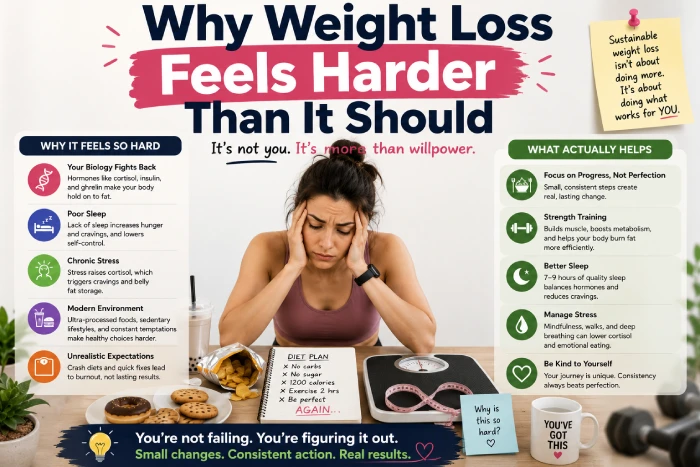
If weight loss seems harder than it should be, here are a handful of real, up-to-date factors working against you (independent of any issues of willpower):
- High–calorie, ultra–processed foods are the norm not the exception. These foods, designed to be easy to gluttonize, dominate the modern American dining table, helping to raise daily calorie counts from behind the scenes, without any single “bad” meal being at fault.
- Total portions have increased. Packaged and restaurant portions now are significantly bigger than they were one generation ago; this changes what we think of as a normal quantity without us really realizing it.
- Chronic sedentary working and living habits suggests that some daily movement even among the actively exercising is compromised-to a degree that even a workout cannot compensate for a day spent in an almost completely sedentary life style.
- Sleep and stress are both working to undermine the regulation of appetite for many. They do this by increasing the hunger hormone, gherlin, and decreasing the fullness hormone, leptin. The increase in the hunger hormone and decrease in the fullness hormone results in making it hard to keep to a calorie deficit, if you can get a good night sleep.
- Diet culture shapes that benchmark. Being bombarded 24/7 by extreme “before & afters” can make a normal, sustainable 1–2 lbs/week pace feel like a failure when it‘s ticking along perfectly.
This doesn‘t mean that healthy weight loss is impossible in 2026, it means that the moderate, situational approach in this guide applies even more now, because it‘s based on these new realities instead of expecting that someone simply needs more willpower.
What Actually Works: The Science Behind Sustainable Weight Loss
Before jumping in to tips, it helps to understand the two or three things that really make a difference, since a lot of what trips people up isn‘t lack of discipline it’s the wrong lever being pulled.
As far as weight loss goes, that‘s a deficit of calories you‘re looking to have in your system right now, but the magnitude and rate at which you approach that deficit is hugely significant. And the CDC‘s recommendations are pretty precise: a daily deficit of 500 calories, you‘d see about 1lb loss per week; a deficit of 750-1000 calories, you‘d see about 2 lbs. much greater than that doesn‘t just get tougher it backfires.
Why faster isn‘t better. rapid weight loss (more than 2 lbs/week for most people) leads to a greater loss of muscle than fat and can impair hunger regulators ghrelin and leptin which makes you hungry, which is a big reason why a lot of rapid weight loss isn‘t maintained. Harvard Health summarize it thus: “Weight loss at a faster rate than recommended usually results in a greater loss of muscle tissue and a reduction in metabolism, which makes it harder to sustain a calorie deficit.”. Several long-term studies have shown that gradual weight loss is maintained more easily at 1, 3 and 5 years that more rapid weight loss.
Diet and exercise aren‘t equally powerful for weight loss. Which is shocking: even the work cited by Cochrane shows that exercise by itself results in fairly limited weight loss, dieting by itself yields significant, durable results and the combination of the two is most effective of all. This doesn‘t mean exercise isn‘t important (it‘s *hugely* important for health, muscle preservation, and long-term maintenance) it just means you shouldn‘t feel like you can‘t lose weight because you‘re unable to exercise.
Small steps add up. There is a widely used 12-step action list in evidence-based weight-maintenance programs such as eating breakfast, watching portions, eating more at home, drinking less calories-containing drinks, keeping a food record and nothing on it is nuts, and all are validated in outcome research. What stands out about this list is not any one action, it‘s that there‘s nothing on it that requires a special diet, a purchase, or a lifestyle shift, which is what accounts for why it‘s common in research even as the more nutsy things were not.
Practical take-away: only remember one number from this guide: 1-2 pounds per week. All the tips below are geared to achieve that rate; none is a frantic attempt at something faster and won‘t last.
It‘s also worth bringing up right away that results are variable, and that‘s totally normal. Your beginning weight, age, sex, sleep, stress, and genetics all play a role in how long a calorie deficit takes to appear on the scale. Even people who follow the same plan will have significantly different weekly results and that‘s precisely why this comprehensive guide is structured around six starting scenarios, not one rule for everyone:
Weight Loss Tips for Beginners
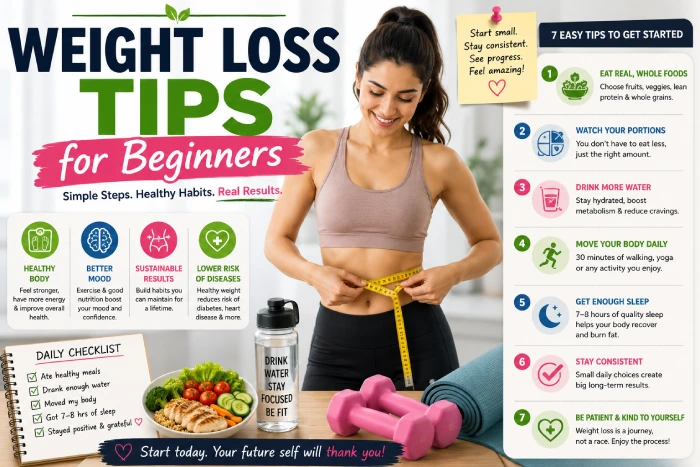
If you never succeeded in losing weight and keeping it off, it‘s not lack of information. The first time you try, it‘s just impossible to go too fast.
Who it‘s for: Those beginning from scratch, particularly if previous efforts have included elimination of whole food groups or a mandatory daily gym session that fizzled out by the first hectic week.
A more practical way to begin: rather than revamp breakfast, lunch and dinner on day one, stay with what you eat day-to-day, week-to-week for the first three days in a row without modifying anything. Many people are amazed to discover that one or two simple, quick, high-leverage swaps (juice versus soda, large proportion of meat and potato dinner) will constitute a large percentage of the additional calories consumed.
Key takeaways:
- Start by writing down what you eat without trying to change anything for a few days many people are quite surprised by where their calories actually come from.
- Make a modest and sustainable (ideally 500 cal/day) deficit rather than a large, aggressive one; better a slow beginning that lasts than a fast one that doesn‘t
- Focusing on one or two of the 12 evidence-based behaviors (eating breakfast, controlling portions, more meals at home) rather than all at once?
General warning, many people give up on a plan not because it didn‘t work but because they assess it after 3 or 4 days and it becomes obvious that the major portion of the ‘real’ signal (energy, hunger handling, actual weight trend) doesn‘t become obvious until closer to 2-3 weeks. Let any single change ‘breathe’ for at least that long before assessing its correctness.
Practical tip: Focus on one easy change from here and for most newcomers, this is as simple as replacing one soda or sweet drink each day with water or adding a veg to one meal for a couple of weeks and then add.
Get a simple beginners step-by-step plan→ [you can read about all the Weight Loss tips to Beginners in our Guide]
Weight Loss Tips for Women
The advice to lose weight is often presented as if no single approach is better for everyone. The truth is that there are tangible, practical constraints on weight loss for women that general advice overlooks.
For whom: women (because we are managing for hormones, natural muscle-mass disparities from men, or other stages of life such as postpartum or perimenopause that alter our response to a calorie deficit).
A practical illustration: If you see a 2-pound jump mid-cycle, don‘t react immediately by “cutting calories to compensate”; follow weight weekly and take the typical increase at ovulation and during menstruation into account you will have a far better measure of success.
Key takeaways:
- Variations in hormones throughout the menstrual cycle influence appetite and water retention; energy. Logging the weight loss from several weeks, rather than a day to day basis smooths out this natural variability.
- Women are generally under-represented in strength training studies and instruction, even though there is compelling data demonstrating that this will help maintain muscle needed for current metabolism while in a deficit.
- E.g., at various life stages such as recovering from giving birth or through the transition to and beyond menopause you may need to require fewer calories and will have additional recovery time to spare. During those stages, taking a slower and more forgiving approach to things can be the healthier, more sustainable option.
A typical pitfall to be aware of: various women are prescribed extremely low calorie intakes that aren‘t based on activity level or muscle mass, which can boomerang for the same reasons as shown in this guide to creating calorie deficits an average, properly balanced deficit is far more effective in this context as well. Frequently, online-based, general calorie goals (which often assume a reference body that is far less than yours) do this…
Practical Tip: If you find that your weight levels out for a week or two around your cycle do not lower your calories even more. It is often water retention rather than a weight loss halt and will usually rectify itself.
Dabbling in all kinds of women-specific tactics? Here‘s the complete list of women’s strategies→ [Read our complete list of Women‘s Weight-Loss Tips]
Weight Loss Tips for Men
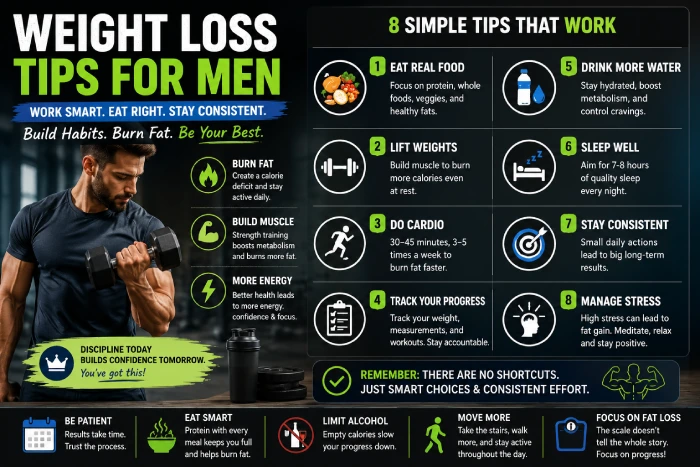
Men typically enter a weight loss program with a greater muscle burden and a higher BMR than women, which alters the figures and typical errors.
For whom it is: men looking for a simple, no-frills system that is aimed specifically at men in such a way as to help them understand how a method that ‘used to work’ during their last period of availability in their 20s is not giving the same results now.
An example – instead of a drastic reduction of calories after noticing weight creep mid-life (say in your forties), you can decide to do the following -recalculate your calorie needs based upon your current age and level of activity, (again assuming a 500cal deficit) and one can be amazed to find that actually, you are not eating a lot more than you should be and an increase in activity (rather than a drastic cut in calorie intake) may just do the trick!
Key takeaways:
- More initial calories required could imply men can handle a slightly larger deficit in a safe manner, but the same limit of 1–2 lbs/week holds true here too big is not always best.
- Muscle preservation applies to men as well as women during a cut, sufficient protein and hit training will make sure the deficit doesn‘t burn through all of the muscle they‘ve worked so hard for
- [Metabolism] always changes as we age and this shouldn’t be seen as « something broke » but a normal and manageable change that warrants a correction in Calorie targets (not throwing in the towel)
Commonpitfall to keep an eye on: men are more likely to go for aggressive, short-time- frame solutions (wedding, reunion, newyears resolution) which “may work” in the short run but almost always produce the “quickest rebound” as habits are unlikely to be developed to carry forward “outside of the event.”
Practical tip: If a routine that worked great five years ago or ten years ago no longer is, the reason most often isn‘t a malfunctioning metabolism it‘s just that your calorie needs have slipped quietly downward with increasing age and decreasing activity, and your old calorie goal is now just too high.
Get the complete list of men-only tips → [Read our complete weight loss tips for Men]
Weight Loss Tips Without Exercise
This is one of the most searched- and most misunderstood- areas of weight loss advice. The science itself is actually encouraging: dieting alone can create significant, durable weight loss even in the absence of an organized exercise regimen.
Who it‘s for: the injured, the challenged, the busy, those not quite ready for exercise this is a perfectly acceptable place to begin.9 10
A practical example:someone should exercise to lose weight who, because of recovering from a knee injury is currently unable to run or do any high-impact activities. She can still achieve a complete, safe calorie deficit through careful controls:focus on protein at each meal, keeping portions always consistent, and feeling free to walk or cycle gently each day if comfortable, without ever doing a single formal workout. Results will be real and continuous on a scale.
Key takeaways:
- Working within an authentic enough calorie deficit through diet alone will generate genuine, long lasting weight loss exercise enhances health and maintenance gains but isn‘t necessary to initiate.
- Non-exercise movement (making the effort to lift the stairs, pacing while on the phone, standing more than sitting) does add up substantially over the course of the week without having to happen in a specific workout
- Sleep and stress management are even more critical levers to pull when you‘re not exercising. Both directly influence hunger hormones and cravings.
Most frequent pitfall to watch out for: in the absence of regular exercise, muscle maintenance is solely dependent upon sufficient protein intake, therefore cutting too much protein intake while in a caloric deficit without exercising will lead, in the shortest period of time, to a true loss of lean mass while losing fat mass, which can negatively affect the experience of progress, even if it is still happening. A rough guideline that many dietitians recommend is to plan on eating at each meal a palm-sized amount of protein, aiming for that as a minimum, simple places to start.
Practical tip: Do these most impact diet changes first protein with every meal and same amount of food all day don‘t be dismayed if you fell unable to check out one component, don‘t think that the entire program is meaningless without the workout part;
See the complete no-exercise weight loss plan → [Find more weight loss strategies without exercise here]
Weight Loss Tips at Home
Not everyone has access to a gym or a trainer, much less a truly effective weight loss program that can be implemented without either a reliable babysitter or the access to a gym to get to one.
For whom it is: everyone who works, trains and eats mainly from home, whether by choice, for economical reasons or because of their circumstances.
A pragmatic example: a working-from-home Mom who has only a few gaps of free time here and there could design an efficient plan with a 20-minute bodyweight circuit (squats, pushups, planks) 3 times a week, 1 hour of batch-cooking on Sunday, and a few subtler adaptations to her kitchen environment (no car ride, no gym membership needed).
Key takeaways:
- Body weight workouts(squats, push ups, planks, walking) can create functional strength and help maintain a calorie deficit without equipment.
- Kitchen environment over willpower pre-measuring and portions and putting tempting foods away of sight got quantifiable reduction of air cravings in eat
- A very easy weekly meal prep cycle eliminates the daily decision fatigue that often results in poorer choices when you’re exhausted or pressed for time.
Always a potential pitfall: working and eating in the same place all day can distort the usual boundaries of eating times, resulting in higher frequency, less conscious snacking than you might exhibit in an office setting designate eating zones and set meal times even at home to substitute for the natural order provided by a workplace. No kitchen open after dinner (lights out, unprepared food away) can function as well as a daily commute once did: a signal that the eating time is finished.
Tip: try creating one ‘friction point’ at home this week (“move time-consuming, less healthy snacks out of arm’s reach” or “pre-portion one meal”) environmental changes work better than willpower in the long run.
Get a complete at home fat loss program (no equipment needed) → [Learn more about our complete at home Weight Loss Tips]
Weight Loss Tips to Lose Belly Fat
Belly fat is the most asked for and most often incorrectly advised on topic in weight-loss material. The truth: there is no such thing as “spot-reducing” an area by working just that area, even if those crunches keep coming.
Who it‘s for:- anyone who wants to visibly slim their waist line, particularly if previous ab-centric exercise routines haven‘t been successful.
A concrete example: an individual who has been grinding away at nightly ab routines for months with, at best, meager results will, in my experience, experience a greater loss of that visceral fat by channeling that effort toward an overall calorie deficit, better sleep, stress reduction because those levers, not ab exercises, are what ultimately flatten that fat snuggled down over and around the abs.
Key takeaways:
- Fat loss occurs overall the body due to a calorie deficiency, but where it takes effect first depends on the individual, predominantly genetics.
- Visceral fat (fat deposited around the organs, associated with more risk) particularly benefits from a continuous calorie deficit, sufficient sleep and stress management sometimes at a brisker pace than the more visible subcutaneous fat reacts.
- Core workout can strengthen muscles and give better posture, so the stomach can appear firm, but doesn‘t burn away fat from it.
Typical pitfall to avoid: belly fat is often one of the final areas to show visible change even in a well-eating plan, because it‘s one of the last areas most common woman body types lose fat from patience and diligent tracking (by waist measurement, not just appearance) are most important here of nearly anywhere else in this guide. Know that there will be a lag of several weeks behind overall scale progress in this area, and that lag is normal and doesn‘t mean the plan isn‘t working.
Helpful suggestion: Measure your waist in addition to your weight on the scale – since normal fluctuations and water retention can hide true fat loss on the scales, a reduction in waist measurement can often be more uplifting and accurate indicator.
Grab the proof-based covering fat solution → [Investigate Weight loss Advice to Reduce Belly Fat]
How to Choose Your Starting Point
Having covered six scenarios above, your aim is not to experiment with all of those, but to pick out the one that precisely represents your life at the time.
- What is your real constraint? Is it time to exercise, lack of experience, a specific target you‘ve set such as belly fat, or whatever? Name it specifically, don‘t default to the “I need to lose weight” as the entire plan.
- Choose the corresponding cluster above, and begin with only one or two sample points from it in the beginning.
- Assume a realistic weekly pace of 1-2 lbs. Anything faster is ultimately working against your own long term goals.
- Monitor something tangible for 2–4 weeks food, waist measurement, or even just adherence to a single habit before you decide if it‘s having an effect.
- Go back to your starting point if you start to change. A “no exercise” starting point today may become an “at home” or general starting point in a few months, and this is a good thing and not a reason to start again.
Want to know how it works from a truly sustainable, long-term perspective? Pick your answer below , [or discover the answers in our guide to sustainable weight loss tips]
To be fair, some people will honestly fall into more than one situation a beginner woman working exclusively from home with no time to exercise, for example. In the case of multiple fitting clusters, begin with the one that deals with your most pressing obstacle at the moment (probably the no-exercise or no-time-to-go-to-the-gym constraints, since those are the hardest ones to combat), and add in the other material when you can get your arms around that piece.
How to Know Your Plan Is Actually Working
The scale is just one indicator,and not always the best indicator from one week to the next. Several other more accurate indicators of progress in the first month:
Daily numbers matter less than weekly averages. 2-4 pounds of that weight variation can happen from day to day just in the effects of water, sodium, and digestion. It takes weekly averages to weed that out more effectively than one morning‘s reading.
Waist measurement, fitting of clothes — these tend to change before the scale does, and change at the same time as body composition is improving for many people who are gaining muscle as well.
Energy and hunger levels. A reasonable deficit should be quite manageable occasionally quite hungry, always a bit drained. Continual fatigue or extreme jonesing is generally a symptom of too aggressive a deficit, not too weak a will.
Consistency of the habit itself and not the result. In those initial few weeks particularly, “Did I adhere to my plan this week” is a more relevant daily question than “Did I lose weight this week” the habit consistency is what leads to the eventual result, even before that result is apparent.
If by this time none of these signals are moving after your 3–4 weeks of real consistency, that is generally a good time to start to recheck your calorie math (an intake is so often underestimated), rather than an indicator that the principles in this guide don‘t hold true for you. Also bear in mind that ‘working’ doesn‘t necessarily have to be dramatic–a body that‘s losing around a pound a week, week after week, is a body doing precisely what the CDC guideline describes as the healthiest, most durable version of this process, even if it doesn’t feel especially exciting day to day.
Why Rapid Weight Loss Backfires
It‘s definitely worth on a serious note, because the likelihood of quick gains is exactly what has people jumping from one bad diet to another.
However, when weight loss occurs at an overly rapid rate, those three factors being discussed all occur at once: a greater proportion of muscle tissue is lost compared to fat, the release of hunger-inducing hormones increases the urge to eat, and metabolism slows to compensate for the drastic reduction in caloric intake. Combined, these three factors contribute to a retained weight loss as well as an ongoing laying down of additional muscle, called “yo-yo dieting”.
People who dropped weight gradually (1-2 lbs/week) have been proven time and again to be significantly more likely to be at that lower weight one, three and even five years after their weight loss than those who had dropped weight on a more rapid pace. The glacial route is not the second prize here it is the more effective one.
It is similarly why so many describe weight loss as a rollercoaster rathert han a flat line: setting an aggressive time scale triggers all sorts of cycle of rapid early progress, increasing hunger and fatigue, breaking point, go back where you started guilt, and attempt again with a more restrictive plan. Going moderate from the outset isn‘t just healthier physiologically, it takes away all the rollercoaster effect that makes weight loss appear to be so very unworkable in the first place.
Common Mistakes People Make with Weight Loss Tips
- Chasing an aggressive calorie deficit. Taking an excess of 750–1,000 calories a day below maintenance will cause more muscle loss and metabolic sacrifice, working against rather than for the goal.
- Removing whole food groups instead of changing the amount of food consumed. BPH models tend to have more difficulty over this first difficult week or social event; PBA models tend to be more resistant.
- Relative progress by the number. Water retention, cycle, normal everyday fluctuation can hide true fat loss the most accurate short-term indications tend to be waist measurement and fit of clothing.
- The starting point is to treat exercise as the rule from day one. For most if not all individuals it is more sustainable to start at the beginning with diet and add in the exercise later on once the foundations are set.
- Starting over from day One negligent day can’t ruin a streak of good days, but how you spin that negligent day has a greater impact.
- Misjudging portion sizes and ‘invisible’ Most people who do watch additional calories tend to underestimate the number of calories they get from cooking oils, salad dressings, drinks, and hand-to-mouth bites – most of which come from people who are otherwise paying attention!
- How your pace compares to others’. Your starting weight, activity level, sleep quality, and stress all influence the rate at which a certain deficit will produce results the same plan might appear very different in two different individuals without either one making a mistake.
Myth vs. Fact: Weight Loss Tips
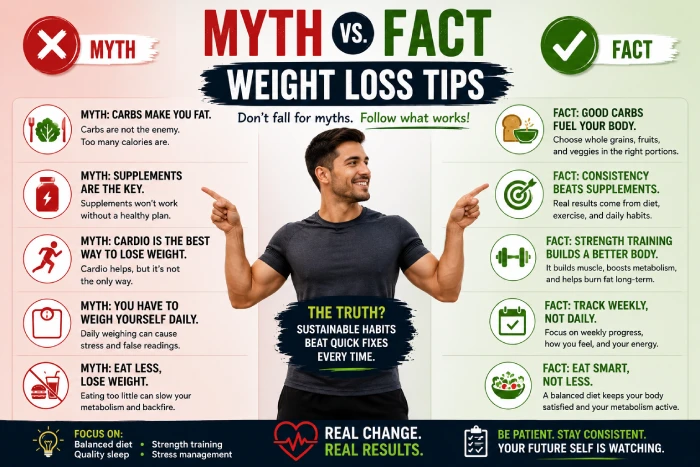
Between digital myths and scientific facts, the distance is so far that it can be said to call for comparison:
| Myth | Fact |
| “One week is enough time to safely safely lose 10 pounds.” | The CDC-safe rate is 1–2 pounds a week. Go faster and it‘s more likely to be muscle and water rather than fat. |
| You have to work out to lose weight. | Studies demonstrate; dieting on its own results in significant, long-term weight reduction whereas taking up exercise gives substantial health benefits, but is not necessary to get started. |
| Ab exercises will burn your belly fat specifically. | Cardiorespiratory (fat burning) activity will result in fat loss over the entire body. For this reason core exercises will not remove fat from around the abdominals; they build and strength muscle underneath the fat. |
| If you‘re losing weight slowly it means it‘s not working. | Gradual loss (1-2 lbs/week) is associated with markedly improved long-term maintenance than rapid loss. (Based on the multi-year outcome studies). |
| Carbs or fat (specifically) the enemy. | Energy balance, in general, determines whether or not you lose weight; it’s both low-carbohydrate and low-fat diets that will work if you use either one to establish a sustainable deficit pick whichever you can stick with. |
Troubleshooting: When Weight Loss Stalls
- The scale hasn‘t changed in a couple of weeks despite every effort. This is normal plateau usually water retention, a smaller than tracked caloric intake or a marginally smaller deficit due to your body adapting to a lower weight. Check your portions and recalculate your target rather than further reducing your calories.
- You‘re losing weight but feel tired/wired. This could be indicative of too aggressive a deficit or it could be poor protein intake, both of which are common at high levels of calorie deficits and should be backed off, not additional increased.
- Weekends torpedo weekday momentum. Prepare a well defined, pre-planned weekend routine ahead of time—not “I‘ll be good”, but a real routine.
- You keep starting from scratch. If this is more than the second restart, then the plan is far too aggressive– halve your calorie deficit, and cut in half the number of changes made at once, and try again.
- Losing weight but your calorie deficit is still present. The more weight you lose, the less calories your body needs to maintain itself. This is a formula that your initial calorie deficiency capitalized upon and needs to be re-evaluated after a substantial weight loss.
- Social occasions (eating out, holidays, traveling) continue to undermine the plan. Instead of trying to avoid them, choose beforehand which aspect of the occasion is negotiable and which one isn‘t (dessert, alcohol, portion size) and stick to that decision a predetermined decision is much more likely to be maintained than an on the spot one.
- You‘ve reached your goal weight but want to be off the “diets” and not regain. The step-down from a goal weight is another one that I find needs its own carefully-planned strategy–“stepping down” to maintenance calories slowly over a period of several weeks rather than a sudden return to old eating habits is one of the most common problems I see that leads to rebound weight gain.
Future Trends: Where Weight Loss Guidance Is Headed
- More subtlety around situational (not one size fits all) advice mirrored by and embedded in the structure of this guide weeding out generic “eat less, move more” material and replacing it with programs that are designed to be appropriate to the true starting point etc.
- Sustainable reinforcements of medical weight-loss tools (including GLP-1 meds) not instead of key lifestyle habits (protein, sleep, consistency) as lifelong habits are what really keep the weight off regardless of tool/mechanism/end point
- A greater focus on maintenance, not just weight loss as studies have begun to unravel the behaviors that sustain weight loss are not exactly the same as those that get it off in the first place
- Wearables and apps that facilitate personalized goals based on “1–2 lbs/week” turning broad advice into accurate calorie, macro targets on the fly
- More situational content, plugging in generic weight loss lists with guidance divided as in this guide: by real limitations, too, such as time, access to gear, health considerations, stage of life (instead of simply by degree of fit).
So keep weight loss tips in perspective. They are not about discovering one magical method. They are about selecting a realistic, well-practiced regimen that will work for you and giving it the 1–2 pounds per week that research indicates is feasible, rather than seeking a faster rate of loss that is generally not maintainable.
If there‘s one thing to remember from this guide, it is this: virtually all of the extreme claims you see elsewhere -10 pounds in a week, one weird trick, one hundred percent food-group ban- are conflicting with the aforementioned body chemistry, not supporting it. Sustainable plans are less focused on extremes: moderate calorie deficit, sufficient protein, good sleep, consistency sustained over months, not days. This isn‘t the sexy answer, but between the CDC and Harvard recommendations woven throughout this entire guide, it is the most reliable one to actually work- and to continue working one year from now.
These six situations list beginners, ladies, gents, sedentary, on-home and stomach-fat in particular whatever represents your current state start off with 1 or 2 habits of any of the situation and expand it from there.
FAQs
Q1) What is the safest rate of weight loss per week?
Both the CDC and Harvard Health recommend 1 to 2 pounds per week, utilizing a daily calorie deficit of approximately 500 to 750 calories per day. While greater weight loss is possible, is generally lean tissue and water loss rather than true fat loss. This has also been associated with poorer long term maintenance.
Q2) Can you lose weight without exercising?
Yes. For example, the study reviewed by Cochrane discovered that while weight loss remains sustainable and substantial with dieting on its own, exercise on its own only has a small impact on weight but it still promotes greater gains in muscle and general health.
Q3) What are the best weight loss tips for beginners?
Begin by recording everything you eat for a few days, then develop one or two habits you know works (eating at regular intervals, downsizing portions, reducing the intake of calorie-laden drinks) rather than updating the whole program simultaneously.
Q4) How can I lose belly fat specifically?
There is no such thing as spot-reduction of fat from a specific area with a certain exercise. When dealing with belly fat (including the visceral fat responsible for health risk), what matters is a calorie deficit, healthy sleep and stress levels and often the reduction will be part of an overall whole-body fat loss plan.
Q5) Why do fast weight loss methods usually fail long-term?
Crash diets- quick lose weight diets- can decrease muscle, alter ghrelin, leptin levels and slow down metabolism, which increases the chances of regaining weight. Research has shown that individuals who lose weight gradually are more likely to maintain their weight loss at one, three and five years.