


Mohd Arbaaz is an Editor and Writer at Fitnessison.com with 5 years of experience in SEO and digital content creation. He creates informative, reader-focused content covering fitness, workouts, nutrition, health, healthy lifestyle, technology, and computers.

Shashi Teja is a Reviewer at Fitnessison with over 6 years of experience in SEO, content strategy, digital publishing, and content optimization. He reviews content for clarity, research quality, topical relevance, readability, structure, and overall usefulness to readers.
Last Updated: September 8, 2026
For other women, weight loss might be very different. Family history, weight and body image issues, age, level of activity, eating and sleeping patterns, stress, medication, important phases of life (getting married, going through a divorce, having a baby, losing a parent), and overall health can all affect body weight and ease of change. That is why there is no one diet or workout plan for every woman.
The most practical method would be to develop sustainable routines involving healthy eating, physical activity, sufficient sleep, modulating stress levels, and setting achievable objectives. As mentioned by the Office on Women‘s Health, women may experience losing weight differently from men and the strategies for weight management should be tailored to the individual.
For a more comprehensive list of tips, visit our main Weight Loss Tips, page.
Why Weight Loss Can Be Different for Women
There are several factors effecting on weight management and influencing on woman changes related to life stages. Pregnancy, postpartum changes, menopause, aging, medications, stress, sleep, and activity changes in lifestyle can influence weight and lifestyle needs. The Office on Women’s Health points out that women can vary in weight gain and loss, and weight goals should be addressed with a clinician when appropriate.
This doesn‘t imply that women require an entirely different way to improve their eating habits and exercise routine. Rather, it means that your weight-loss strategy has to match you, your body, your daily routine, and where you are in life right now.
10 Weight Loss Tips for Women
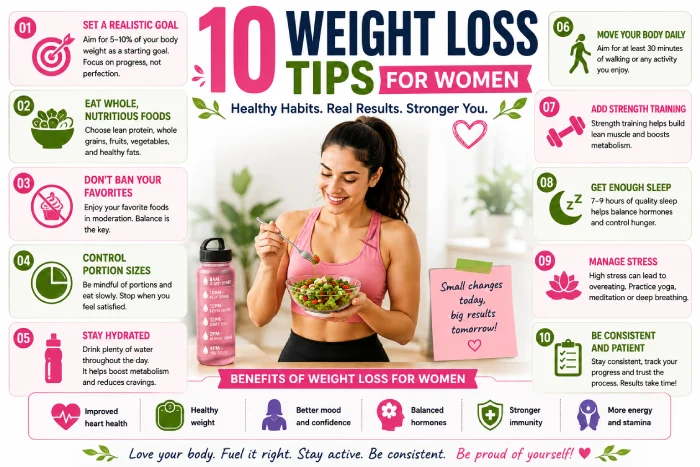
1. Set a Goal That Makes Sense for You
If you want to change your diet or start a new workout routine, decide what it is that you really are after. Maybe you‘re trying to lose weight, get in shape, slim your waist, boost your energy level, or develop healthier habits. If weight loss is advisable for you, you do not have to expect instant results that are significant. NIDDK states that a moderate goal of about 5 percent to 10 percent reduction of your starting weight within six months is often advised for individuals who require weight loss.
For instance, a person who weighs 180 pounds would want to lose approximately 9-18 pounds at first. Your appropriate target might be different. The important thing is to pick a goal that is realistic, not falling for an unreal number due to social media or celebrity transformations.
2. Build Meals Around Protein and Plants
Eating loads of plain vegetables on small portions of food is not what a weight-loss diet have to be! Rather, aim to construct satisfying meals.
Include foods such as:
- Vegetables
- Fruits
- Starting pt. 7.9 we will analyze the cultivation of beans and lentils.
- Eggs
- Fish
- Chicken and other proteins such as.
- Whole grains
- Yogurt
- Nuts and seeds. Handling of nuts and seeds of various mixtures and species.
The Office on Women‘s Health suggests healthy foods like lean protein, whole grains, vegetables and fruits which is also included into a weight-management strategy. A good meal is one that leaves you feeling satisfied and offers you the nutrients your body needs. Design of a (healthy) weekly menu: For instance, instead of planning just a small salad for your midday meal, make vegetables, plus a source of animal or vegetarian protein, combined with a healthy amount of carbohydrates (other than simple sugars).
3. Don‘t Completely Ban Your Favorite Foods
The one big error which women are making when trying to lose weight is the thought that they must be deprived of all foods which they enjoy.
You don’t.
Pizza, chocolate, desserts, meals out and other treats can certainly be incorporated into a healthy diet.
The important factors are frequency, portions & your general diet.
According to the NIDDK, it is not necessary to give up all of one‘s favorites in order to lose weight; If consumed in moderation smaller portions of higher calorie foods may be incorporated into a weight-loss plan on occasion.
Instead of saying:
I‘m on about the fact that I can never eat this again.
Try:
“That‘s something I can eat now and then and just pay attention to the amount.”
That attitude can help make sticking to a healthy diet such a breeze.
4. Pay Attention to Portion Sizes
Eating highly nutritious foods can add a lot of excess calories if you tend to eat extremely large portions. You don‘t necessarily have to count all the calories Begin by raising your level of consciousness about the amount of food you currently serve yourself. Try putting your food onto a plate, rather than eating directly out of a large bag. Eat slowly and allow yourself to identify when you are pleasantly full.
Order only what you will eat in some circumstances. Bring home leftovers if a portion is too large. NIDDK suggests eating smaller proportions of high calorie/high fat foods; this technique is useful for them. I‘m not told to binge. Eat an amount that is right for you. The aim should be to be able to eat an amount that meets your requirements.
5. Make Walking Part of Your Routine
There is no need to spend hours in the gym in order to increase your level of activity. Start walking if you have been inactive for some time or if you‘re new to exercise.
Try:
- A morning walk.
- Taking a walk during your lunch hour.
- An evening walk after dinner
- Use stairs where possible
- Walking and talking on the phone
- Taking a walk at the weekend with friends or family
The NIDDK suggests increasing physical activity little by little and that some activity is better than none. Adults should aim to accumulate at least 150 minutes of moderate intensity aerobic activity each week.
Begin with what seems manageable and build upon it.
6. Add Strength Training to Your Week
If you are in it for the long haul, don‘t stick to just the Cardio. Women should use strength training to tone muscles through muscle integrity and improves strength and physical functioning.
You can exercise at home or in a gym using:
- Dumbbells
- Resistance bands
- Weight machines
- Bodyweight exercises
- Product, household objects where relevant
The NIDDK recommends muscle-strengthening activities at least 2 days a week in adults. Strength training also reduces the risk of muscle loss during weight reduction. You don‘t have to develop into a championship weightlifter. Begin with exercises suited to your fitness level and try to move slowly and steadily.
7. Don‘t Ignore Sleep
Conversations about weight loss tend to revolve solely around food intake and physical activity. Sleep is a subject that should be addressed as well. Sleeping inadequately interferes with healthier habits. Sleep deprivation may cause it to be more challenging to stick to a nutritious diet, workout, and says to alter an individual to take care of urges.
Try to:
- Establish a bedtime so that you always go to bed at the same time.
- Develop a soothing routine before bed.
- Establish a standard prayer time; ask your child to turn off all electronic equipment, including TV and computers, an hour before bedtime.
- Keep your bedroom a comfortable temperature. It is very important to maintain the proper temperature in your room by keeping the window open or closed as needed.
- Allow yourself sufficient sleep.
Do the National Insitutes of Diabetes & Digestive & Kidney Diseases include any other lifestyle factors that might be helpful in weight management? NIDDK lists optimal sleep and stress control. If you‘re trying to improve your general lifestyle, you can also try our guide to good sleep habits.
8. Learn How to Manage Stress
Stress can also act as an obstacle to our established health practices. When you feel overloaded, life can be so hectic that there seems not enough time or energy to fit in exercise, preparing healthy meals, sleep, and other good habits. Don’t react as someone who wants to eradicate all stress; develop practical methods of coping.
Try:
- Walking
- Deep breathing
- Journaling
- Meditation
- Reading
- Components of spending time outdoors(1) Spending time out of doors[edit]
- Speaking with a person you trust
- Intellectual breaks short pauses in learning activities, arising at “various points of the day“even in the context of a busy schedule9.
Dealing with stress is not about eliminating stress entirely. It‘s about finding better ways to cope during tough times.
9. Track Progress Beyond the Scale
The number on the scales can give you some helpful information; however, it should not be your only indicator of progress.
You might also notice:
- Clothes fitting in a variety of ways
- Improved strength
- Better stamina
- More consistent sessions
- Better sleep
- Improved energy
- Greater confidence
- Healthy foods: a more nutritious diet
Weight naturally fluctuates from day to day, so don‘t use one weigh-in as the sole basis for your entire experience. NIDDK suggests tracking progress within the framework of organized weight-management plans, but stresses the importance of lasting lifestyle modifications. Remember to look at the wider context.
10. Choose Consistency Over Extreme Diets
The one eating habit which might be the most key for weight loss is to persist. Extreme diets can tempt us because they deliver on promises of quick results. However, if you can‘t even envisage maintaining a diet for a few months, it‘s probably not a realistic solution.
A weight-management program should have an eating plan, an exercise plan and an after-care program. You don‘t have to be amazing. If you‘re having a bad meal, get back to your usual way of eating at your next meal, or the next day. If you get one day behind, then do your next session as scheduled. If you have a tough week, begin again.
Progress is made by what we do every day; by virtue of one thing done properly.
Weight Loss During Different Stages of a Woman‘s Life
A woman‘s plan for weight loss can require adjustments when her circumstances change.
In their 20s and 30s the might be healthier due to, “naturally becoming stronger, fitter, and more mentally alert,” as well as “increased flexibility, increased energy, less agerelated ill health; lower blood pressure, and 41 percent less risk of suffering a stroke.” After 40, though, it would probably depend more on their behavior than biology.
Meetings and having a busy life; work, friends, family commitments make it hard to follow a healthy routine. Concentrate on cultivating enduring habits consistent activity, healthy eating, sufficient sleep, and moderate serving sizes.
After Pregnancy
Pregnancy and postpartum recovery are a special time in a woman‘s life. Weight loss should not be hurried so much, especially right after giving birth. Nutritional and physical-activity needs can differ due to recovery, breastfeeding and personal health. Discuss with your health care provider, the appropriate timing and method of commencing weight loss following pregnancy.
During Perimenopause and Menopause
Alterations in hormones and lifestyle during midlife may also affect body composition, activity, sleep and weight. Instead of going into ketosis, intake lots of green/strawberries/berries providing good micronutrients, add a good quality blender for the meals and add some weight lifting to get the muscles going with cardio. If you really want to avoid entering ketosis don‘t go so low on calories. The Office on Women‘s Health is another source of information also takes into account the weight changes during menopause and suggests women to discuss their weight concern to the healthcare professionals.
After 50
It is essential to preserve muscle and physical function as you grow older. Strength training, walking, balance activities, a well balanced diet, and plenty of protein. Your exercise program should be suitable for your level of fitness and health.
A Simple Weight Loss Routine for Women
Don‘t panic if you‘re not sure where to start. You don‘t need to change everything in your life. Begin with an uncomplicated format.
- Morning: If it is part of your routine have a healthy breakfast and drink plenty of water.
- Daytime: Fuel yourself with wholesome foods and remain active.
- Afternoon: The length of time that you are able to maintain a period of activity. Sit for less than an hour at a time and try to walk or engage in activity every 1-2 hours.
- Evening: have a nutritious evening meal and do not let the evening become many hours of mindless snacking.
- Night: Minimise stimulation and achieve sufficient rest.
Gradually introduce strength exercises and other activities.
Way more realistic than setting off on absolutely extreme eating plan day one.
What Women Should Avoid During Weight Loss
Be careful with programs that promise:
- Too fast weight loss
- “Detox” results
- Spot reduction of abdominal fat.
- Weight loss reduction in weight without lifestyle changes
- Unrestricted ingestion of certain “burning off” foods.
- Certain results in so many days.
A reliable plan will give attainable limits and lifestyle techniques that enable you. You also don‘t have to compare your body to the model picture of influencers or celebrities or friends. Your own progress.
Who should you see? Healthy men and women should contact their doctor when they have:
- a level of strength that is lower than they think it should be. The level at which you should be worried will depend on whether you have a leading or trailing strength pattern.
- a fitness level below what they consider acceptable. However, it may still be within expectations if it matches what you have been training to attain.
- a fitness level for a particular exercise that is below what you have been aiming for.
- a fitness level above what they thought they could achieve. However, their strength level may remain below what they thought they were capable of if they are keeping within their training levels.
Weight loss is not suitable at every stage and for each woman. If you are not sure if losing weight is right for you, have a medical condition, are on medication that may influence your weight, are pregnant, breastfeeding, or worried about your eating or exercise patterns, speak to your health professional. A healthcare professional is available to guide you to know if you are at a healthy weight, and help develop a plan for your situation. Avoid any excessive restrictive dieting strategies for losing weight if you suffer from a history of eating disorder.
Frequently Asked Questions
What is the single most important tip for women to lose weight?
No single tip. Healthy eating combined with portion control, exercise, weights, sleep, rest, stress, and consistency can help promote a healthy weight.
Can women actually lose weight without gym?
Yes. Doing any of these activities such as walking, cycling, dancing, home exercise, playing sports, or any other activity will contribute to your increased activity level. There is no need for a gym membership.
Are women to cease carbohydrate consumption if they need to lose weight?
Not necessarily. Foods like whole grains, fruits, vegetables, beans, and other carbohydrate containing foods can fit into a healthy eating pattern. Remember, don‘t cut out a whole food group but look at food quality, portion size and overall eating pattern instead.
Women- How much exercise for weight-loss?
Adults should aim for at least 150 minutes of moderate activity, such as cycling or brisk walking, a week, and at least two days of muscle strengthening activities. Depending on their individual needs and goals, some people may need to exercise more.
Is strength training actually beneficial for women who are trying to lose weight?
Absolutely. Strength training will help women develop and preserve muscle mass and enhance strength and physical functioning. It is a vital component of a well-rounded exercise program.
Are women still allowed to eat their favorite foods and lose weight?
Absolutely. You do not always have to cut favorite foods out. NIDDK mentions that very small portions of otherwise favorite, higher-calorie foods may be okay.
Final Thoughts
Women would be best suggested to know that the best tips for weight loss are not under-eating or over-working yourself. Center your design on habits that you will truly be able to sustain. Eat healthfully. Watch your serving sizes. Be active. Do strength training. Sleep well. Reduce your stress. Allow time for your efforts to pay off. Come on that‘s the bottom line. Your body is completely different to everyone else‘s. Your life is completely different to everyone else‘s. A plan that worked for another woman may not be the right plan for you. Begin with small adjustments, keep a steady routine, and be flexible because you‘ll figure out what fits best into your life as you go.