


Mohd Arbaaz is an Editor and Writer at Fitnessison.com with 5 years of experience in SEO and digital content creation. He creates informative, reader-focused content covering fitness, workouts, nutrition, health, healthy lifestyle, technology, and computers.

Shashi Teja is a Reviewer at Fitnessison with over 6 years of experience in SEO, content strategy, digital publishing, and content optimization. He reviews content for clarity, research quality, topical relevance, readability, structure, and overall usefulness to readers.
Last Updated: September 8, 2026
Getting started with weight loss can be confusing and overwhelming. there are any amount of diets, exercise routines, supplements, apps and advice on the internet that claim to give you quick results. As a newcomer it can be difficult to know what really works.
The positive point is that you don‘t need anything drastic: a crazy diet or an exercise program.
In addition, the most sustainable solution is the development of manageable routines around consuming well, exercising regularly, sleeping well, setting attainable targets, and maintaining consistency. Most health-care providers favor slow weight reduction instead of crash dieting, initially aiming to lose approximately 5–10% of initial BW via decreased weekly body weight over a six-month period if weight loss is indicated.
Search for more ideas? Visit our homepage of Weight Loss Tips.
What the novice should be aware of in a weight loss journey?
Losing weight occurs when your daily calorie expenditure exceeds what you consume from foods and drinks. But, to be successful in maintaining your weight this is so much more than just eating less.
It could be your eating habits, the size of your portions, how much physical activity you do, the amount of sleep and stress you have, the environment you are in, the habits you have formed or even your ability to stay on track over time.
This is why, instead of searching for the “perfect diet”, the novice should concentrate on building such a structure that can easily be integrated into daily life.
10 Weight Loss Tips for Beginners
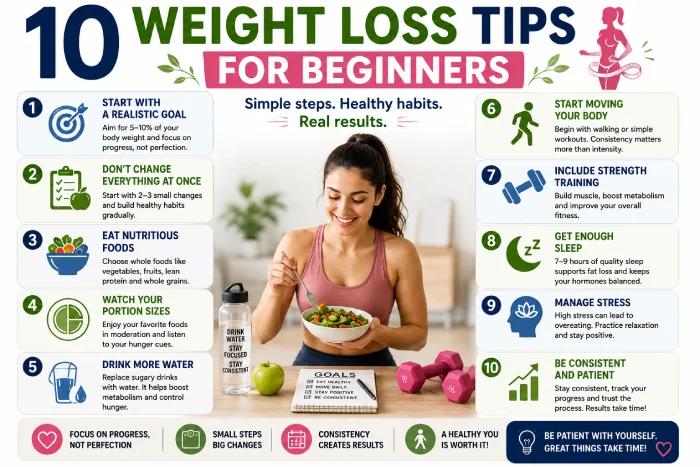
1. Start With a Realistic Goal
You don’t have to set your first goal to lose thousands of pounds.
Rather, select a goal that is attainable in your present circumstances. Likewise, health experts usually suggest an attainable goal of 5% to 10% of baseline body weight over 6 months for those who need to lose weight.
For instance, a 200 pound individual might strive to lose 10–20 pounds in the beginning, instead of an initially huge goal.
Try to make a difficult goal feel more achievable by dividing it into smaller steps.
Instead of thinking:
“I am going to have to lose 30 pounds.”
Try:
My initially goal is to establish better habits and to begin losing the first 5% of my starting weight.
Your suitable goal may depend on your health, age, drugs etc so it‘s best to consult your doctor if you‘re worried.
2. Don‘t Try to Change Everything at Once
Changing your lifestyle completely and simultaneously is a common mistake among beginners.
They can abruptly drop everything they love to eat and binge on their simplest foods, work out every day, cut out all carbs entirely, and gobble up very little food.
That‘s how the pile of documents starts to pile up.
For more concise modifications begin with two or three.
For example:
- Drink more water1.
- Include vegetables in at least one own-made meal.
- Walk for 20 minutes.
- Cut back on the sugary drinks.
- Eat less.
Once these new habits are set in motion, slowly ease in other changes.
Most successful long-term weight control programs focus on permanent changes to diet and activity.
3. Build Your Meals Around Nutritious Foods
You need not even subsist on salads to slim down.
Our healthy eating pattern can include: vegetables, fruits, whole grains, and other protein sources, beans, lentils, nuts, seeds and other foods that are high in nutrients.
In an attempt to keep your meals as small as you can, ensure that they are satisfying.
For example, a balanced meal might include:
Protein + vegetables + whole grain or other carbohydrate + an appropriate amount of healthy fat.
Another way is to make elementary substitutes.
Opt for a piece of fruit instead of a sweet snack that is very refined. Drink water instead of a soft drink. Include 1 or more vegetarian dishes in your lunch or dinner.
According to NIDDK, a healthy-weight management approach recommends selecting whole grains, vibrant vegetables, good food, and appropriate portions.
4. Pay Attention to Portion Sizes
If you‘re eating large portions all the time, then even healthy foods could add more calories than you require.
There isn‘t the need to measure every ingredient to do allthisorexactly weigh all the ingredients or darwith everycalorie.
Instead, make yourself more conscious of the quantity you are consuming.
Serve the food on a plate and eat from it. Don‘t rush through your meal, and take the time to settle comfortably into a sense of being satisfied.
When you are dining out, perhaps try to take some of the meal home rather than try to get it all down. NIDDK promotes portion control and saving food from a restaurant as helpful strategies.
This is for knowledge, not limitation.
5. Make Water Your Go-To Drink
A number of drinks can contain high levels of sugar and energy.
Soda‘s, sugary coffees, energy drinks and all other sugary drinks are capable of upping your calories without providing the same feeling of fullness a meal will.
Daiquiri your water from day one!
You can still have other drinks every now and then. The idea is make sure that you‘re turning to water as first option rather than the sugary sweetened drinks.
If drinking plain water is too boring, choose sparkling water instead or add lemon, lime, cucumber or mint.
6. Start Walking Before You Start Chasing Intense Workouts
Newcomers commonly think:’.
It doesn’t.
Walking can be a great initial activity especially if you have been inactive.
Start with a level of activity that is manageable. (e.g. A moderate activity, such as walking could be introduced for 10 20 minutes on several days and then gradually built-up.)
NIDDK encourages to take it slow and slowly increase your physical activity, you can begin with just few minutes. Any duration even shorter can be added to your total amount of activity.
As you get fitter you can add cycling, swimming, weights, jogging, sports or whatever you enjoy.
Best exercise is an exercise you do.
7. Add Strength Training
Cardio isn‘t the only workout that is worth doing at around weight loss:
Strength training. You will be able to add to and sustain muscle, if done correctly along with better scores for general fitness.
You can start with simple movements such as:
- Squats
- Wall push-ups
- Lunges
- Glute bridges
- Resistance-band exercises
- Light dumbell exercises
You don‘t even have to lift very very heavy weights.
Start at an appropriate level and build up as your strength improves NIDDK suggests progressing gradually in activity and strength-training difficulty rather than large jumps
8. Track Your Progress Without Obsessing Over It
Tracking gets you a grip on whether or not you are heading along the right lines:
You could track:
- Body weight
- Waist measurement
- Daily steps
- Exercise sessions
- Meals
- Water intake
- Sleep
- Regarding how your clothing fits you.
You may not have to account for all data.
Select one or two measurements that are relevant for you.
Don’t forget that your weight can swing naturally from day to day. One day’s number doesn’t tell you how your plan is doing.
Think about the trend over time. Don‘t be concerned with every fluctuation.
NIDDK advocates tracking your food, activity, and weight in you devised training program for managing weight.
9. Don‘t Ignore Sleep and Stress
Weight loss is not just related to food and exercise.
Sleep and stress are also managed regularly by a good lifestyle.
When you are tired or stressed it will be more difficult to stick to your usual routines and you may find it more difficult to plan meals, spend time exercising or making the best food choices.
Develop a regular sleep schedule and try to allow yourself as much sleep as possible.
Another thing you can do is de-stress using simple techniques like walking, working is a breathing exercise to meditation, journaling, talking with friends, taking a break, et cetera.
Imagine such a project as weight loss being just another aspect of an overall healthy lifestyle.
10. Focus on Consistency, Not Perfection
This could be the most useful weight loss tip for beginners.
You are likely to have days when you eat more than you‘ve scheduled.
You‘ll miss a set.
Ten may have been for a holiday, a birthday, a meal out at the restaurant, or a stressful week.
That does not mean your plan was an utter failure.
When you get the chance, do not dwell on “I have wrecked everything,” just get straight back on with daily life.
NIDDK, however, specifically recommends that visitors “prepare for setbacks and be flexible in your plan of action don‘t give up after gaining back a few pounds.”
Learning how to lose weight involves what you should be doing day-in and day-out over months and months and come on, let‘s face it–years. Not what you should be doing for seven glorious days.
What Are the Best Foods for a Newcomer Looking to Lose Weight?
No one diet will suit everyone.
Methodological= means forming meals around wholesome foods with control over amount.
For example, your day could include:
- Breakfast: Eggs served with wholegrain toast and some fruit.
- Lunch: Chicken, beans or other source of protein, with or without vegetables and a portion of rice or other wholegrain.
- Snack: Fruit, yogurt, nuts or other filling item.
- Dinners: Raw or cooked vegetables, fish, chicken, beans, lentils or equivalent.
You can choose the specific foods based on your culture, resources, taste, and dietary guidelines.
An ideal diet is a schedule that you will be able to keep up with over the long haul.
A Simple Beginner Weight Loss Routine
If you‘re feeling lost and don‘t know where to begin, keep it easy during your first week.
Morning
Have a drink of water and have a good breakfast as usual if you are a breakfast eater.
During the Day
Focus on eating mostly healthy foods and go easy on portion sizes. Keep yourself well hydrated.
Afternoon
Go for a walk, bike, run or however you want to move a little more.
Evening
Have a proper dinner and do not make it a ‘snacking evening’.
Before Bed
Allow yourself sufficient sleeping time and to set things in order for the day.
You don‘t have to make this routine perfect. It is just a tool to show you a very simple pattern for repetition.
What rate of weight loss is appropriate for a beginner?
Avoid any program that guarantees a very quick weight loss.
NIDDK materials state that weight loss of around ½ to 2 pounds a week is common in safe and sustainable programs, but that there will be individual variations and that weight may reduce more quickly at the start;
Several factors can influence your rate of weight loss, including your initial weight, eating pattern, activity, health conditions, medications, and other factors.
Instead of asking:
“How fast can I lose weight?”
A better question is:
How many habits is one supposed to keep up at one time?
Common Weight Loss Mistakes Beginners Should Avoid
Save yourself some trouble by not making the usual mistakes.
Following Extreme Diets
E.g. very restrictive diets are difficult to follow and may not be balanced.
Skipping Meals to Save Calories
Skipping meals does not necessarily lead to weight loss. It is what you eat and how much energy you consume that is important.
Exercising Too Much Too Soon
Jumping into heavy workouts every day can drag you down. Beg into it.
Eliminating Entire Food Groups Without a Reason
Removing carbohydrate, fats or other food groups is not essential. An overall varied diet can still be healthy for keeping weight off.
Expecting the Scale to Drop Every Day
Weight fluctuations on a daily basis are not uncommon – just look at a longer-term picture (why not check your weight now?)
Giving Up After One Bad Day
One less meal or one missed workout doesn‘t decide your results.
What are the symptoms that warrant speaking with a health care practitioner?
Not everyone should be aiming for weight loss.
If you have a specific illness, are on any medications that can influence weight, have a history of disordered eating, are pregnant, or don‘t know if weight loss would be right for you consult a doctor or registered dietitian before making any changes.
Your healthcare provider can help you set a safe and reasonable goal and select the best plan to fit your health and situation. The NIDDK suggests consulting with a healthcare provider when setting a weight-loss goal and shaping a plan.
Frequently Asked Questions
Q1) What is the most effective advice for losing weight?
Begin modestly and build up sustainable habits. Consuming a diet high in nutrients, moderation in eating, being more active, getting better rest, and maintaining consistency are ultimately more beneficial than relying on quick fixes.
Q2) How many exersice is to be done by a beginner to lose weight?
Begin at a level that you can handle and slowly raise the level of activity. Adults are usually advised to try to accumulate at least 150 minutes of moderate-intensity physical activity a week, although this varies for each person.
Q3) Is weight loss possible without exercise?
Certainly. Any activity such as walking, cycling, working out at home, dancing, participating in sport and any other movement will increase your activity levels. You do not need to have a gym membership.
Q4) How many pounds should I plan to shed?
A typical minimum target for the average person who needs to lose weight is about 5% to 10% of initial body weight over 6 months. Your goals may be higher or lower so seek advice from a healthcare professional.
Q5) Is it possible for me to enjoy the foods I love and still lose weight?
Yes. You can eat foods you love while maintaining a healthy weight; the key is to be mindful of the portion sizes and your overall daily intake rather than obsessively categorize foods into guilt categories such as “good” foods and “bad” foods.
Final Thoughts
Beginning your weight loss journey can be simple. Set a practical and attainable target, make small shifts in your diet, incorporate some exercise into your routine, consider portions, stay hydrated, ensure good quality sleep, and keep a record of your progress without it becoming daunting.
Most critically,buff yourself.
Weight loss is not a race. It is a process of establishing habits that foster your health in the long-term.