


Mohd Arbaaz is an Editor and Writer at Fitnessison.com with 5 years of experience in SEO and digital content creation. He creates informative, reader-focused content covering fitness, workouts, nutrition, health, healthy lifestyle, technology, and computers.

Shashi Teja is a Reviewer at Fitnessison with over 6 years of experience in SEO, content strategy, digital publishing, and content optimization. He reviews content for clarity, research quality, topical relevance, readability, structure, and overall usefulness to readers.
Last Updated: September 24, 2026
Injury prevention involves avoiding injury on any given occasion by sensible planning, sustainable training, proper form and adequate recovery. It also involves recognizing problems early and stopping. While it won‘t eliminate all risk it can provide a more realistic approach than simply training harder. It is more important for beginners to find exercises that they can do on a regular basis. The exercise should be most within their present level of fitness, health and available recovery time. Exercising as they used to do five years ago, or exercising with the fellow next to them, is not an appropriate initial prescription. This handout combines the key considerations during safe practice when training: warm up, learning movement, progress, fatigue control, detecting injury and returning to activity. This is general education. If there is a current injury, recent surgery or relevant health condition an individual plan from a health care practitioner may be necessary.
What Does Exercise Injury Prevention Involve?
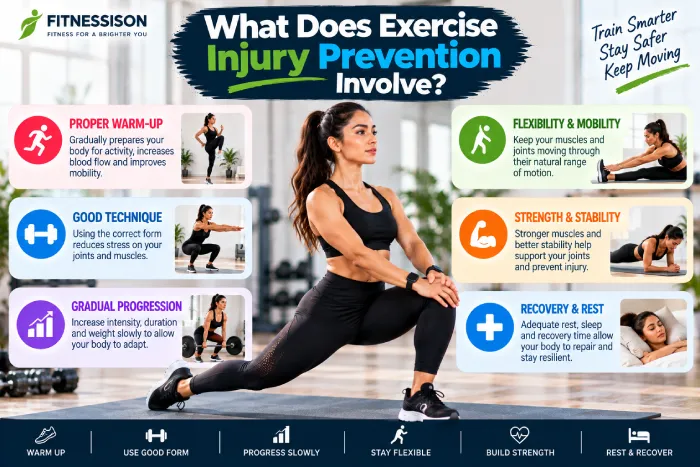
Prevention of exercise injury is a ‘blend of decisions and not a special exercise’. It consists of choosing the correct sport or exercise, being properly prepared for it, regulating one‘s effort and taking the necessary action when circumstances change. The safe exercise guidance from the American Academy of Orthopaedic Surgeons lists these as the factors that can increase risk: a sudden increase in training, inappropriate clothing, hard conditions, injuries. So the relevant question is even more general that “Did I stretch?” Ask is the whole session right for you today.
Sudden injuries and gradual problems need different attention
An acute injury occurs at the time of the specific injury event (fall, awkward twist), where as an overuse injury is one occurring during repetitive loading over a period of time. The following table outlines the difference between these broad patterns by the National Institute of Arthritis and Musculoskeletal and Skin Diseases, although a more gradual problem can lead to an acute injury. That difference shifts prevention priorities. Removing a slippery floor addresses an immediate risk. Examining a short-term jump in running volume addresses chronic exposure. Both are important, but one does not cancel out the other.
The aim is sustainable activity
It’s not about stopping moving altogether. It’s about making your exercise routine maintainable so you can keep going. The potential results – fewer unnecessary setbacks, knowing you’re making the right choices, and a flexible routine when things get busy. Consider prevention as a living document. Any session may be inappropriate based on added weight, altered trail, returning from illness, or neglecting a new symptom.
Check Your Starting Point Before Choosing a Workout
Start with what you are able to do today, not the aspirational goal you may have. Reflect on your recent activity, any ongoing symptoms and your level of comfort with the exercises being suggested. If you are a regular walker it is unlikely you will be able to immediately jump into resistance training. A lifter that is new to running is also trying out a new activity.
Separate a health target from your first week
The suggested adult activity level from the CDC is 150 minutes a week of moderate aerobic activity or 75 minutes a week of vigorous activity along with muscle-strengthening activities on at least 2 days. Alternating between moderate and vigorous activity is also acceptable. These are overall health “targets” – they are not a mandate to do that much straight away. One can find the following section useful. If you have been inactive, it may be reasonable to begin with less than this goal and work your way toward it.
Know when advice is needed
Moderate activity is recommended by the CDC as appropriate for most persons when adding activity. Individuals with chronic conditions should consult their health care provider before adding the amount and type of activity. The CDC suggests also when you have been inactive or have a disability to check with your health care provider to ensure vigorous activity is appropriate. If you already have pain, are recovering from an injury, or are recovering from surgery, follow advice specific to this. A general beginner programme will not cater for a developing fracture or a repaired tendon. Prior to first appointment, identify one achievable target: e.g. mastering the equipment, taking a walk at ease. This helps make sure the first session doesn‘t evolve into an unintended fitness assessment.
Prepare Your Body With a Purposeful Warm-Up
Warm-up provides you with a warm entrance to the day. For more intense training, American Heart Association advises about five to ten minute warm-up. It should feel like this to follow. Practice your lift before you lift, go for a light bike ride before a harder bike ride, or walk before a fast walk.
Use the warm-up to test readiness
A practical sequence is:
- Start gently: Opt for an activity in which you can move comfortably and gently.
- Rehearse session: Run through lighter/less complex versions of the movement sequences.
- Rate your response: Observe any unfamiliar discomfort, abnormal fatigue, and whether you can control the movement.
- Prepare and then proceed. If it uncovers an issue then switch session.
For instance, a short, gentle warm-up before the session allows you to assess the seat position and become aware of any anomalies during pedaling. Before a lift, a warm-up set shows if today’s weight demands adaptation. These examples are ideas for warm-up activity, not a one proven to prevent injury regime. If there is pain and/or discomfort on warm up, additional warm up exercises can‘t replace the examination of the problem.
stretch versus stretch warm up
Static stretching involves maintenance of position, and a dynamic warm-up involves motion. The aim of stretching can be flexibility, but it should not have the primary responsibility to keep you safe. A randomized study of male army recruits showed that a specific pre-exercise stretching program did little to reduce lower-limb injury risk. That result applies to that population and protocol; it does not mean that all stretching is pointless. Looking for an activity-specific choice? Check out our warm-up exercises for various workouts. Refer to it to select appropriate movements instead of incorporating an extensive routine you won’t be able to sustain.
Learn Exercise Form You Can Control
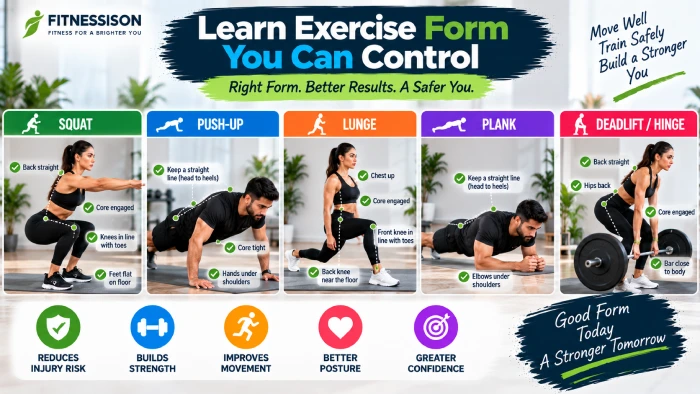
Effective exercise technique involves awareness of the movement you are using, appropriate preparation and a level of exercise manageable by you. You will be aware of the starting position, the technique used and how to finish the exercise. The Mayo Clinic‘s advice for weight training is to learn the proper technique, lift under control, exhale during reps, and lower the weight or decrease reps when you can no longer maintain form; and to carry the weights carefully when removing them from or replacing them on the rack.
Make the exercise fit your present ability
The may be suitable as a good starting point for a novice prior to moving onto a more challenging variation. Any supported movement may be slightly less complex to perform than one where an additional force is applied along with an added balance concern. Examples of the least challenging exercises listed in the NHS exercises guide under strength include: The question is if “a variation suits you your target and your ability” (Bremer et al. 2007, p. 132). You‘ve got the possibility to not pick the most difficult variation in order that the session will be worth.
Solicit the reader for a back-of-the-envelope evaluation you can do
Instead of asking only, “Does this look right?”, try:
- Where shall I put the equipment?
- What about the head (B) should stay controlled all through the movement?
- What is the easier alternative if I am having a hard time?
- Unauthorised use of this set. How do I perfect the set safely?
Tailored responses are simply more manageable than enumerating all possible cues. When you are juggling multiple instructions, rehearse them with lower stake. A new pain is a reason to stop and reevaluate the activity. A clinician may recommend exercises with a parameter of pain for a given rehab program but that is different than you autonomously deciding to work through an unexplained pain. What are the basics of proper movement and exercise form? We explain this in more detail in our guide to proper exercise form and movement basics. For an introduction to resistance exercise in general, see strength training for beginners.
Increase Training Demands Gradually
Advancement of Training Increasing the difficulty of training to match your level of readiness for it. Increasing weight is one way to do this; increasing repetitions, training longer, training more often, moving faster and more obstacles to go under and over… all increase the challenge of the activity.
This matters when several seemingly small changes happen at once. The same runner might keep the same distance, but add some hill running or mix up the pace. The same home workout might maintain the same exercises, but cut the break time and repeat twice.
Keep the change you’re alreadymaking.
Use a short training note rather than relying on memory:
| Training variable | What to record | A change to long-term betterment |
| Frequency | Number of sessions per week | Adding a third workout day |
| Duration or quantity | Minutes, distance, repetitions or sets | Adding A Set In “Katy Daughters,” the Mischo sisters explain how to set up adding. |
| Intensity | Pace, resistance or (perceived) effort. | Speed or weight-intensive |
| Exercise type | Movement, surface or activity | Transitioning from flat walking to hills |
| Response | Symptoms and recovery | Feeling worse later or the next day |
A reasonable planning strategy would be to move 1 item, get feedback and then review how it has worked. This is a way to make decisions clearer, not a scientifically proven formula that prevents every injury.
Suppose a comfortable walk becomes easier. You might extend one outing slightly while keeping the route and pace familiar. If you simultaneously lengthen every walk, add steep hills, and start jogging, it becomes harder to identify which change was too demanding.
This isn‘t a safety threshold, so don‘t interpret the rule of 10%
Increasing running volume by no more than 10% per week is a common guideline with the promise of preventing injury. But a randomized trial of novice runners showed that a longer, graduated programme based on this principle did not prevent injury compared with a standard programme. That doesn’t mean sudden spikes are OK, it just means you can’t have one percentage make all the future decisions. Your recent ramp, your symptoms, what you are doing for work outs, and how much you recover still count. Sometimes the best choice can be to repeat a week when one week is especially difficult or when it‘s just not possible to get to the gym during that week. Notice that progress doesn‘t necessarily have to be shown on every line in a training log. Narrate safe progression in a workout for beginners for guidance in how to make such decisions at different activities.
Balance Training With Recovery
Train and recover as a pair. Filling your calendar with back-to-back challenging sessions doesn’t leave you much flexibility when energy and performance levels are not where you expect them to be. However, rest isn’t necessarily napping and being totally still. For your condition and symptoms, it might mean a walk, moving around a bit more easily or switching to one of your other activities as long as you are actually resting. easier for you.
Know what overtraining is.
General fatigue resulting from a single session of training is unlikely to indicate overtraining syndrome. A more chronic condition characterized by a failure to adapt to training and failure to recover as required; the joint European College of Sport Science and American College of Sports Medicine consensus statement; needs to be present. Diagnosis takes other factors into account and no single generally accepted indicator is available. Chronic fatigue, performance deterioration and mood alteration should be noted, however these symptoms can have other origins. If a decrease in training does not rectify the problem, seek medical advice rather than presuming you need to ‘get motivated’.
Review the experience, not an hour of disappointment
Keep a few simple notes: how the exercise went, did a normal activity become more difficult afterwards, and did your sleep or symptoms alter. After a few regular sessions, these points might enable you to inform a coach or clinician about your issue. For example, if your familiar routine starts feeling noticeably tougher, despite you having a few extra recovery days, then hold planned increases. It is highly unlikely to be a harder workout providing enough clarity on what you are going through. Schedule protect sleep time. Adult protection sleep hours varied from seven to nine hours, depending on age. The CDC recommended seven hours sleep for adult aged 18–60, and recommended sleep hours by age group for the aging. Sleep quantity is important, but. This guideline best supports overall health, not a guarantee that consistently following this guideline minimizes injury risk. For a more in-depth focus on training fatigue and lifestyle adaptations, see our overtraining prevention and recovery guide.
Understand Common Workout Injuries and Soreness
Simple terminology can help convey the problem accurately. It should not be relied upon in place of an examination.
| Term | How it translates to English: | Example |
| Sprain | A tear to a ligament that binds a bone to another bone | An ankle ligament injury following a twist. |
| Strain | A damage of a muscle or a tendon. | A hamstring muscle strain It is the result of tear or partial tear of the musculotendinous junction between the ischmmbris, B ischmmbris and the long head of the Biceps Femoris, ischmohlammbris. |
| Tendinitis | TendinitisAn inflammation of a tendon. | A painful and/or inflammed Achilles tendon. |
| Stress fracture | Bone damage resulting from repetitive stress | The bones in your feet, if you have a stress fracture in your foot |
are in accordance to NIAMS advice on sports injuries. Due to traumatic symptoms can also have contractual reasons, so do not make a self-confirmation solely through the pain.
How is ordinary soreness different?
Exercise that is new to you is a common cause of delayed-onset muscle soreness, or DOMS, says Houston Methodist. The pain typically appears 12 to 24 hours after your workout and reaches its peak between day one and three.
Just the timing of pain is not a good indicator of painless. Sudden pain, swelling, limping, or not using the leg should not be considered “just sore”. Look for trends and improving use.
Any pain associated with a bone also requires further investigation. Pain in the region of a foot or ankle stress fracture is first described as a gradual onset of discomfort, aggravated by post-loading weight-bearing activities, and tender when touched directly over the site of injury. Don’t be running around to “test it” again and again.
Some of the serious workout injuries we‘ve looked at and the warning signs have been outlined above so that you will be aware of the main categories and when to seek medical advice.
Know When to Stop and Seek Help
Discontinue the activity if you experience any new injury or symptoms which interfere with normal motion. Do not use the next set as a test to determine the severity of the problem.
Get urgent assessment for significant symptoms
The NHS suggests emergency care if the pain or swelling worsens or is very severe following injury if you are unable to weight-bear, or if movement is extremely difficult. Any ongoing symptoms which are not improving also require investigation.
Any obvious deformity, a cold or discoloured injured limb or numbness following an injury should be evaluated as an emergency. Call your local emergency number (which differs according to country) for assistance.
Unresponsiveness or other red-flag symptoms new onset chest tightness with marked breathlessness, collapse or similar emergencies should also be met with emergency response. NHS breathlessness guidelines3
Know the warning signs beyond a sprain
Muscle pain, significantly worse than usual, fatigue, and tea- or cola-colored urine following intense physical activity can signal dangerous muscle destruction known as rhabdomyolysis. The CDC recommends seeking emergency care at the first sign of any of these symptoms. Do not wait for the whole set of symptoms to occur or think that ‘normal’ urine is safe.
There‘s not a lot of good news there I‘m afraid the list is numerous and potentially life threatening, not to mention effective these signs are all reasons to get assessed, not pointers to diagnosing yourself. If your symptoms are uncertain, contact your local medical practice.
Account for Food, Equipment, and Your Surroundings
The design of the workout is only part of the equation. An easy workout can easily be defeated by the if it is set up in an unsafe way, or if the activity is not supported.
Eat enough to support the work
The 2023 IOC consensus defines the health and performance issues resulting from chronic or severe low energy availability as below energy availability (EA) for optimal health and performance: the state in which there is a deficiency in dietary energy intake in relation to the energy expended through exercise, which could impact both male and female athletes. The BMJ description that accompanies this material mentions effects on bone health.
So for the recreational exerciser–the bottom line pay attention to diet as you train harder. Don‘t rely on harder and harder workouts and a more and more restrictive diet to always go hand in hand. Ongoing fatigue, menstrual disruption or repetitive stress injuries to bone should be evaluated by a health care professional.
Make the space usable before starting
Ensure the floor is free of hazards, equipment is properly secured, and there is enough room to perform the movement. At home this may include moving a fragile rug or repositioning a chair. At the gym ask how to use an unknown piece of equipment before loading it.
Normal hazard checks. Do not cost the earth in equipment but do need to be checked prior to commencing.
Change the plan when conditions change
When it’s hot, the CDC advises to exercise in cooler hours of the day, take it slow, and schedule hydration. If you become dizzy or weak, stop what you’re doing and find a cool environment. Symptoms of heat illness need to be seen to by a doctor.
A well known route does not pose the same requirements in all situations. Allow yourself some permission to go home early, reposition the session, or put a distant session into the diary rather than see the original plan as a duty.
Return to Exercise After Injury in Stages
Getting back after injury is not just ticking away the days. The nature of the injury, extent of the injury, treatment that you receive and the activity that you are returning to will all affect this decision.
The guidelines provided by the NIAMS regarding rehabilitation states that rehabilitation (when needed) helps rebuild strength and movement to do the activity again. A health care provider will be able to tell you what you are ready for or what you need to work on.
Treat return as a process
The return to sport consensus statement form 2016, defines a progression from participation to sport to performance. When used judiciously for recreational activity, the difference is when you do some modified activity, return to your typical workout, or meet your prior challenges.
For instance, simply being able to walk comfortably after suffering an ankle sprain does not necessarily imply that you are prepared for rapid changes in direction. Likewise, simply finding a given low level of exercise manageable does not validate your having previously lifted at this level.
Discuss these questions with your treating professional:
- Valid activities to continue with at this stage are:
- What makes a good movement, strength, or balance criterion for?
- Are there any symptoms that should alert me to cut back or stop the workload?
- What shall I do if the symptoms return later that day or the next morning?
- What needs to go on before I can carry on at that same level?
Keep the plan specific to the injury
A problem with the tendons, broken bone or the repair post operation all won‘t have one universal timetable. Limitations and tolerable levels of symptoms can all vary. Stick to the plan specific to your problem rather than adopt someone else‘s return to activity timetable.
You are still part of the decisions. Let the clinician know what you want to go back to (specific activities), what equipment you use, and what a typical session involves. ‘I want to exercise again’ is less helpful than providing details of movements and loads.
Our guide for resuming training following injury describes how to get ready for these conversations and plan a progressive return.
Build a Beginner Routine You Can Repeat
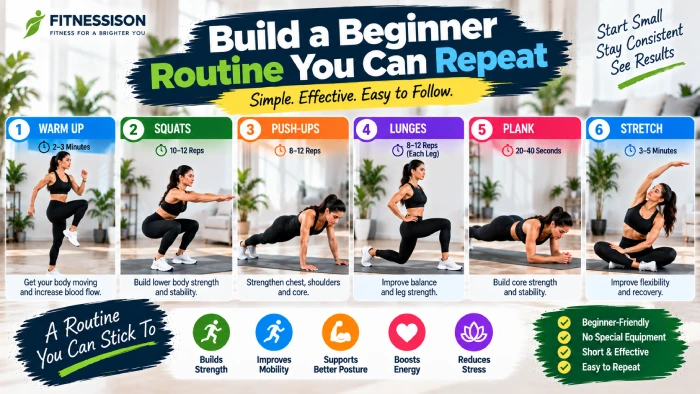
A good starting program for an otherwise healthy adult without a current injury is one that is simple to learn, practical to find the time for, and adaptable. Even if it is not all-inclusive of possible fitness methods, it should include several.
Use a simple planning process
- Select an activity which is within your reach. For the initial phase, select something that is readily accessible to you and also within the scope of your present ability.
- Use a supported starting point. We should be cautious not to use the first session as an experiment for our maximum tolerance or capacity.
- Give yourself the time you need to prepare. Add the warm-up to your date with yourself.
- Allow for a little Allow for work, sleep, commitments to family and other activities.
- Document anything that occurred. Record date/time/session, your effort and any symptoms you may have.
- Review before applying Raise the demands when the current intervention has been well tolerated.
This is an organizational example, not, for example, an individualized exercise prescription. It is intended to help you make your next decision with information from the last session.
Judge effort in context
Regarding aerobic work, the CDC ‘talk test’ states that moderate exercise allows talking but not singing, and at high intensity using more than a few words causes a loss of breath.
Apply that as a general intensity test and not as a guarantee that exercise is safe to undertake. Breathlessness, abnormal symp-toms etc. are a different matter to general tiredness of exercise.
Just comparing activity options? Our guide to cardio workouts can help you see the formats on offer. Select what suits you, not what you think you should do.
Easing down: After aerobic workout, easing down is important. Take as much as 5 to 10 minutes to gradually walk slower to allow your heart rate and blood pressure to return to normal. Cool down is a way to transition out of exercise; it does not cancel an overreaching body.
Choose the Right Kind of Support
It all depends on what question you want answered. Technique coaching and injury diagnosis are two very different things.
| Your primary requirement | The available pathways for each agent to reach their transactions. | Useful Questions to Ask |
| Without prior knowledge of unfamiliar exercises. | A certified trainer or exercise specialist | Can you show me this and provide me with a simpler version? |
| Persistent pain, injury suspicion | A registered healthcare professional | What do I need assessment? |
| Restoring function after injury. | Your treating clinician or physical therapist | What informs my next step? |
| Keen to un-concern about fueling or restrictive eating. | A registered dietitian and clinician as required | Is what I eat helping my activity and health? |
Verify appropriate citations in your area and for the services you offer. 2. Inquire how the professional deals with issues that are beyond their expertise. An exercise technique instructor should be ready to refer you for medical evaluation if needed.
When selecting a program, ensure that the starting level is easily determined, instructions are clear and easy to follow, there are options to modify the difficulty of the movements and an explanation of how to progress through the program. Be wary of claims that a product, move or combination will always prevent injury.
Specific prevention programmes in specific settings have been shown to be effective for instance a 2024 FUNBALL randomised study in young male soccer players demonstrated an decrease in in injuries with its structured program. That does not mean the same results apply to every adult gym routine. Match the evidence to the population and activity being discussed.
Frequently Asked Questions
Can I exercise every day without getting injured?
Daily activity, maybe, but daily hard training sessions, a whole other matter. Think about the activity, the exertion, the symptoms you experience and the tolerance to recover. An easy walk should not be sacrificed for yet another hard training session. A daily streak should not take precedence over a necessary change of plan, and no schedule will eliminate injuries.
Should I work out if my muscles are still sore?
Soreness. Light discomfort should still be manageable with simple, easy activity, but at the end of the day the response to soreness is key. Do not repeat a hard session before the soreness has greatly hindered movement. Severe pain, progressive symptoms, swelling or limping all require greater attention than normal post-workout stiffness. If you are unsure whether what you are feeling is soreness or injury, get assessed rather than fending for yourself with heavier training.
Do I need to buy special equipment to prevent injuries?
You need equipment appropriate to the activity, and in condition for use. Pricing does not determine protection. Begin with fit, traction, stability and proper alignment.Consider whether sport-specific protective equipment is needed.If an injury requires a brace or other support, check with your health-care provider.
Is strength training safe for someone new to exercise?
Strength training may be integrated into the beginner routine when the exercise and resistance can be performed at the individual‘s performance level. The creation of a familiarity with setup and movement is fundamental. Seek support with equipment that is unknown, and start with a moderate load. Current injury, medical history or symptoms, may necessitate modifications or advice prior to beginning a program
Does being flexible mean I am less likely to get injured?
Flexibility by itself doesn‘t tell you how likely you are to get injured. The movement, the training load, the way you perform the movement and the past injuries and recovery are also factors. Stretching can help for a movement goal but it isn‘t permission to neglect other parts of preparation. Do not impose painful postures just because you believe more Range will make it safer.
How long should I rest after a workout injury?
NOT ALL REST is appropriate for all injury. A strain may need very different treatment from a fracture. Rest should be considered along with diagnosis, symptoms, function and advice from your therapist. Rest may be the first step in recovery and return to activity, followed by appropriate rehabilitation and progressive return.
Can I keep training a different body part while injured?
Sometimes, but confirm that the alternative activity respects your restrictions. An exercise aimed at another muscle group may still load the injured area through balance, bracing, gripping, or getting into position. Ask your clinician which activities are suitable. Staying active should support the recovery plan rather than become a way to work around necessary restrictions.
Conclusion
A safer routine begins with a realistic starting point and improves through small, informed adjustments. Prepare for the session, learn movements you can control, keep track of changes, and leave room for recovery. When symptoms appear, respond to them rather than treating the plan as something you must finish at any cost. Choose the next step that addresses your actual need: a better warm-up, help with technique, a clearer progression plan, or professional assessment. Consistent attention to those decisions is the foundation of practical injury prevention.