


Mohd Arbaaz is an Editor and Writer at Fitnessison.com with 5 years of experience in SEO and digital content creation. He creates informative, reader-focused content covering fitness, workouts, nutrition, health, healthy lifestyle, technology, and computers.

Shashi Teja is a Reviewer at Fitnessison with over 6 years of experience in SEO, content strategy, digital publishing, and content optimization. He reviews content for clarity, research quality, topical relevance, readability, structure, and overall usefulness to readers.
Last Updated: September 9, 2026
Introduction
If you’ve been putting off cardio because you don’t have a gym membership, a treadmill, or a big open space — this guide is your answer.
Cardio workouts at home are not a compromise. They‘re an authorized, science-based method of burning fat, building a better, more efficient heart, ramping up your metabolism, and enhancing your stamina – all without equipment, all with just your body weight and a floor area that covers just a few square feet of space, and a proper program.
The US gym industry makes more than $35 billion a year, but millions of individuals achieve incredible cardiovascular results each year without ever walking into a gym. It‘s not equipment; it‘s intensity, structure, and consistency.
In this guide you will learn about all of the most important home cardio types, the most calorie-burning ones, best ways to perform them for weightloss and where to go for definitive full deep-dive programs. Whether you are a beginner looking for your first workout or you just want high-intensity fatburning sessions without the commute your every question should be answered here.
Cardio Workouts Resource Center
Explore our complete collection of cardio workout guides covering HIIT, jump rope exercises, beginner-friendly low-impact cardio, dance workouts, weight-loss cardio, and bodyweight exercises.
What Is Home Cardio And How Does It Work
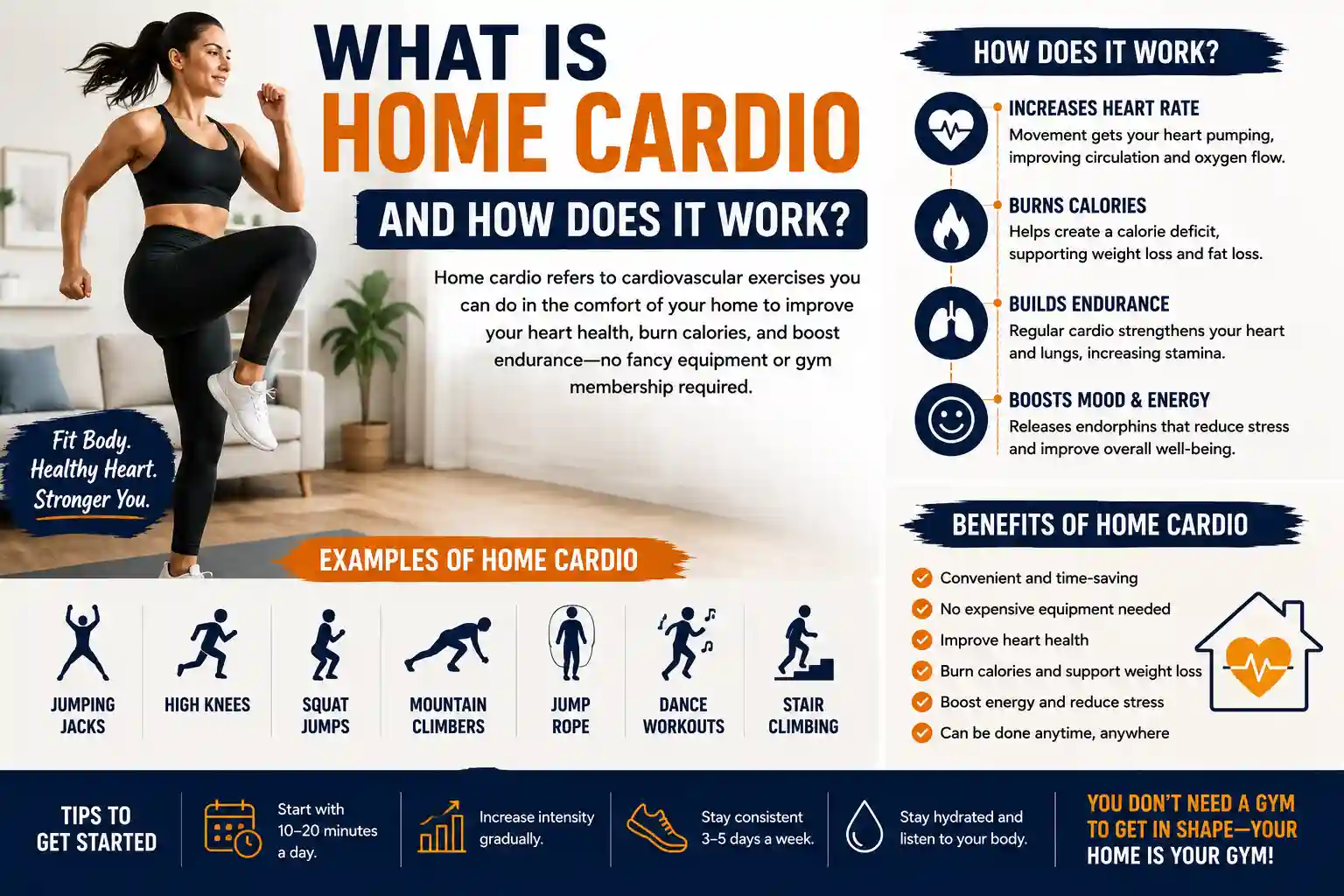
Cardio abbreviation for cardiovascular exercise is any type of rhythmic, repetitive activity that increases you heart rate above resting level and maintains it there for a period of time.
At its core, cardio works by:
- Raising your heart and respiration levels.
- Making your cardiovascular system work harder so it has to push more blood and oxygen to your exercising muscles
- The fact that you burn calories during the session (and can even burn them for hours after!)
- Gradually increasing your heart’s efficiency and capacity over time
Aerobic vs. Anaerobic Cardio
| Type | Intensity | Energy Source | Examples |
| Aerobic (steady-state) | Low–Moderate (50–70% max HR) | Fat + oxygen | Jogging in place, march, dance |
| Anaerobic (high intensity) | High–Max (80–95% max HR) | Glucose (fast energy) | HIIT sprints, burpees, jump rope intervals. |
Both types burn calories and increase fitness. It‘s the way in which they do this and your body recovers that differs.
Aero- cardio works at a higher percentage of fat burn but takes a longer time to gain the caloric burn.
Anaerobic / HIIT cardio has a less caloric burn during the activity compared to aerobic, but has a post ethyl EPOC (post-exercise oxygen consumption) effect, meaning your body still remains burning at a higher caloric rate for up to 48 hours after.
Calories burned by Home Cardio:
| Exercise (30 minutes) | 130 lb person | 160 lb person | 190 lb person |
| Jumping jacks | 170 cal | 210 cal | 250 cal |
| Jump rope (moderate) | 280 cal | 340 cal | 400 cal |
| HIIT (high intensity) | 250–350 cal | 300–450 cal | 380–520 cal |
| Dance cardio | 180 cal | 220 cal | 265 cal |
| Stair climbing | 190 cal | 235 cal | 280 cal |
| Low impact cardio | 130 cal | 160 cal | 190 cal |
| Burpees | 270 cal | 330 cal | 400 cal |
Calculated from MET, cannot take actual burn into account as reflects intensity & fitness level, not the datayou‘d actually like.
Main Point: level of intensity is the single most important variable for heart home cardio. You can do the same 30 min workout and burn 130 calories or 450+ calories depending upon how hard you work.
Cardio at Home for Beginners: Start Here
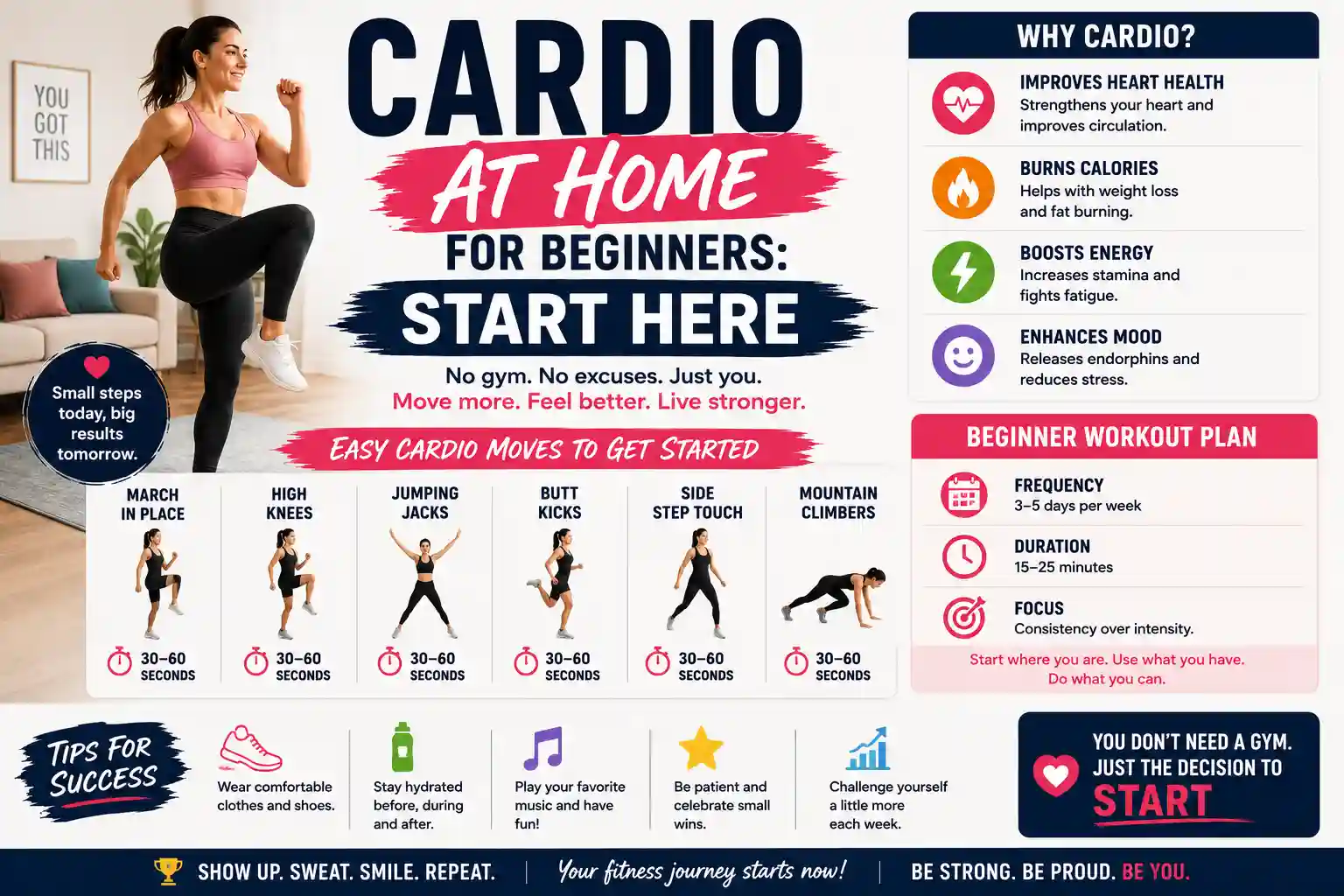
The biggest mistake beginner home cardio: Going to hard to soon.
Beginning your aerobic program with high-intensity hopping, running when your cardio system is not yet prepared for that sort of stress will leave you burned out in a matter of days or even a week, or worse, injured. You‘ll see much better results in the long run if you prepare your body first.
What Beginners Should Focus On
- Heart rate awareness: if you can talk during moderate cardio, it should be easy to do so. If you cant talk at all, reduce intensity. If you can just notice that your breathing is starting to become a little more labored, increase intensity.
- Form defeats speed: Maintaining good technique in all movement avoiding undue stress and joint damage.
- Duration over intensity first: 20–30 minutes moderate effort beats 10 minutes of unsustainable all-out effort
- Consistency over perfection: 3 sessions per week for 4 weeks is better than 7 days of one heroic week
Sample Beginner Home Cardio Workout (20 Minutes, No Equipment)
| Exercise | Duration | Rest |
| March in place (warm-up) | 2 min | — |
| Stepping side to side | 2 min | 30 sec |
| Bodyweight squats (slow) | 2 min | 30 sec |
| Low-impact jumping jacks | 2 min | 30 sec |
| Step forward lunges (alternating) | 2 min | 30 sec |
| Modified mountain climbers (slow) | 1 min | 45 sec |
| March in place | 2 min | — |
| Total | ~20 min |
Mini Summary: beginners do well from low-to-moderate intensity, regular work, and progression over weeks/months. If first getting movement quality and cardiovascular base correctly, this is an investment for some sizable increase within weeks.
Read More: Complete 4-week beginner program, progressions, calorie burn goals and modifications – view our full beginners cardio workouts at home guide.
HIIT Cardio at Home: Maximum Results in Minimum Time
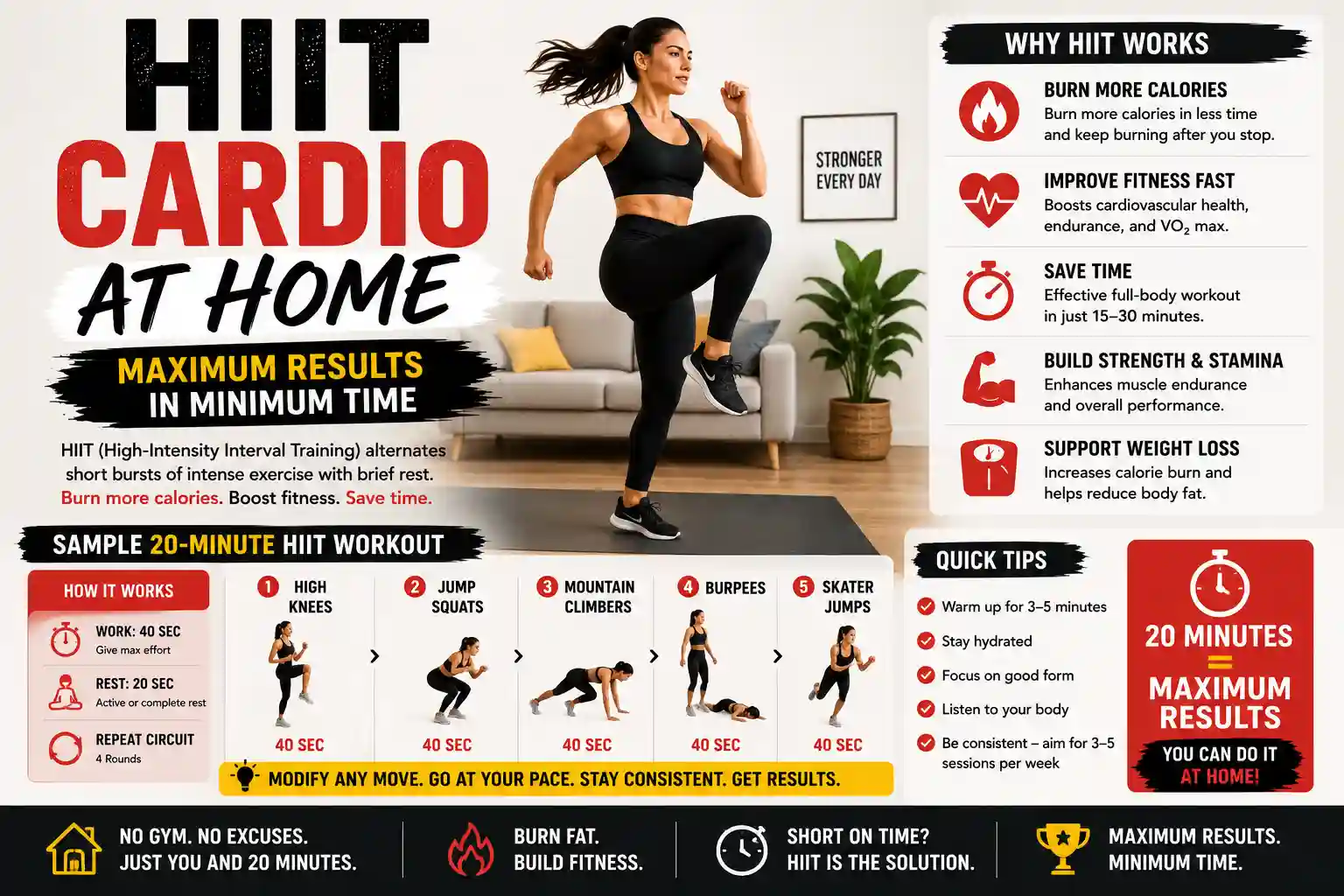
If all you‘ve got is 20-25 minutes. If you‘re looking for the maximum calorie burn on a home cardio workout HIIT (High-Intensity Interval Training).
This form of exercise involves alternating high-intensity bursts with recovery. Your body responds by pushing your cardiovascular and metabolic system as hard as it can, running an intense calorie burn and fitness adaptation engine that blows past the life of your workout.
Why HIIT Works So Well at Home
- It requires no equipment burstges, high knees, jump squats and mountain climbers require no equipment My Personal Experiences of Compex Muscle Simulator having trained with the swimmer.. well since I wasn‘t pressurised by a coach, it was a complete new experience, for a personal gym.
- Time-efficient — 20 minutes of high intensity interval training (HIIT) has been proven to be more effective for fat loss then 45 minutes of moderate steady state cardio in numerous studies.
- EPOC effect metabolic rate remains high 14 36 hours following session
- Variable (scalable) intensity can be altered by changing exercises (jump squat to squat) without altering overall structure
Standard HIIT Ratios
| Protocol | Work | Rest | Best For |
| Classic HIIT | 30 sec | 30 sec | General fitness, beginners to intermediate |
| Tabata | 20 sec | 10 sec | Advanced, maximum intensity |
| 40/20 | 40 sec | 20 sec | Intermediate, more volume |
| 45/15 | 45 sec | 15 sec | Advanced fat burning |
Sample 20-Minute HIIT Home Workout
Format: 40 seconds of work / 20 seconds of rest / 4 rounds, each consisting of five exercises
Exercises:
- Burpees
- High knees
- Jump squats
- Mountain climbers
- Lateral shuffle
Warm-up: arm circles and light marching for 3 minutes Cool-down: walking and deep breathing for 2 minutes
Total: ~25 minutes | Calorie expenditure: 250–400 calories
Mini Summary: HIIT: Home cardio is perhaps your fastest fat-burning workout. Two to three sessions per week is sufficient — HIIT requires 48 hours of recovery between sessions.
Read More: Complete HIIT programs, exercise variations, beginner modifications, and advanced protocols — see our full guide to HIIT cardio workout at home.
Low Impact Cardio at Home: High Results Without the Joint Stress
Low impact cardio is one of the most misunderstood classes in the world of fitness. A lot of folks assume “low impact” means “easy” or “weak.” Not so.
Low impact is just what it says–one foot is always on the ground–no landing forces which are the reasons jumping motions stress knees, hips and ankles. Even the vigorous intensities and resulting calorie expenditures can be achieved.
Who Should Prioritize Low Impact Cardio
- Beginners starting from zero fitness level
- Anyone with knee pain, hip issues, or joint problems
- Older adults (50+) prioritizing joint preservation
- Pregnant women or early postpartum recovery
- Anyone recovering from a lower-body injury
- People in apartments where jumping causes noise issues
Effective Low Impact Home Cardio Exercises
| Exercise | Impact Level | Intensity Potential |
| Walking in place (high knees) | Zero | Low–Moderate |
| Side steps with arm drive | Zero | Moderate |
| Standing bicycle crunches | Zero | Moderate |
| Step touches | Zero | Low–Moderate |
| Swimming arms (standing) | Zero | Low |
| Low-impact squat (no jump) | Low | Moderate–High |
| Standing oblique crunches | Zero | Moderate |
| Modified mountain climbers (slow) | Low | Moderate |
The Low Impact HIIT Method
You can apply HIIT intervals to low-impact movements for significant calorie burn without joint stress. Example: 40 seconds of fast side steps with arm drive / 20 seconds rest — repeated for 5–6 rounds.
Mini Summary: Low impact cardio at home is not a consolation prize — it’s the smartest choice for sustainability, injury prevention, and long-term consistency. You can build significant cardiovascular fitness without a single jump.
Read More: Low-impact HIIT, routines for bad knees, senior-friendly workouts, and apartment-safe cardio — see our complete guide to low impact cardio workouts at home.
Fat Burning Cardio at Home: What Actually Works
“Fat burning” is one of the most marketed — and most misunderstood — terms in fitness. Here’s the honest breakdown.
Fat loss happens when you burn more calories than you consume. Period. The type of cardio that produces fat loss is the type that:
- Burns a significant number of calories per session
- You can do consistently — 3–5 times per week
- Doesn’t lead to injury or burnout
The Best Fat-Burning Home Cardio Exercises (Ranked by Calorie Burn)
| Exercise | Approx Cal/Hour (155 lb person) | Impact |
| Burpees | 600–700 | High |
| Jump rope | 600–800 | High |
| HIIT circuit | 500–700 | High |
| High knees | 500–600 | High |
| Jump squats | 450–550 | High |
| Dance cardio (vigorous) | 400–500 | Low–Medium |
| Stair climbing | 400–500 | Medium |
| Mountain climbers | 450–550 | High |
| Jumping jacks | 350–450 | Medium–High |
Fat Burning vs. Cardio Zone: The Truth
You’ve probably heard of the “fat burning zone” — the idea that exercising at 60–70% of max heart rate burns more fat than higher intensities. This is technically true per minute — but misleading for total fat loss.
Here‘s why: more intense cardio actually burns more total calories each time, and while the percentage that comes from fat is lower, the actual amount burned (by simple math) frequently works out to be an even higher number.
Example:
- 45 minutes low intensity: burns 250 calories (60% from fat = 150 fat calories)
- 25 minutes HIIT: Burns 350 calories (40% fat 140 fat calories) + EPOC adds another 50–100 calories after exercise}
The math favors intensity for total fat loss in less time.
Mini Summary: The best fat burning cardio at home is the most intensive you can comfortably do every single day (or as often as you do it). Progressively train to HIIT, and pair it with a safe, calorie controlled diet.
Further reading: The best fat burning exercise combinations, 30-minute fat burning workouts, belly fat cardio exercises, calorie burn comparisons visit our full fat burning cardio workouts at home guide.
Jump Rope Cardio: The Underrated Home Fat-Burner
A jump rope is less than $15. It is stored in a drawer. And it might be the most calorie-dense piece of cardio equipment in existence.
At moderate intensity, jumping rope burns approximately 600–800 calories per hour — comparable to running at 8 mph. At high intensity, it rivals sprint intervals. It also builds coordination, calf strength, timing, and footwork in ways that most cardio options don’t.
Why Jump Rope Works So Well for Home Cardio
- No space required — 4×4 feet is enough
- No noise — a good rope on a mat is nearly silent
- Full-body engagement — arms, core, calves, and cardiovascular system all working
- Scalable — slow singles for beginners, double-unders or alternating feet for advanced
- Low cost — a quality speed rope costs $10–$25
Jump Rope Cardio: Intensity Levels
| Level | Technique | Calorie Burn (20 min) |
| Beginner | Slow single jumps, alternating feet | 150–200 cal |
| Intermediate | Continuous single jumps at pace | 200–280 cal |
| Advanced | High knees while jumping, intervals | 280–350 cal |
| Expert | Double-unders, speed intervals | 350–450+ cal |
Sample 15-Minute Jump Rope Cardio Interval
| Interval | Duration | Rest |
| Slow singles (warm-up) | 2 min | — |
| Moderate pace | 1 min | 30 sec |
| Fast pace | 45 sec | 45 sec |
| Alternating feet | 1 min | 30 sec |
| Sprint pace | 30 sec | 60 sec |
| Repeat rounds 2–4 | — | — |
| Slow cool-down | 2 min | — |
Mini Summary: Jump rope is one of the highest-return home cardio tools available. The learning curve is short, the results are fast, and the investment is minimal.
Read More: Complete jump rope routines, weight loss programming, calorie burn data, and beginner technique guides — see our full jump rope cardio workout at home guide.
Dance Cardio at Home: The Workout That Doesn’t Feel Like Work
Hate traditional cardio? Dance cardio might be your loophole.
Dance-based home cardio workouts — including Zumba-style routines, hip-hop cardio, and freestyle movement workouts — deliver genuine cardiovascular benefits while feeling more like fun than exercise. And that distinction matters more than most fitness advice admits.
Adherence is the #1 predictor of workout results. A workout you enjoy and actually do consistently beats the “optimal” workout you quit after two weeks.
What Dance Cardio Actually Burns
Studies on Zumba-style dance cardio show an average calorie burn of 369–460 calories per 60-minute session — comparable to moderate-paced jogging. Intensity varies significantly based on effort level and the style of movements.
Benefits Beyond Calories
- Improves coordination, balance, and rhythm
- Engages core muscles continuously through movement patterns
- Positive psychological effect — lower cortisol (stress hormone) post-session vs. traditional cardio in some studies
- No equipment, no specific fitness level required
- Endlessly varied — music and choreography changes eliminate boredom
Types of Dance Cardio You Can Do at Home
| Style | Intensity | Best For |
| Zumba-style Latin cardio | Moderate | Beginners, fun-focused |
| Hip-hop cardio | Moderate–High | Energy, motivation |
| Cardio dance fitness (free-form) | Variable | All levels |
| Step aerobics with music | Moderate | Coordination, seniors |
| BollyX / Bollywood dance | Moderate | Cultural variety, fun |
Mini Summary: Dance cardio is a legitimate, research-supported form of cardiovascular training. If you’ve struggled to stick with traditional cardio, this category deserves serious consideration.
Read More: Best free dance cardio workouts, beginner routines, Zumba alternatives, and how to structure dance cardio for weight loss — see our full guide to dance cardio workout at home.
Stair Cardio at Home: The Overlooked Fat-Burning Machine
If you have a staircase in your home, you’re sitting on one of the most effective cardio tools possible — and probably walking past it every day without a second thought.
Stair climbing activates the glutes, hamstrings, quads, and calves simultaneously — more muscle engagement than flat-ground walking or jogging. More muscles working = more calories burned per minute.
Stair Cardio vs. Other Common Home Cardio
| Activity (30 min, 155 lb person) | Calories Burned |
| Stair climbing (vigorous) | 285–320 cal |
| Walking on flat ground | 150–170 cal |
| Jogging in place | 240–270 cal |
| Jumping jacks | 210–240 cal |
| Stair HIIT (intervals) | 300–380 cal |
Ways to Use Stairs for Cardio
- Basic climbing: Walk or jog up and down continuously for 20–30 minutes
- Step intervals: Sprint up, walk down — repeat for 10–15 rounds
- Stair HIIT: Alternate stairs with floor exercises (push-ups between stair runs)
- Step touch: Use a single step (bottom stair) for step aerobics movements
- Lateral step-ups: Step sideways up the first 2–3 stairs for glute and hip emphasis
No Staircase? Use One Step
Even a single stair — the bottom step — opens up step-ups, step touches, box taps, and incline push-ups. A stair stepper platform (under $30) mimics stair climbing on a flat floor.
Mini Summary: Stair cardio burns more calories per minute than most flat-ground cardio and simultaneously strengthens the lower body. It’s one of the most underused home fitness assets.
Read More: Stair HIIT workouts, step routines, stair cardio for weight loss, and beginner-to-advanced stair programs — see our complete guide to stair cardio workout at home.
Home Cardio Workout Plan for Weight Loss
Having individual workouts is one thing. Having a structured weekly plan is what actually produces consistent fat loss.
A cardio-only approach to weight loss has diminishing returns — your body adapts, efficiency increases, and fewer calories get burned doing the same workout over time. A smart plan prevents this by rotating intensity, workout types, and duration.
The Principles of an Effective Home Cardio Plan
- Frequency: 3–5 sessions per week for fat loss
- Variety: Rotate high-intensity and low-intensity days to prevent overtraining
- Progression: Increase duration or intensity every 2 weeks
- Recovery: At least 1–2 full rest days per week
- Nutrition alignment: Cardio works best when paired with a modest calorie deficit (300–500 calories below maintenance)
Sample Weekly Home Cardio Plan (Intermediate)
| Day | Workout Type | Duration | Intensity |
| Monday | HIIT cardio circuit | 25 min | High |
| Tuesday | Rest or light walk | — | Very Low |
| Wednesday | Dance or stair cardio | 35 min | Moderate |
| Thursday | Low-impact cardio | 30 min | Moderate |
| Friday | Jump rope intervals | 20 min | High |
| Saturday | Fat-burning cardio circuit | 30 min | Moderate–High |
| Sunday | Rest or active recovery | — | Very Low |
Total weekly cardio: ~140 minutes | Estimated weekly calorie burn: 800–1,400+ calories (depending on intensity and bodyweight)
30-Day Cardio Challenge: Structure
| Week | Focus | Sessions/Week | Avg Duration |
| Week 1 | Foundation — low to moderate | 3 | 20 min |
| Week 2 | Add intensity — introduce HIIT | 4 | 25 min |
| Week 3 | Full plan — all types rotating | 5 | 30 min |
| Week 4 | Progressive — longer or harder | 5 | 35 min |
Mini Summary: A structured weekly plan removes decision fatigue, prevents overtraining, ensures variety, and creates the progression needed for continued fat loss. Randomness produces random results.
Read More: Full 30-day challenge, weekly cardio schedules, how many cardio sessions per week to lose weight — see our complete cardio workout plan for weight loss at home.
Cardio Myths — Busted
Myth vs. Fact
| Myth | Fact |
| “You need a gym or treadmill for real cardio” | Bodyweight home cardio can burn as many calories as gym machines — intensity is what matters |
| “Longer cardio sessions burn more fat” | Shorter, high-intensity sessions can outperform longer moderate sessions for total fat loss |
| “The fat-burning zone is best for losing weight” | Total calorie burn matters more than fat percentage — HIIT burns more total calories in less time |
| “Cardio destroys muscle” | Moderate cardio (3–4 sessions/week) does not cause significant muscle loss; excessive cardio with undereating does |
| “Spot reduction works — cardio burns belly fat specifically” | Fat loss is systemic — your body decides where it pulls from; you cannot target belly fat with specific exercises |
| “You have to do cardio every day to lose weight” | 3–5 structured sessions with proper nutrition and rest days produces better results than daily moderate sessions |
| “Low impact means low results” | Low-impact cardio can produce excellent calorie burn and fitness results — impact level ≠ intensity level |
| “Cardio before breakfast burns more fat” | Fasted cardio burns marginally more fat during the session but total daily calorie balance dominates fat loss outcomes |
Home Cardio: Equipment That Expands Your Options (Without Breaking the Bank)
You don’t need equipment for effective home cardio. But a small investment opens up significantly more workout variety.
| Equipment | Cost | What It Adds |
| Jump rope | $10–$25 | High-intensity cardio, coordination training |
| Resistance bands | $15–$30 | Cardio + resistance circuits |
| Yoga mat | $20–$40 | Floor comfort, noise reduction for jumping |
| Step platform | $25–$50 | Stair cardio without stairs, step aerobics |
| Mini trampoline | $50–$100 | Low-impact but high-intensity bounce cardio |
| Kettlebell (single) | $30–$60 | Swing-based cardio + strength hybrid |
None of the above are necessary. All eight cluster guides in this hub include equipment-free workout options.
How to Build Your Home Cardio Routine: 4 Steps
Step 1: Identify Your Primary Goal
- Fat loss → prioritize HIIT and high-calorie-burn sessions 3–5x per week
- General fitness → 3 moderate sessions per week, variety of types
- Joint-friendly cardio → low-impact focus with moderate intensity
- Fun and adherence → dance cardio or jump rope for enjoyment factor
Step 2: Choose Your Starting Intensity Level
- Complete beginner → low to moderate, 20 minutes, 3x per week
- Some fitness base → moderate to high, 25–30 minutes, 3–4x per week
- Experienced → HIIT + variety, 30–40 minutes, 4–5x per week
Step 3: Pick 2–3 Workout Types to Rotate
Rotation prevents adaptation and boredom. Example: HIIT on Monday, dance cardio Wednesday, jump rope or stairs Friday.
Step 4: Set a 4-Week Minimum Commitment
Cardiovascular adaptations begin within 2 weeks. Visible changes in fitness and body composition appear at 4–6 weeks. Make decisions about changing your plan after 4 weeks — not after 4 days.
Home Cardio for Special Situations
| Situation | Best Cardio Type | Key Modification |
| Apartment (noise concern) | Low-impact, dance, step | No jumping; use yoga mat for cushioning |
| Bad knees / joint pain | Low-impact, swimming motions, step | Avoid jumping, high-impact landings |
| 50+ or seniors | Low-impact, walking in place, dance | Slower pace; chair-supported options |
| Very small space | Jump rope, stair steps, HIIT in 6×6 ft | Choose vertical over lateral movements |
| No equipment at all | Bodyweight HIIT, dance, walking | Zero-cost options available for all levels |
| Very short on time | Tabata (4 minutes at max intensity) | Extremely short but extremely intense |
| Returning after injury | Low-impact, walking, gentle dance | Ease in — monitor response of injured area |
FAQs: Cardio Workouts at Home
Q1: What is the best form of cardio to do at home?
If you want the most burn for your buck and want to shed the most body fat, then HIIT (high intensity interval training) is the best home cardio option. Twenty to twenty-five minutes of a HIIT session with burpees, high knees, jump squats and mountain climbers will burn 250–450 calories and stay in fat-burning mode for up to 48 hours. For people who can‘t handle high impact workouts, vigorous, low-impact cardio drills will do the same trick.
Q2: Can you lose weight with home cardio alone?
Yes but only when combined with a calorie deficit (eating less than you burn) will cardio elicit fat loss. Cardio can undoubtedly provide a deficit contribution but cannot outrun a poor diet. A scheme of three to five home cardio sessions per week and a slight cutback in caloric intake (300 500 kcal/day below maintenance) results in reliable sustainable fat loss.
Q3: How long should a home cardio workout be?
How long: depends on how intense. 15-25 mins is usually enough for an intense HIIT workout. Moderately paced steady-state cardio needs to be 30-45 mins. Low-impact is better 30-40 mins. Newcomers should aim for 20 mins, then increase. Consistency beats duration, three 20-minute sessions beat one long session a week.
Home cardio with “no” equipment: Burpees, High knees, Jumping jack, Mountain climber, Jump squats, Inchworm, Lateral shuffles, Plank jack, Speed skater lunges, Body weight squat jumps. Low impact,no equipment: March in place, Standing bicycle crunches, Step touches, Side steps, modified mountain climber. You can do your entire HIIT or steady-state cardio with “no” equipment.
Q4: How many days per week should I do cardio at home?
For fat loss aerobic sessions should be performed 4–5 times a week. For healthy cardiovascular system/muscular conditioning 3 times a week. The American Heart Association considers between 150min moderate or 75min vigorous intensity aerobic activity weekly sufficient. At least 1–2 days rest or active recovery shall be performed to allow recovery of cardiovascular system and muscles.
Q5: HIIT versus steady state cardio. Which provides better fat loss results? at home
For saving time and creating a caloric burn after every workout, a good argument can be made for HIIT. When it comes to joint health and the ability to keep doing it though, steady state cardio is the way to go. The perfect compromise: incorporate both into your schedule, alternating between them. Do HIIT sessions 2-3 times a week, and lower intensity sessions on the remaining days.
Q6: cardio at home with bad knees?
Yes. Home low-impact cardio reduces the amount of jumping and forceful landings that require loading on the knee joint. Examples of low-impact home cardio are: walking in place, side stepping, step touches, stationary bicycle crunches, seated cardio, and water cardio with access to a pool. Do NOT perform: high knees jumping, jump squats, or burpees.
Q7: When during the day should you do home cardio?
The optimal time is whatever time you‘ll actually do it no matter how busy your schedule. There is not a significant difference between morning and evening cardio in controlled trials in terms of fat-loss. Morning cardio might be beneficial for adherence (less schedule conflicts in the evening). Evening cardio might allow greater effort (higher body temperature). Pick the time that is best for your schedule, not the ‘truths’ of fitness.