


Mohd Arbaaz is an Editor and Writer at Fitnessison.com with 5 years of experience in SEO and digital content creation. He creates informative, reader-focused content covering fitness, workouts, nutrition, health, healthy lifestyle, technology, and computers.

Shashi Teja is a Reviewer at Fitnessison with over 6 years of experience in SEO, content strategy, digital publishing, and content optimization. He reviews content for clarity, research quality, topical relevance, readability, structure, and overall usefulness to readers.
Last Updated: September 9, 2026
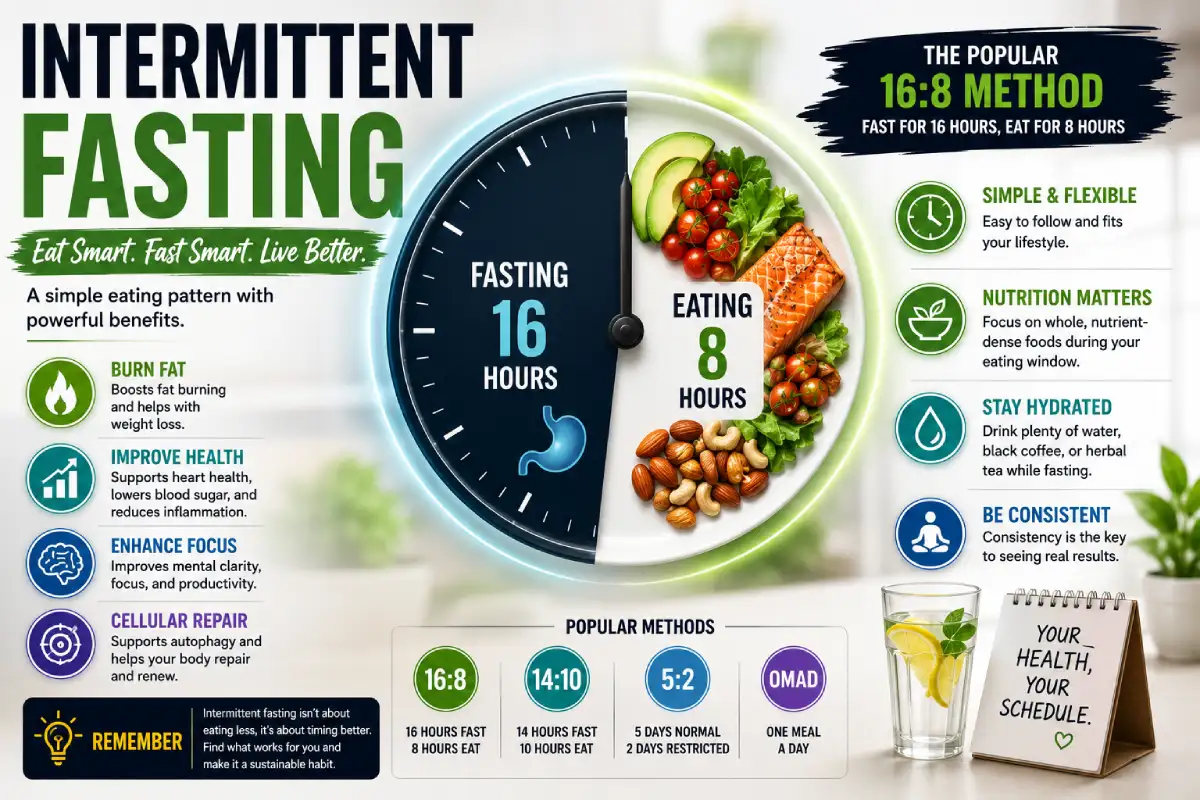
The “new” craze in food is and has been for a long time now intermittent fasting. It is quickly becoming one of the most searched ways to lose weight/make fitness. However, it has gained a lot more publicity than it has research. Granted, this may not mean much. It means it’s worth understanding clearly, rather than through the lens of viral claims about “cellular detox” and dramatic transformations.
Intermittent Fasting (IF) is an eating pattern that involves cycles of fasting and non-fasting. It is not a diet in the traditional sense although most of its variations do result in weight loss due to caloric restriction. It differs from other diets in that it doesn‘t specify which foods are to be eaten only when they are to be eaten. The 16/8 fasting schedule is the most common one; in it the person is eating within an 8 hour window every day and fasting for the remaining 16 hours, usually by skipping breakfast or dinner.
This guide breaks down what intermittent fasting actually does, the most common schedules, who should be cautious with it, and where the evidence is strong versus overhyped — without trying to cram a full meal plan, exercise program, and troubleshooting guide into one page. Each section links to a dedicated guide if you want to go deeper.
A quick introductory remark: this is a general primer. If you are suffering from a medical condition, are on medication, are pregnant or nursing, or have a history of disordered eating, consult a healthcare provider before attempting intermittent fasting.
Intermittent Fasting Resource Center
Explore our complete collection of intermittent fasting guides covering the 16:8 method, beginner guidance, meal planning, fasting for women, exercise considerations, and common mistakes and myths.
What Intermittent Fasting Actually Does
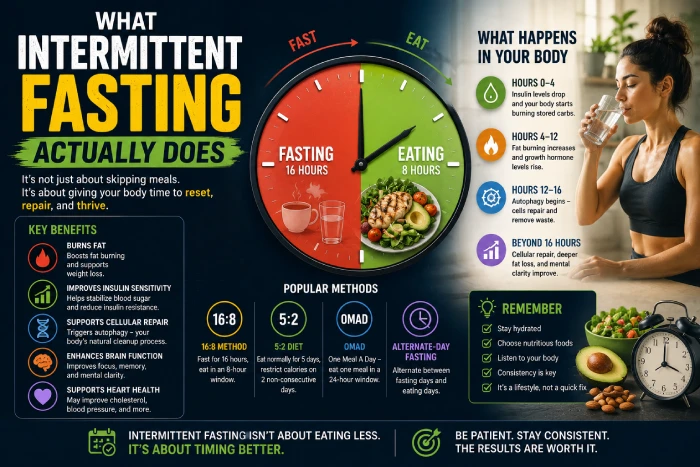
The core mechanism behind intermittent fasting is simpler than most marketing suggests.
Key takeaways:
- Restricting your eating to a shorter window naturally tends to reduce total calorie intake for most people, which is a major driver of the weight loss associated with IF
- A major Cochrane systematic review of 22 randomized trials found intermittent fasting produces weight loss results broadly similar to traditional calorie restriction — not dramatically superior, despite popular claims
- Some research also points to modest improvements in blood pressure, insulin sensitivity, and cholesterol markers, independent of weight loss in certain studies — though results vary and more long-term research is needed
- The appeal for many people isn’t superior results — it’s simplicity. Not having to track every meal, and instead just tracking a window, is easier for some people to sustain than constant calorie counting
Mini summary: intermittent fasting is a legitimate, evidence-supported approach — just not a metabolic shortcut that outperforms other calorie-controlled diets. Its real advantage for many people is adherence, not biology. In other words, the schedule isn’t doing something magical to your metabolism that a well-structured calorie-controlled diet couldn’t also achieve — it’s doing something practical: making it easier for many people to naturally land on fewer calories without having to think about it meal by meal.
Intermittent Fasting vs. Other Diet Approaches
It helps to see how IF stacks up against more familiar approaches, since a lot of the confusion online comes from comparing it to the wrong baseline.
| Approach | How It Works | Best For |
| Intermittent fasting | Restricts when you eat, not what | People who find timing structure easier to follow than counting every meal |
| Traditional calorie counting | Tracks total daily intake against a target | People who want precise control and flexibility in meal timing |
| Low-carb/keto | Restricts carbohydrate intake specifically | People who respond well to reduced carb intake and don’t mind cutting a food group |
| Portion control (no formal tracking) | Relies on consistent, moderate portions without counting | People who prefer an intuitive approach over structured rules |
Key takeaways:
- None of these approaches has been shown to produce dramatically better fat loss than the others when calorie intake ends up similar — the “best” diet is largely the one a person can sustain
- Intermittent fasting and low-carb approaches are sometimes combined, though this isn’t necessary for either to work on its own
- People who struggle with grazing or snacking throughout the day sometimes find IF’s structure easier than open-ended portion control
Mini summary: IF isn’t competing to be the objectively best diet — it’s one structural option among several equally valid ones, and the right choice depends on which structure fits your life and preferences.
A Realistic Example Day
Seeing a full day mapped out often makes the schedule feel more approachable than reading about fasting windows in the abstract.
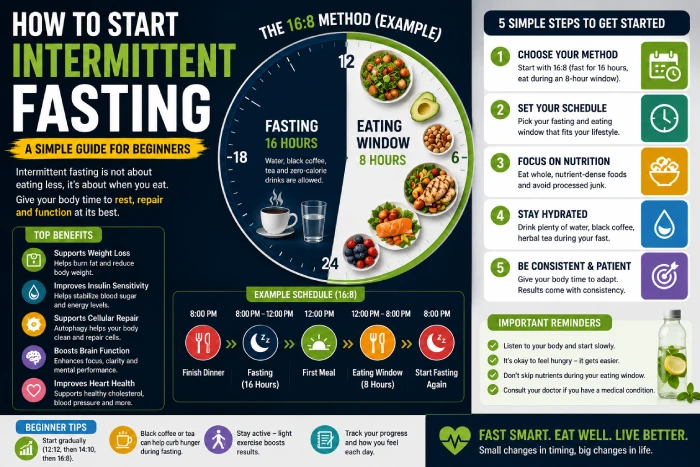
A typical 16/8 day might look like:
- 8:00 AM: Black coffee or water (fasting window continues)
- 12:00 PM: First meal — a protein-forward lunch (e.g., grilled chicken, vegetables, a whole grain)
- 3:30 PM: A snack within the eating window (e.g., Greek yogurt with fruit, or a handful of nuts)
- 7:30 PM: Dinner, the last meal before the eating window closes
- 8:00 PM onward: Fasting window begins again, water and unsweetened tea are fine
This structure keeps a consistent 8-hour eating window (noon to 8pm) and a 16-hour fast that mostly overlaps with sleep, which is why many people find it easier than it sounds — a large portion of the “fasting” happens while you’re not awake to notice it.
Practical tip: Map out your own version of this schedule around your actual daily routine — work hours, family meals, workout timing — rather than adopting a generic schedule that fights against your normal day.
Tracking Progress Beyond the Scale
As with any weight-related approach, the scale is only one signal, and it’s worth tracking more than that.
Key takeaways:
- Energy and hunger patterns often shift within the first few weeks — many people report more stable energy and less frequent hunger once adapted, which is worth noting even before any change in weight
- Body measurements and how clothes fit can reveal composition changes that the scale alone won’t show, particularly if strength training is part of the routine
- Blood markers (if you have regular checkups) — blood pressure, fasting glucose, cholesterol — are relevant metrics some people track over months, given the metabolic changes associated with IF in research
- Adherence itself is worth tracking — how many days did the schedule actually work for you this week — since consistency is what ultimately drives results, more than any single day’s performance
Practical tip: Give any new schedule at least 3–4 weeks before judging whether it’s working — the adjustment period alone can make early results look worse than the approach’s real, longer-term potential.
Common Intermittent Fasting Schedules
There isn’t one single way to do IF — several schedules fall under the same umbrella, each with different day-to-day demands.
Key takeaways:
- 16/8 (time-restricted eating): Fast for 16 hours, eat within an 8-hour window — the most popular and generally the easiest schedule for beginners
- 5:2 method: Eat normally five days a week, then significantly restrict calories (often to roughly 500–600) on two non-consecutive days
- Alternate-day fasting: Alternates between a normal eating day and a fasting or very low-calorie day — more demanding and generally better suited to people with prior fasting experience
- OMAD (one meal a day): An extreme version involving a very short eating window — not recommended as a starting point due to the difficulty of meeting nutritional needs in one sitting
Practical tip: If you‘re just beginning to fast, going from overnight (skip a snack after dinner and before breakfast) to 12 hours and slowly increasing to 16/8 is much easier than jumping to more extreme fasting faster.
Curious for an in-depth look into the most popular? Check out 16/8 intermittent fasting comprehensive guide for all the important details & sample daily time frames.
How to Start Intermittent Fasting
Most common reason for people to drop out in the first week is immediate transition to a rigid fasting window.
Key takeaways:
- Gradually extending your overnight fast (starting from your natural 8–10 hour overnight gap and slowly pushing it to 14, then 16 hours) tends to work better than an abrupt switch
- Staying hydrated during the fasting window — water, black coffee, and plain tea are generally considered fine — helps manage hunger
- The first 1–2 weeks are typically the hardest as your body adjusts; hunger, mild irritability, and difficulty concentrating are common early on and usually ease with consistency
Helpful hint: choose a mealtime window that fits into your day instinctively most people will find it easier to do no breakfast and eat from around noon-8 pm than an early eating window that involves skipping dinner and evening socializing.
If you want a more comprehensive beginner–friendy pathway through the steps of a new eating pattern, check out our detailed guide to intermittent fasting for newbies.
What to Eat During Your Eating Window
Intermittent fasting controls when you eat, not automatically what — but what fills your eating window has a big impact on how sustainable and effective it feels.
Key takeaways:
- Protein helps preserve muscle and supports satiety, which matters more in a shorter eating window where it’s easy to under-eat protein without planning
- Fiber-rich foods (vegetables, whole grains, legumes) help manage hunger during the fasting hours that follow
- Intermittent fasting isn’t an excuse to eat unlimited amounts within the window — if the goal is weight loss, overall calorie balance across the day still matters
- Breaking a longer fast with a very large, heavy meal can cause digestive discomfort — easing in with a moderate first meal tends to feel better
Practical tip: Plan your first meal of the eating window in advance, especially early on — arriving at “break-fast” without a plan is one of the most common ways people overeat or reach for low-quality, convenient food.
For full sample days, see our guide to intermittent fasting meal plans.
Intermittent Fasting and Exercise
Integrating a fasting regimen with regular training introduces three questions that most common fasting articles do not seem to answer well.
Key takeaways:
- Fasted training (working out before your eating window opens) is generally safe for moderate-intensity exercise for most healthy adults, though performance in high-intensity or long-duration sessions may be reduced without pre-workout fuel
- Protein timing still matters — getting adequate protein within your eating window, especially around training, supports muscle maintenance during a fasting-based approach
- Some research on time-restricted eating paired with exercise found modest improvements in fat loss and muscle preservation compared to eating the same calories on a normal schedule — though the effect size was small
Practical tip: If a fasted workout consistently leaves you feeling foggy or underpowered, there’s no rule against shifting your eating window slightly so a small meal lands before training — sustainability matters more than following a rigid schedule perfectly.
Get the complete guide to intermittent fasting and exercise, including fasted cardio pros and cons.
Intermittent Fasting for Women: What’s Different
Much of the general IF advice online is written without accounting for how hormonal factors can affect the experience for women specifically.
Key takeaways:
- Some research suggests women may be somewhat more sensitive than men to the hormonal effects of extended fasting or aggressive calorie restriction, particularly around reproductive hormones — this is an area still being actively researched
- Menstrual cycle phase can affect hunger, energy, and how a fasting schedule feels — many find a shorter or more flexible fasting window easier to sustain during certain phases of the cycle
- Pregnancy and breastfeeding are contexts where intermittent fasting is generally not recommended without direct medical guidance, given increased nutritional needs during these periods
Practical tip: If maintaining any standard 16/8 pattern seems too demanding, a shorter eating window (12–14 hours) is a perfectly valid modification there‘s no research showing longer fasts are necessary for benefits.
For a more in-depth conversation, check out our article on intermittent fasting for women.
Autophagy: What the Research Actually Shows
“Autophagy” is one of the most cited buzzwords in fasting books and blogs, invariably used as evidence that fasting causes a shocking cellular detox. The truth is far less sensational.
Key takeaways:
- Autophagy is a real cellular process where the body breaks down and recycles damaged components — it’s linked to fasting in animal studies, and some markers of it have been observed in humans during extended fasting
- Most of the strongest autophagy evidence comes from animal research or fasting periods considerably longer than a typical 16-hour daily fast, so it’s unclear how much a standard 16/8 schedule actually triggers this process in humans
- The specific anti-aging and disease-prevention claims attached to autophagy in social media content are largely extrapolated from early-stage or animal research, not confirmed in large human trials
Practical tip: It’s reasonable to view autophagy as an interesting area of ongoing research rather than a proven, guaranteed benefit of a standard daily fasting window — the more consistently supported benefits (potential modest metabolic improvements, easier calorie control) are reason enough to consider IF on their own.
Common Side Effects and How to Manage Them
It doesn‘t always feel fantastic to adapt to the rhythm of intermittent fasting – knowing what is common helps to tell „your body adjusting” from “something that needs to be stopped.
Key takeaways:
- Headaches and irritability are common in the first several days, often related to lower blood sugar and caffeine timing changes — they typically ease within one to two weeks
- Difficulty concentrating can occur during the fasting window initially, particularly for people used to eating frequently throughout the day
- Digestive changes, including constipation, can occur with a shorter eating window, especially if fiber and fluid intake aren’t adjusted accordingly
- Sleep disruption is occasionally reported, especially if the eating window shifts meals very late or very early relative to someone’s normal routine
Practical tip: The majority of adaptation side effects are gone after 2 weeks. Symptoms with severe and/or long-lasting side effects beyond 2 weeks (or the likes of fainting, abnormal shifts in mood, or over-involvement with food) should be discussed with a doctor rather than persevered with.
Who Should Be Cautious With Intermittent Fasting
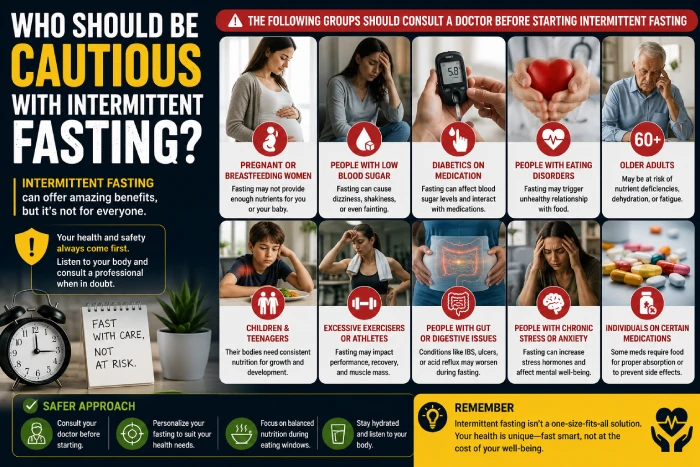
Intermittent fasting is not for everyone and it‘s worth being honest about it rather than pretending there‘s no risk.
Groups who should talk to a doctor first, or generally avoid IF:
- Pregnant or breastfeeding individuals, given significantly increased nutritional and caloric needs during these periods
- Children and teenagers under 18, whose growth and development needs differ substantially from adults
- People with type 1 diabetes who take insulin, due to hypoglycemia risk during fasting periods — Johns Hopkins researchers specifically note this as an area of concern given the lack of dedicated safety studies in this population
- Anyone with a current or past history of disordered eating, since structured food restriction can be a difficult pattern to navigate safely and may reinforce unhealthy relationships with food or eating rules
- People taking medications that require food or have strict timing requirements, since a shifted eating schedule can affect medication timing and effectiveness
- Anyone managing a chronic illness where blood sugar stability, nutrient timing, or consistent caloric intake is medically important
Practical tip: If you fall into any of these categories, or you’re simply unsure, a conversation with a doctor before starting is the safer and more informed path — intermittent fasting isn’t an emergency intervention, and there’s no downside to getting personalized guidance first. A doctor can also help distinguish between normal adjustment symptoms and something that warrants stopping.
Common Mistakes and Myths
- Believing fasting has a special “fat-burning switch” that other diets don’t. The primary mechanism is reduced calorie intake, similar to other approaches — not a unique metabolic advantage that outperforms equivalent calorie restriction through other means.
- Treating the eating window as unlimited. Overeating during the eating window can offset or eliminate any calorie deficit created by fasting — it’s entirely possible to gain weight while doing IF if intake within the window is consistently high.
- Jumping straight into a 16-hour fast or OMAD as a beginner. This dramatically increases the odds of quitting within the first week due to excessive hunger and irritability, and can make the entire approach feel far harder than it needs to be.
- Assuming fasting always preserves muscle better than other diets. Adequate protein intake and resistance training matter more for muscle preservation than the fasting schedule itself — a fasting schedule with low protein intake can still result in meaningful muscle loss.
- Ignoring how it feels. Persistent dizziness, extreme fatigue, or disrupted sleep are signs to adjust the approach or stop, not signs to “push through” out of commitment to a rigid schedule.
- Comparing fasting-day performance to non-fasting days too harshly. Some reduction in energy or focus during the fasting window, especially early on, is common and doesn’t necessarily mean the approach isn’t working.
- Assuming what works for someone else will work identically for you. Individual responses to fasting vary based on genetics, activity level, sleep, and stress — a schedule that works well for one person may need real adjustment for another.
Myth vs. Fact
Myth: “Intermittent fasting puts your body into ketosis and burns fat much faster than other diets.”
Fact: While longer fasts can shift metabolism toward burning stored fat for energy, current systematic reviews find overall fat loss from IF is comparable to traditional calorie restriction, not dramatically faster.
Myth: “Fasting slows down your metabolism.”
Fact: Short-term intermittent fasting (in the range most people practice, like 16/8) hasn’t been shown to meaningfully slow resting metabolism — that concern applies more to prolonged, severe calorie restriction over extended periods.
Myth: “You’ll lose muscle if you exercise while fasting.”
Fact: Muscle loss during fasting-based approaches is driven primarily by inadequate protein intake and lack of resistance training, not by the timing of meals relative to a workout.
Myth: “Intermittent fasting is unsafe for most people.”
Fact: For most healthy adults, research generally supports IF as a safe approach — the caution applies specifically to certain groups (pregnant or breastfeeding people, those with type 1 diabetes, a history of disordered eating, and adolescents), not the general population.
Realistic Expectations
Given the evidence, it’s worth setting expectations accurately: intermittent fasting is a legitimate tool that works about as well as other calorie-controlled approaches for weight loss and offers some potential metabolic benefits — but it’s not inherently superior, and it’s not magic. The people who see the best long-term results tend to be the ones who find the schedule genuinely easy to stick with, not the ones chasing the most extreme version of it.
It’s also worth remembering that “works as well as” isn’t a knock against intermittent fasting — it simply means the decision to try it should be based on lifestyle fit rather than a belief that it will outperform every other approach. If skipping breakfast and eating within a defined window genuinely feels easier than tracking every meal, that preference alone is a perfectly valid reason to choose IF. If it feels restrictive or triggers anxiety around food, that’s equally valid information pointing toward a different structure.
The Bottom Line
Intermittent fasting is a flexible, evidence-supported eating pattern — not a miracle metabolic hack, and not something everyone needs to try. It works primarily by making it easier for many people to naturally eat fewer calories, and it may offer modest additional metabolic benefits for some. Whether it’s the right approach depends on your schedule, health history, and whether the structure genuinely makes eating well easier for you. Use the guides linked throughout this page to build out your specific schedule, starter plan, meal structure, and exercise approach.
12. FAQs
Q1) What is intermittent fasting?
Intermittent fasting is an eating pattern that cycles between periods of eating and fasting, restricting when you eat rather than what you eat. The most common version, 16/8, involves fasting for 16 hours and eating within an 8-hour window.
Q2) Does intermittent fasting actually work for weight loss?
Yes, but research shows it works about as well as traditional calorie restriction — not dramatically better. Its main advantage for many people is that the structure makes it easier to naturally eat fewer calories.
Q3) What can I drink during the fasting window?
Water, black coffee, and plain tea are generally consider acceptable during a fast since they contain negligible calories. Adding sugar, cream, or other calorie-containing additions technically breaks the fast.
Q4) Is intermittent fasting safe for everyone?
No. It’s generally consider safe for most healthy adults, but pregnant or breastfeeding individuals, people under 18, those with type 1 diabetes, and anyone with a history of disordered eating should talk to a doctor first or avoid it.
Q5) Can I exercise while intermittent fasting?
Yes, moderate exercise during a fast state is generally safe for most healthy adults, though performance in high-intensity or long sessions may be affect. Adjusting the eating window around workouts is a reasonable option if fasted training doesn’t feel good.
Q6) How long does it take to adjust to intermittent fasting?
Most people experience the toughest adjustment period in the first one to two weeks, with symptoms like hunger and irritability typically easing as the body adapts to the new eating pattern.
FINAL CONCLUSION
This pillar page functions as a true hub: it gives an honest, research-grounded explanation of what intermittent fasting does (and doesn’t do). Sets realistic expectations against the marketing hype common in this space. And delivers practical value across all six core areas — schedules, getting start, meal planning, women’s considerations, exercise, and mistakes/myths — before routing readers to a dedicated cluster page for depth. Publishing the six cluster articles next, each linking back to this pillar, completes the topical authority structure around intermittent fasting.