


Mohd Arbaaz is an Editor and Writer at Fitnessison.com with 5 years of experience in SEO and digital content creation. He creates informative, reader-focused content covering fitness, workouts, nutrition, health, healthy lifestyle, technology, and computers.

Shashi Teja is a Reviewer at Fitnessison with over 6 years of experience in SEO, content strategy, digital publishing, and content optimization. He reviews content for clarity, research quality, topical relevance, readability, structure, and overall usefulness to readers.
Last Updated: September 21, 2026
Advanced yoga postures are the evolution of everyday yoga sequences for the practiced and dedicated yoga consumer. These poses require a certain amount of strength, endurance, flexibility, coordination, focus and kinesthetic awareness to perform things which the beginner takes time to master; in advanced yoga, they are shown off.
Always remember, that a practice of advanced yoga isn‘t to ‘show-off’ the flexibility or the hardest of asanas. They are more about developing higher control, greater patience, discipline and an enhanced pranamayama.
If you want to get right into some of the best advanced yoga postures out there, then this guide will take you through many of the most popular advanced yoga poses, their benefits, how to prepare for them, and how to practice them safely. For the overarching strategy, read our complete guide on yoga asanas.
What Is Considered an Advanced Yoga Pose?
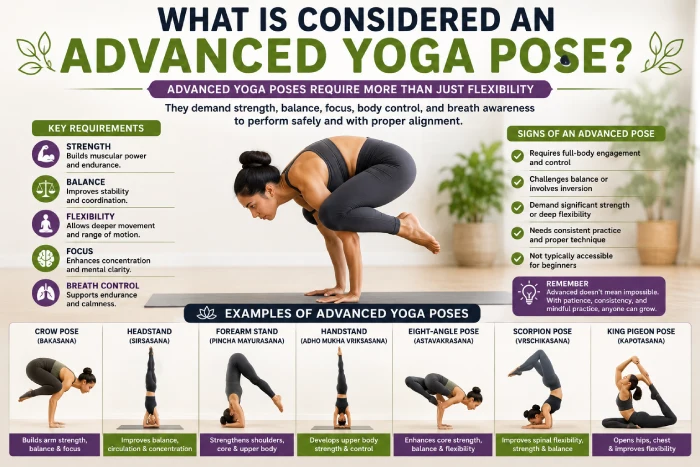
Not every challenging pose is considered advanced. Advanced yoga poses typically require:
- Exceptional balance
- Core strength
- Shoulder stability
- Hip flexibility
- Spinal mobility
- Mental focus
- Controlled breathing
Most advanced poses are especially difficult because they involve several skills at the same time, and therefore they are much more demanding than beginner or intermediate asanas.
Benefits of Practicing Advanced Yoga Poses
Furthermore, modern yoga offers a number of physical and mental benefits, including:
Builds Full-Body Strength
A significant percentage of the many advanced poses put a strain on multiple muscles.
Improves Flexibility
Deeps stretches enable the maintenance of general mobility and the range of movement of joints
Enhances Balance and Coordination
Balancing exercises are great for strengthening stabilizers. They also aid in overall body control.
Increases Mental Focus
Complex poses demand focus and concentration.
Boosts Confidence
Achieving difficult poses produces a feeling of achievement.
Develops Body Awareness
More advanced yoga emphasizes greater control of movement and positioning.
Essential Requirements Before Attempting Advanced Yoga
It should be possible to perform poses beyond the beginning level before moving on to advanced postures.
Master Beginner and Intermediate Poses
More advanced yoga is a progression of basic movements.
Develop Core Strength
A weak core makes arm balances and inversions difficult.
Improve Shoulder Mobility
A large number of more challenging poses are very hard on the shoulders.
Prioritize Consistency
More effective than less frequent metimes: intensive training.
Warm Up Properly
Always prep muscles and joints prior to trying complex poses.
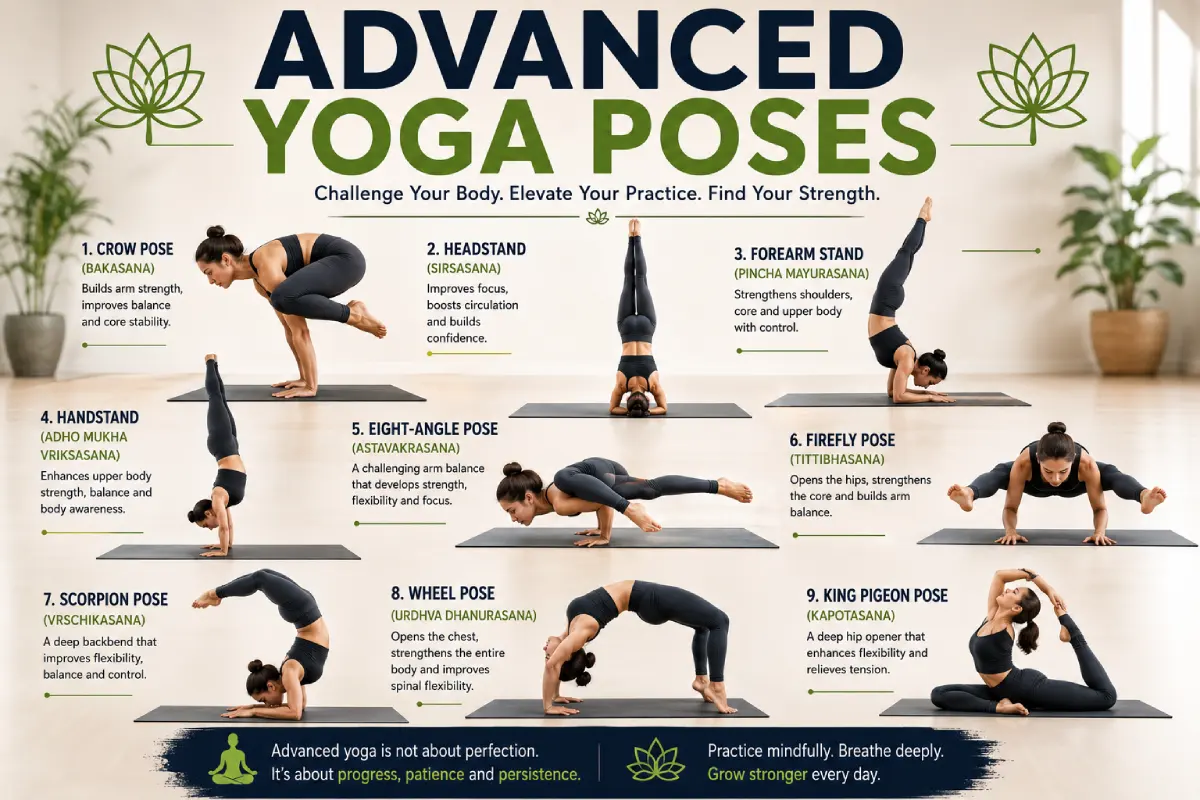
Crow Pose (Bakasana)
Crow Pose is often believed to be the first advanced arm balance.
How to Perform
- Start with a squat position.
- Position hands so that they are equally distant apart from each other at shoulder level.
- Place the knees on the upper arms.
- “Lean the weight forward.
- Raise your feet.
Benefits
- Builds strength in the arms and shoulders
- Improves balance
- Core stability is built
- Enhances concentration
Crow Pose is an option to take you into the world of other armbalances.
Headstand (Sirsasana)
Referred as the “King of Yoga Poses” and is one of the most performed variations.
Benefits
- Improves balance
- Strengthens shoulders
- Improves a sense of body.
- Builds confidence
Safety Tips
Practice against a wall if you need to master the technique prior to free-standing headstands.
Forearm Stand (Pincha Mayurasana)
Forearm Stand demands Strength, flexibility and control.
Benefits
- Strengthens shoulders
- Improves balance
- Strengthening core muscles
- Increases upper-body endurance
Most students use a wall for support when first learning this pose.
Handstand (Adho Mukha Vrksasana)
Handstand is one of the most difficult yoga Inversion.
Benefits
- Builds up strength in your upper body;
- Improves coordination
- Builds confidence
- Improves body control
Preparation Exercises
- Plank Pose
- Dolphin Pose
- Crow Pose
- Wall Handstands
Progression dophistication: increase the intensity, duration, number of repetitions or sets. Progressively50.7.
Eight-Angle Pose (Astavakrasana)
Eight-Angle Pose is a combination of arm balance and twist.
Benefits
- Strengthens arms
- Builds bystability
- Improves flexibility
- Enhances focus
A pose which involves great mobility of the hips and strength of the upper-body.
Firefly Pose (Tittibhasana)
Firefly pose is fairly difficult to perform arm balance that requires flexibility and strength.
Benefits
- Gives strength to wrists and shoulders
- Enhances the flexibility of the hamstrings
- Develops core strength
- Enhances balance
Rather perverse in the way that we have all been taught the classic well known posture can be achieved by many serious practitioners given adequate time and training.
Scorpion Pose (Vrschikasana)
Identify the Scorpion Pose (monkeys). It is a move that blends inversion, flexibility and strength.
Benefits
- Enhance stiffnessof the vertebral column
- Strengthens shoulders
- Enhances balance
- Builds confidence
This post is perhaps one of the most amazing visuals among the yoga positions.
Wheel Pose (Urdhva Dhanurasana)
Wheel Pose is an advanced backbend and it will open up the front of the body.
Benefits
- An easier to move vertebrae
- Strengthens your arms and legs
- Increases the volume of the Chest.
- Enhances flexibility
Regular backbend practice will assist in preparing the body for Wheel Pose.
To take the next step, see our detailed guide on basic yoga poses.
King Pigeon Pose (Kapotasana)
King Pigeon is a deep backbend and hip opener.
Benefits
- Improves flexibility
- Opens the chest
- Improves flexibility of the spine
- Builds muscle faster. Builds supporting muscles.
The intensity of the stretch requires careful preparation.
Advanced Yoga Pose Progression
A progression which is safe will help to lessen the injury risk.
Stage 1: Foundation Building
Focus on:
- Downward Dog
- Warrior Poses
- Plank
- Boat Pose
- Bridge Pose
Stage 2: Intermediate Development
Practice:
- Crow Pose
- Side Plank
- Wheel Pose
- Pigeon Pose
Stage 3: Advanced Training
Progress toward:
- Headstand
- Forearm Stand
- Handstand
- Scorpion Pose
- Firefly Pose
It should develop in a gradual and continuous path.
Common Mistakes When Practicing Advanced Yoga
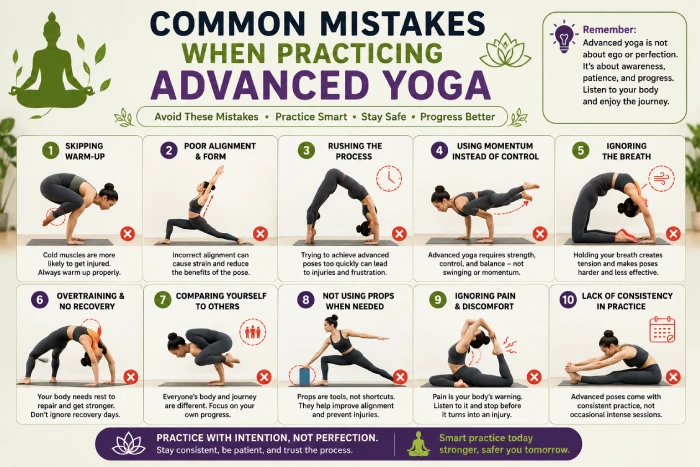
Moving Too Quickly
Excessively fast progression The faster the progress, the greater the risk of injury.
Ignoring Alignment
The correct form takes preference. The end shape is of secondary importance.
Skipping Warm-Ups
Presents advanced poses. They can be very demanding on muscles and joints. To be able to ‘perform’ advanced yoga poses, the student must have prepared muscles and joints.
Comparing Yourself to Others
Every single yoga journey is unique.
Holding Your Breath
A consistent breathable enhances his performance and stabilty.
Frequency of Practicing Advanced Yoga
For most practitioners:
3–5 Sessions Per Week
This rate allows skill development too but still allows recovery to take place as well.
Include Recovery Days
Recovery for what we are repairing for progressing for preventing injury.
Balance Intensity
Mix up difficult sessions with some easier ones.
Yoga Accessories That Can Help
Props can also be used for advanced practice:
Yoga Blocks
Stability and alignment can be improved.
Yoga Strap
Help in the supervision of a flexibility programme.
Wall Support
Beneficial for inversions, balance training.
Yoga Wheel
Contributes to helping to increase backbend range of motion.
In the hands of a trained trainer,props are a positive, necessary part of a smart training program.
Safety Tips for Advanced Yoga
- Warm up sufficiently.
- Progress gradually.
- Practicing under supervision whenever possible.
- Try not to antagonize the movement.
- Listen to your body.
- If you experience any pain, please as told.
Long-term success is built on safe advancement.
Final Thoughts
Not all yoga poses are meant to be easy. Yes, certain advanced poses absolutely will push your strengths, flexibility and your mind to its limits. ‘Housekeeping poses’ such as Handstand, Scorpion, Firefly and King Pigeon may be appearing too extreme but with determined consistency most poses are achievable with the edge of safety in mind.
Keep in mind that yoga is not about perfection. More advanced yoga practice is about perseverance, structure, and development. Concentrate on the continuous gains you make each day; recognize your achievements and relish the experience of becoming more fit and self-assured.
Frequently Asked Questions
What is the most difficult yoga pose?
Scorpion Pose, Handstand and Firefly Pose are notoriously some of the most difficult yoga poses according to many practitioners.
How long will it take to master advanced yoga poses?
The length of time depends. They can take months or even years of diligent performance.
Is it okay for beginners to practice such complicated yoga poses?
A beginning should be taken to develop oneself by going through a work of beginner and intermediate yoga.
What about more advanced yoga poses?
Yes, when done appropriately with the right prep, technique and progression.
Building muscle with advanced yoga poses?
Several longer advanced poses build up great upper-body, core and lower-body strength through body weight resistance exercises.