


Mohd Arbaaz is an Editor and Writer at Fitnessison.com with 5 years of experience in SEO and digital content creation. He creates informative, reader-focused content covering fitness, workouts, nutrition, health, healthy lifestyle, technology, and computers.

Shashi Teja is a Reviewer at Fitnessison with over 6 years of experience in SEO, content strategy, digital publishing, and content optimization. He reviews content for clarity, research quality, topical relevance, readability, structure, and overall usefulness to readers.
Last Updated: September 21, 2026
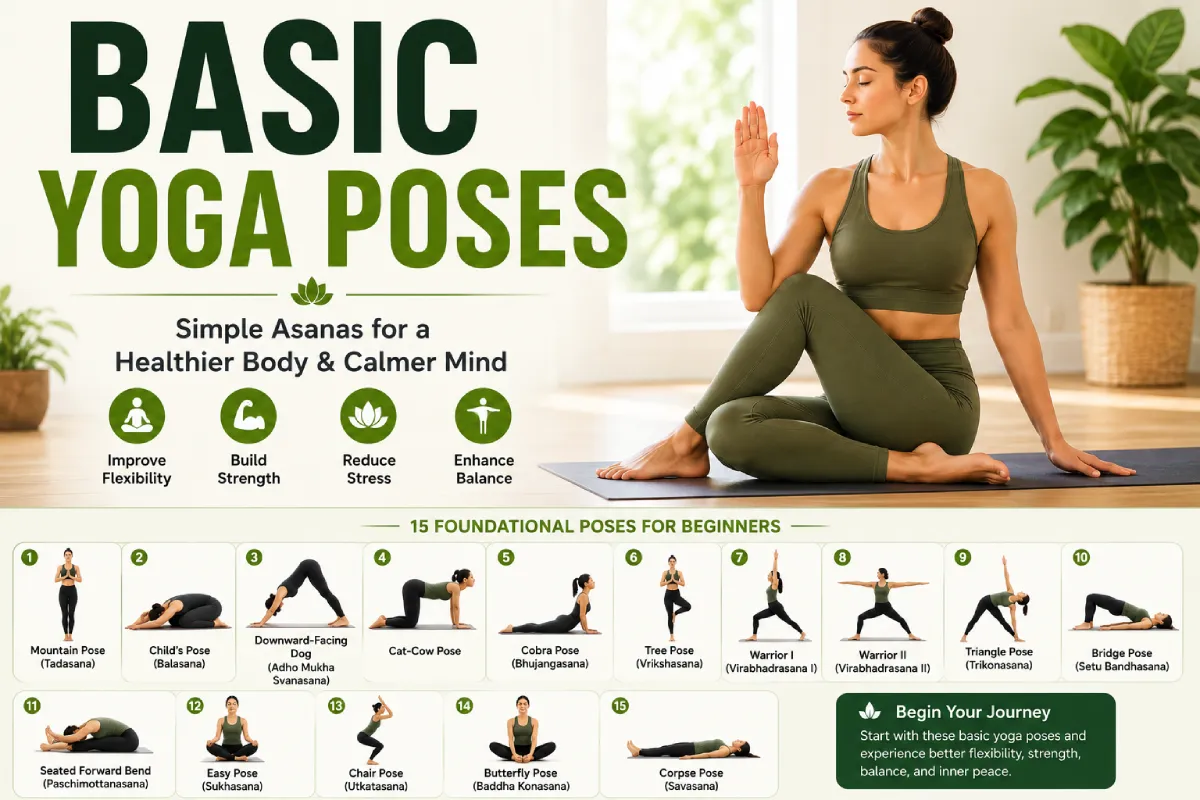
If this is your first time practicing yoga there are a few basic yoga poses that are essential in establishing a good foundation for your practice. These basic but effective yoga poses help you in gaining flexibility, strength, balance and mindfulness as well as preparing your body for more advanced postures and movements. Practice at home or go to a yoga class, and familiarize yourself with some easy yoga poses to begin. In this guide you will learn about the most of the basic yoga poses, what are they for and the way to do them. For the overarching strategy, read our complete guide on yoga asanas.
What Are Basic Yoga Asanas?
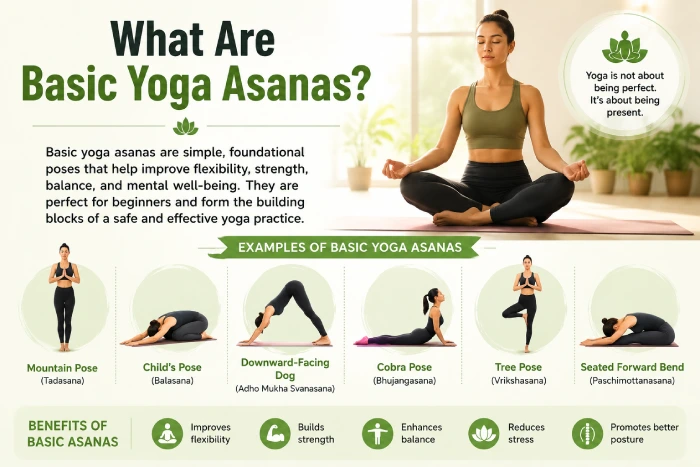
Foundational yoga poses are common poses that are designed to help novices get familiar with yoga. They typically involve good technique, situating of the breath, and mental concentration. Beginners tend to learn the poses first since they can be performed by people of every skill level.
As some of the poses are based on classic yoga asanas, these are poses that have been used for years to boost both physical and mental health. By becoming familiar with these basic yoga positions, you‘ll be ready to try out more difficult yoga exercises as your confidence grows.
Benefits of Practicing Basic Yoga Poses
Performing the fundamental yoga poses on a regular basis has various physical and mental advantages.
Improves Flexibility
Gently stretches muscles and joints, helping to improve flexibility
Builds Strength
Others begin poses which work the whole body, like the beginners poses which engage core muscles and the muscles in legs, arms and back.
Enhances Balance
Standing poses help to build up stability and coordination.
Supports Better Posture
Yoga promotes correct body alignment which help in relieving pain due to poor posture.
Reduces Stress
Integrating movement with conscious breathing can de-stress and soothe the mind.
Boosts Energy
A brief yoga workout will stimulate circulation and refresh you.
15 Basic Yoga Poses Every Beginner Should Know
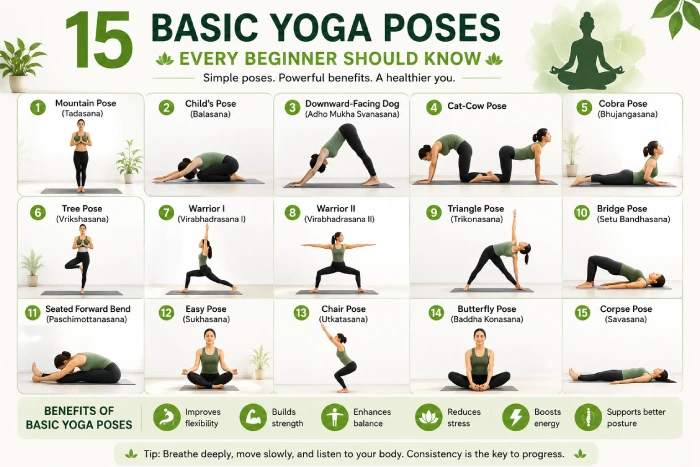
1. Mountain Pose (Tadasana)
Mountain Pose: a basic posture that shows correct alignment and posture.
How to Do It:
- Stand upright feet together.
- Remain in a neutral position.
- Loosen up your shoulder.
- Before starting any abdominal work, get the abdominal muscles warm by contracting and relaxing them repeatedly while standing still. Do not do crunching exercises until you‘ve developed sufficient strength in the abdominals to avoid damage.
- Breathe deeply.
Benefits:
- Improves stance
- Enhances balance
- Develops body-awareness
2. Child‘s Pose (Balasana)
Child‘s Pose is a relaxing position, most often taken in between difficult poses.
How to Do It:
- Get down on the floor by kneeling.
- Sit on your heels.
- Extend your hands in front of you.
- Ahhh rest your forehead on the mat.
Benefits:
- Relieves tension
- Now, stretch the hips and back
- Promotes relaxation
3. Downward-Facing Dog (Adho Mukha Svanasana)
One of the best-known yoga poses, Downward Dog, lengthens the whole body.
How to Do It:
- Begin on all fours.
- Lift your hips high.
- Try to straighten your legs as far as is comfortable.
- Brace your hand to the floor.
Benefits:
- This exercise develops strength and endurance in the arms and shoulders
- 5. Lays the hamstrings and calves on a stretch
- Improves circulation
4. Cat-Cow Pose
This flow movement enhances the flexibility of the spine.
How to Do It:
- Start on hands and knees.
- Inhale and then extend the back (Cow Pose).
- Exhale and round your spine (Cat Pose).
- Repeat slowly.
Benefits:
- Enhanced spinal mobility
- Reduces stiffness
- Improves stance
5. Cobra Pose (Bhujangasana)
Back bend, braces of low back and opens chest.
How to Do It:
- Invention on your stomach.
- Position hands under shoulders.
- Keeping hips grounded, lift your chest.
Benefits:
- Back muscles are strengthened.
- Improves suppleness
- Opens the pericardium (refers to opening the chest)
6. Tree Pose (Vrikshasana)
Tree Pose improves balance and attentiveness.
How to Do It:
- Standing on one leg.
- Position contralateral foot on your inner thighs or calves.
- Stand with palms pressed together at your chest.
Benefits:
- Improves balance
- Strengthens legs
- Enhances focus
7. Warrior I (Virabhadrasana I)
Engages the core and muscles of the hips and inner thighs to help mature strength and constancy.
How to Do It:
- Step one foot back.
- Bend the front knee.
- Raise your arms high overhead.
Benefits:
- Strengthens legs
- Improves endurance
- Opens hips and chest
8. Warrior II (Virabhadrasana II)
Warrior II is good for the lower body.
How to Do It:
- Raise your arms to be parallel with the floor.
- Bend the anterior knee.
- Gaze over the front hand.
Benefits:
- Strengthens legs
- Improves balance
- Builds stamina
9. Triangle Pose (Trikonasana)
Triangle‘s benefits for the body are two fold in that it extends and strengthens the body at the same time.
How to Do It:
- Stand with your feet apart so that () are far apart.
- And reach one hand down in to your shin or ankle.
- The other armraise up.
Benefits:
- Improves suppleness
- Exercises core muscles, abdominal, back, shoulder and arm.
- Enhances balance
10. Bridge Pose (Setu Bandhasana)
Bridge Pose is a back-bend pose, which targets the back and the bum.
How to Do It:
- Lay flat on your back.
- Sit while tonging your knees.
- Hips: higher.
Benefits:
- Gains upper body, arms and shoulders.
- Opens the chest
- Supports the health of the spine, Basal supports help to send the vital signals between the brains and the rest of the body.
11. Seated Forward Bend (Paschimottanasana)
This relaxing pose opens up the whole back of the body.
How to Do It:
- Sit down with your legs extended.
- Spring out toward your toes.
- Maintain a long spine.
Benefits:
- Improves suppleness
- Relieves stress
- Stretches hamstrings
12. Easy Pose (Sukhasana)
A best seated position for meditation and breath exercises.
How to Do It:
- Sit cross-legged.
- Check your spine; make sure you are standing up square.
- Rest the hand on your knees.
Benefits:
- Encourages mindfulness
- Improves posture
- Supports relaxation
13. Chair Pose (Utkatasana)
Chair Pose works on solidification every system of the body.
How to Do It:
- Stand tall.
- Got down on his knees.
- Extend your arms up and overhead.
Benefits:
- Strengthens legs
- Builds endurance
- Improves stability
14. Butterfly Pose (Baddha Konasana)
Synonyms: ‘Butterfly Pose’ Relax the hips, groin.
How to Do It:
- Sit with the bottoms of the feet together.
- Let knees fall out to sides.
- Feet fit in my hands.
Benefits:
- Enhances ability to bend the body11.6%
- Relieves tension
- Encourages relaxation
15. Corpse Pose (Savasana)
All yoga practices should finish with Savasana.
How to Do It:
- Falsehood on the floor on your back.
- Loosen all your muscles.
- Concentrate on breathing.
Benefits:
- Reduces stress
- Promotes recovery
- Encourages mindfulness
Basic Yoga Poses for Suppleness
For flexibility, have your client use poses that target the large muscle groups of the body.
Optional poses include:
- Child’s Pose
- Downward-Facing Dog
- Butterfly Pose
- Seated Forward Bend
- Triangle Pose
Practicing these consistently can help increase your strength of motion and loosen your muscles.
To take the next step, see our detailed guide on yoga poses for back pain.
Basic Yoga Poses for Strength
Yoga is not just about widening. Several beginner poses involve quite a bit of strength.
Best poses for strength:
- Warrior I
- Warrior II
- Chair Pose
- Bridge Pose
- Downward-Facing Dog
Involves several group muscles, enhancing functional fitness.
Morning Yoga Routine Using Basic Yoga Poses
A quick way to wake up the entire body and mind.
10-Minute Beginner Yoga Flow
- Mountain Pose– 1 min.
- Cat-Cow Pose –1 minute.
- Downward-Facing Dog – 1 minute;
- Warrior I – 1 minute each side.
- Warrior II 1 min. each side
- Triangle Pose – 1 minute each side.
- Child‘s Pose – 1 minute
- Savasana 2 minutes
This series is intended to get your body moving, stimulate circulation, and clear your mind, prior to beginning your day.
Common Mistakes Beginners Should Avoid
Holding Your Breath
Breathing. Use your breath for yoga. Stay with deep, even breathing as you do any pose.
Pushing Too Hard
Do not pull or push yourself into any position until it‘s painful or unbearable.
Ignoring Alignment
Set-up:. Ensuring a correct set-up provides protection from injuries as well as enhancing the benefits of every pose.
Comparing Yourself to Others
Step away from the hurried pace of life, give over the responsibility and time…. Your own yoga. Take time with every step of your yoga. Learn your yoga.
Skipping Warm-Ups
A few minutes of gentle movement before practice will loosen muscles and joints.
How Often Should One Practice Basic Yoga Poses?
Beginners can start with:
- 10–20 minutes per day.
- 3–5 sessions a week
Time isn‘t the only factor. Short periods of time each day can still be effective over time.
Basic Yoga Poses vs Advanced Yoga Poses
| Basic Yoga Poses | Advanced Yoga Poses |
| Simple to understand | Require experience |
| (Pace all your fundamentals). Use your fundamentals, you have to use your fundamentals, all the time. Use your fundamentals. (Use them better) Use the fundamentals well, the grid, use the engine, go faster. Follow on the bump, have a go, shut the door and go. This is what you want to do | Demand more flexibility |
| Beginner Friendly. | Best for moderate to advanced practitioners |
| Reduced likelihood of damage | Greater technical complexity, |
| Build confidence | Require substantial(body) muscle tone |
Start with the basics simple, easy and non-dangerous poses will allow anyone to practice forever.
First-Time Tips for Starting Yoga
- Wear comfortable clothing.
- Choose a non-slip yoga mat.
- Will be “p ractices in a quiet room.
- Concentrate on breathing correctly.
- Listening to Your Body: By recognizing how your body reacts to different hassles and what‘s bothering you may be the most important benefit of all.
- Stay consistent.
Have fun with it and cherish the little successes.
FAQs
Best yoga pose for beginners?
Mountain pose, Child‘s pose and Cat- Cow pose are perhaps the most simplest and most beginner friendly poses in yoga.
The number of poses I should be doing.
Practise five to ten yoga postures, everyday and you will enhance your confidence, flexibility and strength.
Is it possible to teach yourself yoga at home?
Yes. It is possible for some people, even complete beginners, to learn yoga on their own at home, following instructions given on websites, videos and course timetable.
For how long do I stay in each stretch?
Most beginner poses will be comfortable and easily held for 20 seconds to a minute or two.
Are the basic yoga postures good for the elderly?
Yes. Basic yoga poses can be modified for patients who are incapacitated or elderly on to chairs or slings.
Conclusion
Basic beginner yoga asanas (poses, postures) will make you into a healthy and sustainable yoga solution. The basic yoga asana not merely works to enhance your power, flexibility, stability, outlook and mental status, but also it gets ready you to advance yoga asanas. Whatever your reasons behind practicing yoga, fitness or health or stress alleviation, if you learn to perform not-too-difficult yoga poses, you can make yoga a lifelong practice.
To learn more about traditional and modern postures get our full guide of Yoga Asanas and keep on your yoga path.