
Mohd Arbaaz is an Editor and Writer at Fitnessison.com with 5 years of experience in SEO and digital content creation. He creates informative, reader-focused content covering fitness, workouts, nutrition, health, healthy lifestyle, technology, and computers.

Shashi Teja is a Reviewer at Fitnessison with over 6 years of experience in SEO, content strategy, digital publishing, and content optimization. He reviews content for clarity, research quality, topical relevance, readability, structure, and overall usefulness to readers.
Last Updated: September 21, 2026
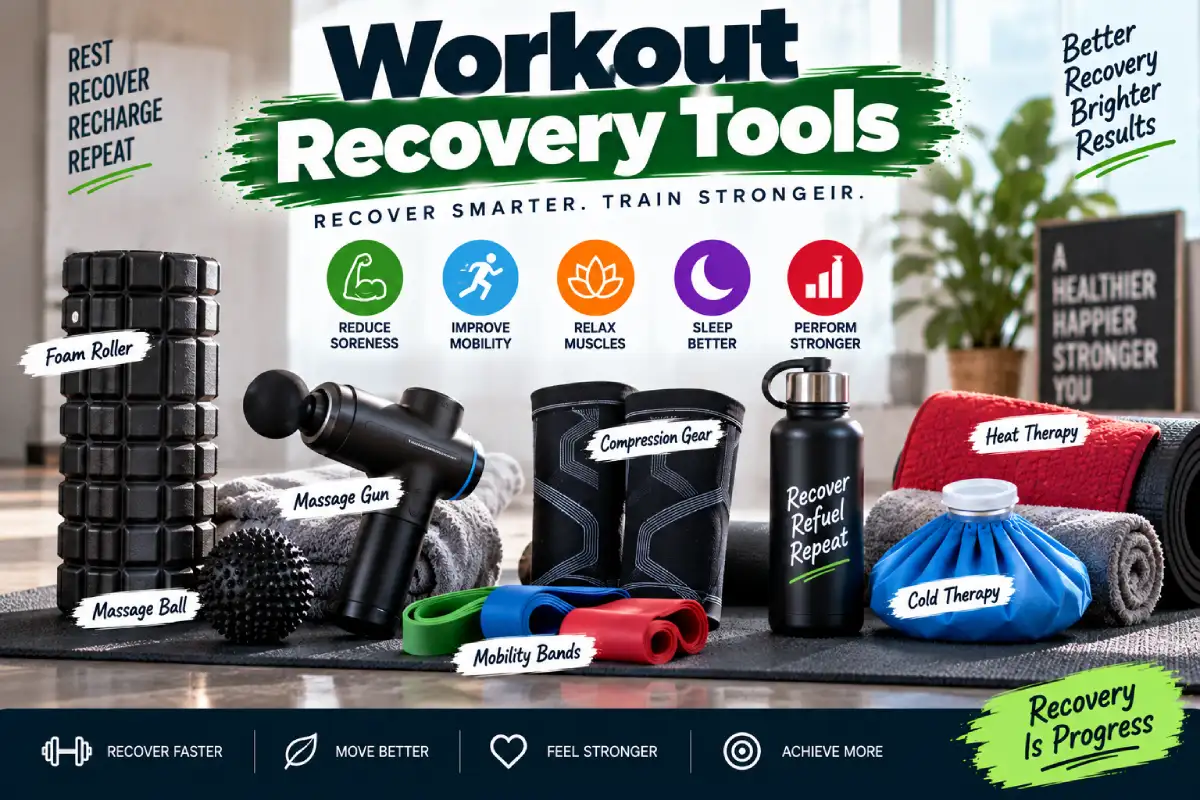
With workout recovery tools it‘s often easier to deal with muscle tightness, soreness and fatigue after a workout. There are many different options on the market including foam rollers, massage guns, compression wear, recovery boots, and so on. However, you do not have to own every single piece of recovery equipment out there. The key is to know what each one can actually do and use that in conjunction with the fundamentals of exercise such as sleep, eating well, drinking enough water, training appropriately and resting.
What Are Workout Recovery Tools?
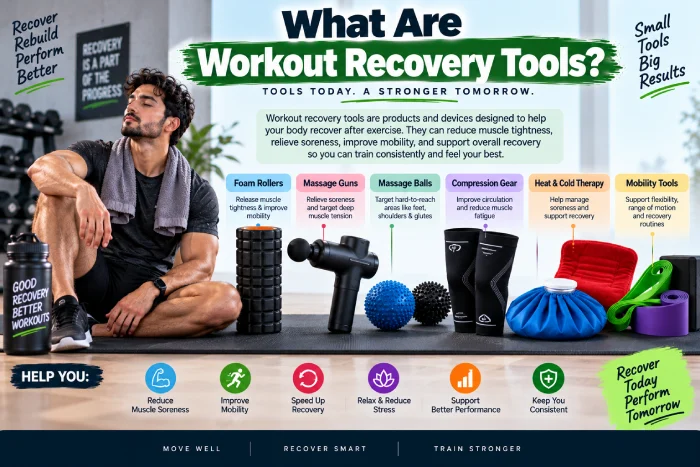
Workout recovery products or devices- products and/or devices that aid in comfort, mobility, relaxation, or recovery after or between physical activity sessions. Some are inexpensive and basic; some use technological advancements to apply massage, compression, heat, or cold therapy.
Common examples include:
- Foam rollers
- Massage guns
- Massage balls
- Compression clothing
- Compression boots
- Heating pads
- Cold packs
- Recovery mats
- Mobility bands
- Percussion massage guns/family34These devices comprise a small battery-operated tool with an attachment to the head, which delivers percussion massage massage to the desired target area.
These can be helpful, but they can,t substitute for a well designed workout recovery program.
1. Foam Rollers
Foam rollers are one of the most widely used work-out recovery aids. They enable users to apply pressure to various parts of the body through a slow passage over the roller. They are used by many individuals after strength training, running or other intense workouts.
Can temporarily decrease the sensation of tightness or stiffness in your muscles and can be a good addition to a warm-up or cool down regimen. Begin with light pressure. You do not have to make foam rolling painful for it to be effective.
Best for:
- (1) General muscle tightness.
- Mobility routines
- Pre-workout preparation
- Post-workout relaxation
2. Massage Guns
Massage guns work by dynamically percussing against muscles. They are widely used because they are fast and can be applied without a partner. A massage gun may help temporarily relax muscle tension and increase the sensation of ease of movement. Use the lower setting initially, especially around sensitive tissues. Do not use over bones, joints, unhealed wounds or areas of unexplained pain.
Best for:
- Muscle tightness
- Fast performance sessions.
- Large muscle groups(ho, tri, bi, pairs)
- Pre-workout muscle pretesting to pass the time in the gym.
3. Massage Balls
Massage balls are smaller and more focused than foam rollers. May be helpful for feet, shoulders, glutes, or upper back. Smaller contact area will create the sensation of more pressure. Slow, gentle presses. Avoid painful joints.
Best for:
- Specific muscle work.
- Feet and shoulders.
- Angulation of joint Surroudnd area of tightens
- Travel-friendly recovery
4. Compression Gear
Compression socks, sleeves, tights and other garments squeeze areas of the body. Athletes frequently wear compression garments during or after exercise. While many find it comfortable and think it relieves heaviness in the legs following excessive activity, compression wear can only be an optional recovery tool, and not a substitute for sleep, nutrition and rest.
Best for:
- Feeling comfortable after training
- Travel
- Endurance athletes
- People who like to wear compression garments
5. Compression Recovery Boots
The compression boots apply by inflating that sequentially squeeze certain parts of the legs. They are becoming more popular and can be seen in gyms and sports recovery centers. The compression boots could relax you a little after hard training, but there is no need for such expensive recovery equipment in order to get stronger. If compression boots are fun for you and it is not breaking the bank then it is ok.
Best for:
- Post-training relaxation
- Leg comfort
- Athlés avec un entraînement important
6. Heat Therapy
Heating pads, warm baths and other heat sources can be soothing when you muscles are tight. Relaxation may be especially soothing so keep the heat source at a comfortable temperature and limit the time in the heat source. Do not sleep with a heating pad on.
Best for:
- Muscle stiffness
- Relaxation
- Pre-stretching comfort
- Recovery-day routines
7. Cold Therapy
Cold packs and cold-water immersion are frequently used post strenuous exercise. Cold has the ability to temporarily block sensation, such as pain and soreness. Cold can be an effective treatment for some symptoms, but should not be used after every workout. For individuals concerned with muscle hypertrophy, the timing and frequency of cold exposure could be important, so it should not simply be considered a default post workout routine.
Best for:
- Download temporary relief of soreness.
- Post-exercise comfort
- Athletes with particular strategies of recovery
8. Mobility Bands
Bands can also be used effectively for controlled mobility exercises. They are inexpensive, portable and light-weight. You can perform shoulder, hip or ankle controlled mobility in the pain-free ranges of motion with them.
Best for:
- Mobility work
- Warm-ups
- Recovery sessions
- Home workouts
Which Workout Recovery Tools Should You Choose?
Your shopping list can be kept on file so you do not have to buy several products at the same time. It is best to initially start off with the most basic product that will satisfy your requirements.
For example:
| Goal | Possible Tool |
| Loss of general muscle tone. | Foam roller |
| Localized muscle pressure. This concept involves apply-ing slightly more pressure with the fingers than is used in detecting the myofascial trigger point, with a specific focus on the tender area, addressing the similarity of tender areas and trigger points. | Massage ball |
| Quick muscle massage. | Massage gun |
| Comfortable handle recovery | Compression gear |
| What is relaxation and stiffness? | Heat therapy |
| Mobility | Resistance band |
| Temporary pain relief | Cold therapy |
Another consideration should be your budget and desires. A $20 mobility tool that you use regularly can be far more effective and benefit you more than a costly recovery tool that is never utilized.
What Recovery Tools Cannot Replace
Recovery devices can assist, but they are not the crux of recovery.
Do not let equipment distract you from:
- Sleep health.
- Eating sufficient healthy food
- Intake of sufficient amount of protein.
- Staying hydrated
- Scheduling rest days in a training program.
- Managing training intensity.
- Dealing with wounds
- Listening to your own body.
Consider recovery tools as just extra bells and whistles on top of a good routine, rather than hacks to avoid a good routine.
Common Mistakes When Using Recovery Tools
Increasing the force of application or duration of application to a recovery device will not necessarily lead to greater benefits.
Avoid:
- Self-myofascial release (SMR) using a foam roller until in pain
- Aggressively using massage guns
- Applying extreme heat.
- Applying excessive cold therapy
- Overlooking no reason for unexplained pain,
- The purchase of equipment prior to assessing your recovery requirements
- Using gadgets as a substitute for sleep
Stop the treatment if sharp pain, numbness, significant swelling, or abnormal discomfort occurs. Any continued or severe symptoms should be examined by a appropriate practitioner.
Final Thoughts
Recovery tools for workouts can be additional helpful parts of an overall recovery plan. They include, but are not limited to: foam rollers, massage guns, mobility bands, compression equipment, heat and cold therapy all of which serve various functions. Choosing the appropriate tools depends on the desired outcome and an individual‘s needs. You don‘t have to invest in costly hardware to recover effectively. Begin with the essentials and employ recovery devices as helpful features. The most effective workout recovery devices are the ones that best suit your requirements, financial plan, training program, and recovery objectives.