


Mohd Arbaaz is an Editor and Writer at Fitnessison.com with 5 years of experience in SEO and digital content creation. He creates informative, reader-focused content covering fitness, workouts, nutrition, health, healthy lifestyle, technology, and computers.

Shashi Teja is a Reviewer at Fitnessison with over 6 years of experience in SEO, content strategy, digital publishing, and content optimization. He reviews content for clarity, research quality, topical relevance, readability, structure, and overall usefulness to readers.
Last Updated: September 21, 2026
Stretching after your workout is an easy way to gently return your body to the world. You might be tight, winded, and a little shaky after a hard workout… but a few minutes of slow, gentle stretching at the end of the workout can bring your nervous system and your muscles back to balance.
Remember, stretching is not always a cure for the aches and pains or the fear of the aches and pains…and it certainly won‘t prevent all the aches and pains associated with every session. But it is an important aspect of your overall procedure of sleeping, eating, drinking, resting and training well.
What Is Post-Workout Stretching?
Stretching after a workout- Stretching gently immediately following your workout, when your muscles are warm. Taking your muscles through their range of motion gently, rather than forcing your stretch into extreme positions. Moving slowly and not pushing your body to the point of pain.
A normal post workout stretching session should last approximately 5 to 10 minutes. It can be targeted at the muscles you used in your workout. An example of something you could do in a leg workout session is a light stretch session for your hamstrings, quads, calves, hips and glutes.
What Are the Benefits of Post-Workout Stretching?
Regular stretching exercises can be beneficial in helping to maintain space and movement and, helping to achieve good range of movement.
A nice way to relax after a session.
Potential benefits include:
- Supporting flexibility
- Enhance comfortable port of movement
- Minimiser la sensation de contrainte
- Assisting to alleviate your mental heat
- Towards mindful and deeper breathing
- Supporting mobility
- Establishing a routine of recovery
Nevertheless, stretching after exercise should be thought of as not necessarily a means to prevent the occurrence of delayed-onset soreness. Muscle soreness can arise for a variety of factors and can occur following any extreme exercise, and involves much more than just stretching.
Best Post-Workout Stretches
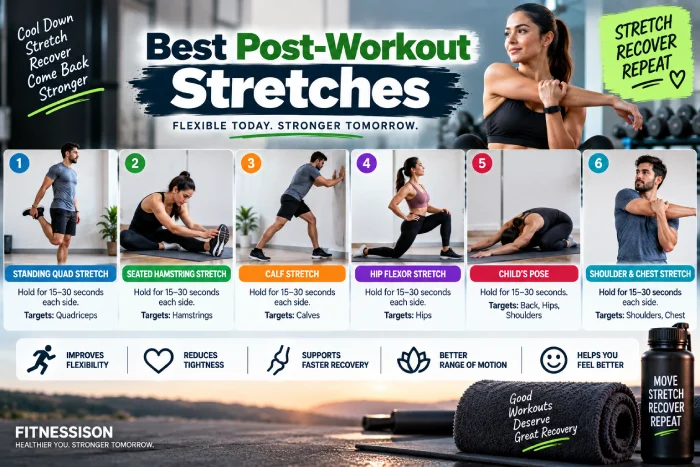
The optimal stretches are based on your trained muscles. Perform each movement smoothly and slowly.
1. Standing Quad Stretch
Step 1. Rest your weight on something you can hold onto if you need to. Bend one knee and gently pull your heel in the direction of your glutes. Take your time to push as long as this stretch is comfortable for you before completing the other side. This targets the front of the thigh.
2. Seated Hamstring Stretch
Sit with one leg out straight and bend the other leg in comfortably. Keep your back fairly loose and lean forward slightly towards the leg out straight. You should be able to feel a light stretch down the back of your thigh. Do not try and reach your toes.
3. Calf Stretch
Press your hands against the wall. Take a step back with one foot so that the heel remains on the ground. Gently bend the front knee and keep the back leg straight for a pleasurable stretch for the calf.
4. Hip Flexor Stretch
Beginning half kneeling position with one knee on the mat. Maintain an upright torso and lean your hips forward until tension in the front of your hip of the kneeling limb is felt.
5. Child’s Pose
A gentle stretch for the back, hips, shoulders; child pose. Turn into it very slowly, and position the knees or arms to ensure a sense of relaxation rather than trying to push into the most intense stretch. Concentrate on slow, deep breathing.
6. Shoulder and Chest Stretch
Take a light shoulder-chest stretch after upper-body exercises to ease you out of the session. Do not pull vigorously on the shoulder joint.
How Long Should You Hold a Stretch?
You don’t have to hold each position for more than a few seconds. For a post-workout stretch, aim to hold a comfortable static stretch for 15 to 30 seconds. Repeat the same as often as needed on the other side. You can expect a mild pulling sensation while you stretch, but avoid pain. If you are holding your breath or strain to hold the stretch, ease up.
Should You Stretch After Every Workout?
Feel free to add in post workout stretching whenever you find it beneficial and your body is up for it. Some people find that they want to stretch after every session as it helps them move into recovery mode. Some people might just do a brief warm-up mobility routine or a light walk. Your routine can be quite simple. In fact, five or so minutes of light stretching can be the easiest to adhere to.
Common Post-Workout Stretching Mistakes
Stretching could be attempted to be excessive.
Avoid these common mistakes:
- Traveling aggressively during a stretch
- Can be characterized as…running through a stabbing pain.
- Holding your breath The sensation experienced by astronauts when holding their breath, which is determined by the pressure of carbon dioxide rather than oxygen as in terrestrial conditions. Now appears on other graphs and is abbreviated by the cell (with a line above).
- Attempting to force it quickly intois flexibility
- Working a single muscle for an extended period
- Using stretching as an alternative to recovery
- Copying complex stretches blindly
It‘s not necessary for your body to feel too stretched to get benefit from the class. It‘s ofte better to be gentle and controlled in this.
Post-Workout Stretching vs. Mobility Work
Stretching and mobility work are connected, but not identical. In general, stretching is as much about muscle elongation or flexibility as it is about range of motion. Mobility work and exercises are about consciously controlling range of motion in more dynamic movements. Both may have a place after a workout. As an example, you could try ending an strength session with some static stretching, but then include some mobility work on a different recovery day. The decision is likely to be based on your goals and your body.
A Simple 5-Minute Post-Workout Routine
Too busy?
Try this simple routine after a workout:
- 30 seconds: Easy quad stretch, right side.
- 30 seconds Hamstring stretch on the right and on the left.
- 30 seconds: Warm-up via calf stretch on both sides.
- 30 seconds: Hip flexor stretch on each side.
- 1 minute: Relaxed chest, shoulder or upper-back stretching.
Repeat a few slow breaths. Modify the routine depending which muscles you trained.
When Should You Stop Stretching?
It should not be painful, sharp, sudden or intense. If you feel any strange pain, dizziness, numbness or extreme pain, please discontinue. If you are injured or have pain issues, you may wish to consult your doctor or physiotherapist before embarking on new stretching.
Final Thoughts
Post-workout stretching is also an easy addition to your workout recovery. Loosening stretches for the muscles you have engaged during your workout can be a great way to promote flexibility, comfortable motion, and relaxation of your body by the end of your workout. It doesn‘t have to be a complicated a program. Start off with five to ten minutes of gentle warm-up stretches that focus on breathing and feeling. It is important to remember that post-workout stretching is only one of many recovery methods. A permanent routine can be followed by combining post-workout stretching and adequate sleep, water intake, healthy eating, active recovery, and sleep.