
Last Updated: June 22, 2026
Clean Eating is about picking foods that’re whole and not messed with too much. We want to avoid foods with stuff lots of sugar and things that come in too much packaging. This guide will tell you what clean eating means the basic rules to follow what foods are good to eat and the good things that can happen when you do it. It will also show you how to get started with eating and give you links to other helpful things like meal ideas, breakfast ideas, snack ideas and more. Clean eating is about making good choices and eating foods like clean eating foods that are good, for you.
Clean Eating Resource Center
Explore our complete collection of clean eating guides, including beginner tips, meal plans, food lists, breakfast ideas, weight loss strategies, whole foods comparisons, healthy snacks, and family-friendly recipes.
What Is Clean Eating? (The Real, Simple Answer)
If you are trying to eat healthily but are overwhelmed by so many different diet tips then maybe clean eating could be just what you need. As its not a diet. Its a way of looking at food.
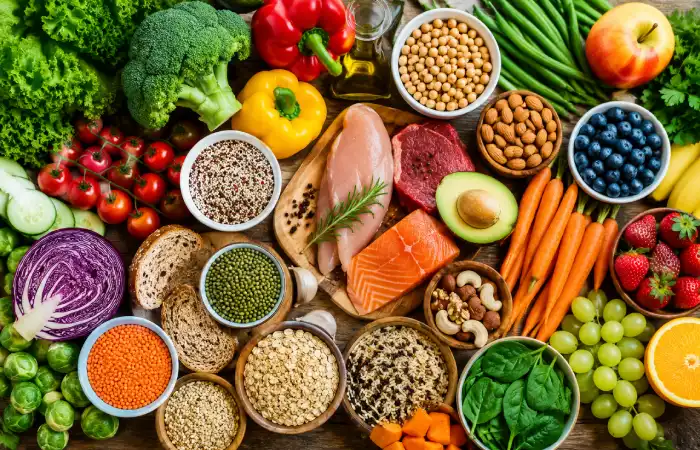
For eating to be ‘better’ it should mean selecting foods that are as close to their original/native state as possible. Native foods are naturally occuring food products such as vegetable and or fresh fruit, very lean protein products, wholegrain products and healthy fats. Eating should also mean limiting or eliminating products such as processed foods, added flavorings, refined sugars and additives.
That‘s the clean eating meaning in terms of shape – nothing is taboo, there‘s no obsession in it. That‘s good , honest food, in regular use.In the US where the majority of adults get more than 50% of their total daily calories from ultra-processed foods as I suggest going ‘clean eating’ can make a massive difference to ones health, energy & body composition even prior to taking a calorie count.
All aspects of eating are included. You will learn the essential concept and then go off and find more detailed information on each topic, from meal plans and food lists, to recipes and ideas for breakfast. on clean eating.
The Core Rules of Clean Eating
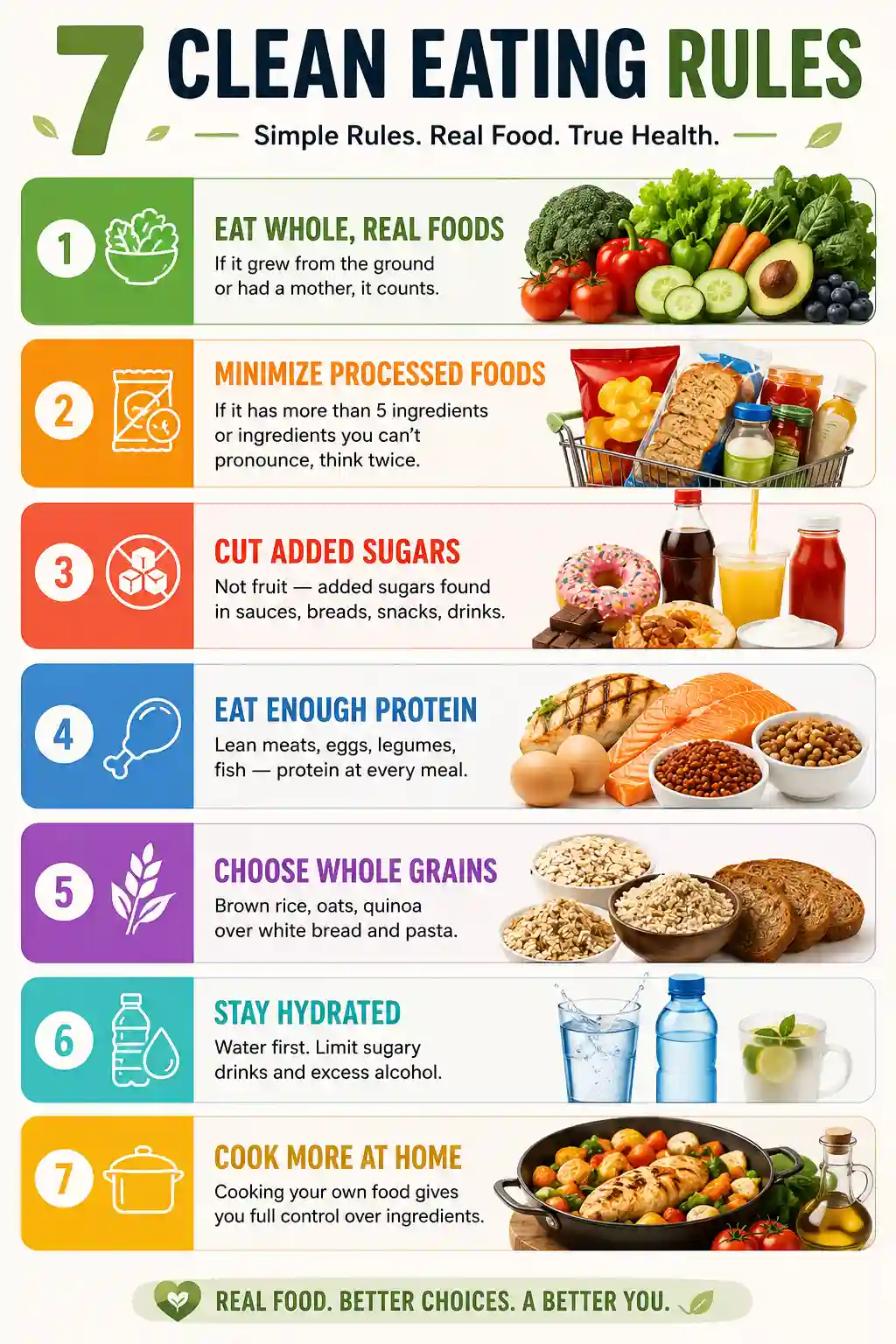
Clean eating doesn’t come with a rigid rulebook. But there are consistent principles that nearly every expert agrees on.
The 7 Core Clean Eating Rules
| Rule | What It Means |
|---|---|
| Eat whole, real foods | If it grew from the ground or if it had a mother, it counts |
| Minimize processed foods | Think twice it the analysis has these 5 ingredients or if they can‘t pronounce the ingredients: |
| Cut added sugars | Not fruit added sugars in sauces, bread, snack, drinks |
| Eat enough protein | Lean meats, eggs, beans, fish protein at every meal. |
| Choose whole grains | Brown rice, oats, quinoa instead of white bread and pasta |
| Stay hydrated | Water (first). Cut down on sugary drinks and too much alcohol. |
| Cook more at home | Eliminate additives by cooking your own meals |
What “Minimally Processed” Actually Means
This is where most go wrong. You are not cutting out all cooked and processed food. You are leaving everything in its natural state and not stripping it of it‘s nutrients and replacing it with manmade chemicals.
Lightly processed: Frozen vegetables; Frozen fruits; Canned vegetables in water; Canned squash in water; Breads and crackers with some whole grains; Plain yogurt without added sugars.
Moderate processing (not pristine): breakfast bars, premixed pre-sized ingredients, orange juice, sweetened granola, frozen fruit smoothies, flavored instant oatmeal, fruit yogurt (not plain), instant and flavored oatmeal, breakfast cereals (not whole grain)
Note: The word Natural” written on the label is significant. The term…natural” has little to do with the law. Have a look at the ingredients list-not as nutrition facts panel.Mini Summary: The 7 one fact rules on which clean eating is founded. The principle remains unchanged-real unprocessed foods you can find at your house.
If you‘re new to this and don‘t know where to begin? Our all inclusive guide to CLEAN EATING FOR BEGINNERS will take you through exactly how to start, the sort of mistakes you need to avoid and even a beginners’ shopping list to help you make the right choices!
What Can You Actually Eat? The Clean Eating Food List
The first question everyone asks when they discover clean eating: What can I eat?
In fairness, it’s a significant lot. Clean eating is one of the less hard ends of the spectrum, healthy eating-wise – you’re not banning entire food groups like in keto, or excluding other typical categories like Whole30.
Clean Eating Food Categories at a Glance
- Vegetables (unlimited): Spinach, kale, broccoli, courgettes, sweet potato, cauliflower, peppers, onions, garlic, cucumber, asparagus, carrots.
- Produce (per day): 1-3 serves. Berries, apple, Banana, Pear, Mandaring, Mango, Pineapples, Cantaloupe Watermelon, Cherries, Peachs etc.
- Lean Proteins: chicken breast, turkey, eggs, salmon, tuna, shrimp, Greek yogurt, cottage cheese, lentils, chickpeas, black beans
- Whole grains brown rice, quinoa, oats, whole wheat pasta, farro, barley, wholemeal bread (double-check on the labels!)
- Unhealthy Fats Butter, cheese, palm oil, fast food, processed baked goods, fried foods, meats which have been fried and are high in fat.
- Dairy (optional, lightly processed): plain Greek yogurt, cottage cheese, cheese (not all at once!), milk (dairy, soy, rice, almond, oat or other plant milk unsweetened)
One of the key goals of clean eating is limiting ultra-processed foods that often contain added sugars, unhealthy fats, and artificial ingredients.
Foods to Minimize or Avoid
| Avoid | Why |
|---|---|
| White bread, white rice, and white pasta. | Refined stripped nutrients, blood sugar spikes |
| Pre-packaged snack foods ( chips, cookies) | Ultra processed, rich in Na+ and with additives |
| Sugary drinks (soda, juice, energy drinks) | Liquid sugar, zero satiety |
| Deli meats with preservatives | High sodium, nitrates |
| Margarine and vegetable shortening | Trans fats, heavily processed |
| Flavored instant foods | Inclusion of hidden within the ingredients list. Hidden sugar, sodium, artificial flavors. |
Mini Summary the clean eating food list is quite extensive and varied. You are bringing in more whole foods, not just prohibition.
Get the complete breakdown of every food category, a printable shopping list, and pantry staples in our full CLEAN EATING FOOD LIST guide.
The Real Benefits of Clean Eating
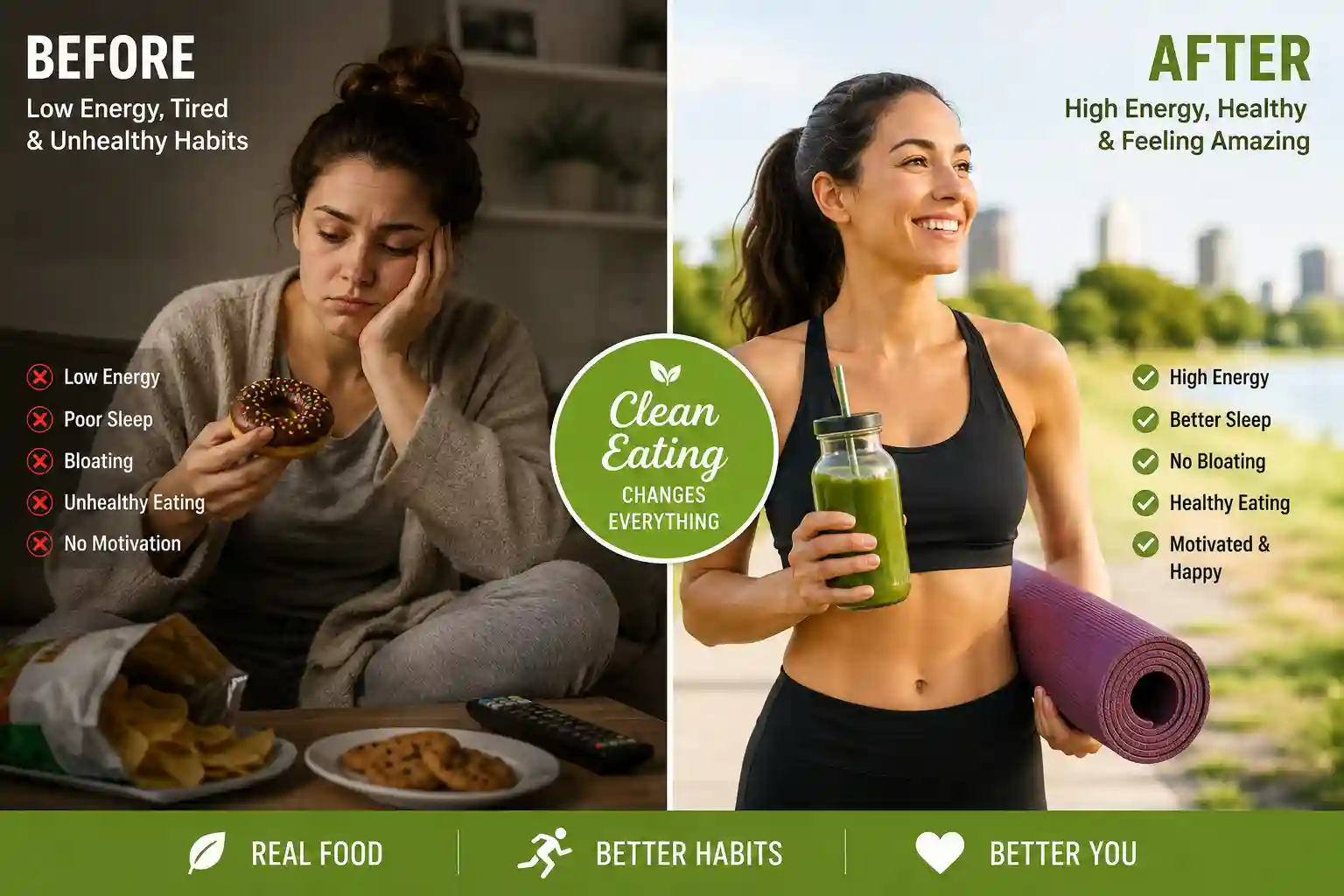
Clean eating. Not just about weight loss,. Although that is often a happy addition. The health benefits go far beyond the number on the scales.
What Happens When You Start Eating Clean
Within 1–2 weeks:
- Less bloating and digestive disturbances
- More consistent energy throughout the day (e.g. not crashing at 3pm)
- Better sleep quality
- Less slva cravings as it takes a while for the taste buds to adjust to now sweet taste of fruit.
Within 1–3 months:
- Pro-found alteration in body composition.
- Improved skin clarity (most people see this within 3-4 weeks)
- Lower inflammation markers
- Better mood & mental acuity You will enjoy more energy and more concentration when performing your daily tasks. It is also helpful in lessening low energy, irritability, and feeling of being overwhelmed.
Long-term:
- Reduced risk of type 2 diabetes mellitus, cardiovascular disease and some cancers.
- Healthier gut microbiome
- Sustainable weight management
- Lowering blood pressure and cholesterol levels.
What the Research Says
A study in Cell Metabolism from 2019 showed that on top of choosing to eat unprocessed, plain foods versus standard processed foods, those eating an ultra-processed diet ate over 500 calories more a day than those eating an unprocessed diet. The reason being, that refined foods are made in such a way so as to trick your body‘s natural signal of satiety.
Another reason why clean eating is successful is that calorie intakes from unrefined foods tend to be more satiating. You require high volumes of food in order to be satisfied and do not experience hunger for extended periods.
Mini Summary: Benefits of clean eating extend well beyond just the weight. Energy, skin, digestion and long term disease risk, all improve when you regularly choose from whole food options.
Does the concept of Clean Eating for Weight Loss work?
Short answer: yes but not magic. It just so happens some whole foods naturally eat less Calorie per bite. They have fewer calories per gram, so to speak, but more fiber and protein.
By replacing a bag of chips (400 calories, zero satiety) with grilled chicken breast and roasted sweet potato (400 calories, 35g protein, 5g fiber) your body responds completely differently:
Why Clean Eating Supports Fat Loss
- More volume/ calorie for vegetables and grains take more room in your stomach.
- Protein at every meal – lean proteins help you maintain muscle tissue, which keeps hunger hormones at bay.
- Less liquid calories soda alone is 300-500 calories per day l… Unrepples (one less can of soda a day can add 300-500 calories a day)
- Less hyper-palatable foods. (less pre-processed foods less overeating triggers).
- Blood sugar stabilizers in the form of grains and fiber may help you if you experience the spike/crash cycle which leads to craving.
What Clean Eating Is NOT
That‘s not crash dieting. That‘s not depriving yourself. That‘s not skipping meals. That‘s swapping out “high-calorie, low-nutrient” foods with “low-calorie, high-nutrient” foods.
Eating clean will enable the majority to naturally drop some weight because they will be eating more filling food and much less “empty” calories.
Mini conclusion: It helps to lose weight naturally by eating clean foods, being more satisfied and eating less empty calories. It can be done without necessarily counting calories.
For a structured plan with calorie guidelines and recipes created for fat loss, check out our comprehensive guide to clean eating for weight loss.
How to Start Clean Eating: A Practical First Week
One very common mistake I see beginners doing when they first start clean eating is trying to change everything at once-they always fail.
The smarter way: progress, not perfection.
The 5-Step Clean Eating Start Plan
- Step 1: clear out one category. Do not clear your whole kitchen out. Re place one item in the category with one that has less packaging, for example, a packet of sugar coated breakfast cereal instead of raw oats, a can of coke instead of a bottle of soda water.
- Step 2: Create your clean plate formula Each time you eat: 1/2 plate veges, 1/4 lean protein, 1/4 whole grain or starchs.
- Step 3: Begin to read labels. Observe: superfood ingredient lists; known ingredients and preservatives; minimal added sugar (<5 grams/serving); no trans-fatty acids or hydrogenated oils.
- Step 4: Prepare 1 week‘s worth of meals each week for instance, prepare a large batch of a protein (grilled chicken, baked salmon), a grain (brown rice, quinoa), then throw a bunch of vegetables in the oven. This should give you three to four meals.
- Choose your clean staples: Food selections which are your favorites (5-7) and are either naturally clean or easily cleaned. Incorporate those choices into your weekly plan until it is engrained.
A Simple Clean Eating Day
| Meal | Example |
|---|---|
| Breakfast | Eggs mixed + spinach + toast made from whole grain |
| Snack | Apple + 1tsp almond butter |
| Lunch | Grilled chicken and brown rice and roasted broccoli |
| Snack | Greek yogurt + blueberries |
| Dinner | Baked salmon + Quinoa + Asparagus |
MiniSummary: To start eating clean, you don‘t need to revolutionize your entire life. One change at a time, one prep session/week, and five favorite meals will get you there.
Clean Eating Meal Plans: What a Week Actually Looks Like
Question that people want to know the answer of is: what does one week of clean eating look like?
Here‘s a simple 3-day snapshot to give you a real-world picture:
3-Day Clean Eating Snapshot
Day 1
- Breakfast- overnight oats with chia seed , berries and almond butter
- Lunch:Turkey and avocado lettuce wraps Baked sweet potato fries
- Dinner: Baked chicken thighs served with roasted sweet potato and served with green beans.
- Snacks: some almonds + banana
Day 2
- Breakfast: Veggie Omlette (Eggs, Spinach, Peppers, Onions)
- Lunch: Quinoa and chick pea bowl, cucumber,tomato, and lemon-tahini dressing
- 2.4.3 Dinner Chicken or shrimp stir fry with rice and vegetables up 2.4.4 Lab meal8 Portioned meal of hamburger patty with baked potatoes, salad, and bread6 n the way. This analysis would provide insight into the difference in nutritional content between home-cooked and restaurant meals.
- Snacks: Greek yogurt + honey+peeled celery+removed hummus.
Day 3
- Breakfast: HCsmoothie– spinach, banana, protein powder, almond milk
- Lunch: Lentil ‘soup’ along with some ‘for you’ bread, made by biona
- Evening meal: Grass fed beef burger patties. Not in a bun (wholegrain instead if possible)and eat whole sweet potato chips (with some ordinary ones) + small side salad.
- Snacks : apple chunks + cottage cheese
Repeat the pattern: protein at every meal, vegetables throughout the book, whole grains instead of refined.
Mini Summary: A healthy eating meal plan can be so simple or a pain. Prepare whole foods early and cook generously. Part of your whole food meal plan.
Get a full 7-day plan with complete recipes, a shopping list, and meal prep instructions in our dedicated clean eating meal plan guide.
Clean Eating Breakfast: Why It Sets the Whole Day
Your first hour of food intake after awake has effect on your hunger hormone, blood sugar, and energy for a whole day.
What is an average American breakfast not-so healthy variety pack of carbs sugary cereal, flavored yogurt, muffin, orange juice? Well, it can be more than 600 calories of refined carbs and sugar with practically no protein or fiber. The result: spike to crash to want-to-eat-by-10AM.
A healthy eating breakfast changes the story.
What Makes a Breakfast “Clean”
- Protein as the anchor eggs, Greek yogurt, protein smoothie, cottage cheese
- Fiber from real food oats, berries, veggies, seeds 4PMG: (long grain) barley, rye, Khorasan wheat (kamut), oats (with husks on) dry toast, bread, wholemeal cereal 4OMY: (medium grain) Japanese rice, semolina, pasta (wholemeal)
- No added sugar plain versions of each; sweeten naturally with fruit
- Minimal processing for example, made from familiar, whole ingredients, is…
Quick Clean Breakfast Ideas
- Batch of egg muffins with vegetables (done this Sunday).
- Overnight oats with chia, almond butter and blue berries
- Greek yogurt with granola (label required) and a fresh fruit parfait (label needed)
- Wholegrain with avocados, on toast with 2 poached eggs, (cut in half).
- Protein shake with spinach, banana and protein powder.
Mini Summary it gets underway in the early morning. Breaking the fast with a satiating protein fiber abundant meal will curb appetite, cut cravings, and set a happy/healthy tone for the day ahead.
20+ quick clean breakfast recipes, batch prep ideas, and options under 300 calories — see our complete clean eating breakfast ideas guide.
Clean Eating Snacks: Staying On Track Between Meals
That‘s where most of the “eating clean” plans break down… Snacking. It‘s not that people lose motivation, it‘s just that they pick whatever is easiest, and often that means processed foods.
It‘s not willpower. It‘s ready.
The Clean Snacking Rule
A clean snack has at least two of the following three things:
- Protein to make you feel satisfied
- Fiber to delay digestion
- Healthy fats to curb cravings
One rice cake on its own, does not pass this test. One rice cake with almond butter and banana slices, passes.
10 Clean Eating Snacks Under 200 Calories
| Snack | Approx Calories |
|---|---|
| Apple + 1tbsp peanut butter | 180 cal |
| Plain Greek yogurt (or vanilla Greek yogurt to add sweetness) + berries | 130 cal |
| Hard-boiled egg + handful almonds | 190 cal |
| Celery + hummus (3 tbsp.) | 110 cal |
| Curds + slices of cucumber | 120 cal |
| Edamame (½ cup, shelled) | 95 cal |
| Banana + 1 tbsp almond butter | 195 cal |
| Carrots+ guacamole (2 tbsp) | 100 cal |
| A small handful of mixed nuts | 170 cal |
| Sliced turkey + avocado rollups | 150 cal |
Mini Summary: Clean snacking is simply about planning. Create a snack rotation of 5 7 options you truly love, and keep them on hand.
Snacks for work, snacks for kids, options under 100 calories, and a full clean snack prep guide — see our complete healthy clean eating snacks guide.
Clean Eating for the Whole Family
Reason number one people give for giving up on clean eating: their family refuses to eat healthy.
The good news: clean eating is family-friendly without being boring or complicated. Kids and finicky eaters will love clean food when served properly.
Family Clean Eating Principles
- Never use the word ‘diet’…just cook tasty food and it just turns out to be clean.
- Keep familiar tastes tacos made from seasoned ground turkey, whole wheat buns for sandwiches, pasta served with a pureed tomato-based sauce
- Get kids involved in cooking kids will eat more of the food they‘ve prepared.
- Be colorful colorful plates are more eye catching for kids.
- Gradual swaps replace white rice with brown rice, using whole grain regular pasta; most families don‘t notice
Easy Clean Family Meals
-
- Chicken, taco bowl & brown rice, black beans and fresh salsa
- Turkey balls from meat with whole grain pasta and home made tomato sauce
- Sheet Pan Salmon with Roasted Sweet Potatoes and Broccoli
- Pizza (clean) on (whole grain) naan with (part-skim) mozzarella and veg(ie) toppings
- Beef and vegetable stir fry with brown rice
Mini Summary: Clean eating does work for families if you keep it to familiar formats with cleaner ingredients, not weird foods or obvious ‘health food’ presentations.
Kid-approved recipes, busy weeknight dinner ideas, and a family meal prep system — see our complete guide to clean eating recipes for families.
Comparison: Clean Eating and Other Diets
Readers have frequently asked how clean eating compares to mainstream diets. Here is an unbiased summary:
| Diet | Core Rule | Overlaps With Clean Eating | Key Difference |
|---|---|---|---|
| Whole30 | No grains, dairy, legumes, sugar for 30 days, and add in more good fats (avocado and oil)?. | Emphasizes whole foods | More restrictive, short-term elimination |
| Paleo | Eat the way it was meant to be nothing but flesh, fresh fruits and vegetables. No grains or dairy. | Whole foods, lean protein | Jettisons grains and beans.. Cleaner eating drops grains and beans |
| Mediterranean | Olive oil, fish, vegetables, medium wines | Heavy plant focus, good fat sources | More liberal on soft drinks and wine |
| Keto | Less than 50g carbs/day if producing ketones, for maintaining ketosis | Reduces (eliminates) sugar and refined grains | Removes fruit and many whole grains |
| Intuitive Eating | Eat according to hunger/fullness, no rules | No moralizing of food. | No specific guidelines for food quality |
Which is best? The one you feel you can never do unless you plan to follow it for the rest of your life. Clean eating is the easiest and most flexible of these methods, and that is probably why it‘s usually used as a guideline to obtain, rather than a regime to live by.
Mini Summary: Clean eating incorporates elements from all four main approaches to healthy eating. It has more structure than intuitive eating, but is not as rigid as Paleo or Whole30.
Side-by-side comparison (full list), advantages/disadvantages of each, and how to decide read our full guide to clean eating vs. whole food diet comparison
Common Clean Eating Myths Busted
Myth vs. Fact
| Myth | Fact |
|---|---|
| “Clean eating is expensive” | According to the Department of nutrition, beans, lentils, oats, frozen vegetables and eggs are some of the best inexpensive options. |
| She‘s saying that if you are eating clean you should not be eating carbs. | All that clean eating isn‘t so clean on the carbs front. It‘s good to see a food group everyone is eating plenty of. It‘s just that these are the carbs we don‘t want. |
| . You will never be able to dine out | Most restaurants will be able to cater for clean eating, can request to have it grilled, salads, steamed veg, hold the sauce |
| “Clean eating is only one of the latest fad diets” | Is “clean eating” a new concept? No it is not!It is ”…completely in keeping with settled issues of nutritional science covered over the last three or four decades.” |
| “It takes hours to cook” | Meal prepping 1–2 hours on Sundays will provide you with most of the meal for the week |
| ‘You can‘t eat fruit because of sugar’ | Natural fruit sugar is packaged with fiber, vitamins and antioxidants – its not added sugar |
| “Clean eating is all or nothing” | 80/20 rule eating clean 80% of the time provides a lot of benefit. |
The 80/20 Rule: A More Sustainable Approach
No one eats perfect 100% of the time. And that that is what causes the failure of trying to, and thus ends up unachieveable clean eating attempts.
The principle of 80/20 rule is very simple: 80% clean, lean eating; 20% more forgiving eating.
In reality that could be everyday; imagine you‘re on 21 meals per week, so 17 are clean plus everything else. The other 4 can be a slice of birthday cake, restaurant burger or a slice of pizza guilt free without ruining all your hard work.
While psychologically sustainable and releases the ‘failure spiral’ of ‘all or nothing’, it still gives 80-90% of all the benefits clean eating gives.
The tweak: the 20% can‘ t become ‘go ahead and eat junk everyday’. It‘s a ‘I‘ll grant myself a bit of flexibility for events in the normal course of life’.
Is Clean Eating Right for You? Quick Self-Assessment
Clean eating is a strong fit if you:
- Drops pounds easily on your current diet or supplements you with the things you need to eat a healthy diet
- Have experienced bloating and if you have had digestive or skin problems which you think have been related to food.
- Looking to shed pounds while not starving yourself of calories?
- I dislike restrictive diet rules.
- Aims to support the family in improving their diet
- Have a problem with your blood sugar or cholesterol?
Clean eating may need modification if you:
- I Have had issues with disordered eating (see registered dietitian first)
- You will be an athlete with very high caloric requirements (clean eating will work just need to be able to push out the larger volumes)
- Have specific diets for medical needs (please always check with your doctor)
FAQs: What Does Clean Eating Mean?
Q: What is the clean eating diet?
Clean eating refers to an overall way of eating including mostly whole, unrefined, minimally processed foods (fresh fruit and vegetables, lean meat and fish, beans and pulses, local grains, healthy oils etc.) and excluding or severely limiting foods which are in general highly processed (dairy and meat products, sauces, snacks, candies, baked goods etc.) and many of which are high in sugar, artificial ingredients etc. rather than being actual foods.
Q. What are the rules of clean eating?
The basics are to; eat whole foods-nature based foods that are unprocessed, eat as little processed foods as possible, no sugar added, include protein at every meal, eat wholegrain than refined, drink lots of water and make everything from scratch whenever possible.
Q: Does clean eating work for weight loss?
Yes. Since clean eating automatically reduces calorie density, increases protein and fiber intake, gets rid of liquid sugar calories, and cuts out the hyper-palatable processed foods that cause “carb rage” and unconcious overeating, one will naturally reduce calories and lose weight without counting. Most people lose when they get into “real” food.
Nothing is ‘banned’ in a clean eating style of nutrition but is simply avoided white bread, processed pasta, carbonated drinks, processed snack items, food additives, preservatives (packaged meats), spreads (margarine), instant snacks, and any food type which contains a significant measure of all the above particularly extra sugar and artificial aromas.
Q: How do I start clean eating as a beginner?
Start by doing one swap at a time…..Eat the processed food you consume the most and see if there is a whole-food swap. Find a simple clean-plate plan (half plate veg, ¼ plate protein, ¼ plate whole grains). Plan your meal prep once a week.Choose 5-7 simple healthy meals you like and eat those…over and over.
Q: Does clear eating funds?
Certainly not. The cheapest foods happen to be oats, brown rice, lentils, eggs, beans and frozen vegetables in season. The price increases as you buy specialised products or organic everything but still these are certainly not necessities.
Q: It is fine to eat out while eating clean.
Yes. Order grilled (or broiled) meats or fish, sauce on the side, take salads or steamed vegetables for side dishes and avoid fried foods. Clean choices can usually be made even if a restaurant does not have a ‘clean’ section of the menu. ‘Whole foods diet’ and ‘clean eating’ are so close and used interchangeably that the term ‘whole foods diet’ is used to eat foods in their natural state from nature, in the same state as they are found, with as little processing as possible. Clean eating can be used as a nationwide term with the catch, in a natural, unprocessed way with a variety of other foods, e.g., plain yogurt, frozen veg, which still fit within a clean eating/whole foods diet.
CONCLUSION
What exactly is clean eating then? It means making the decision to eat real food and not to eat processed food on an everyday basis imperfectly of course.
Clean eating isn‘t about counting every calorie, following some complicated protocol, or never enjoying dining out again. It‘s just one very basic question you ask yourself each time you eat: is this food nature‘s way or has a huge amount of processing and nutrient removing been implemented?
That question regularly asked changes the way you eat, feel, and appear.
This is your beginning. Every single large clean eating topic has a guide of it below: a complete clean eating weekly meal plan, a complete clean eating list of groceries to get in the store, the best clean eating breakfast ideas to have a positive start every single day, healthy clean eating snacks, recipes for the family to join in with…
Begin easy. Keep in one pace. Tips will emerge.