

Mohd Arbaaz is an Editor and Writer at Fitnessison.com with 5 years of experience in SEO and digital content creation. He creates informative, reader-focused content covering fitness, workouts, nutrition, health, healthy lifestyle, technology, and computers.

Shashi Teja is a Reviewer at Fitnessison with over 6 years of experience in SEO, content strategy, digital publishing, and content optimization. He reviews content for clarity, research quality, topical relevance, readability, structure, and overall usefulness to readers.
Last Updated: September 22, 2026
Sleep tracking is now a feature on many fitness watches, smart rings and other health devices. These devices often try to estimate sleep duration, wake time and potentially even how long you spent during various sleep stages. For the even most avid exerciser sleep tracking can offer some valuable insights into recovery and routine but it is essential to have a reasonable understanding of what these devices can provide and when they begin to fall short.
What Is Sleep Tracking?
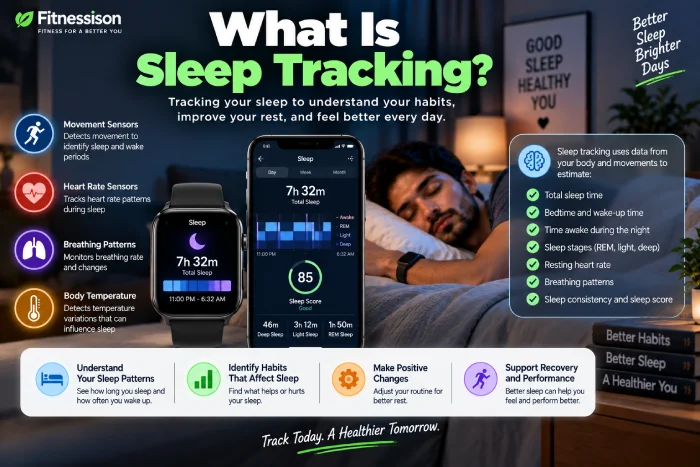
Sleep tracking involves monitoring and recording details about your sleep. Devices like smartwatches, fitness bands, smart rings, and sleep-specific devices derive data (for example, movement, heart rate) to interpret sleep.
Depending on the device, you may see information about:
- Total sleep time.
- Bedtime and time to awaken.
- Time awake at night.
- Sleep stages
- Breathing patterns
- Sleep consistency
- Sleep scores
These measurements can also allow you to see a trend over time, rather than just relying on your memory of how you were sleeping.
How Do Sleep Trackers Work?
Most consumer sleep trackers don‘t record brain waves directly. A clinical sleep study, called a polysomnography, uses sensors on the scalp to record brain waves, eye movements and muscle activity, breathing and cardiac activity, among other factors. From these measurements sleep stages can be identified more directly. (aasm.org)
Most consumer devices estimate sleep and wake duration by detecting motion with accelerometers or estimating heart-rate using optical sensors. Since these measures are indirect they are only estimates and should not be considered as a medical diagnosis.
Can Sleep Tracking Help You?
One of the biggest advantages of sleep tracking, for many people, is the ability to identify patterns. I.e. you may find that your sleep gets shorter if you:
- Walk out very late
- Caffeine consumption should be avoided in the afternoons.
- Stay out later on the weekends
- Use your phone while lying in bed.
- Crossing time zones
- Had a stressful day
Focus over multiple weeks instead of a single score in one night. Use that information to make practical changes to your sleep schedule.
Are Sleep Trackers Accurate?
Sleep Trackers can be helpful but may not always be accurate. Most consumer devices rely on movement and other physiological signals to make a guess at what sleep stages you are in instead of actually observing your brain activity. Studies have been done to compare different consumer sleep technologies and they‘ve been shown to vary in accuracy. For example, when you might actually be awake and lying still a sleep tracker may have claimed you were actually sleeping. It might have also could estimate REM sleep or deep sleep phases differently from a clinical sleep study. Because of this, think of your device as a good guide, not a true measurement.
Should You Trust Your Sleep Score?
Using a sleep score can be quite useful as a simple summary but it shouldn‘t be your sole criterion for assessing your sleep. Instead, reflect on how you actually feel.
- Do you wake up feeling well rested?
- Are you alert enough during the day?
- Are you able to hold your attention?
- Are you progressing normally during your workouts?
A high score doesn’t always equate to a good night’s sleep and a low score doesn’t necessarily indicate a problem. Your own sleep history and current lifestyle are also factors to consider.
Sleep Tracking and Exercise Recovery
If you train every day and spend time keeping to the same routine, charting sleep cycles can help you to compare the two schedules.
For example, you could record:
Level of effort >> at bedtime >> total sleep >> ability to do what you do in a day >> how you perform in the gym
You might observe helpful patterns over time. For example, after a long day of training and a short night’s sleep, you might feel more worn out the next day. Perhaps you are able to keep a schedule of sleep and training that helps you feel energized. This doesn’t indicate that one thing leads to another, but it can help you look for trends.
Common Sleep Tracking Mistakes
Sleep tracking can be a distraction if you latch on to the numbers too much.
Checking Your Score Every Morning
A single odd night will not give you an indication of your entire sleep.
Trying to Perfect Every Number
Sleep varies naturally from one night to the next. It is unwise to aim for a certain quantity of deep, or REM sleep.
Ignoring How You Feel
Your tracker is unable to measure your feelings of being rested, alert, and recovered.
Treating Estimates as Diagnoses
No movement sensor can claim to have diagnosed a sleep disorder merely because the information it provides is abnormal.
What Is Orthosomnia?
Losing sleep over sleep-tracking obsessiveness Orthosomnia is what we call an obsession with obtaining perfect sleep-tracker results. For some, constantly monitoring sleep scores can turn into a sleep-anxiety disorder. If you find yourself monitoring every sleep score or will frequently adjust your bedtime to get a certain set of scores, try a break from sleep tracking. The end game for tracking is better sleep, not perfect data.
How to Use Sleep Tracking Wisely
Simple if you’re going to use a wearable or sleep tracker.
Track Trends
Think longerterm over many days or weeks and not just the single night.
Compare With Your Routine
Take from the above a few variables like caffeine, exercise, stress, bedtime and screens and see how they play with your sleep data.
Focus on Useful Metrics
Total sleep time and consistency might be more feasible options than obsessing over individual sleep-stage estimates.
Listen to Your Body
Your daytime feeling of energy, mood, ability to concentrate, and workout performance all contribute to the picture of your health.
Use Data to Experiment
Make slight adjustments one at a time and monitor whether your sleeping pattern is affected.
When Should You Talk to a Professional?
Discuss these concerns with a healthcare provider: trouble falling asleep, waking during the night, excessive daytime sleepiness, or feeling unrefreshed upon awakening. While a sleep tracker can offer helpful insights, it is not a substitute for an evaluation by a healthcare provider.
Final Thoughts
Sleep tracking might be helpful for learning about your patterns, just keep in mind the big picture and not every data point. Fitness watches and smart rings are able to estimate, to various degrees of accuracy, your sleep quantity, quality, and stages. However, it‘s important to realize consumer devices are not Diagnostic tools and don‘t treat their information as such. Use your tracking as a guide, monitor how you feel, and stick to habits that promote quality sleep and recovery.