

Mohd Arbaaz is an Editor and Writer at Fitnessison.com with 5 years of experience in SEO and digital content creation. He creates informative, reader-focused content covering fitness, workouts, nutrition, health, healthy lifestyle, technology, and computers.

Shashi Teja is a Reviewer at Fitnessison with over 6 years of experience in SEO, content strategy, digital publishing, and content optimization. He reviews content for clarity, research quality, topical relevance, readability, structure, and overall usefulness to readers.
Last Updated: September 22, 2026
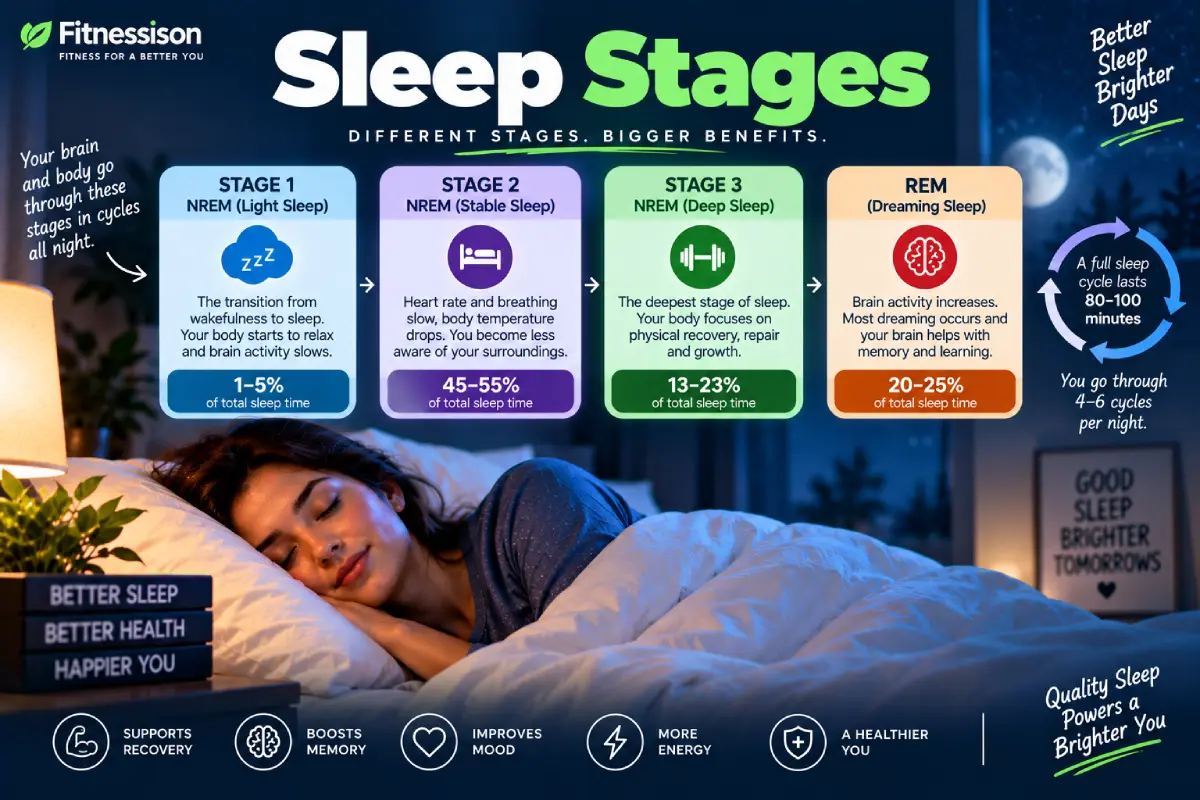
Sleep is not an instantaneous static era: your brain and body go through various states of sleep, each executing various functions, depending on what stage of sleep you are in. Comprehending the various sleep stages can provide an understanding into why sleep is needed for physical recovery, memory, energy and health overall. You can generally break sleep down into one of two classifications: non-REM sleep or rapid eye movement sleep. There are 3 stages of non-REM sleep, and we tend to experience them a number of times in one night.
What Are Sleep Stages?
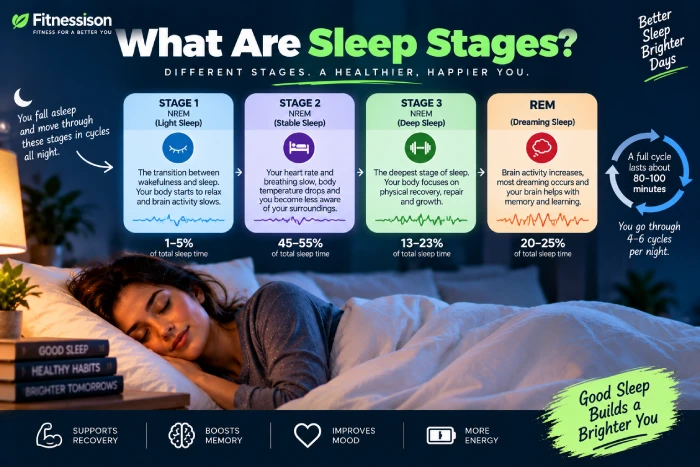
Stages are different types of activity of your brain and body when you are asleep. During an ordinary night you experience four to six cycles of sleep which last, on average, 80-100 minutes each. During the course of the night, the amount of time you spend in each stage fluctuates, and between each sleep cycle you have a period of brief awakening, each of which is forgotten the following morning.
The main sleep stages are:
- Stage 1 NREM
- Stage 2 NREM
- Stage 3 NREM
- REM sleep
Stage 1: Light Sleep
Stage 1 is the beginning of sleep; it is a transition from your waking state to sleep. When this happens the muscles relax, and your brain activity decreases. It is possible to wake up fairly easy at this stage, so if there is a loud noise, movement or talking you would wake up again. Generally stage 1 does not last very long and is the way into sleep.
Stage 2: Stable Sleep
Stage 2 Is a deeper sleep than Stage 1. You body relaxes further, your heart rate and breathing generally slow down and your body temperature falls. Your brain activity changes (becomes slower) as you become less aware of your environment. You spend much of your night sleeping in Stage 2.Sleep. For a fit athlete who is recovering, this stage of sleep is one of the stages that are generally experienced, as part of the rest process of the body.
Stage 3: Deep Sleep
The third stage is often known as deep sleep, or slow-wave sleep. It is the most profound stages of NREM sleep. Deep sleep is generally experienced more during the first half of sleep; it appears more profoundly after the onset of sleep. Deep sleep is crucial to your health as sleep allows to bodily repair and restoration and also normal body functioning. Your body is able to continue all necessary repair and rebuild functions as you sleep and for this reason, continually depriving yourself of sleep should leave you feeling less restored, especially if you are training regularly.
REM Sleep: The Dreaming Stage
REM is the acronym for rapid eye movement REM sleep is when the brain activity is closer to waking compared to non-REM sleep, your eyes move rapidly and the majority of your dreaming occurs. Your muscles are usually temporarily paralyzed during REM sleep to prevent you from actually acting out your dreams. REM sleep occurs more often later in the night. Therefore, if you adopt an early awake/sleep cycle, or have short sleep lengths, your later sleep stages will be affected. REM sleep also has a role in learning and memory.
How Sleep Stages Change During the Night
Sleep does not proceeds in exactly the same way from sleeping time into morning. The beginning of the night you are usually in more deep Stage 3 sleep. Later before waking up the REM periods are prolonged. This cyclic repetition is one of the reasons why sleep length and regularity both are important. If you regularly sleep too little you might not give your body enough time to go through enough normal sleep cycles.
Why Sleep Stages Matter for Exercise Recovery
If you exercise regularly sleep plays an important role in your recovery. Exercise imposes stress on your muscles and the body. Recovery allows the body to adapt to that specific stress. Sleep promotes many processes involved in healthy brain and body functioning. Adequate sleep is essential for one‘s general health and well-being. It would be more advisable for the individual to just to strive to have enough, or those when TST (should be TTST if referring to the total sleep time) and some disorganized sleep schedule.
The CDC recommends between 7-9 hours of sleep a night for most adults aged 18–60 years. What individual needs might be, while variable, it is normal to fall somewhere within this range.
How to Support Healthy Sleep Stages
You have no direct control over sleep stages. However, there are factors that can be conducive to healthy sleep.
Try these simple habits:
- Maintain the same bedtime and wake-up time.
- Project open the curtains and try to get outside into sunlight during the day, preferably in the morning.
- Engage in physical activity every day, yet steer clear of exercises that disrupt your sleep schedule.
- Reduce exposure to bright artificial light in the hours before sleeping.
- Maintain a comfortable, quiet, dark room for sleeping.
- Don‘t consume caffeine in the late evening.
- Prioritize sleep and allow yourself sufficient rest.
Your biological clock is influenced by light, dark, and other environmental cues, so it helps to keep a regular schedule.
Can You Improve Deep or REM Sleep?
Instead, it is preferable to consider overall support of healthy sleep rather than trying to manipulate specific stages of sleep. Your body will always maintain a certain order of NREM and REM sleep throughout the night. Having a consistent sleeping schedule, adequate total sleep time, activity during the day, and a proper sleeping environment will help maintain proper sleep stages. Sleep-monitoring watches and apps might be able to estimate your sleep stage, but consumer devices are not always a reliable measure of yourself.
When Should You Pay Attention to Your Sleep?
If you occasionally sleep poorly, that‘s quite normal. If, on the other hand, you have difficulty sleeping on a consistent basis, frequently wake in the middle of the night, oversleep in the day, or wake feeling unrefreshed, you should discuss the problem with your doctor. Persistent sleep difficulties may be associated with a sleep disorder or other medical problem.
Final Thoughts
Part of the reason sleeping is so much more than just being in bed for some time is because we know the stages of sleep. Between the start of sleep and the end NREM sleep stages continually change from the lightest through to the deepest, with REM sleep occurring more so towards the end. These cycles go on through the night. For optimal fitness recovery and health; an emphasis on the fundamentals will benefit. Sleep enough, on a regular schedule, exercise and sleep in a good setting.