


Mohd Arbaaz is an Editor and Writer at Fitnessison.com with 5 years of experience in SEO and digital content creation. He creates informative, reader-focused content covering fitness, workouts, nutrition, health, healthy lifestyle, technology, and computers.

Shashi Teja is a Reviewer at Fitnessison with over 6 years of experience in SEO, content strategy, digital publishing, and content optimization. He reviews content for clarity, research quality, topical relevance, readability, structure, and overall usefulness to readers.
Last Updated: September 22, 2026
It is how you sleep, not how long you sleep. sleeping eight hours is not enough. For an active person, good sleep quality is part of recovery. Sleep allows your whole body and mind a chance to rejuvenate, and ready yourself for yet another day of activities. The good news is that you don‘t necessarily have to undergo a crazy schedule in order to make your sleeping habits better.
What Is Sleep Quality?
Sleep quality 1 is how easily you fall asleep, how well you sleep and how rested you feel when you wake up. 2 Sleep quality is similar in that it is the ability to fall asleep relatively easily, and sleep through most of the night feeling reasonably rested.
Poor sleep quality can involve:
- Task of take a long time to fall asleep
- Often waking at night
- Knowing what it is to wake too early
- Feeling tired during the day
- Get a irregular sleeping pattern
The quality of sleep may be compromised by factors such as stress, illness, drugs, caffeine, lifestyle choices and some sleep disorders.
Sleep quality vs sleep quantity
- Quantity of sleep, is about how much sleep you get.
- Quality of sleep is how good or bad you sleep.
- Both of the matter.
Getting sufficient sleep duration is important, but having uninterrupted and regular sleep cycle is also benefits for feeling well rested and functioning properly.
Why Is Sleep Quality Important for Recovery?
Sleep is just one aspect of your comprehensive recovery program. Working out applies both acute stress to your muscles and cardiovascular and nervous systems, so your body takes some downtime to recover from this stress. Studies on fit and able bodies have also demonstrated significant associations between sleep, exercise and recovery.
Sleep quality. Tiredness and fatigue caused by poor sleep may impact on general concentration, reaction time and physical performance. This should be viewed as general fatigue and not the fact that the effects of a bad night‘s sleep will ruin the progression of your gym performance. Recovery is also affected by training workload, diet, hydration, stress and rest, to treat sleep as a critical factor in this.
Can Exercise Improve Sleep Quality?
For many people taking part in some form of exercise can promote better sleep. It has been shown that exercise can enhance certain measures of sleep quantity and sleep efficiency; however, these findings may not always be consistent for each individual and type of exercise. You do not need an intense routine:
Activities such as:
- Walking
- Running
- Cycling
- Swimming
- Strength training
- Yoga
- Mobility exercises
Can all be incorporated into an active life. The key is regularity. For others, however, a workout in the evening can be energising. If it affects your sleep, and you’re able to do so, try to fit in some of the more vigorous exercise a little earlier.
7 Ways to Improve Sleep Quality
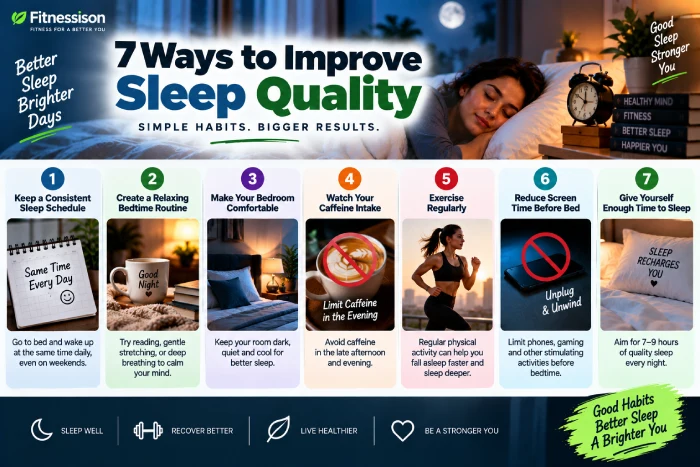
1. Keep a consistent schedule
Come up with a bedtime routine such as, wanting to be in bed every night at a certain time and ready to put the lights out at that time. Scheduling a regular routine could help you develop good sleep patterns.
2. Create a relaxing bedtime routine
Relax into slumber. Give yourself some time to relax before bed. Reading, stretching and breathing exercises, or listening to some soft music will bring you down after the busy day.
3. Make your bedroom comfortable
Make sure your sleeping environment is dark, quiet and comfortable. Adjust coverings, ventilation and room temperature, if you are sensitive to temperature changes.
4. Watch your caffeine intake
Sleep Disrupter Caffeine may come between you and slumber–particularly later in the day. The next time you’re having a hard time getting to sleep, have your last serve of caffeine a bit sooner.
5. Exercise regularly
Moving around regularly can help with sleep. You don‘t have to push yourself every time you work out.
6. Reduce stimulating activities before bed
Electronics. Phones, gaming, work and exciting content can make it more difficult for some to relax. Why not try giving yourself a restful period before you go to bed.
7. Give yourself enough time to sleep
No matter how good your sleep routine, there is no substitute for consistently providing yourself with adequate time in bed. Balance your sleep needs along with the rest of your daily routine, not at the tail end of it.
Common Sleep Quality Mistakes
One mistake you might be making is counting only on the hours you’re in bed. Eight hours in bed doesn’t automatically equal eight hours of quality sleep.
It is also an easy trap to fall into using sleep trackers. Be cautious. They can be used to analyse long term patterns, but any measurement of sleep recorded by a wearable device is an estimation. Don‘t become anxious over a poor sleep score. And finally, don‘t underestimate stress. A comfortable bed might not be enough if your mind is racing before bed.
What If You Sleep Poorly After a Workout?
Working out after a bad night’s sleep isn’t a reason to throw in the towel. Consider your true state of mind If you are fairly alert and you are aware that you simply happen to be slightly sluggish then an easier session could be more appropriate. But if your sleep has been so poor you are feeling extremely tired, unwell or have trouble concentrating then it might be better not to train. The sensitive issue is short falls in sleep.
When Should You Seek Help?
Sometimes poor sleep happens. If it persists, it might be worth consulting a health care professional. Are you failing to fall asleep or to wake up refreshed despite having adequate opportunity to sleep? Do you have ongoing sleepiness during the day or heavy, irregular snoring with episodes of breath holding?
Final Thoughts
Sleep is an extremely important aspect of a healthy lifestyle and a good workout recovery. Quality of sleep is one of the important aspects of the sleep equation and it is not just a matter of getting the hours. By going to bed, going to sleep, maintaining a comfortable sleep environment, exercising, limiting caffeine consumption and developing a relaxing bedtime routine away from the lights can all help to promote the best sleep conditions possible. You do not need to have a good night every night. Instead, develop good habits that you can do day-in-day-out. Once excellent sleep becomes your ‘usual’ you will notice the benefits to your vitality, training, recovery and wellbeing.