

Mohd Arbaaz is an Editor and Writer at Fitnessison.com with 5 years of experience in SEO and digital content creation. He creates informative, reader-focused content covering fitness, workouts, nutrition, health, healthy lifestyle, technology, and computers.

Shashi Teja is a Reviewer at Fitnessison with over 6 years of experience in SEO, content strategy, digital publishing, and content optimization. He reviews content for clarity, research quality, topical relevance, readability, structure, and overall usefulness to readers.
Last Updated: September 21, 2026
Sleep and recovery don’t get the attention they deserve. You might have an excellent workout regime, consume sufficient amounts of protein, and train regularly, but your recovery can be negatively affected if your sleep is hampered on a regular basis.
Getting between 7 and 8 hours of sleep is optimal as it allows your body to recoup its energy, manage essential biological processes, and recover from the physical and mental exhaustion of the day. This is crucial for active adults as exercise introduces a training load to which they have to adapt.
It’s not about just working out more. It’s about achieving a healthy balance of stress and recovery. This guide will cover what about sleep effects recovery, how many hours of sleep an active adult needs, how the different stages of sleep relate to recovery, the effect of exercise on sleep quality, and ways to improve your recovery practices.
What Is the Connection Between Sleep and Recovery?
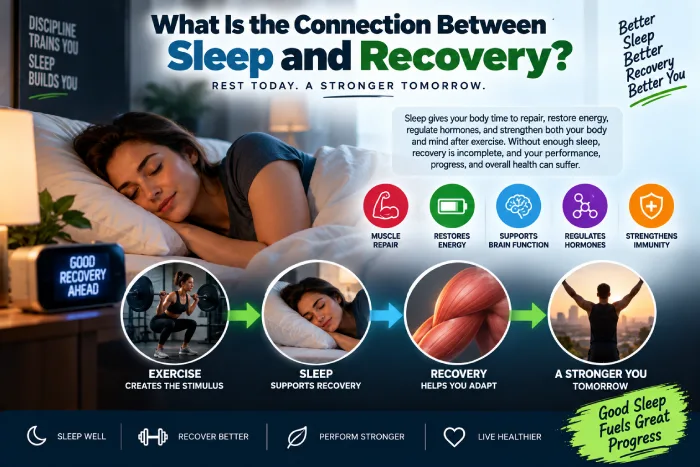
Sleep is one aspect of the wider recovery system. When you sleep your body and brain never turn ‘off’, but rather keep performing necessary function. You go through repeated cycles of deep non-REM and REM sleep to varying degrees with each phase assisting in your body recovery, brain function and memory. This is relevant if you train, because training is a stress, that you need to recover from: – A tough strength training session can leave your muscles totally exhausted for a long time: – A long run can cause extreme physical fatigue: – A really hard HIIT workout can impact quite heavily on your muscles, as well as your cardiovascular system.
Key takeaways
- Sleep is a key aspect of healing.
- Recovery is more than just muscles.
- Sleep facilitates the physical and mental functions relevant to training.
- Training during poor sleep is more difficult.
- Recovery also relates to nutrition and hydration, load and stress.
A useful way to think about it is:
Training is the stimulus. Recovery is giving your body the time to adapt.
Learn more about the overall recovery process in our guide to workout recovery.
Mini summary
Sleep is not the time taken away from the fitness equation. Sleep is a contributor towards this equation.
How Sleep Supports Physical Recovery
During sleep, your body takes care of many functions. Among athletes, sleep has been associated with recovery, performance and other physiological and psychological functions.
Sleep is an important factor in maintaining most normal immune, metabolic and endocrine functions. However, that doesn’t mean a longer sleep can simply make everything better when it comes to recovery. Training load, drinking and eating while training, hydration, injury, stresses, health all will play their role. But sacking out early will remove one of the basic building blocks of recovery.
Muscle recovery
Resistance exercise causes stress on our tissues. Our bodies require time to recover and adapt from this stress, and sleep plays a role here. Slow wave deep (non-REM) sleep has been linked to physical recovery, and research has investigated sleep, hormones, and tissue repair. We should regard sleep more as a facilitator of recovery than a magical way to grow muscle.
Nervous system recovery
It isn’t all about the muscles! Your brain and nerves are responsible for mobility, coordination, reaction time, motivation and decision making. In athletic people, lack of sleep can impair reaction speed and accuracy, along with cognitive ability, strength and endurance. Which is why that workout was exceptionally hard, compared to your normal good night’s rest!
Energy restoration
This is when your sleep impacts on your energy levels and daytime functioning. If you regularly sleep less than you need, in time, fatigue builds up. This can negatively impact your motivation to train, concentration for exercise and ability to perform your usual daily activities.
Practical example
Think of two individuals performing the same lower-body workout. Person A sleeps well and eats well. Person B sleeps five or six hours nearly every night and often misses meals. The workout may be the same. The recovery environment is not.
Key takeaway
Sleep will never substitute good training and nutrition. However, there is time when the opposite is true.
Mini summary
Like the base that underpins all your other recovery practices. To learn more, connect this article to the upcoming cluster about how sleep advances physical recovery.
How Much Sleep Do Active Adults Need?
One of the most common questions is:
“ Do I Need More Sleep If I Exercise?”
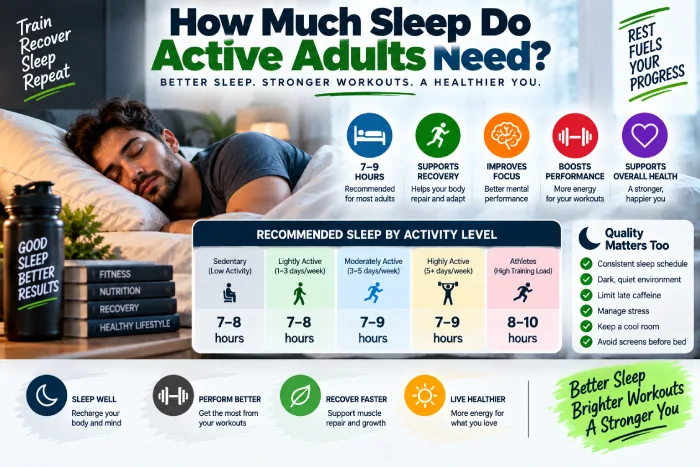
There is not a single number that applies to all active individuals. CDC recommends that the general population of healthy adults aged 18-60 years get at least seven hours of sleep each night routinely. Similarly, CDC recommends at least seven hours of sleep per night for adult athletes and active individuals 18-60, with separate guidelines for other ages.
Sometimes rest can be extended for athletes and others experiencing a high training volume. The general recommendation for athletes in the literature is 7-9 hours for adults in general and some athletes may require even more depending on the nature of their training and individual needs.
A practical guide
| Activity level | Sleep in practice |
| Light activity | Your standard sleep order is correct |
| Working out regularly at the gym | Aim for regular, good-quality sleep |
| Regular strength/cardio training | Make sure to get plenty of rest and recuperation |
| Heavy training blocks | Ask: Does this require extra sleep |
| Competition periods | 5. PROTECT SLEEP TIMEE AND REGULARITY |
| Absence of convalescence or residual fatigue | In conjunction with fitness, nutrition and health, consider overall sleep improvement |
– These are guidelines, not strict rules. Your sleep need may be different.
Do you need exactly eight hours?
No.
Eight hours is a practical goal for a great many grown-ups, but it’s not necessarily a biological need. The real question should be: are you routinely getting sufficient rest for your body, and mobility?
Signs you may need to prioritise sleep
You may want to review your sleep if you regularly experience:
- DAYTIME SLEEPINESS.
- Poor concentration
- Low motivation
- Decreased Intensity of Exercise
- Higher effort perception
- Irritability
- Hard to measure progress between sessions
- Repeatedly getting coffee
Signs of this can be caused by others, so they shouldn’t directly be contented to sleep.
Key takeaway
Begin with the standard adult guideline of minimum seven hours and observe your body and performance.
Mini summary
It’s more important to stay consistent than try to hit a perfect number every night.
Sleep Stages and Muscle Recovery
Sleep is a series of phases, not a single one. You go through non-REM and REM sleep multiple times in a single night.
There are three stages of Non-REM sleep.
- Stage 1: Going to sleep
- Stage 2: is a more advanced stage of light sleep.
- Stage 3: is deep or slow wave sleep.
REM sleep has a high level of brain activity, and is associated with specific tasksuch as learning and memory.
Why deep sleep gets so much attention
People call Stage 3 sleep “the most restorative” because this is the time when following breathing and heart rate slows, muscles relax, blood flow to muscles increases, and the body makes repair and growth of tissues. Early research has studied the link between hormone changes and slow-wave sleep, or deep sleep.
But to believe that one sleep stage exclusively enables the muscles to recover would be to be inaccurate. All healthy sleep consists in the entire sleep architecture.
What about REM sleep?
Why does all this matter to truly active people? Because their rest, in particular REM sleep, is crucial for their brain function, their learning, their memory.
Training also requires:
- Motor learning
- Coordination
- Concentration
- Decision-making
- Skill development
A basketball player practicing shooting, for instance, requires not only their leg muscles to be exercised. The brain and nervous system must also be up to snuff.
Key takeaway
Don‘t fret about obtaining a specific percentage of deep or REM sleep. Prioritize good sleep first.
Mini summary
WaKe 1234 DeepSleep>p Wavetitioner If we are truthful, we’ll admit that gaining a good night’s sleep and healthy sleep patterns are worth more than striving for sleep scores from a device.
How Exercise Affects Sleep Quality
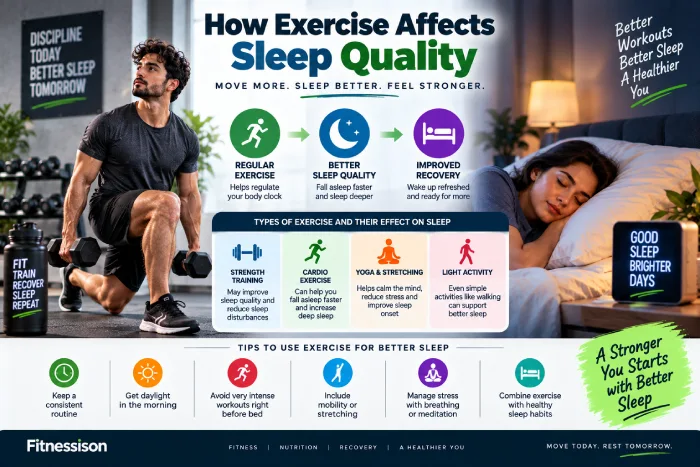
Exercise can help you sleep and, conversely, a lack of sleep can also affect your ability to exercise. According to the CDC, physical activity can help to promote good sleep.
Regular exercise may therefore become part of a positive cycle:
Exercise → improves sleep → improves recovery → enhances training
However, they can also really matter in terms of timing and how big, how rapid, the impact is.
Morning exercise
For some individuals, morning exercise could aid in imbuing a feeling of daily regularity. Patterns of outdoor activity in the morning will also be influenced by natural lighting levels that impact circadian rhythm.
Afternoon exercise
Joining a couch to sit should not be an problem for many individuals, as afternoon training is easy and would not encroach into sleeping hours. It could also be a good way to break up the monotony of sitting at a desk all day.
Evening exercise
The fact that you exercise in the evening is not automatically bad for sleep. For many people, exercising in the evening presents no problems. But, particularly strong exercise on the day or just before going to bed can keep some people lively or promote their ability to switch off. It’s individual.
What if evening workouts are your only option?
Don’t quit training just because you fail to train in the morning. Push the experiment. Can you do a harder session when the body is fresh? Make yourself pack up and leave earlier. Let yourself recover. Maintain a calm atmosphere.
Consistently establish a bedtime routine.
Key takeaway
The time you can exercise best is at that time when you can always adhere to it without disturbing your sleep.
Mini summary
Exercise is a sleep friend, but your workout timing can be a sleep enemy. We’ll dive into the mechanics of how exactly this relationship between exercise and sleep quality and quantity works on a future cluster page.
Ways to Improve Sleep and Recovery
You don’t need a bed-in-a-bag to upgrade your sleep. All you need is the basics.
1. Keep a consistent sleep schedule
Aim for consistency At least, maintain as much of a consistent sleep routine as possible. Try to go to bed and get up at similar times.
2. Get daylight during the day
Natural light earlier in the day will assist your body‘s circadian rhythm. One way to do this is by taking a walk in the morning.
3. Exercise regularly
Exercise also helps you sleep.
4. Create a wind-down period
Don’t assume your brain can switch from working intensely, playing a game or working out into deep sleep.1 Take your time to wind down.
5. Make your bedroom sleep-friendly
The environment can make it more than you sleep – dark, quiet and comfortable.
6. Watch caffeine timing
Caffeine can take hours to wear off. If you find that you are cracking down on your sleep if you have caffeine at night, try moving your last dose of caffeine earlier in the evening.
7. Be sensible with screens
Bright light and arousing content near bedtime can be more challenging for some people to wind down.
8. Do not turn sleep into another performance test
This is an important point. All of this means that if your wearables are encouraging you to check every night and obsess about whether you got enough “deep sleep”, that tracking can actually become stressful.
Key takeaway
Optimize the behaviours you have control over before tackling sophisticated recovery technology.
Mini summary
A boring routine that you follow daily sometimes is more useful than a elaborate routine that you give up in 1 week.
Sleep, Nutrition and Recovery Work Together
Sleep is just one piece of recovery. Nutrition makes sure you have the fuel and micro/macronutrients to sustain your training Hydration supports normal physiological function Rest days remove training stress Active recovery can provide the movement with less stimulus than a hard training session. These factors are all interconnected.
Example recovery system
Training
Provides a stimulus.
Nutrition
Offers energy and essential nutrients.
Sleep
Allows for respite and adjustment.
Rest or active recovery
Assesses all additional play.
Interview at the following training session
You come back in even better shape. That’s why more workouts are not always the solution when you hit a plateau. Sometimes, what you need is recovery.
Key takeaway
Don‘t use sleep as the substitute for the food or the rest. Use it as just another major component of the good recovery system.
Mini summary
Good recovery plan overall beats trying to use one “best” method of recovery.
Sleep and Recovery: Rest Days vs Active Recovery
Rest days and active recovery are separate.
| Feature | Rest Day | Active Recovery |
| Main goal | Decreases in training stress | Allow Convenient Movement |
| Intensity | Severe or absent. | Low |
| Examples | Sleep, usual daily activity | Walking, relaxed cycling, gentle movement |
| Best for | Poor recovery Sleep issues, stress, fatigue, soreness, high training56. | Gentle stiffness and comprehensive restoration |
| Main mistake | Guilt at resting | Take recovery to the next level |
Should be tired, presenting any indicators requires additional time then true advisable.If you feel OK but somewhat stiff, then a low-intensity walk or mobility session may be benefit. Don’t treat every “active recovery” day as a heavy training day.
Key takeaway
Recovery is meant to diminish stress, not mask other stress as if it were recovery.
Mini summary
Use rest and active recovery in proportion to the type and intensity of what you have been training and the way you are feeling.
For more information, see the Fitnessison guide on rest days.
Can Poor Sleep Affect Your Workout?
Yes.
One bad night’s sleep doesn’t mean you have to abandon your training. But perhaps you should be prepared to dial it down a notch. An increasing number of systematic reviews of studies have established links between sleep loss and slow reaction times, reduced accuracy, strength, endurance and mental ability.
After one poor night
You might:
- Experience more fatigue
- Still require a longer Warmup
- “Find normal weights feel four times heavier”
- Have less motivation
- Difficulty staying focused
Have a lower intensity session on days you are feeling more fatigued. For instance, instead of attempting a oneRM, go for an easier technique-based session.
After several poor nights
The situation is different. Sleep deprivation repeated can result in a greater recovery issue.
Rather than continually pushing through, review:
- Training volume
- Training intensity
- Sleep duration
- Nutrition
- Hydration
- Stress
- Rest days
Simple decision framework
Feeling normal?
Adhere to your planned workout.
Battered but able?
Think: taper up or down.
Feeling very sleepy, dizzy, unwell or finding it hard to concentrate?
Don’t stress a workout, grow a rep.
Key takeaway
Do not think you can punch one down for the count. The value of good sleep cannot be overstated. Multiple nights of bad sleep cannot be ignored.
Common Sleep and Recovery Mistakes
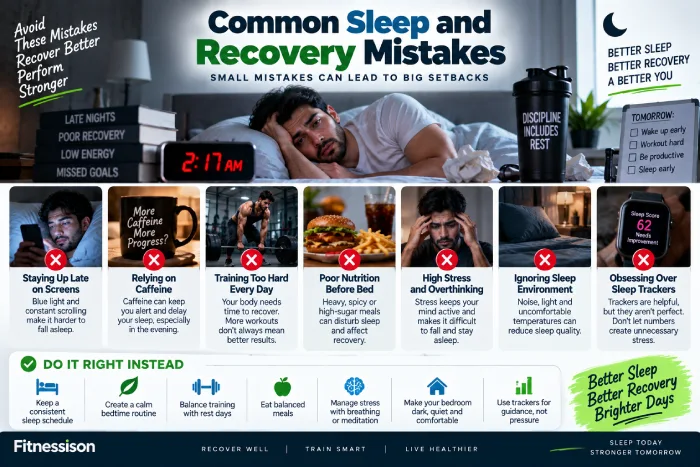
Mistake 1: Treating sleep as optional
Others would schedule their workouts, food and supplements but leave sleep until the end of the day. Like the party, ‘That can also lead to a recovery bottleneck.
Mistake 2: Chasing supplements before fixing sleep
Supplements may have a role under some conditions. But they cannot make up for poor sleep, night after night.
Mistake 3: Training hard every day
More training is not inherently better. Your body requires time to adapt.
Mistake 4: Sleeping much longer only at weekends
Getting extra sleep may seem like a relief after a rough week, but it shouldn’t be used as the weekly excuse for inadequate sleep.
Mistake 5: Obsessing over wearable data
Sleep trackers are a great way to look at trends. They can’t accurately record everything that’s happening while you sleep. Use them as a tool and not as a direct medical measure of your every night’s score.
Mistake 6: Blaming everything on sleep
Poor performance may also result from:
- Poor nutrition
- Excessive training
- Stress
- Dehydration
- Illness
- Injury
- Poor programming
Consider the big picture.
Sleep and Recovery for Muscle Growth
Building muscle is not just about lifting weights. Resistance training is what causes it. Proper nutrition is what provides the energy and raw materials. Rest is what allows for the adaptation to the training. Sleep is exactly that.
There has also been research on how sleep influences stress hormones and how this affects muscle recovery – but how things work isn’t as straightforward as “Sleep equals muscle growth”.
If muscle growth is your goal
Focus on:
- Progressive resistance training. This refers to methods that enable the amount of work to be increased; it may be by increasing the number of repetitions (repetitive progressive resistance), the number of sets of work (set progressive resistance training).
- Proper nutrition protein and overall nutrition
- Consistent sleep
- Adequate rest between high stress sessions
- Relevant training volume
- Long-term consistency
One hour’s sleep will not make up for a badly framed workout schedule.
Mini summary
Sleep is the enhancer of training adaptations, but not the replacement.
Sleep and Recovery for Weight Loss
Sleep is also interesting for your right to weight management. Sleep should not be promoted as a weight loss method on its own, but on the other hand, permanent weight loss will still be supported by a healthy and balanced diet, exercis e, behaviour and basic energy balance.
Lack of sleep can also make it tougher to keep up with healthy habits. You may feel more tired more exhausted you may have less impulse your may have less willpower to work out your may find it more difficult to stick to your regular eating pattern.
Key takeaway
See sleep as a health behaviour support rather than a diuretic.
What About Naps?
Sometimes naps are a good idea. A catnap may help offset daytime sleepiness following an uncharacteristically poor night. Studies in athletic groups have examined naps and sleep extension as potential performance and recovery aids. However, a nap is never a substitute for a normal night’s sleep. A longer or later nap might also delay your regular bedtime.
A practical approach
If you nap, experiment with:
- Short sleep-apnea
- This early this afternoon
- An silent environment
- Sufficient time to become properly awake before any strenuous activity
Your experience is important. A person who naturally falls asleep can have varying attitudes towards naps in contrast to a person experiencing existing insomnia.
Mini summary
Don’t use napping to fix a pattern of poor sleep.
How to Build a Simple Sleep and Recovery Routine
Don’t overthink things. Start simple using this straightforward process.
Morning
- Consistent wakening time.
- Expose them to natural daylight.
- Get your body moving.
- Consume in line with your ordinary diet.
During the day
- Enter your workout as you performed it.
- Eat sufficient quantities to fuel your exercise.
- Ensure regular consumption of liquids.
- If you sit for long durations, take brief breaks to move.
Evening
- Quit working out late if you find that it messes up your sleep.
- Consume your usual food after your workout session.
- Minimize stimulating activities before bedtime.
- Maintain a cool, dark bedroom.
- Maintain the same overall sleep schedule.
Before bed
Ask yourself:
“Have I given a silence of him enough chance to sleep?”
That question is often more useful than:
“What supplement can help me recover quicker?”
Mini summary
The simplest fatigue recovery exercises are maybe the most effective ones to repeat.
When Poor Sleep May Need Professional Attention
Some sleep problems are not so easily corrected through improved habits.
Consider speaking with a healthcare professional if you regularly experience problems such as:
- Trouble remaining asleep / suffering from an inability to get to sleep.
- Frequent waking
- Daytime hypersomnia, which is defined as being abnormally sleepy during the day when awake, occurs in approximately six to 30 percent of the general population.
- Loud snoring, the pauses in breathing.
- Continued fatigue despite adequate time in bed
- Sum issues that interfere with day to day life
- Persistent worries about sleep amount or quality
The CDC suggests consulting with your healthcare provider when you experience sleeping problems. It is not advisable to consider that your every trouble back after recovery is the results of the training. Decide the root cause of the condition to properly investigate.
Key takeaway
The sleep hygiene is effective, but ongoing sleep difficulties should be explored further.
Myth vs Fact: Sleep and Recovery
| Myth | Fact |
| Having more sleep is always better for recovery. | Implication 1: separate sleep and eating schedules. Duration of sleep varies between 2 and 10 hours. |
| Every body has to work for 8 hours. | AASM recommends at least 7 hours for the adult minimum; individual needs will vary |
| You only get a rest from doing things or hoping during sleep. | Sleep facilitates the recovery of our bodies and minds |
| A single bad night destroys all your effort | One bad night doesn‘t undo months of progress |
| Greater number of workouts always means better out come. | You will also need to recover. |
| Your sleep tracker is aware of your sleep quality. | Sleep-related variables are estimated by wearables, and should therefore be used with care |
| Naps substitute for night sleep | Naps can be beneficial in certain circumstances but cannot replace the need for daily sleep. |
| Deep sleep is the sole vital stage of sleep | A good sleep should consist of NREM sleep and REM sleep |
Sleep and Recovery: What Should You Focus on First?
If recovery info is just too much to take, go back to the beginning
Priority 1: Sleep duration
- If possible, allow yourself extra time in bed to get the more hours of sleep you normally require.
Priority 2: Sleep consistency
Make an effort to stick to a relatively stable timetable.
Priority 3: Training load
Ensure your exercises are demanding enough without being more than required.
Priority 4: Nutrition
Eat sufficient amounts and ensure intake of sufficient protein, carbohydrate, fat and fluid.
Priority 5: Rest and active recovery
Build in the workouts when your body needs them most.
Priority 6: Advanced recovery tools
This shouldn’t even be a concern until the essentials are in place. Only then should you think about fancy recovery tools, gadgets, and protocols. Why? A sleep tracker is not going to put you to bed an hour earlier every night. A massage gun is not going to cure your sleep debt. And yet another supplement is not going to make up for missing a day of recovery.
The simple rule
Don’t mistake optimising the details for optimisation of the basics.
The Future of Sleep and Recovery
The relationship between sleep and recovery is likely to be also enhanced via wearable technology and customised training. Today, most devices are able to track sleep length and heart rate with other movement indicators. Tomorrow’s devices may be able to integrate this data with training load and behavioural cues.
However, having more data does not automatically produce better decisions. The most effective means of technology will be realized technology that provides information using an effective, readily understandable means to allow for operation.
For example:
Your sleep has been off your baseline for several nights so think about backing off on today‘s training. This may be more helpful than just giving you another recovery score. A lot of research is currently looking at personalised solutions for sleep, circadian timing, exercise and recovery instead of focusing on universally applicable recommendations.
Mini summary
It is probably inevitable that the future of recovery will be more individualised, though it is unlikely that the basics on sleep will….
FAQs
What is sleep and recovery?
Sleep and recovery is the relation of quality sleep to the body‘s mechanisms for replenishing energy, facilitating physiological processes, modifying brain activity and readiness for future activity.
How does sleep support physical recovery?
Sleep offers a period when some physiologic processes necessary for restoration and restoration can take place. Deep non-REM sleep is good for physical restoration, and healthy sleep in general, good for functioning.
How much sleep do active adults need?
Regularly obtaining more than seven hours of sleep per night is suitable for the majority of healthy participants aged 18–60. A greater amount of sleep may be necessary if heavy training, orientation is experienced.
Does sleep help muscle recovery?
Certainly indeed sleep is a major component of post-exercise recovery. However muscle recovery is based on many other factors such as training volume, diet, hydration and individual differences.
Does exercise improve sleep?
Exercising can help many individual sleep better.
Can exercising at night affect sleep?
It may do for some people, especially if you exercise intensely within three hours of sleep. But this is not always the case; not everyone will have the same reaction.
What sleep stage is best for muscle recovery?
Deep non-REM sleep is known to be most closely associated with physical restoration, but normal sleep structure and healthy recovery requires a normal sleep architecture.
Can a nap help workout recovery?
Taking a brief nap may be beneficial for alertness and recovery, especially following insufficient sleep at night. It is not a substitute for sleep at night.
Does poor sleep affect workout performance?
Decreases in sleep can impair a wide variety of physical and mental elements of performance such as reaction time, accuracy, strength and endurance
Is seven hours enough for muscle recovery?
Seven hours is the bare minimum recommended for a healthy adult aged 18–60, although individual requirements may differ. An individual who participates in high training intensity may require additional sleep to recover than has been suggested here.
Final Conclusion
Sleep and recovery should not be isolated components of a fitness routine. They are interconnected. Workouts deliver the training stimulus. Nutrition supplies energy and nutrients. Rest alleviates training stress. And sleep allows the body the time to perform many of the processes necessary for the repair and recovery in preparation for the next challenge. For the majority of adults, getting at least 7 hours sleep is a crucial first step but a person’s individual requirements can vary.
You do not need a high maintenance recovery strategy to get started. Get quality sleep, train sensibly, eat right, hydrate, allow for enough recovery time between hard training sessions. Then find the best you can achieve from this. The most effective sleep and recovery plan is not the one that aims for perfection, but one that is sustainable on a week to week basis.