


Mohd Arbaaz is an Editor and Writer at Fitnessison.com with 5 years of experience in SEO and digital content creation. He creates informative, reader-focused content covering fitness, workouts, nutrition, health, healthy lifestyle, technology, and computers.

Shashi Teja is a Reviewer at Fitnessison with over 6 years of experience in SEO, content strategy, digital publishing, and content optimization. He reviews content for clarity, research quality, topical relevance, readability, structure, and overall usefulness to readers.
Last Updated: September 9, 2026
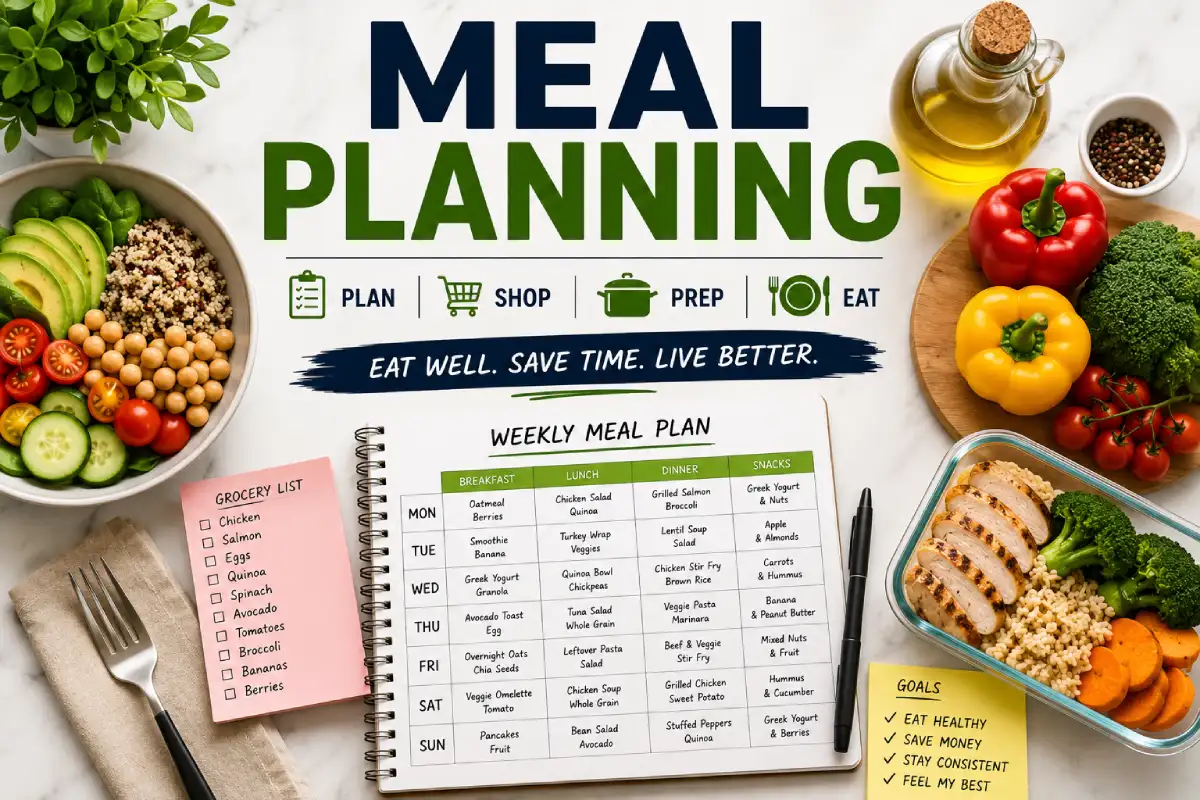
Meal planning is one of the easiest and most simple tricks to making healthy eating more structured, affordable and feasible. Instead of trying to dream up something to make each time you get hungry, you plan out all of the meals you want to have for the week, see what ingredients you already have, write up a shopping list and prep whatever will make your week easier. However, effective meal planning isn‘t about having 7 days of deliciously balanced recipes or literally cooking all day on Sundays. A good meal plan should fit in with your life.
Monday might be hectic, you may be eating out on Wednesday, leftovers on Thursday, and you may have almost no time to cook on Friday. A good meal planning plan allows for those things rather than ignoring them. This is a simple introduction to Meal Planning and directs you to more comprehensive approaches to weekly planning, meal prep, cost-saving, weight management, and nourishing your family.
Meal Planning Resource Center
Explore our complete collection of meal-planning guides covering weekly meal preparation, healthy breakfasts, high-protein meals, vegetarian options, budget-friendly planning, and practical strategies for busy professionals.
What Is Meal Planning?
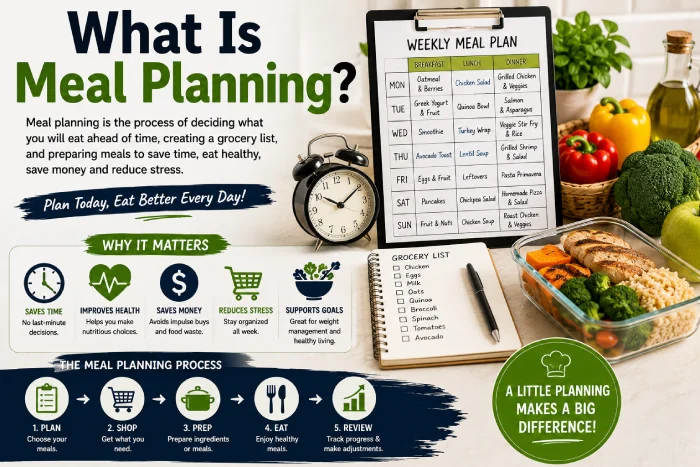
Meal planning involves planning ahead what you are expecting to eat in terms of meals/snacks in a specified time, a week or so.
A basic meal-planning system looks like this:
Verify what you have > identify the foods you will be having > write a shopping list > go shopping > prepare, as appropriate > eat > reflect > refine.
Meal planning doesn‘t have to equal having every thing made weeks ahead of time. For instance, you could plan to have chicken bowls on Monday, vegetable pasta on Tuesday, leftovers on Wednesday, tacos on Thursday, and go out to eat on Friday. This is still meal planning. Meal prep is a different thing. Meal prep is making food or components of food in advance. That could involve washing vegetables, cooking rice, barbecuing chicken, making soup, dividing snacks into portions or freezing meals.
Key takeaway
Meal planning is a way to decide what you will eat. Meal prep is a way to prepare some of it in advance. To learn the practical impact more thoroughly, read ourplanned guide to Meal Prep for Beginners.
Why Meal Planning Can Make Healthy Eating Easier
But healthy eating is often the issue exactly when you are too tired and hungry to do anything about it. It‘s 6:30. You haven‘t thought of what you‘ll eat. There‘s no ready meal. You open the fridge. Then you shut it. And you order a pizza. That‘s not actually a motivation issue. It‘s a planning issue. Planning is about a decision taking place before you need to decide.
A study of over 40,000 adults found that those who reported planning their meals also tended to have higher diet quality and variety. In addition to finding a similar trend for associations between meal planning and reduced odds of overweight or obesity in some groups, the authors noted: “the observational nature of these data precludes any suggestion that meal planning caused the study outcomes”.
Meal planning can also:
- Okanagan, helps to reduce the number of decisions that we face on a daily basis.
- Reduce the time consumed by grocery shopping by making it more targeted.
- Help you use any food already in your kitchen.
- Facilitate the preparation of nutritionally balanced meals.
- Minimize rushing to buy takeout.
- Increase the budget they can for purchasing food.
- Be more mindful or intentional about leftovers.
- Volunteer to help organize family dinners.
Cleveland Clinic also promotes the time savings, the reduced decision fatigue, increased meal quality, as well as the financial benefits of meal preparation.
Practical example
Instead of asking:
“What should I eat tonight?”
you‘ve already answered:
I‘m having chicken, roasted veg and rice tonight.
That minor choice eliminates an incredible amount of friction.
Key takeaway
Meal planning is not so much focus on optimal nutrition as having a process in place to make better choices easier. Please see our future [Weekly Meal Planning] in detail.
The 5-Part Meal Planning Formula
You need not even need a complicated spreadsheet to make a balanced week.
Start by thinking about five elements:
| Element | Important points to bear in mind. |
| Protein | Eggs, fish, chicken, turkey, beans, lentils, yogurt, tofu |
| Produce | Vegetables and fruits. Consumed in high quantities, these foods are cheap due to the low cost of production and storage (drying, preservation, frozen. For consumers, refrigerated, deep frozen, canned, dried.). |
| Carbohydrates | Choose whole grains, potatoes, rice, oats and other favorites |
| Healthy fats | Nuts, seeds, avocado, olive oil etc. |
| Flavor | Herbs, spices, sauces and seasonings |
This is not a prescriptive solutions. It is a planning framework.
For example, one dinner could be:
Grilled chicken + fried-blanched broccoli + the potatoes + the dressing create on the olive oil.
Another could be:
Lentils, plus vegetables and rice with a sauce made from yogurt.
Another:
Fish + salad + grains + avocado.
The meal planning principle is unchanged though they differ:
Key takeaway
Focus on nourishing ingredients when planning Build meals, rather than always hunting for the perfect recipe.
How to Start Meal Planning as a Beginner
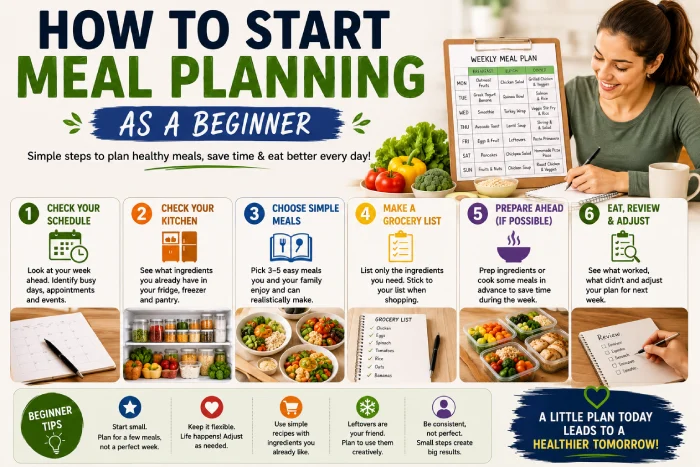
- If you‘ve never meal planned, don‘t plan 21 meals! That‘s a surefire way to decide that meal planning is not your thing. Just plan 1 meal.
- If every breakfast is chaotic to plan your breakfast.
- If dinner is the issue, make dinner plans.
- If you often buy lunch during working days then let start with lunches.
Cleveland Clinic would suggest starting with the most challenging meal as opposed to preparing all of your meals for 7 days in advance.
A beginner-friendly process
Step 1: Check your calendar.
Always consider late workdays, appointments, social events, travel and restaurant meal.
Step 2: Check your kitchen.
Thoroughly examine the fridge, freezer and produce canisters.
Step 3: Pick a few meals.
Pick simple dishes that you already know how to cook.
Step 4: Reuse ingredients.
If purchasing spinach, have some in several different dishes. If cooking chicken, then serve it in several different dishes.
Step 5: Write the grocery list.
Stock up on what you really require.
Step 6: Prepare only what helps.
You certainly don‘t have to cook everything all at once.
Mini summary
Kick off with simple beginnings. A great beginner plan has perhaps only three dinners and a handful of lunches planned. That‘s sufficient to make it a habit. For more information, see our upcoming [Meal Prep for Beginners] cluster.
Weekly Meal Planning: Build the Week Around Your Schedule
An easy to make mistake here is to make the menu then look at the calendar. Doing it opposite will be more efficient. You calendar should affect the menu you plan.
Imagine your week looks like this:
| Day | Schedule | Dinner approach |
| Monday | Busy | 20-minute meal |
| Tuesday | Normal | Cook from scratch Not all of the trail mix we sampled was available ready made, so some were prepared fresh with their ingredients. |
| Wednesday | Late meeting | Leftovers |
| Thursday | Free evening | New recipe |
| Friday | Social plans | Flexible |
| Saturday | More time | Batch cooking |
| Sunday | Family day | Easy dinner |
And suddenly, your meal plan becomes doable. You don‘t have to have seven totally different recipes. Three or four main dinners will work just fine, especially if “PLU” (left overs) can be incorporated into it.
A useful weekly pattern
- Monday: a new meal!
- Tuesday: Leftovers or something simple or fast or abroad (imagine providing another meal when on another continent)
- Wednesday: Fresh meals “anytime” (without sauce, , is for from airport).
- Thursday: Repurpose leftovers
- Friday: It is a flexible meal
- Saturday: more complicated cooking
- Sunday: preparation of the batches
This adds variety without the week becoming monotonous.
Key takeaway
Your good meal plan is a reflection of your calendar. It‘s not the time to plan a long recipe if you know you‘re going to be tired that night. Our next Weekly Meal Planning article can provide insight into 7-day schedules, templates and grocery lists.
Meal Planning vs. Meal Prep
These several expressions are commonly confused with each other.
Meal planning
You decide:
- What you will eat.
- When you are going to eat it.
- Which ingredients do I need to have?
- The amount of courses. If you notice that you would require too How much of each course you‘d need to make this.
Meal prep
You actually prepare:
- Ingredients
- Individual portions
- Complete meals
- Freezer meals
- Snacks
You have the ability to achieve neither.
Example
You plan:
Monday)–chicken tacos
But don‘t pre-cook anything.
That‘s it. How do you get there? Make a simple menu for each day of the week. For each day, write down the name of your stores on one shopping list and take it with you. When you get there, just pick up those items. That‘s it.
You prepare:
- Cooked chicken
- Chopped vegetables
- Rice
- Sauce
Prepare your meals for the week this Sunday and have them ready to take to work to be consumed during the week. That is meal prepping. You can merge both approaches.
Mini summary
Planning gives your week purpose. Preparation reduces the effort needed to implement the plan.
Meal Planning for Weight Loss
Meal planning can be handy for general weight management as it draws a lot of thought to what foods we consume. We are not caught off guard going out to buy something to eat when super hungry, we have the choice of what to eat at our disposal already. A structured meal plan and grocery list has also been studied in a behavioral weight-control setting, where subjects given a structured meal plan and grocery list experienced significantly greater weight loss than the standard behavioral-treatment group.
The relationship between average meal-planning frequency and weight loss has been examined. These more recent findings from another worksite behavioral weight-loss program showed that higher average meal-planning frequency was linked to greater weight loss. But it is not a magic cure for losing weight in the face of the meal planning. Your total calories, physical activity, health and sleep and other factors are still relevant.
A weight-management meal plan can emphasize
- Protein-rich foods
- Vegetables
- Fruits
- Whole grains
- Let‘s talk about beans and lentils.
- Appropriate portions
- High-fiber foods
- Sort of minimally processed foods.
- Provisions to take when required.
You don‘t need to give up your favorite foods. Simply choose if and when you want them and how much.
Example
Instead of:
I‘m taking a vow never to eat pizza.
Try:
Friday I will have pizza and a salad with it, remembering to have a portion size that is appropriate for me.
That way may be simpler to keep. For a more detailed guide, refer to our planned [Meal Planning for Weight Loss] article.
Budget Meal Planning: Eat Well Without Overspending
Eating healthy is not about purchasing costly specialty foods. The corner stone of a good budget meal plan is low cost staple foods.
Consider:
- Oats
- Rice
- Potatoes
- Beans
- Lentils
- Eggs
- Frozen vegetables
- Seasonal produce
- Canned fish
- Plain yogurt
- Whole grains
- Both for chicken when on sale
Use the “one ingredient, multiple meals” strategy
Imagine you buy a big bag of carrots. Open them up, and use them for three or four different recipes.
Use them in:
- Soup
- Stir-fry
- Roasted veggie bowls.
- Salads
- Snacks
The same applies for proteins, grains, sauces and vegetables.
Shop your kitchen first
Before making your grocery list, check:
Freezer:→ refigerator:→ pantry:→ food stores:
This can simple order which might protect against repeat purchase.
Watch sales strategically
Don‘t be tempted by discounted products. Compra foods you‘ll use regularly and not just because is cheap; an ingredient that will be wasted isn‘t actually part of a good deal.
Key takeaway
Budget meal planning is not about buying the cheapest food, it is about buying the food you will actually eat. Our upcoming [Budget Meal Planning] guide will include shopping lists, ideas for cheap meals, buying seasonally and reducing food waste.
Family Meal Planning Without Cooking Five Different Dinners
It is time-consuming when everyone has different likes. It does not have to be a separate dish for individual. Rather put various items on the table so people can choose.
Example: Taco night
Prepare:
- Protein
- Beans
- Lettuce
- Tomatoes
- Cheese
- Avocado
- Salsa
- Tortillas
Tacos can be made by one family member. A bowl can be made by another. A selection of extras can be brought by another. The same ingredients are used as ever.
Another example: Pasta night
Serve:
- Pasta
- Tomato sauce
- Chicken or beans? Would you rather eat chicken than beans? However, the higher the number of trials, the more significant the positive effect is. So, the final decision is… ‘chen’ (chicken) or ‘vei’ (beans).
- Roasted vegetables
- Salad
Anyone can make up a meal to suit their tastes. This makes family eating much easier without making the kitchen a Short-order restaurant.
Involve children
Older children can help:
- Select 1 dinner:
- Wash vegetables
- Assemble snacks
- Added fish to the shopping list.
- Assist in setting the table.
Family Meal Planning is more feasible with the whole family involved. Our proposed has the potential to extend out to child-specific factors, larger families, and shared grocery lists.
How to Create a Grocery List From Your Meal Plan
Meal plans are much more helpful when they turn into a specific shopping list. Write down your meals, the ingredients, then what you currently have.
Example
Meal: Chicken bowls
You need:
- Chicken
- Rice
- Broccoli
- Carrots
- Yogurt
- Lemon
- Seasonings
Existing ingredientsHif you already have rice and seasonings in buy don‘t buy them again. You‘ll save money and trouble.
Organize the list by store section
Produce
- Broccoli
- Carrots
- Bananas
- Spinach
Protein
- Chicken
- Eggs
- Yogurt
Grains
- Rice
- Oats
- Whole-grain bread
Pantry
- Beans
- Tomato sauce
- Spices
This may also lead to a quicker grocery shopping and less forgotten items.
The 80/20 Approach to Meal Planning
A helpful meal plan doesn‘t need to be totally healthy all the time. Just visualize your total week.
You might have:
- Home cooked food mostly
- One restaurant dinner.
- One simple frozen meal.
- One last night 9p.m. 9 a.m. The residual darkness of None begins to lift at 9 p.m. When I stay up through the night working on the essay, there is no difference between the night of one residuals. I am caught again in the rhythm of exhaustion I have followed all day.
- A dessert
- A social gathering
That‘s living your normal life. We are not trying to design a week that could be found in a nutrition textbook. We are trying to produce a week that is healthy enough, delicious enough, cheap enough, and feasible enough that we can do it every single week.
Key takeaway
Allows for the realities of life.
How Much Should You Meal Prep?
There‘s no one way.
Some individual piece of life enmay This.
For some, their love lies in preparing the ingredients rather than cooking the meal itself.
For example, you might prepare:
- One protein
- One grain
- Two vegetables
- One sauce
Then combine them in other places on the week.
Three common preparation styles
– Complete meals: Prepare and package them.
Preparing in bulk: Cook a large amount of a single product.
– Ingredient prep: Prepare ingredients that can be used across several of my dishes.
Preparing ingredients may also be helpful if you are not fond of eating the same thing over and over again.
Mini summary
Select the prepping style that is most compatible with your personality. If you prefer routine, complete meal prepping may be more suitable. If you want more variety, ingredient prepping may be better suited for you.
Food Storage: The Part You Shouldn’t Ignore
Meal planning will be effective only if prepared foods are stored safely. As recommended by the US Department of Agriculture‘s Food Safety and Inspection Service, in general, store leftovers in refrigerator at a temperature below 40 F to 3 to 4 days.
USDA also advises allowing foods to cool quickly in shallow containers and to reheat leftovers to 165°F.
Practical storage habits
- Store Lads’ leftovers in the fridge.
- CoolingRate Use shallow pans for quicker cooling.
- Write the date on label containers.
- Freeze any foods you don‘t intend to eat within the time span it will keep in the refrigerator.
- Maintain refrigerator temperatures of 40°F or below.
- Reheat leftovers completely.
- When uncertain, discard.
Avoid compromising on food safety due to the desire to avoid wasting food.
Key takeaway
A good meal plan should be more than a list of things you are going to cook. It should also include when you‘re going to eat them.
Common Meal Planning Mistakes
Planning Too Many Recipes
Seven days does not have to mean seven aTpes.
Ignoring Your Schedule
How much time does it take for you to prepare a meal? If it is a ridiculous amount of time like 90 minutes, you probably shouldn‘t make it on your busiest night.
Buying Without Checking Your Pantry
You may already possess these half of the ingredients.
Preparing Too Much Food
The more may not be better.
Start with what can practically be ingested.
Making Every Meal “Perfect”
As if the chaos weren‘t enough, perfection increases the difficulty of planning.
Forgetting Snacks
Include snacks if they are part of your usual diet.
Ignoring Preferences
If you hate this recipe, you won‘t do it!
Not Planning for Leftovers
Left overs.
Forgetting Food Safety
There is a shelf life on prepared food.
Have a plan.
Meal Planning Myths vs. Facts
| Myth | Fact |
| Meal planning is the term for preparing all the week‘s meals on Sunday. | Here is an example of you just planning meals or preparing ingredients; |
| “Every meal has got to be healthy” | It‘s the general trend that counts more than being perfect |
| . Meal planning is more than simply losing weight | It can help with time, budget, organization and nutrition |
| And so, because you need expensive containers | Elementary safe food storage functions. |
| 7 were the number of varied dinners. | Extra and repeats can make the week easier |
| It takes hours to plan meals. | A brief planning session can sometimes be sufficient |
| Genain families require their own dishes. | A flexible component can be used for various preferences. |
| Meal planning and healthy eating are both costly. | Inexpensive yet reliable basic items can build up the… |
Troubleshooting: When Your Meal Plan Keeps Failing
Problem: You keep abandoning the plan by Wednesday
Try: Prepare fewer dishes and include leftovers.
Problem: You hate eating the same food repeatedly
Try: preparer des ingrédients à la place d‘un repas complet.
Problem: Your groceries keep going to waste
Try: Base your meals on the food you already have.
Problem: Dinner takes too long
Sample: Do an extra quick meal and store it for those very busy nights.
Problem: Your family won’t eat the food
Try: Have family members make all the meals or incorporate the build your own method.
Problem: Meal planning feels exhausting
Try. Assemble a rotating list of 10–15 dishes you‘re already familiar with.
Problem: You overspend
Suggestions: Make a plan before you go shopping, shop around, eat things that are in season and reuse ingredients.
A Simple 30-Minute Weekly Meal Planning System
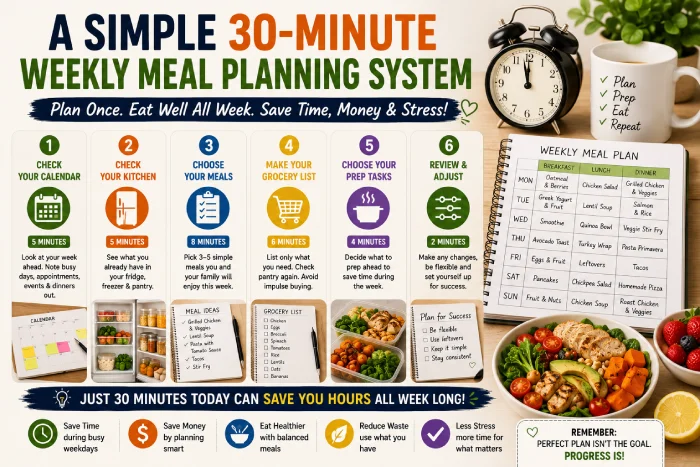
You don‘t have to spend the whole weekend planning.
Try this:
Minutes 1–5: Check the calendar
Ascertain busy evenings, social gatherings, eating out at the restaurant and travelling.
Minutes 6–10: Check your kitchen
Look round the fridge, freezer, and cupboard.
Minutes 11–18: Choose meals
Choose 3-5 main meals.
Minutes 19–24: Build the grocery list
Write on the ingredients you require. itself.abc Write on the ingredients you actually require.
Minutes 25–30: Choose your prep tasks
Decide what can be prepared in advance washed, chopped, cooked or divided into portions. That‘s all. Don‘t worry if the plan isn‘t presentable. It just has to be practical.
A Flexible 7-Day Meal Planning Example
It‘s more of a simple system than a rigid diet.
| Day | Breakfast | Lunch | Dinner |
| Monday | Eggs + wholegrain toast! | Chicken salad | Vegetable stir-fry+ rice. |
| Tuesday | Oatmeal + fruit | Leftover chicken | Lentil bowl |
| Wednesday | Yogurt + fruit + nuts. | Lentil leftovers | Fish + veg + potatos |
| Thursday | Eggs + fruit. | Grain bowl | Chicken tacos |
| Friday | O, Y, + (AM, MM, PM (true) 00-15)/SP. This is a combination of the first two equations. It is: 1oz oats, 4oz yogurt, in the midday or evening. | Leftovers | Flexible/restaurant meal |
| Saturday | Vegetable omelet | Sandwich + fruit | Fresh pasta +vegetables |
| Sunday | What we got: oats + berries. How we think it tastes: possibly yum. As we sit down to lunch we‘d imagine general scrumminess, encouraged, after further comment, by visions of sweet and juicy dates, followed 20 min later by something comforting and comforting eaten. How it might resemble to your first time: Hopefully delicious (but not in first time masticating) | Leftovers | Simple family dinner. |
That‘s not a prescription.
It shows the practice of saving excess ingredients / leftovers. Repeat a certain ingredient /things, keep some space.
Meal Planning for Different Goals
Meal planning varies according to its purpose.
For Healthy Eating
Create a balance maximize variety. Keep vegetables, fruits, and whole grains at the core of each meal; have more protein foods and fewer solid fats and added sugars.
For Weight Management
Focus on more satisfying meals, being aware of serving sizes, eating nutrient rich foods and being consistent.
For Saving Money
Focus on inexpensive basics, sales, seasonal stuff, leftovers, and frozen foods.
For Saving Time
Use quick meals (baking, grinding, chopping, etc), cook in a big batch, do common prep work and use leftovers.
For Families
Make flexible meals, and include other household members in selecting a menu.
For Beginners
Begin with one or two meals instead of trying to plan the entire week. Your goal will influence what and how you do.
Meal Planning and Real Life: Leave Room for the Unexpected
A meal plan is not written in stone. You planned to have chicken on Tuesday and got caught staying late at work, serve the chicken on Wednesday instead. If you have uninvited guests, change things up. If you‘re not in the mood to cook, have a backup meal. Because of this, every well written meal plan needs to include one flexible meal.
Keep a few emergency options available:
- Frozen vegetables
- Eggs
- Canned beans
- Whole-grain bread
- Frozen protein
- Soup
- Oats
- Yogurt
- Fruit
One backup meal can save you from stretching one lost night into a week of uncontrollable eating.
Future of Meal Planning: More Flexible, Less Rigid
Digitalization and meal individuality in planning is advancing rapidly. Existing apps can generate shopping lists, store recipes and provide nutritional info and customize meals; AI-based “smart” planning tools help generate menus based on content of one‘s kitchen, the individual budget, time constraints and tastes:
Technology doesn‘t address the key issue though. Even with a meal plan, it still has to be compatible with your daily life. The most successful tools will probably be those that respond when your plans change rather than make you adhere to an inflexible menu.
The future of meal planning doesn‘t have to be more complex planning. It is improved personalization and flexibility.
Who Benefits Most From Meal Planning?
Meal planning can be especially useful if you:
- Enjoys ordering take-out regularly.
- Be able to think forward, for example, I don‘t Know what to cook.
- Getting overwhelmed with work.
- Intend to save money.
- Got a family to support.
- Are committed to healthier eating.
- Would like to have more consistency with your nutrition.
- Waste food on a weekly basis.
- Getting totally lost in the grocery store.
But you don‘t need a particular problem to get a benefit.
Eating is complicated and even a seemingly simple plan can liven things up.
When Meal Planning May Need Professional Guidance
A generalized meal plan cannot take the place of clinical nutrition advice tailored to the individual.
Individuals with diabetes, kidney disease, major food allergies, a history of an eating disorder, or another medical condition that is diet-dependent, should consult a qualified health care practitioner.
There are a few other aspects that may need more specialized nutritional intervention including:2728
Registered dietitian can provide a potential meal plan based on your health, nutritional needs, preferences, financial and lifestyle considerations.
Frequently Asked Questions About Meal Planning
Q1) What is meal planning?
Meal planning– is planning in advance what meals and snacks you think you will eat, and what ingredients will be required to prepare them.
Q2) Is meal planning the same as meal prep?
No. Meal planning is what you‘re going to eat. Meal prep is making ingredients or entire meals before you‘ve got to eat them. The two can be combined or used individually.
Q3) How far ahead should I plan meals?
One week is a reasonable beginning, but you may want to prepare three days, several days, or even a longer period of time to fit your schedule and for the types of food you want to store.
Q4) What should a beginner meal plan include?
Begin with a couple of quick and easy familiar breakfast, lunch and dinner ideas. Make sure to include some protein foods, vegetables or fruits, maybe your favorite carbohydrate foods, and snacks if required.
Q5) Can meal planning help with weight loss?
It could aid weight regulation by encouraging more conscious food selection and less impulsive eating. Evidences have shown relationships between meal planning and diet quality, and some behavioral weight-loss research has shown negative correlations between planning frequency and weight loss.
Q6) Is meal planning expensive?
It isn‘t. With the exception of feed, planning around affordable staples, seasonal produce, sales, leftovers and ingredients that can be used in several ways can keep costs low.
Q7) How do I meal plan for a family?
Opt for meals that can be adapted for individual family members. Build-your-own taco, bowl, sandwich and pasta meals are helpful.
Q8) How long does meal-prepped food last?
The USDA guidelines state prepared leftovers should be used within three to four days when stored in the refrigerator and those not consumed within this time should be frozen.
Q9) Do I need to meal prep every meal?
No. You can just think out a meal plan, make up one chef-hard dish, batch cook up loads of ingredients, or prep some snack foods.
Q10) What is the easiest way to start meal planning?
Decide on three dinners for next week, see what you already have in your kitchen, compile a shopping list and cook one or two ingredients in advance.
The Bottom Line
The reality is, meal planning doesn‘t have to be a crazy diet, a zoo of a cook book or an all day marathon in the kitchen! Find a system that really works in your life. Begin by assessing your schedule and kitchen. Select several practical ‘make life easier’ meals. Create an organized grocery list. Cook only what actually cuts down on time. Have built-in use leftovers. Have an easy ‘just in case’ meal.
Then go over the week.
What worked?
What didn’t?
What is it safe to assume?
That‘s how your meal planning become a good habit and not just one more task on your to-do list. Need extra help? Check out the related weekly meal planning, meal prep for beginners, budget meal planning, meal planning for weight loss, and family meal planning links in this hub.
And a quick reminder: you‘re not trying to plan an ideal week. The aim is to initiate a behavior that is easier to become a habit.