


Mohd Arbaaz is an Editor and Writer at Fitnessison.com with 5 years of experience in SEO and digital content creation. He creates informative, reader-focused content covering fitness, workouts, nutrition, health, healthy lifestyle, technology, and computers.

Shashi Teja is a Reviewer at Fitnessison with over 6 years of experience in SEO, content strategy, digital publishing, and content optimization. He reviews content for clarity, research quality, topical relevance, readability, structure, and overall usefulness to readers.
Last Updated: September 24, 2026
Getting into your workout, unprepared, is comparable to Turning on your car and shifting into Overdrive before you ever leave your driveway. Warm-up exercises are meant to allow your body to get ready to gradually go from still to moving in complete harmony with your movement. A good warm-up doesn‘t have to consume your entire workout; begin the session with one. A few minutes of active movement, mobility drills and around the movements you plan to perform in your workout will allow you to progress into the actual workout much safer and mentally ready. Leading into your workout whether running, lifting weights, playing sports or even working out from home, should be a part of any rational workout training plan.
What Is a Warm-Up?
Warm-up is a brief activity and is a part of your starting before your main session. The goal is to get moving gradually and prepare your muscles and joints.
A warm-up may include:
- Light walking/jogging (i.e. subtle shift in speed up or down)
- Dynamic stretching
- Muscle stretching exercises.
- Bodyweight movements
- Sport-specific drills
- The lightest repetitions of your primary workout.
The type of warm-up depends on the main exercise or activity. For example, a running warm-up will generally involve the legs and ankles more, while an upper body warm-up will involve the shoulders, upper back and arms.
Why Should You Warm Up Before Exercise?
Reason you want to warm up would include that it elicits a gradual increase in activity level. It‘s much better to go from the inert state of sitting at the computer and laptop into a series of unweighted, moderate tempo squat repetitions, by way of several unweighted minutes, than to go directly into weighted, fast repetitions of a compound exercise you‘ve never done before. Warming up can also be beneficial by giving you a chance to practice movement styles you‘ll need to work on during your training session; for example, warming up with relatively slow, unweighted repetitions of a squat can help you sharpen the movement technique for doing weighted repetitions. Keep in mind though that warming up is not a fool-proof method of avoiding injury; injury risk is multifactorial and depends upon factors like training volume, health status, and recovery practice.
Dynamic Stretching or Static Stretching?
What kind of stretching you do could depend on where you are doing it. Dynamic stretching is moving in a controlled manner examples are leg swings, arm circles, walking lunges, hip sways etc.
However, these exercises can easily be incorporated into the warm-up prior to strength training. Static stretching is where you hold the stretch position for some time; classic hamstrings, calves and quads are examples. It can be beneficial to include static stretching as part of a flexibility program, however, your warm-up does not need to be solely comprised of static stretches. For most activities, a gentle gradual warm-up and dynamic movement will suffice.
8 Warm-Up Exercises to Try
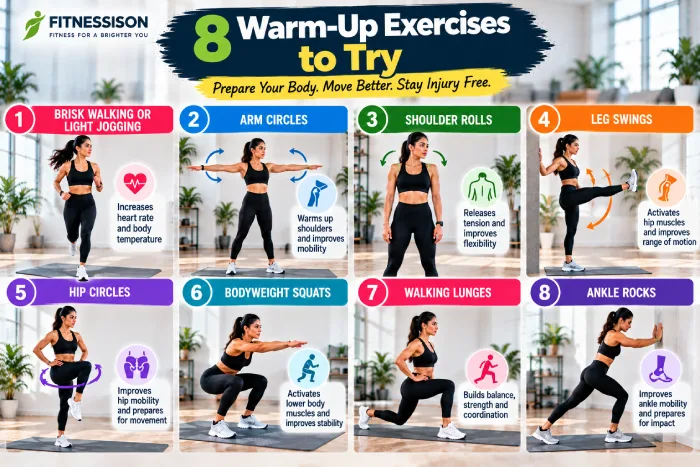
1. Brisk Walking or Light Jogging
Begin with a few minutes of walking or slow jogging. If you are about to run, start out at an easy pace rather than jumping right into going at your usual running pace. This will provide an easy way to build activity gradually.
2. Arm Circles
Make sure to stand and circle your arms in a small confined motion. If it feels good, slowly try to enlarge the circle. Aim to go back and forth between directions a few times. This simple exercise can be done before any upper-body training or activities that involve the shoulders.
3. Shoulder Rolls
Shoulder circling. Gently roll your shoulders forward and back. Do not use a forced motion of the shoulders to achieve a long range of motion. It may be especially beneficial to do this before working out after a long period of time of sitting.
4. Leg Swings
Stand holding a wall or other stable object for balance. Bring one leg in front of the other, swinging it back and forth under control. The motion should increase in size without turning into an angry kicking motion. Repeat on the other side.
5. Hip Circles
Stand relaxed and raise one knee a little. Rotate the knee in a slow circle before lowering your foot. Do this clockwise and anticlockwise before switching legs. Hip circles are a good warm-up before doing any lower body training.
6. Bodyweight Squats
Get into a comfortable stance with your feet. squat down slowly and forward to the standing position. Begin with a few repetitions and focus on moving smoothly. Get under the weighted squat training session with these to learn the correct movement pattern.
7. Walking Lunges
Step out with one leg and kneel down into a steady lunge. With a strong push upward through the floor, bring your other leg forward. The exercise should be comfortable, so reduce the range if needed. Walking lunges work a variety of lower-body muscles, as well as demanding balance and coordination.
8. Ankle Rocks
Stand in front of a wall, with one foot slightly forward of the other. Keep your heel planted and slide your knee forward toward the wall. Bring your knee back and repeat before switching legs. This may be beneficial prior to running, wall-sitting, squatting, lunging, or other activities involving the lower body.
Build Your Warm-Up Around Your Workout
Certainly not hard to do the same warm-up every time we do any form of exercise. As an alternative, think of what your session demands
For running:
Start with walking or gentle jogging, then gradually progress to slow, rhythmic knee and ankle movements.
For strength training:
Use general movement before doing body weights or significantly lighter sets of what you will be doing.
For upper-body training:
The sets should incorporate arm circles, other shoulder motions, whatever thorax rotations, and some warm up sets for lighter weights.
For sports:
Begin with general movement, then slowly introduce sport-specific movements or changes of directions or balanced jumps.
This way of warming up your muscles is more beneficial as it gets you ready for the task you are actually going to perform.
How Long Should a Warm-Up Last?
There‘s no one duration that applies to everyone. For many of the simple general workouts 5 to 10 minutes is a reasonable starting point. You might want longer if the workout is very heavy, it cold or you are preparing for a strong sport. It doesn‘t need to leave you tired, but it should leave you primed. Another test is simple; by the time it‘s over you should be primed to work out rather than tired.
Mistakes to Avoid
A warm-up can become pointless if it‘s too hard for you.
Avoid:
- Beginning at a high level of intensity
- Movements performed with excessive velocity (the opposite pole of the scale).
- A stretch one forcibly passively or actively.
- Copying an advanced athlete‘s training routine
- Using the same warm-up for each activity.
- Having pried all morning at a handful of trivial opening moves .’ On the other hand, immersing yourself so long in your preparatory warm-up that you‘re tired before you even begin to play.
- A person ignores a sudden or unusual pain
If an exercise causes pain, discontinue and alter the movement rather than attempting to persevere.
A Quick 5-Minute Warm-Up
When you‘re short on time, keep things simple:
- Minute 1: fast walk/march
- Minute 2 – Arm circles and shoulder rolls
- Minute 3: hip circles and leg swings
- Minute 4: Squats with no weights
- Minute 5: If out, light version of what you‘re going to do. If in, walking lunges.
Then slowly up the intensity for the main part of your training.
Final Takeaway
Warm ups don‘t have to be complex. The most effective warm up is the one that moves you into your forth coming work, slowly. Begin with the least intense, then incorporate controlled mobility or dynamic exercises, following up with an easier variation of your workout. It‘s easy: warm up the body, bring it up to weight, then switch to the work.