

Mohd Arbaaz is an Editor and Writer at Fitnessison.com with 5 years of experience in SEO and digital content creation. He creates informative, reader-focused content covering fitness, workouts, nutrition, health, healthy lifestyle, technology, and computers.

Shashi Teja is a Reviewer at Fitnessison with over 6 years of experience in SEO, content strategy, digital publishing, and content optimization. He reviews content for clarity, research quality, topical relevance, readability, structure, and overall usefulness to readers.
Last Updated: September 24, 2026
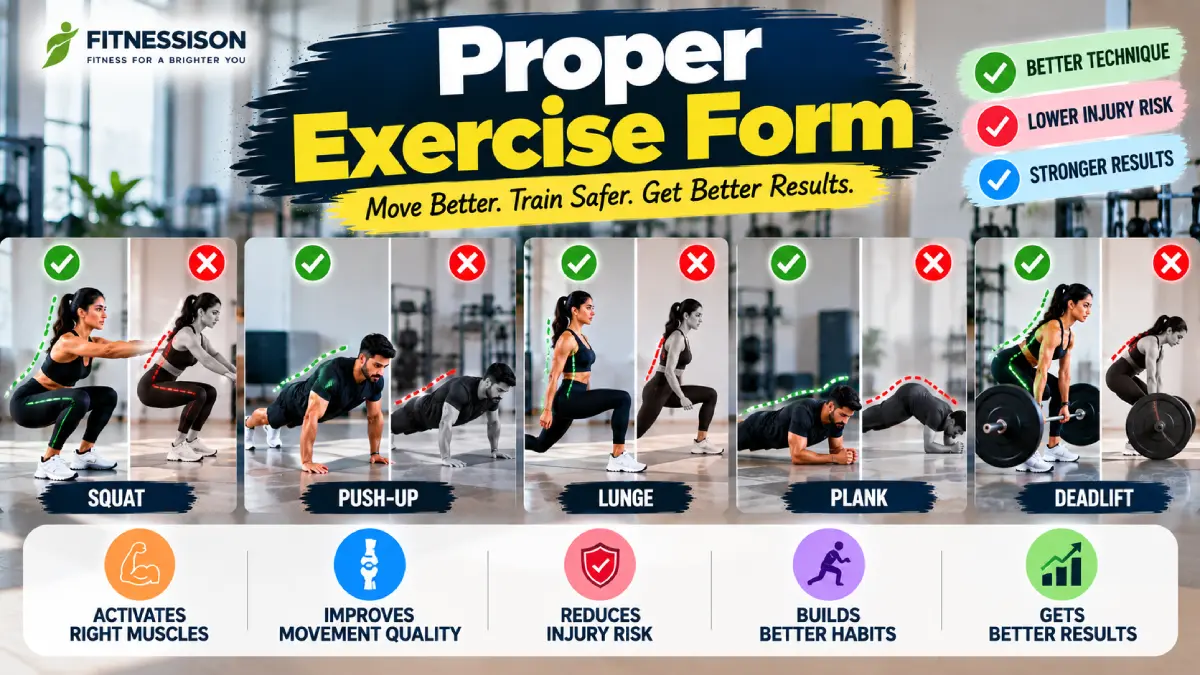
Exercise form is how you position your body and control the movement of the exercise. Good form enables you to perform an exercise with more control and helps you hit the muscles intended to be targeted by the particular exercise. Technique is important whether you are performing a squat, a push-up, a lunge, a plank, or lifting weights. You won‘t have perfect form on your first workout but getting the hang of the basics and practicing improving your control makes your training more effective. Good form also refers to selecting a variation and resistance you can control.
What Does Proper Exercise Form Mean?
Good form is not just about moving through a sequence perfectly.
It means being able to perform the movement with appropriate:
- Body positioning
- Range of Motion Simply put, this term refers to the measurement of the angle created between the extension and flexion of a joint.
- Speed
- Balance
- Stability
- Breathing
- Load or resistance
- Control
Your best technique can therefore be slightly different. For instance, due to differences in body proportions, mobility, strength, or experience, two people might squat with different stances but both have controlled descents. The key is to find a safe and effective pattern that adapts well to your body and your movement.
Why Does Exercise Form Matter?
A hard exercise can be made harder to control by poor technique, and could put certain parts of your body into poses that they shouldn‘t be in. Good technique will help you use the correct muscles and control the exercise.
Form becomes particularly important when:
- Learning to new exercise. You have to take the time to understand a totally new exercise.
- Increasing resistance
- Training near fatigue
- Executing complex Movements
- Going back to exercise after a rest.
But form is not the only consideration. The amount of training, rest and recovery, history of injury, level of general fitness, equipment used, and other factors all have an important influence.
Start With a Weight You Can Control
One of the most common mistakes is selecting a weight that is too heavy. If you find yourself having to swing the weight, significantly altering your body position or repetitively forcing rep out just so you can finish, you are likely selecting too difficult of a weight. Begin light.
Ask yourself:
Is it possible to refine process controls for build-up and removal of material from start to finish?
If no, make the resistor smaller or pick a easier variation. Later the work can be built up.
Focus on the Movement, Not Just the Repetitions
Simple things like counting out a set number of repetitions can be underestimated. For instance, an individual may set a target of 15 squats and simply fly through the last 5. Concentrate on each repetition.
A controlled squat might look like:
- Enjoy a relaxed squat posture.
- Freeze your paws.
- Note: For the following, imagine you are actively bracing your trunk in a normal, natural fashion.
- Flex hips and knees simultaneously.
- In regions under control from 782 B.C. continually.
- Get on your feet again. Take you time. Slow yourself down.
The method will differ based on your body and what kind of squat you’re doing.
Exercise form is how you position your body and control the movement of the exercise. Good form enables you to perform an exercise with more control and helps you hit the muscles intended to be targeted by the particular exercise. Technique is important whether you are performing a squat, a push-up, a lunge, a plank, or lifting weights. You won‘t have perfect form on your first workout but getting the hang of the basics and practicing improving your control makes your training more effective. Good form also refers to selecting a variation and resistance you can control.
What Does Proper Exercise Form Mean?
Good form is not just about moving through a sequence perfectly.
It means being able to perform the movement with appropriate:
- Body positioning
- Range of Motion Simply put, this term refers to the measurement of the angle created between the extension and flexion of a joint.
- Speed
- Balance
- Stability
- Breathing
- Load or resistance
- Control
Your best technique can therefore be slightly different. For instance, due to differences in body proportions, mobility, strength, or experience, two people might squat with different stances but both have controlled descents. The key is to find a safe and effective pattern that adapts well to your body and your movement.
Why Does Exercise Form Matter?
A hard exercise can be made harder to control by poor technique, and could put certain parts of your body into poses that they shouldn‘t be in. Good technique will help you use the correct muscles and control the exercise.
Form becomes particularly important when:
- Learning to new exercise. You have to take the time to understand a totally new exercise.
- Increasing resistance
- Training near fatigue
- Executing complex Movements
- Going back to exercise after a rest.
But form is not the only consideration. The amount of training, rest and recovery, history of injury, level of general fitness, equipment used, and other factors all have an important influence.
Start With a Weight You Can Control
One of the most common mistakes is selecting a weight that is too heavy. If you find yourself having to swing the weight, significantly altering your body position or repetitively forcing rep out just so you can finish, you are likely selecting too difficult of a weight. Begin light.
Ask yourself:
Is it possible to refine process controls for build-up and removal of material from start to finish?
If no, make the resistor smaller or pick a easier variation. Later the work can be built up.
Focus on the Movement, Not Just the Repetitions
Simple things like counting out a set number of repetitions can be underestimated. For instance, an individual may set a target of 15 squats and simply fly through the last 5. Concentrate on each repetition.
A controlled squat might look like:
- Enjoy a relaxed squat posture.
- Freeze your paws.
- Note: For the following, imagine you are actively bracing your trunk in a normal, natural fashion.
- Flex hips and knees simultaneously.
- In regions under control from 782 B.C. continually.
- Get on your feet again. Take you time. Slow yourself down.
The method will differ based on your body and what kind of squat you’re doing.
Proper Form for Common Exercises
Squats
In the basic body weight squat keep your feet planted and lower gradually make sure your knees track forward instead of caving inwards. Keep your torso controlled and get down as deep as you can handle. If you are learning the movement practice the body weight version before moving on to one with a lot of weight.
Push-Ups
Begin with your hands slightly outside or just underneath the shoulders. Keep the body as straight as possible from the head through the hips to the legs. Push down under control and back up. An easier variation is the incline push-up if the regular push-up is too difficult.
Lunges
Advance and descend throughbalance. Do not allow to descend steeply; retain control of downward motion. One can not force back knee to the ground: shorter controlled descents a logical point of departure.
Planks
The plank is not just about staying in the position for as long as possible. The aim is to keep the body rigid and not allowing the hips to sink or rack up. If you are unable to hold the position, take a break or perform a easier version of the exercise.
Hip Hinge and Deadlift
In the application of learning a deadlift or hip-hinge movement, it is critical to initiate the movement by hinging from the hips while gainfully controlling the trunk. Use a very light weight or no weight at all when first learned. Loaded hinge exercises can be intimidating and requires instruction from a trained Fitness Professional.
How to Improve Your Exercise Form
Slow Down
Slow down your repetitions a bit. Moving more slowly can help you become more aware of how your body is moving. You don‘t want to move overly slow, just don‘t do your repetitions as quickly as usual.
Use a Mirror Carefully
The mirror can be a good feedback tool for some movements. However it can be a distraction to always to be looking at yourself. Use it as a learning aid but try to focus on the feeling of the movement and feels whether you can control it.
Record Your Technique
Filming a set from the side or front may occasionally allow you to observe motion patterns that you didn‘t detect during the set. If you are unsure of what you are observing, it may be a good idea to seek feedback from a trained professional.
Reduce the Resistance
If your method starts failing again and again, a quick way to dial it back is lowering the weight. If you get stronger and more controlled you will be able to push yourself more.
Form vs Heavy Weight: Which Matters More?
For the majority of beginners, learning to control an exercise should precede attempting to load more weight. A heavier weight is not necessarily a better workout! If the addition of resistance causes a significant breakdown of technique, then decrease the load and re-establish control. Then build up resistance slowly, while practicing an appropriate movement pattern.
Signs You Should Modify an Exercise
Pay attention when:
- You are unable to get rid of the moving.
- You change your dynamics and your memory of the phrasing from take to take.
- Use momentum to complete.
- You feel severe pain
- Your balance keeps collapsing.
- You can stilt to a 45 degree orientation. You are not able to stay at the intended location.
These indicators do not always mean that you are doing the exercise “wrong”; they are however signs that some form of modification might be necessary to the exercise you are doing. This can include less resistance, less range, a slower speed or a less complicated variation.
A Simple Rule for Better Form
Always perform an exercise without weight until you are able to perform it in a slow, controlled manner.
Think of your progression like this:
About your self-control. Learn Practice Control Progress If you are not learn and practice, you cannot control yourself, which will lead you to progress.
- Keep it simple.
- Practice the movement.
- Build controll.
- Expanding the task/gradually raising the difficulty.
This method might lead to a sustainable workout program, and at the same time help you gain competence with exercises.
Final Thoughts
Exercise form is all about quality of movement, not attempting to make every repetition identical. Use a modification of an exercise you can perform with reasonable control, select a load you can perform with a degree of mastery, and then gradually challenge your strength and movement. It is worth noting that exercise form is only one aspect of injury prevention. Warm up, load selection, recovery, mobility, strength and body awareness all are important considerations.
Exercise form is how you position your body and control the movement of the exercise. Good form enables you to perform an exercise with more control and helps you hit the muscles intended to be targeted by the particular exercise. Technique is important whether you are performing a squat, a push-up, a lunge, a plank, or lifting weights. You won‘t have perfect form on your first workout but getting the hang of the basics and practicing improving your control makes your training more effective. Good form also refers to selecting a variation and resistance you can control.
What Does Proper Exercise Form Mean?
Good form is not just about moving through a sequence perfectly.
It means being able to perform the movement with appropriate:
- Body positioning
- Range of Motion Simply put, this term refers to the measurement of the angle created between the extension and flexion of a joint.
- Speed
- Balance
- Stability
- Breathing
- Load or resistance
- Control
Your best technique can therefore be slightly different. For instance, due to differences in body proportions, mobility, strength, or experience, two people might squat with different stances but both have controlled descents. The key is to find a safe and effective pattern that adapts well to your body and your movement.
Why Does Exercise Form Matter?
A hard exercise can be made harder to control by poor technique, and could put certain parts of your body into poses that they shouldn‘t be in. Good technique will help you use the correct muscles and control the exercise.
Form becomes particularly important when:
- Learning to new exercise. You have to take the time to understand a totally new exercise.
- Increasing resistance
- Training near fatigue
- Executing complex Movements
- Going back to exercise after a rest.
But form is not the only consideration. The amount of training, rest and recovery, history of injury, level of general fitness, equipment used, and other factors all have an important influence.
Start With a Weight You Can Control
One of the most common mistakes is selecting a weight that is too heavy. If you find yourself having to swing the weight, significantly altering your body position or repetitively forcing rep out just so you can finish, you are likely selecting too difficult of a weight. Begin light.
Ask yourself:
Is it possible to refine process controls for build-up and removal of material from start to finish?
If no, make the resistor smaller or pick a easier variation. Later the work can be built up.
Focus on the Movement, Not Just the Repetitions
Simple things like counting out a set number of repetitions can be underestimated. For instance, an individual may set a target of 15 squats and simply fly through the last 5. Concentrate on each repetition.
A controlled squat might look like:
- Enjoy a relaxed squat posture.
- Freeze your paws.
- Note: For the following, imagine you are actively bracing your trunk in a normal, natural fashion.
- Flex hips and knees simultaneously.
- In regions under control from 782 B.C. continually.
- Get on your feet again. Take you time. Slow yourself down.
The method will differ based on your body and what kind of squat you’re doing.
Proper Form for Common Exercises
Squats
In the basic body weight squat keep your feet planted and lower gradually make sure your knees track forward instead of caving inwards. Keep your torso controlled and get down as deep as you can handle. If you are learning the movement practice the body weight version before moving on to one with a lot of weight.
Push-Ups
Begin with your hands slightly outside or just underneath the shoulders. Keep the body as straight as possible from the head through the hips to the legs. Push down under control and back up. An easier variation is the incline push-up if the regular push-up is too difficult.
Lunges
Advance and descend throughbalance. Do not allow to descend steeply; retain control of downward motion. One can not force back knee to the ground: shorter controlled descents a logical point of departure.
Planks
The plank is not just about staying in the position for as long as possible. The aim is to keep the body rigid and not allowing the hips to sink or rack up. If you are unable to hold the position, take a break or perform a easier version of the exercise.
Hip Hinge and Deadlift
In the application of learning a deadlift or hip-hinge movement, it is critical to initiate the movement by hinging from the hips while gainfully controlling the trunk. Use a very light weight or no weight at all when first learned. Loaded hinge exercises can be intimidating and requires instruction from a trained Fitness Professional.
How to Improve Your Exercise Form
Slow Down
Slow down your repetitions a bit. Moving more slowly can help you become more aware of how your body is moving. You don‘t want to move overly slow, just don‘t do your repetitions as quickly as usual.
Use a Mirror Carefully
The mirror can be a good feedback tool for some movements. However it can be a distraction to always to be looking at yourself. Use it as a learning aid but try to focus on the feeling of the movement and feels whether you can control it.
Record Your Technique
Filming a set from the side or front may occasionally allow you to observe motion patterns that you didn‘t detect during the set. If you are unsure of what you are observing, it may be a good idea to seek feedback from a trained professional.
Reduce the Resistance
If your method starts failing again and again, a quick way to dial it back is lowering the weight. If you get stronger and more controlled you will be able to push yourself more.
Form vs Heavy Weight: Which Matters More?
For the majority of beginners, learning to control an exercise should precede attempting to load more weight. A heavier weight is not necessarily a better workout! If the addition of resistance causes a significant breakdown of technique, then decrease the load and re-establish control. Then build up resistance slowly, while practicing an appropriate movement pattern.
Signs You Should Modify an Exercise
Pay attention when:
- You are unable to get rid of the moving.
- You change your dynamics and your memory of the phrasing from take to take.
- Use momentum to complete.
- You feel severe pain
- Your balance keeps collapsing.
- You can stilt to a 45 degree orientation. You are not able to stay at the intended location.
These indicators do not always mean that you are doing the exercise “wrong”; they are however signs that some form of modification might be necessary to the exercise you are doing. This can include less resistance, less range, a slower speed or a less complicated variation.
A Simple Rule for Better Form
Always perform an exercise without weight until you are able to perform it in a slow, controlled manner.
Think of your progression like this:
About your self-control. Learn Practice Control Progress If you are not learn and practice, you cannot control yourself, which will lead you to progress.
- Keep it simple.
- Practice the movement.
- Build controll.
- Expanding the task/gradually raising the difficulty.
This method might lead to a sustainable workout program, and at the same time help you gain competence with exercises.
Final Thoughts
Exercise form is all about quality of movement, not attempting to make every repetition identical. Use a modification of an exercise you can perform with reasonable control, select a load you can perform with a degree of mastery, and then gradually challenge your strength and movement. It is worth noting that exercise form is only one aspect of injury prevention. Warm up, load selection, recovery, mobility, strength and body awareness all are important considerations.
Exercise form is how you position your body and control the movement of the exercise. Good form enables you to perform an exercise with more control and helps you hit the muscles intended to be targeted by the particular exercise. Technique is important whether you are performing a squat, a push-up, a lunge, a plank, or lifting weights. You won‘t have perfect form on your first workout but getting the hang of the basics and practicing improving your control makes your training more effective. Good form also refers to selecting a variation and resistance you can control.
What Does Proper Exercise Form Mean?
Good form is not just about moving through a sequence perfectly.
It means being able to perform the movement with appropriate:
- Body positioning
- Range of Motion Simply put, this term refers to the measurement of the angle created between the extension and flexion of a joint.
- Speed
- Balance
- Stability
- Breathing
- Load or resistance
- Control
Your best technique can therefore be slightly different. For instance, due to differences in body proportions, mobility, strength, or experience, two people might squat with different stances but both have controlled descents. The key is to find a safe and effective pattern that adapts well to your body and your movement.
Why Does Exercise Form Matter?
A hard exercise can be made harder to control by poor technique, and could put certain parts of your body into poses that they shouldn‘t be in. Good technique will help you use the correct muscles and control the exercise.
Form becomes particularly important when:
- Learning to new exercise. You have to take the time to understand a totally new exercise.
- Increasing resistance
- Training near fatigue
- Executing complex Movements
- Going back to exercise after a rest.
But form is not the only consideration. The amount of training, rest and recovery, history of injury, level of general fitness, equipment used, and other factors all have an important influence.
Start With a Weight You Can Control
One of the most common mistakes is selecting a weight that is too heavy. If you find yourself having to swing the weight, significantly altering your body position or repetitively forcing rep out just so you can finish, you are likely selecting too difficult of a weight. Begin light.
Ask yourself:
Is it possible to refine process controls for build-up and removal of material from start to finish?
If no, make the resistor smaller or pick a easier variation. Later the work can be built up.
Focus on the Movement, Not Just the Repetitions
Simple things like counting out a set number of repetitions can be underestimated. For instance, an individual may set a target of 15 squats and simply fly through the last 5. Concentrate on each repetition.
A controlled squat might look like:
- Enjoy a relaxed squat posture.
- Freeze your paws.
- Note: For the following, imagine you are actively bracing your trunk in a normal, natural fashion.
- Flex hips and knees simultaneously.
- In regions under control from 782 B.C. continually.
- Get on your feet again. Take you time. Slow yourself down.
The method will differ based on your body and what kind of squat you’re doing.
Proper Form for Common Exercises
Squats
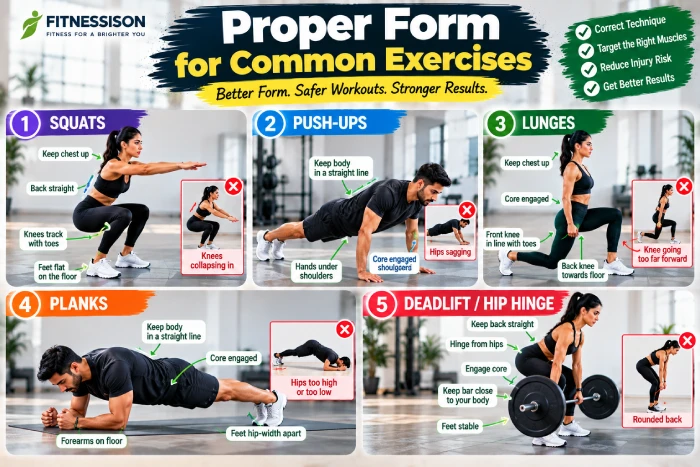
In the basic body weight squat keep your feet planted and lower gradually make sure your knees track forward instead of caving inwards. Keep your torso controlled and get down as deep as you can handle. If you are learning the movement practice the body weight version before moving on to one with a lot of weight.
Push-Ups
Begin with your hands slightly outside or just underneath the shoulders. Keep the body as straight as possible from the head through the hips to the legs. Push down under control and back up. An easier variation is the incline push-up if the regular push-up is too difficult.
Lunges
Advance and descend throughbalance. Do not allow to descend steeply; retain control of downward motion. One can not force back knee to the ground: shorter controlled descents a logical point of departure.
Planks
The plank is not just about staying in the position for as long as possible. The aim is to keep the body rigid and not allowing the hips to sink or rack up. If you are unable to hold the position, take a break or perform a easier version of the exercise.
Hip Hinge and Deadlift
In the application of learning a deadlift or hip-hinge movement, it is critical to initiate the movement by hinging from the hips while gainfully controlling the trunk. Use a very light weight or no weight at all when first learned. Loaded hinge exercises can be intimidating and requires instruction from a trained Fitness Professional.
How to Improve Your Exercise Form
Slow Down
Slow down your repetitions a bit. Moving more slowly can help you become more aware of how your body is moving. You don‘t want to move overly slow, just don‘t do your repetitions as quickly as usual.
Use a Mirror Carefully
The mirror can be a good feedback tool for some movements. However it can be a distraction to always to be looking at yourself. Use it as a learning aid but try to focus on the feeling of the movement and feels whether you can control it.
Record Your Technique
Filming a set from the side or front may occasionally allow you to observe motion patterns that you didn‘t detect during the set. If you are unsure of what you are observing, it may be a good idea to seek feedback from a trained professional.
Reduce the Resistance
If your method starts failing again and again, a quick way to dial it back is lowering the weight. If you get stronger and more controlled you will be able to push yourself more.
Form vs Heavy Weight: Which Matters More?
For the majority of beginners, learning to control an exercise should precede attempting to load more weight. A heavier weight is not necessarily a better workout! If the addition of resistance causes a significant breakdown of technique, then decrease the load and re-establish control. Then build up resistance slowly, while practicing an appropriate movement pattern.
Signs You Should Modify an Exercise
Pay attention when:
- You are unable to get rid of the moving.
- You change your dynamics and your memory of the phrasing from take to take.
- Use momentum to complete.
- You feel severe pain
- Your balance keeps collapsing.
- You can stilt to a 45 degree orientation. You are not able to stay at the intended location.
These indicators do not always mean that you are doing the exercise “wrong”; they are however signs that some form of modification might be necessary to the exercise you are doing. This can include less resistance, less range, a slower speed or a less complicated variation.
A Simple Rule for Better Form
Always perform an exercise without weight until you are able to perform it in a slow, controlled manner.
Think of your progression like this:
About your self-control. Learn Practice Control Progress If you are not learn and practice, you cannot control yourself, which will lead you to progress.
- Keep it simple.
- Practice the movement.
- Build controll.
- Expanding the task/gradually raising the difficulty.
This method might lead to a sustainable workout program, and at the same time help you gain competence with exercises.
Final Thoughts
Exercise form is all about quality of movement, not attempting to make every repetition identical. Use a modification of an exercise you can perform with reasonable control, select a load you can perform with a degree of mastery, and then gradually challenge your strength and movement. It is worth noting that exercise form is only one aspect of injury prevention. Warm up, load selection, recovery, mobility, strength and body awareness all are important considerations.
Squats
In the basic body weight squat keep your feet planted and lower gradually make sure your knees track forward instead of caving inwards. Keep your torso controlled and get down as deep as you can handle. If you are learning the movement practice the body weight version before moving on to one with a lot of weight.
Push-Ups
Begin with your hands slightly outside or just underneath the shoulders. Keep the body as straight as possible from the head through the hips to the legs. Push down under control and back up. An easier variation is the incline push-up if the regular push-up is too difficult.
Lunges
Advance and descend throughbalance. Do not allow to descend steeply; retain control of downward motion. One can not force back knee to the ground: shorter controlled descents a logical point of departure.
Planks
The plank is not just about staying in the position for as long as possible. The aim is to keep the body rigid and not allowing the hips to sink or rack up. If you are unable to hold the position, take a break or perform a easier version of the exercise.
Hip Hinge and Deadlift
In the application of learning a deadlift or hip-hinge movement, it is critical to initiate the movement by hinging from the hips while gainfully controlling the trunk. Use a very light weight or no weight at all when first learned. Loaded hinge exercises can be intimidating and requires instruction from a trained Fitness Professional.
How to Improve Your Exercise Form
Slow Down
Slow down your repetitions a bit. Moving more slowly can help you become more aware of how your body is moving. You don‘t want to move overly slow, just don‘t do your repetitions as quickly as usual.
Use a Mirror Carefully
The mirror can be a good feedback tool for some movements. However it can be a distraction to always to be looking at yourself. Use it as a learning aid but try to focus on the feeling of the movement and feels whether you can control it.
Record Your Technique
Filming a set from the side or front may occasionally allow you to observe motion patterns that you didn‘t detect during the set. If you are unsure of what you are observing, it may be a good idea to seek feedback from a trained professional.
Reduce the Resistance
If your method starts failing again and again, a quick way to dial it back is lowering the weight. If you get stronger and more controlled you will be able to push yourself more.
Form vs Heavy Weight: Which Matters More?
For the majority of beginners, learning to control an exercise should precede attempting to load more weight. A heavier weight is not necessarily a better workout! If the addition of resistance causes a significant breakdown of technique, then decrease the load and re-establish control. Then build up resistance slowly, while practicing an appropriate movement pattern.
Signs You Should Modify an Exercise
Pay attention when:
- You are unable to get rid of the moving.
- You change your dynamics and your memory of the phrasing from take to take.
- Use momentum to complete.
- You feel severe pain
- Your balance keeps collapsing.
- You can stilt to a 45 degree orientation. You are not able to stay at the intended location.
These indicators do not always mean that you are doing the exercise “wrong”; they are however signs that some form of modification might be necessary to the exercise you are doing. This can include less resistance, less range, a slower speed or a less complicated variation.
A Simple Rule for Better Form
Always perform an exercise without weight until you are able to perform it in a slow, controlled manner.
Think of your progression like this:
About your self-control. Learn Practice Control Progress If you are not learn and practice, you cannot control yourself, which will lead you to progress.
- Keep it simple.
- Practice the movement.
- Build controll.
- Expanding the task/gradually raising the difficulty.
This method might lead to a sustainable workout program, and at the same time help you gain competence with exercises.
Final Thoughts
Exercise form is all about quality of movement, not attempting to make every repetition identical. Use a modification of an exercise you can perform with reasonable control, select a load you can perform with a degree of mastery, and then gradually challenge your strength and movement. It is worth noting that exercise form is only one aspect of injury prevention. Warm up, load selection, recovery, mobility, strength and body awareness all are important considerations.