

Mohd Arbaaz is an Editor and Writer at Fitnessison.com with 5 years of experience in SEO and digital content creation. He creates informative, reader-focused content covering fitness, workouts, nutrition, health, healthy lifestyle, technology, and computers.

Shashi Teja is a Reviewer at Fitnessison with over 6 years of experience in SEO, content strategy, digital publishing, and content optimization. He reviews content for clarity, research quality, topical relevance, readability, structure, and overall usefulness to readers.
Last Updated: September 24, 2026
Prevention of overtraining is just part of establishing a sustainable fitness program. The benefits of training hard and consistently include increased strength, endurance, mobility, and overall fitness. But more is not always better. Your body requires some time for adaption. When training becomes too frequent, intense, or demanding, fatigue accumulates faster than the body can recover. This is not just a question of training volume, but of training, recovery, nutrition, sleep, and daily stress-balancing.
What Is Overtraining?
Overtraining is when the stresses that your body is subjected to are greater that what you can recover from. It may be helpful to differentiate this from the simply fatigue of a hard session. Fatigued after a tough session is normal. Fatigued for weeks on end as your performances and motivation slide.
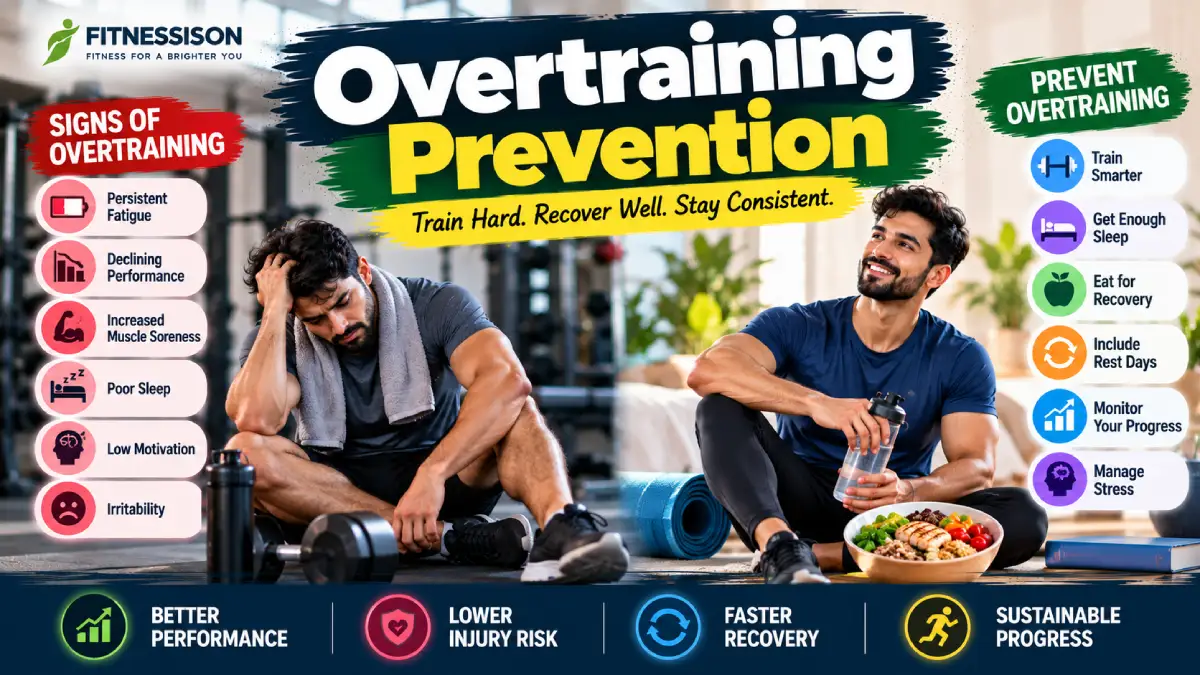
Possible signs that you‘re not recovering well can include:
- Persistent fatigue
- Aforementioned continuing decline in workout performance over a period of time.
- Less muscle soreness
- Poor sleep
- Reduced motivation
- Irritability
- Experiencing an abnormal level of fatigue while engaging in everyday tasks
- Take longer time to recover than normal.
There can be numerous reasons for these symptoms, so they shouldn‘t be solely linked to overtraining.
Why Does Overtraining Happen?
Overtraining is not caused by one hard workout. In most cases, overtraining is more likely to be the result of cumulative training stress combined with adequate recovery.
Common contributors include:
- Increasing the intensity of a workout too quickly
- Going to the gym intensely every day
- Failing to take rest or easier days
- Getting insufficient sleep,3 4 5 6 7 8 9 effects of sleep deprivation.
- Not enough to sustain activity
- The effects of overworking you by doing the same really hard workout too often
- Disregarding chronic fatigue
- The addition of training to those with high everyday stress
For instance one person might add distance onto their run, add an additional session of weight lifting and start some high intensity training all simultaneously. At first glance they might be manageable, however combined they may become seemingly impossible to bounce back from.
7 Strategies for Overtraining Prevention
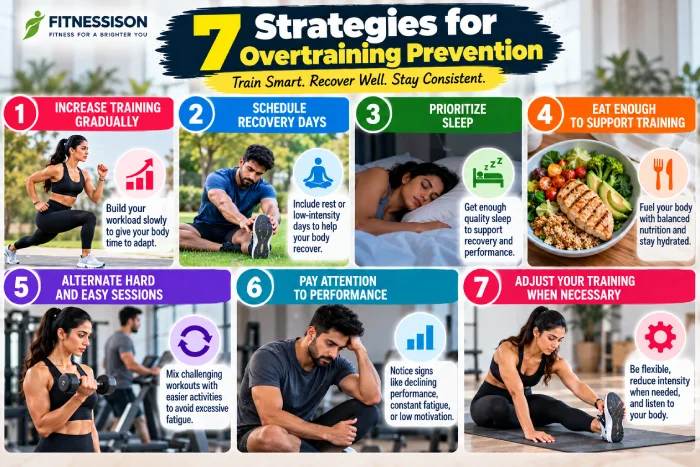
1. Increase Training Gradually
The easiest thing to do to control the effects of training stress is not to increase everything at the same time. Simply trying to increase running distance but not either speed or weekly training sessions is often an effective way of avoiding over training.
Think of progression as:
Build → Adapt → Progress
Not attempting to improve everything at once.
2. Schedule Recovery Days
Rest is not wasted training. It‘s a time that you can rest your body from all the training you have done before.
Depending on your program, recovery might involve complete rest or low-intensity activities such as:
- Walking
- Gentle mobility
- Easy cycling
- Light stretching
Recovery requirements will vary depending on your training volume. Fitness levels, Age etc.
3. Prioritize Sleep
Exercise is an essential part of physical restoration. Although adults require sleep to restore, this amount varies from person to person. When it comes to exercising, don’t just think about how long you’re working out: Do you sleep enough on a regular basis? A few simple practices can be helpful: going to bed and arising at about the same time each day, establishing a peaceful sleeping environment, and avoiding sleeping inhibitors.
4. Eat Enough to Support Training
Having enough energy and nutrients to get through workouts and recover is essential for your body. Daily exercise combined with chronic under-fueling can make fatigue much more difficult to deals with.
A balanced diet can include:
- Protein-rich foods
- Whole grains and other carbohydrate-rich foods
- Fruit and vegetable
- Healthy fats
- Adequate fluids
Your diet‘s composition will depend upon the types of activity you are involved in and your individual goals.
5. Alternate Hard and Easy Sessions
Sometimes you just don‘t need to make every workout a push for all you‘re worth. Create a weekly routine with some tough sessions and some lighter sessions.
For example:
- Monday: – Strength training
- Tuesday: Gentle walk or mobility
- Wednesday: Weight lifting
- Thursday: Recovery effort
- Friday: Cardio
- Saturday: Optional light activity
- Sunday: Rest
This isn’t as crucial for every individual. The idea is to prevent consecutive books of training body-high quality without rest in between.
6. Pay Attention to Performance
Performance can also give you valuable feedback on your response to training. If your usual workout feels far more difficult, your pace is slowing drastically, or your regular strength tests are consistently falling-off, don‘t just ‘train through it’ think about whether you need more recovery. Performance will naturally dip temporarily from time to time, and there are many possible reasons for this (lack of sleep, high stress levels, bad diet, sickness, the hard workout). Be aware of trends rather than every single time your performance drops-off.
7. Adjust Your Training When Necessary
A training plan should be adaptable. Sometimes it is more beneficial to dial down the intensity or volume than to push through another hard workout when you‘re feeling knackered although it doesn‘t mean putting your dreams on hold. It just means adjusting the plan to something you can sustain over the long haul.
Overtraining vs Normal Muscle Soreness
It‘s not difficult to muddle up the soreness felt after training hard with the signs of over training. Usually a new or intense workout will leave you slightly sore for a few days. This in itself does not mean you are overtraining. Yes, the concern should be taken if fatigue, soreness, poor recoveries, poor performance or other signs are still present or significantly affecting your normal day to day activity. If symptoms are excessively severe or consistent and abnormal, consult a suitable health care professional.
How Much Exercise Is Too Much?
Not everyone knows the magic number for too much exercise.
The amount you can handle depends on factors such as:
- Training experience
- Workout intensity
- Training frequency
- Sleep
- Nutrition
- Stress
- Recovery
- Health status
Even a professional athlete can handle training volume that might be too much for a beginner. Rather than following someone else‘s program, plan your training load around your present level of fatigue and scale up from there.
A Simple Recovery Check
Before starting a demanding workout, ask yourself:
- How did I sleep?
- How I Feel Today?
- Am I performing normally?
- Am I still feeling the pain from what I did earlier?
- Have I been training solidly for a few days in a row?
If three or more answers imply that your fatigue level is high, play today‘s session down.
Final Thoughts
How to Prevent Overtraining Preventing overtraining is managing the interaction between work and rest. Train consistently but not every session; log and plan your training and trade intensity for volume; allow lighter days; sleep well and eat quality food; be alert to signs and symptoms of fatigue, and not just how we feel. You do not need to work the hardest every day to gain benefit.