

Mohd Arbaaz is an Editor and Writer at Fitnessison.com with 5 years of experience in SEO and digital content creation. He creates informative, reader-focused content covering fitness, workouts, nutrition, health, healthy lifestyle, technology, and computers.

Shashi Teja is a Reviewer at Fitnessison with over 6 years of experience in SEO, content strategy, digital publishing, and content optimization. He reviews content for clarity, research quality, topical relevance, readability, structure, and overall usefulness to readers.
Last Updated: September 23, 2026
Mobility is the practice of controlled movements that enhance the use or increase of your available range of motion. Contrary to stretching, mobility exercises involve movement, strength, balance, coordination and control. You don‘t have to be an athletic to do mobility work. Mobilty exercises can be incorporated into warm up routines, cool down, active recovery or short movement snack breaks during the day. The focus is not to push your joints into uncomfortable extremes, but to move better and with more confidence through ranges that are relevant to your daily life and training.
What Are Mobility Exercises?
Mobility drills involve moving joints through a range of motion in a controlled manner. An ankle mobility drill might consist of using the knee to roll over the toes while the heel stays grounded. A hip mobility drill might consist of slow hip circles or lunging with a twist.
Common mobility exercises include:
- Ankle rocks
- Hip circles
- Shoulder circles
- Thoracic rotations
- Cat-cow movements
- Walking lunges
- Controlled squats
- Arm raises
Mobility exercises are unlike passive stretches in that you are in control of the movement.
Why Is Mobility Training Important?
Mobility may influence your efficiency in motion and activity. Activities such as walking, squatting, reaching overhead, walking out of a chair, ascending stairs, and lifting objects involve joints in useful ranges of motion. Working on mobility can help to develop these movement patterns. It also can go hand-in-hand with strength training, because strength in a controlled range of motion is a part of functional movement. Keep in mind, mobility trainings may not be the solution to preventing injury and pain. If you have ongoing pain or injury then you should consider seeking guidance of a professional.
Best Mobility Exercises for Beginners
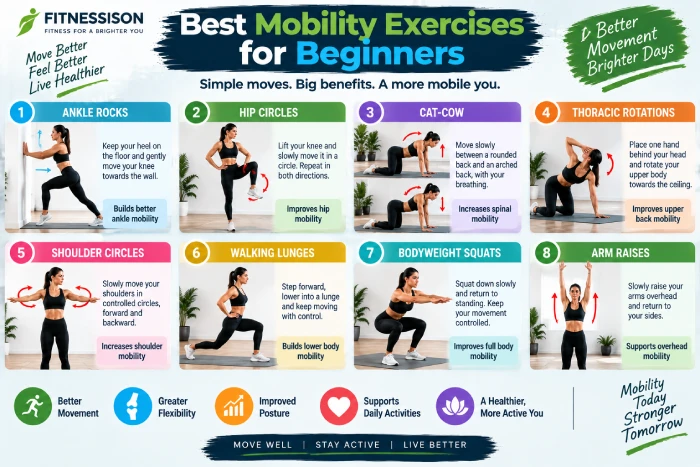
1. Ankle Rocks
Stand with one foot slightly in front of the other, facing the wall. Place the heel of the front foot flat on the ground and slowly bend the knee forward. Then return to the start position and repeat.
Why: It provides anterior ankle dorsiflexion which is a movement that can be beneficial to walking, lunges and squats.
2. Hip Circles
Hold upright, support if needed. Slightly lift the knee and gradually make a slow circular motion. Repeat in both directions then switch side.
Tip: Ensure the movement remains comfortable rather than attempting to form the largest circle.
3. Cat-Cow
Begin on all fours. Begin to slowly round your back and then go through the opposite shape slowly. Take your time and go along with the breath, not forcing your back into the maximum stretch.
Why do it: control of motion through the spine.
4. Thoracic Rotations
Begin on all fours. Place one hand behind your head. Keeping your lower body still, slowly rotate your upper body toward the ceiling. Return to start position and repeat on the other side.
Reason to try: It makes the upper-back rotate in a controlled fashion.
5. Shoulder Circles
Stand in a comfortable position and keep moving your shoulders in slow, controlled circles. These can be small initially, and gradually enlarged until comfort is achieved.
Why do it: this is a simple motion that can be added before working your upper body or after lengthy periods on the computer.
6. Walking Lunges
Step forwards with control into a lunge and then push up through the floor to rise up. Repeat starting with the other leg.
Why do it: Walking lunges incorporate movement of the lower body, balance, and coordination.
7. Controlled Bodyweight Squats
Begin with stand relaxed on your feet. Rest slowly go down to squat, then back to starting position, remain focused on control.
Why should we do it: Squats provide an opportunity to develop smooth teamwork of the ankles, knees, hips and trunk.
8. Arm Raises
Lift your arms slowly and smoothly above your head then slowly lower them. Do not attempt to over stretch your shoulders.
Why try it: An easy way to give overhead work a go.
How Often Should You Do Mobility Exercises?
There is not one all-encompassing schedule that fits everyone. A quick mobility routine done daily a few times per week is a good place to start. It is also possible to add a couple of exercises to your current warm up.
For example:
Before a lower-body workout:
- Ankle rocks
- Hip circles
- Walking lunges
- Bodyweight squats
Before an upper-body workout:
- Shoulder circles
- Arm raises
- Thoracic rotations
- Controlled reaching
You don‘t need to dedicate 30 or 60 minutes every day to mobility. Having a shorter routine makes it more likely that you‘ll keep doing it regularly.
Mobility Exercises vs Stretching
Mobility exercises and stretching are similar, but not the same. Many stretching exercises are about relaxing and stretching the muscles and tissues around the joints to maintain or improve flexibility. Movement exercises are about actively controlling the movement. For instance, a hamstring stretch while sitting is a flexibly exercise, while a slow, controlled leg raise exercises the control of the active use of the muscles through the range of motion. Both can be part of an fitness program.
Common Mobility Training Mistakes
Moving too quickly
Movements that are too fast can be difficult to control.
The more reasonable approach: Adopt a relaxed attitude in terms of tempo and take your time to pay attention to the movement.
Forcing your range
For certain test conditions, the extensive range was not necessarily better.
Less optimal procedure: Utilize a large range of motion, and then increase it over time.
Ignoring strength
Flexibility is fine but how about mobility:
Better approach: Go for strength work which you can control through the relevant ranges, where suitable.
Copying advanced routines
Another person may have different mobility requirements than yourself.
Correction: 4. Select exercises that reflect your activities and limitations to movement, points:
Expecting instant results
Mobility is most often acquired with repetition.
Improved method: Monitor improvement over time. Wait until several weeks into a training program before rating yourself. Do not make an assessment after a single training.
A Simple 10-Minute Mobility Routine
If you‘re new to mobility training, try this simple structure:
- 1 minute: Shoulder circles and arm swings
- 2 minutes: rotations thorase
- 2 minutes-hip circles
- 2 minutes ankle rocks
- 2 minutes: Body weight squats (done in controlled fashion)
- 1 minute: All body very relaxed movement
Maintain the movement within a comfortable pain free range. Do not force through sharp pain or prolonged discomfort.
Final Thoughts
Mobility exercises allow you to learn how to control movement and remain in a good range of motion. They are actually quite simple and do not require special equipment or intences training programs. Simply performing movements like ankle rocks, hip circles, thoracic rotation, shoulder circles, lunging, and controlled body weight squats can accomplish just this.