
Mohd Arbaaz is an Editor and Writer at Fitnessison.com with 5 years of experience in SEO and digital content creation. He creates informative, reader-focused content covering fitness, workouts, nutrition, health, healthy lifestyle, technology, and computers.

Shashi Teja is a Reviewer at Fitnessison with over 6 years of experience in SEO, content strategy, digital publishing, and content optimization. He reviews content for clarity, research quality, topical relevance, readability, structure, and overall usefulness to readers.
Last Updated: September 23, 2026
Foam rolling is an easy way to massage your own muscles and other soft tissues as you lie on or roll over a hard foam cylinder. This is done by the chair of pressure on the tissues by the foam. You can use it prior to activity, post activity or when on recovery days. You may have seen foam rollers in the gym or at a therapy clinic. They can be an effective method for people who feel tight after training or during a deskbound working day. Foam rolling should not be used instead of stretching, strength training or therapy but should be one of several elements of your mobility programme.
What Is Foam Rolling?
Foam rolling- Moving a body part back and forth over a foam roller, using your own body weight to apply pressure.
Common areas include:
- Calves
- Hamstrings
- Quadriceps
- Glutes
- Upper back
- Lats
The pressure might be uncomfortable to some, and over certain sensitive areas, but should never be sharp or “OUCH!!” feeling. What you are not trying to do is smash the muscle or roll at top speed 14, no need for a rollercoaster ride here. Slow steady control is usually more beneficial than rolling back and forth at speed.
What Is it good for in terms of foam rolling?
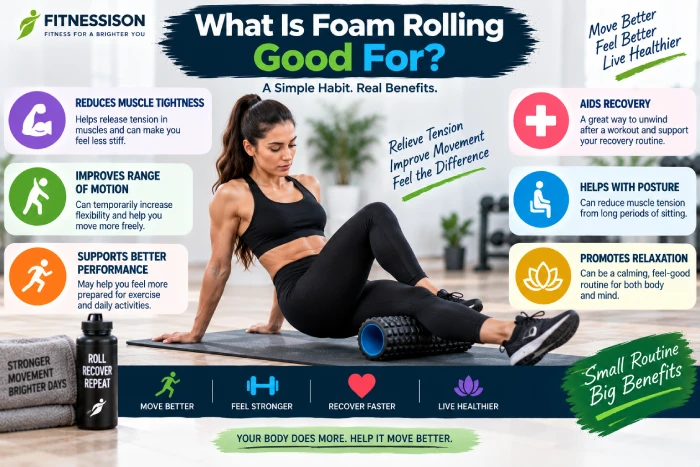
1. May Improve Short-Term Range of Motion
Foam rolling can make a joint or muscle group move more freely for a period of time. For instance foam rolling the quadriceps before lower-body training might make some movements easier. However, this does not indicate foam rolling permanently alters muscles or joints. The changes are usually short term which is why foam rolling is beneficial prior to a movement.
2. May Reduce Feelings of Muscle Tightness
Once you have worked out, you may notice that your muscles feel tight or uncomfortable. Foam rolling is a type of selfmassage that some people find calming and worthwhile in alleviating these feelings.
3. Can Complement Mobility Training
Foam rolling and mobility training compliment each other nicely. For example, spend 3-5 minutes rolling out your upper back area and then take your thoracic mobility exercises. The roller isn‘t taking over just yet. It just gets added into the movement.
4. Easy to Use at Home
You do not need to belong to a gym or perform any complex arrangements to use a foam roller. After a few simple lessons you can effectively use one in your own home with a minimum of space.
5. Supports a Recovery Routine
Different recovery methods are: foam rolling, in addition with walking, light mobility exercises, stretching, sound sleep, and a properly designed training program. Recovery is not about the one magic approach. It‘s about controlling of your overall training.
How to Foam Roll Safely
Begin by selecting a comfortable roller. Those new to self-myofascial release may want to select a softer roller. Those more advanced in self-myofascial release may select a firmer roller. Position the target muscle group over the roller. Hold body weight with hands, feet, or other part of the body to adjust the degree of intensity.
Then:
- In a slow breathing pattern.
- Take a few moments to pause over the opening of this movement where it is tight or sensitive.
- Breathe normally.
- Make sure you do not roll over any bones or joints.
- Minimize the pressure.
- Immediately cease if you notice any severe or abnormal pain.
After some time you don‘t have to put in long hours at the muscle every time. Your body should respond just after a short session.
Best Foam Rolling Exercises
Quadriceps Roll
Lie on your stomach over the foam roller, which should be placed directly under the thighs. Push off your arms and slowly roll from just above the knees toward the hips do not roll directly over the knee joint.
Hamstring Roll
Position yourself on the floor with the roller beneath the thighs. Support yourself with the hands and roll backwards and forwards. If you prefer, you can focus on one leg at a time.
Calf Roll
Following a one- leg stance roll your lower leg back and forth over the roller. Sit with the roller under one calf. Place your hands behind you and slowly roll your lower leg over the roller. Repeat on the other side.
Glute Roll
Roll on foam roller. Lean distribute your weight more on your left or right to soften the pressure distribute your weight. Roll slowly throughout your gluteus. Do not roll too aggressively.
Upper-Back Roll
Position yourself supine with the roller located on your upper back. Place the hands behind the head and gently extend and flex the upper back on the roller. Do not roll too aggressively over the neck or lower back.
When Should You Foam Roll
You can perform foam rollingbefore, during or afteryour workout.
Prior to a workout.
A quick addition that can ease you into exercise is to get comfortable with moving. Try an exercise routine and then include a series of dynamic motions to prep you for workout.
For example:
Foam rolling >pressing into dynamic mobility >working out
After an exercise:
Foam rolling is also popular among some after the workout as part of a cool-down. Do this in conjunction with some light stretching and deep breathing:
On recovery days
A short session can also be added when there‘s no hard workout planned, instead work a few miles on foot or play with some easy mobility drills.
Foam Rolling vs Stretching
Both foam rolling and stretching are different.
- Foam rolling: External pressure, self massage,
- Static stretching: stretches a muscle by holding it in a lengthened position.
- Dynamic mobility:Relies on controlled active movements.
You can utilize all three based on your objectives. For instance, an individual can foam roll for a minute, mobilize for a minute, do a workout, then end with relaxing static stretching. Do not feel obligated to incorporate all three. Select modalities that can benefit your training.
Common Foam Rolling Mistakes
Wrong speed of rolling; roller set is an important factor in determining the correct speed. If too fast, surface may become dulling or burnish by dragging the work surface against the die face. Also, the work surface is dragged, which causes a drag on the workpiece, raising the force required for roll-ing.
Moving fast increases the difficulty of pressure control.
Best approach: Pause to observethe feeling of the area.
Applying an excessive amount of force: If an instrument is held “too firmly,” inadvertent injury to tissue is more likely. For instance, pincers, needle holders, or scissors may slip away and cause damage to the affected tissue.
The more the pressure, the better.
Better approach: Suggest to start with moderate pressure and increase pressure if felt comfortable.
Rolling directly into joints
The roller is designed for use on soft-tissue areas (not for forceful application into joints).
Better approach: Work behind the joint to avoid putting too much weight directly on it.
Assault on pain as an object (pain as a conquerable thing)
Foam rolling is not pain free, but pain is different from discomfort.
Improved method: Pause or lessen the pressure if you experience discomfort or odd sensations.
Expecting foam rolling to solve all problems
If pain persists, if injury occurs, or if there is weakness or limited movement, seek professional evaluation. Foam rolling is not a replacement for medical or physical therapy treatment.
How Often Should You Foam Roll?
There is no one rigorous schedule that applies to everyone. You can incorporate foam rolling once in a while before or after your workout or you can simply add a few short sessions to your “off” days. Just don‘t let foam rolling take the place of the basics of working out.
Prioritize:
- Strength training
- Regular movement
- Mobility exercises
- Appropriate stretching
- Sleep
- Balanced nutrition
- Has a good workout recovery.
Foam rolling is not meant to replace those habits but rather, be added onto them.
Final Thoughts
Foam rolling is an easy way to include self-massage and movement prep in your workout. It may assist with short-term range of motion and muscle tightness, and many individuals use foam rolling in their warm-up or post-workout routine. Use slow, gentle movements and do not try to force into painful areas. Most importantly, think of foam rolling as just one aspect of a comprehensive movement program. Add mobility work, strength training, flexibility, and general physical activity to your program to maximize fitness.