

Mohd Arbaaz is an Editor and Writer at Fitnessison.com with 5 years of experience in SEO and digital content creation. He creates informative, reader-focused content covering fitness, workouts, nutrition, health, healthy lifestyle, technology, and computers.

Shashi Teja is a Reviewer at Fitnessison with over 6 years of experience in SEO, content strategy, digital publishing, and content optimization. He reviews content for clarity, research quality, topical relevance, readability, structure, and overall usefulness to readers.
Last Updated: September 22, 2026
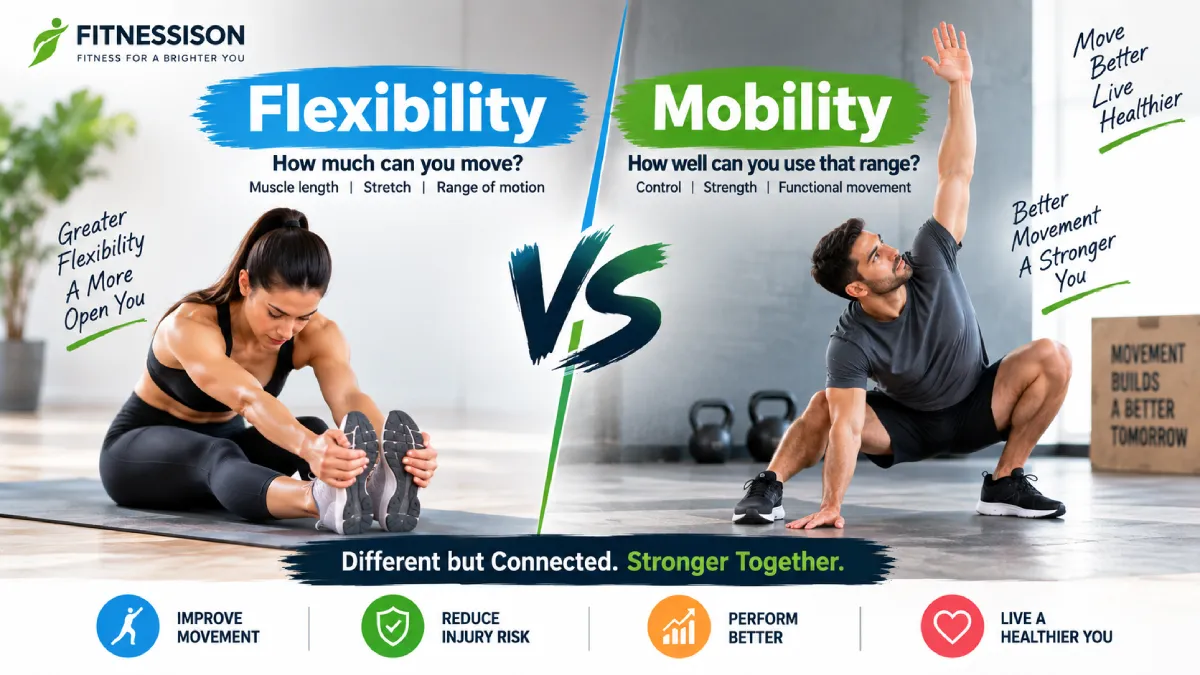
A popular question among those who exercise, stretch, practice yoga, or want to improve movement is, ‘what is the difference between flexibility and mobility?’ The terms are often used synonymously but it turns out they refer to two related but separate concepts. Flexibility is primarily concerned with the availability of the range of motion (ROM) whereas mobility is a measure of the optimal use of the available ROM. Flexibility is about the available ROM and mobility about the active use of available ROM.
What Is Flexibility?
Flexibility is defined as the capacity of a muscle group and the related soft tissues to lengthen, thus allowing a joint to move through its range. An example of a flexible person would be able to perform a hamstring stretch. The hamstring muscles are located on the back of the thigh.
Flexibility can vary from person to person because of factors such as:
- Age
- Body structure
- Joint anatomy
- Activity level
- Training history
- Muscle characteristics
- Previous injuries
Flexibility is in many cases is addressed with stretching. Static stretch has the edges of an extended position held for a period, and is frequently used if improving flexibility is the primary goal. Having improved flexibility doesn‘t necessarily mean you‘ve developed control of that range.
What Is Mobility?
Mobility is the ability to actively move a joint or body part through the available range of motion with control.For instance, say you can use your hands to lift your leg high toward your chest. This would demonstrate that your body is capable of getting into that position. Now say you could lift your leg to a similar degree using only your muscular force that is a different matter.
Mobility involves several factors, including:
- Range of motion.
- Coordination
- Balance
- Stability
- Motor control
Which is precisely why it is more beneficial for the mobility circuit do controlled movements instead of passive stretching;
Flexibility vs Mobility: Key Differences
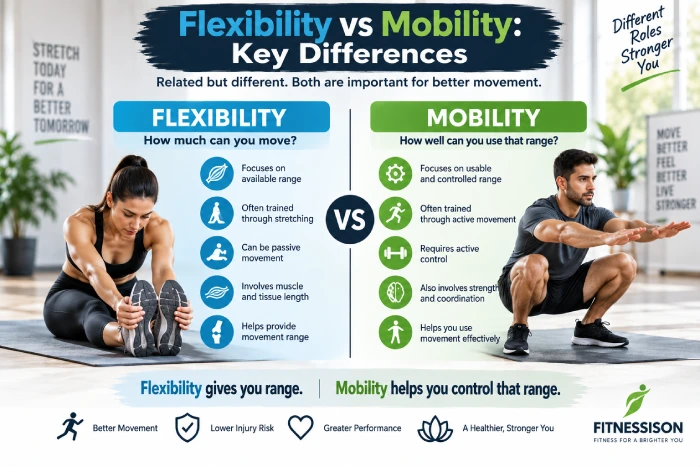
| Flexibility | Mobility |
| Center mainly on available range | Text Concentrates on sampling within a usable and controlled range |
| Often trained via stretching | Frequently through eccentrics61 With dynamic movement. |
| Can also be a passive movement. | Requires active management. Specifically, they demand some level of active control. |
| The involves the length of the muscle and the tissue | Involves also strength and coordination |
| Helps provides movement range 9. | Guides you in the healthy use of movement |
The two characteristics are related they are not equal. Flexibility can be described as a system that allows one to reach a take position. Mobility on the other hand is one’s ability to get into and stay within that position.
Can You Be Flexible but Not Mobile?
Yes.
An individual can have fantastic passive flexibility but have poor control through the same range during performing an exercise. For instance, an individual may be able to reach a particular position in a deep squat when assisted but may find it difficult to get into a deep squat position independently with good control. Continually practicing stretching exercises may not be the answer as the individual would need more controlled mobility based exercises and strength work through the relevant range. This is a good example of why it should not be assumed that every restrictions to movement are the result of a lack of flexibility.
Can You Have Good Mobility Without Extreme Flexibility?
Yes.
You do not need to be the most flexible person in the world to have functional mobility. Your mobility should meet your specific needs and activities. A runner, weight-lifter, yoga enthusiast and office worker all have different movement needs. For instance, if you squat the amount of ankle and hip ROM to get to the 90 degree position is what you‘re after. On the other hand, if you do a lot of over-head work you will need good shoulder and upper-back mobility. The point here is not to have the greatest ROM in the world. It is to have useful range with control.
Why Do You Need Both?
Flexibility and mobility affect each other. Think about doing a squat. You require sufficient mobility in your ankles and hips to get to the bottom, but also controlled strength, coordination, balance and control to hold it. You can extend this principle to lunges, running, over-head movements and other daily activities, so a well-rounded programme can involve both flexibility and mobility work.
Flexibility exercises may include:
- Hamstring stretches
- Calf stretches
- Hip-flexor stretches
- Chest stretches
- Gentle static stretching
Mobility exercises may include:
- Ankle rocks
- Hip circles
- Shoulder rotations
- Thoracic rotations
- Controlled squats
- Dynamic lunges
When Should You Train Flexibility and Mobility?
Mobility exercises are good to include in a warm-up since they are controlled movements. For instance, doing ankle movements, hip circles and controlled bodyweight squats before doing a session for the lower body. Flexibility training can be done after a session or as its own flexibility session. Duration doesn’t necessarily mean quality so you don’t need to spend an hour doing mobility work. Better to do five minutes regularly than forty-five minutes rarely.
Common Mistakes to Avoid
One of the most common errors is the belief that every movement restriction must be stretched out.
Other mistakes include:
- Painful flexes/assisted stretch (If you not – Second knee flexion from end range to 2 nd knee flexion.
- Chasing extreme ranges of motion
- Ignoring strength training.
- Copying someone‘s else routine
- Taking random mobility exercises
- Expecting immediate results
- Stretching without moving.
If any movement is stiff or has a “stabing” or “bitey” feel to it, and does not become soft and resting, don‘t push in.
How Do You Know What You Need?
Ask yourself three simple questions:
Do I have enough range?
If not, the use of flexibility work may help.
Can I control the range actively?
If not, perhaps more focus on mobility and strength work is warranted.
Does the limitation affect an activity I actually perform?
Target your training towards the motions that are relevant to your training, sporting, or daily existence.
Final Thoughts
It always helps to bear in mind that flexible vs mobility comparison by making this simple distinction: flexibility is predominantly about potential range and mobility is about actively performing control for that range.
You‘re free to do both. For example, a balanced approach to fitness would include stretching, mobility drills and strength training to get you moving and feeling good. The objective isn‘t to be more flexible than anyone else (unless you want to). The objective is to learn what you need and have strength and control to use it.