

Mohd Arbaaz is an Editor and Writer at Fitnessison.com with 5 years of experience in SEO and digital content creation. He creates informative, reader-focused content covering fitness, workouts, nutrition, health, healthy lifestyle, technology, and computers.

Shashi Teja is a Reviewer at Fitnessison with over 6 years of experience in SEO, content strategy, digital publishing, and content optimization. He reviews content for clarity, research quality, topical relevance, readability, structure, and overall usefulness to readers.
Last Updated: September 23, 2026
Dynamic stretching is stretching that involves movement where the joints and muscles are moved through a pain free range. Static stretching, differs in that the position is held, where as dynamic involves continual motion. It is used often before activity such as sport, running, weight lifting and other exercise activity. A basic example of a dynamic stretching routine does not have to take a long time. It is a matter of three or four gentle controlled strokes to switch your body from inactivity to activity and ensuring the key joints and muscles are considered:
What Is Dynamic Stretching?
Dynamic stretching involves actively moving through a joints full ROM. For instance than performing a static hamstring stretch you could perform a controlled swing of your leg. Instead of holding your arms in one position you could use controlled arm circles.
Common dynamic stretches include:
- Leg swings
- Arm circles
- Walking lunges
- Hip circles
- Torso rotations
- High-knee marches
- Bodyweight squats
- Ankle movements
The key word here is controlled. Dynamic stretching doesn‘t just mean you get to go bananas and rebound left and right or shove a joint into its maximum extent. It should ease into motion and help get your body ready for what is to come.
Dynamic Stretching vs Static Stretching
Dynamic and static stretching serve different functions.
| Dynamic Stretching | Static Stretching |
| Active voice This use of voice is very common. It is where the subject of the sentence performs the action. | Currently serves as Sign Language Instructor and consultant. |
| It moves through a variety of motions. | Roars and extends to a stretch. |
| Sometimes played at warm-ups | Commonly performed following workout or on alternate days for flexibility session without working out |
| Physiological Increases blood flow to the cardiovascular and respiratory systems so oxygen is available for the working muscles. Muscle Warm-Up. The joint‘s range of motion and elasticity increase with movement.37 38The physiological effects of warming up also enhances neuromuscular efficiency by increasing the speed of nerve transmission.90 | Typically used will be effective on the flexibility. |
| Rp59ardemRecheisure usually performed with respect to controlled repetitions | Typically at a time period |
One is not necessarily better than the other. It depends on what do you want to accomplish, what kind of workout are you doing, etc. For instance, some dynamic movements are logical before a strength or running workout; on the other hand, you can add some static stretching when increasing your flexibility is your ultimate goal.
What Are the Benefits of Dynamic Stretching?
1. Prepares Your Body for Exercise
Dynamic stretching is used to actively engage the joints and muscles you will train. For example, a runner might choose to do leg swings or walking lunges. An individual getting ready to train their upper body might do arm circles or thoracic rotations.
2. Increases Movement Readiness
Gradually moving through various ranges may help ease you into working out from a state of being inactive. This can be beneficial if you‘ve been sitting for an extended period of time before your session.
3. Supports Movement Quality
Through controlled movement you can also work on the positions you will take during your training. For instance, doing bodyweight squats can help you develop a solid squat position, yet still allow you to practice movement control.
4. Supports Mobility
Dynamic stretching might be just one element of a mobility program. Unlike static stretching, where the stretch is static, dynamic movements are active. This provides opportunity for more coordination and control:
5. Makes Warm-Ups More Specific
A warm-up should set you up for the activity you are about to do. Dynamic stretching allows a workout specific warm-up to be developed rather than a static or usual warm-up.
Best Dynamic Stretching Exercises
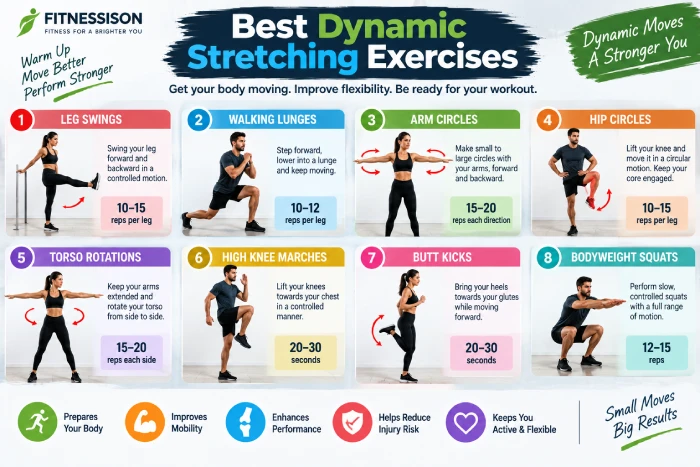
You don‘t need to do lots of exercises. Pick a movement that fits with the workout you are doing.
Leg Swings
While holding on to a chair or stable object, swing one leg forward and backward. Be gentle and increase the forward and backward motion, just as long as it is comfortable.
Walking Lunges
Take a step forward into a lunge, bring your step under you, and continue walking. Walking lunges are great for warm-ups because they warm up the hips, knees and legs for the rest of the workout.
Arm Circles
Make circles with your arms and then increase the size of circle and arm movement. Do not go to pain, but keep the movement comfortable rather than stretching the shoulders to death.
Hip Circles
Maintain an upright posture and slowly circle one leg in controlled motions. This can be particularly effective before performing a workout that involves the lower-body.
Torso Rotations
Walk around and rotate your chest from side to side, bend in the knees slightly. Do not jerk the rotation and, when stepping, position the feet comfortably apart.
Bodyweight Squats
Perform 8-12 slow bodyweight squats prior to lower-body training. Ensuring that depth is tolerable and that the feet are stiff.
How Long Should Dynamic Stretching Take?
There is no one size fits all for every individual. A realistic warm-up might be anywhere from 5 to 10 minutes for most workouts.
For a lower-body workout, you might spend several minutes on:
- Ankle movements
- Hip circles
- Leg swings
- Walking lunges
- Bodyweight squats
For an upper-body workout, you could include:
- Arm circles
- Shoulder movements
- Thoracic rotations
- Controlled reaching movements Reaching movements: all movements that bring the hand from the resting position to the target; seems to be the most studied movement in the experiment.
Warm-up, not drain out. If your warm-up has you spent before you start, then you may have overdone it.
Common Dynamic Stretching Mistakes
While the task of performing dynamic stretches is fairly straightforward, the technique you choose is not insignificant.
Moving too aggressively
Rapid, uncontrolled movements may exert unnecessary pressure on joints and muscles.
A superior method: Begin at a slow pace and softly increase the range.
Copying advanced athletes
An exercise movement which is suitable for an experienced athlete may also be unsuitable for a beginner.
Improved strategy: Choose easier movements within your skill level.
Treating pain as progress
Static–First, pain during dynamic stretching should not be sharp or get worse.
Better strategy: Within an acceptable range and cease operations if you are sensing the series of candles/reads/losses up to that point is indicating a problem.
Using the same routine for every workout
Warm-ups can be specific to the task at hand. Adapt your warm-up to what you are about to do.
Better way: Make your dynamic stretching workout specific.
Turning stretching into a workout
A warm-up is designed to get you ready to perform don‘t kill yourself in the process.
Approach can be improved: Maintain the correct intensity.
Is Dynamic Stretching Good Before a Workout?
For some of these workouts I think it would be beneficial to have some dynamic movement involved in the warm-up. During practice prior to a run, attention might be divided between the hips, ankles and legs. You are able to train similar to your regular workout. Prior to participation in sports, sport-specific activities that are performed can serve as a good precursor to faster activity. Remember though, dynamic stretching should not replace your complete warm-up. You may also want to warm-up by gradually increasing the intensity of the movement you are going to do.
Dynamic Stretching and Flexibility
Dynamic stretching, while good for your total movement practice and mobility, isn‘t the only aspect of flexibility training you could utilize. If the reason you are interested in improving flexibility is because you want to be more flexible, you could incorporate static stretches and strengthening exercises through useful ranges of motion into a more comprehensive program. Remember, dynamic stretching is just one tool you might employ.
Final Thoughts
Dynamic stretching is another way to prepare the body for many forms of exercise. Unlike static stretching, it involves moving through a comfortably controlled range of motion and helps to warm-up the joints, muscles and movement patterns. Maintain a controlled movement, avoid moving into ranges that are not comfortable and match the specific exercise.