

Mohd Arbaaz is an Editor and Writer at Fitnessison.com with 5 years of experience in SEO and digital content creation. He creates informative, reader-focused content covering fitness, workouts, nutrition, health, healthy lifestyle, technology, and computers.

Shashi Teja is a Reviewer at Fitnessison with over 6 years of experience in SEO, content strategy, digital publishing, and content optimization. He reviews content for clarity, research quality, topical relevance, readability, structure, and overall usefulness to readers.
Last Updated: September 22, 2026
Flexibility and mobility are two specific aspects of fitness that are commonly confused. Flexibility is where you can touch your toes but can‘t perform a deep squat. Mobility is where you are strong while reaching over head but feel stiff in the shoulders and hips during daily activities. You can stretch all the time but still feel restricted with running, weight lifting or even getting up off the floor.
Flexibility is interpreted as the amount of “available range” of a muscle and other structures, which might be tolerated passively. Mobility is focused more on how well you can actively move and control that “available range”.
In simple terms:
Flexibility provides you with the available range. Mobility is what allows you to use and control this range.
They all matter for physical activity, daily movement and keeping you functioning your best as you age. The new ACE guidance also clarifies that we can think of mobility as active control, strength and coordination & balance, not just a big range of motion. This guide explains what flexibility and mobility mean, how they differ, why they matter, how to build a safe routine, and which mistakes can hold your progress back.
What Are Flexibility and Mobility?
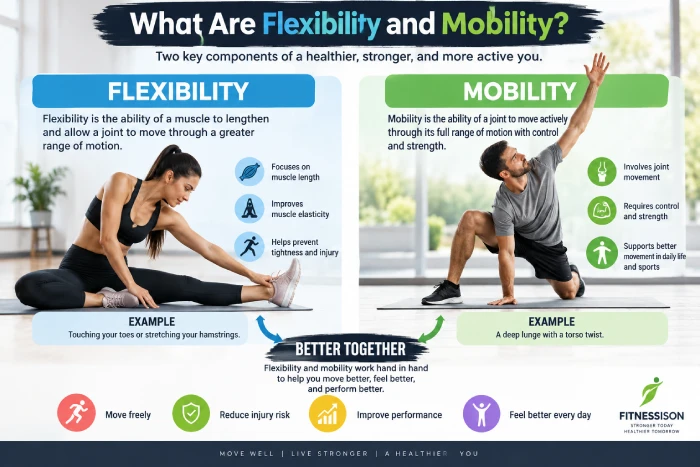
Flexibility and mobility are related, yet distinct attributes.
What is flexibility?
Flexibility refers to how far muscles and tissue surrounding can be stretched and extended. For instance flexion of hamstring muscle. If you lift your knees up towards chest by using of strap, it would be a passive stretch and the flexibility‘s extent your limbs flex freely are1 characteristic of passive flexibility.
Flexibility can be influenced by:
- Muscle and connective-tissue properties
- Stretch tolerance
- Joint structure
- Previous activity
- Training history
- Age
- Individual anatomy
Flexibility: According to the Cleveland Clinic, “flexibility is defined simply as the ability to move your muscles and joints through their full range of motion.” The Cleveland Clinic explains the concept of flexibility and range of motion as it relates to daily activities such as reaching, bending or lifting.
What is mobility?
Mobility, on the other hand, is more encompassing.
It is your capacity to move a joint or group of joints or a segment of the body through a functional range of motion with control. For instance, one’s capacity to lift his or her leg high as demonstrated by his or her hands is an indication of ability to have flexibility.
But can they raise the leg to the same level with their own muscles? This is a mobility question. Mobility is not just flexibility. How well you utilize your available range also depends on strength, coordination, balance, joint control and nervous-system control.
Key takeaway
Range of motion is all that is available. Mobility is what is able to be used, actively.
Practical example
Two individuals are able to reach their toes in a seated stretch. One person can reach the toes, but cannot control a deep squat with stable feet, knees and hips (something that takes a lot of mobility to achieve). The second person can reach her toes and controls a squat. Their flexibility appears similar but their functional ability is different.
Mini summary
You don‘t need to settle for mobility over flexibility learn how your program can benefit from having both.
Looking for the detailed breakdown? Check out our upcoming cluster article: What Are Flexibility and Mobility?
Flexibility vs Mobility: What’s the Difference?
The simple way of conceptualising the difference is to consider ‘passive range’ in comparison to ‘active control’.
| Flexibility | Mobility |
| While concerns above primarily concerned available/passive range | Active, usable range concerns |
| Frequently used with stretching | Usually trained with restricted motion |
| External aid can be provided | Demands muscular control of your own |
| Strong emphasis on tissue extensibility/ stretch tolerance | Includes strength, coordination and stability |
| Most, efficient in moving through limited tissue | Allows you to restrict movement through range when needed |
As it stands, ACE’s professional guidelines make this distinction and highlight that someone can have sufficient passive flexibility but may still find it difficult to manage that range of motion during activities like squatting, reaching overhead or rotating.
Why the difference matters
What if your hips and passive range available is enough for a deep squat but you just can‘t stay in control when you actually squat. Increasing passive stretching is not going to necessarily adress the problem if the limiting factor. Instead, the limiting factor might be movement control, strength and practice in the available range. Conversely, if you don‘t have enough range for the position then flexibility work should be a focus. As you can see, a good programme should fit the exercise to the limitation.
Key takeaway
Increased range of motion does not necessarily translate to improved movement.
You require sufficient reach and controllability.
Practical tip
When something feels restricted, ask:
- Am I really low in range?
- Is it possible to look at the range passively?
- Is I can I use the same distance controlling actively?
- Are you actually going to do that movement?
That easy checklist will keep you from doing a random stretch that isn‘t targeted for the actual problem.
Mini summary
Flexibility and mobility are related, but they are not interchangeable. Learn more: Performance Issues: Definition & Examples Next,Flexibility vs. Mobility: Which is Better?
What Are the Benefits of Mobility and Flexibility Training?
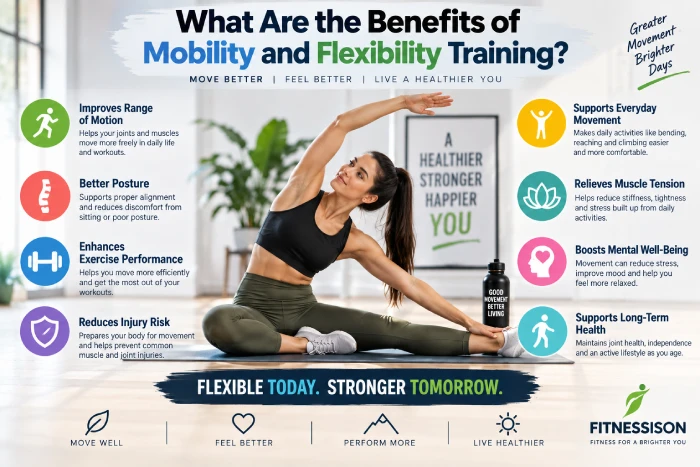
Movement practice on a regular basis can help achieve most of your fitness and daily activities goals
1. Better range of motion
Getting flexible work will open up movement that used to be already tight. Mobility training can then allow you to control the range of that movement. Think in terms of squats, lunges, reaching overhead, running, reaching in general and other movements of daily life.
2. Easier everyday movement
Mobility is not just for athletes. Sitting down, stepping over an obstacle, reaching for something on a high shelf, tying your shoes or getting yourself on the floor all require planning and execution of coordinated movement. Preserving functional ranges of motion may take the drudgery out of my shopping!
3. Better movement quality
Movement is seldom restricted to one joint. Consider the following examples. A squat utilises the ankles, knees, hips and trunk. An overhead press utilises the shoulder girdle, upper back and trunk. Walking utilises the feet, ankles, knees, hips and spine. Good mobility allows these areas to all work effectively.
4. Support for exercise technique
Poor movement assessment can have an effect on technique. Restrictions in the ankle can influence squatting technique, restrictions in the shoulders and/or thoracic spine can affect overhead movements. However it isn‘t always related to poor movement, strength, skill, fatigue, anatomy and the program design have a role to play.
5. Balance and physical function
Mobility goes hand in hand with strength and balance. Harvard Health states ‘Muscle strengthening can be beneficial regardless of age or fitness level for enhancing mobility, supporting the concept that mobility is more than just stretching’.
6. Less perceived stiffness
Feeling better after relocating Many individuals end up being more comfortable immediately after relocating. Gentle mobility work can be especially fitting following long durations of sitting or being inactive however it isn’t appropriate as a diagnostic or treatment for ongoing pain, If movement develops pain, swelling, tingling, weakness or a developing pain then seek professional help.
Key takeaway
Mobility and flexibility can improve movement quality, range of motion and movement in daily life but they are just two components of total fitness.
Practical tip
Don‘t value success in only how far your stretch.
Also ask:
- Is it easier for me to move?
- Can I move the hand?
- Am I improving my form?
- Does daily activity seem more manageable?
Mini summary
It’s all about movement for function, not looks for spectacle.
Read next: The advantages of a mobility and flexibility training to follow:
Which Areas Should You Focus On?
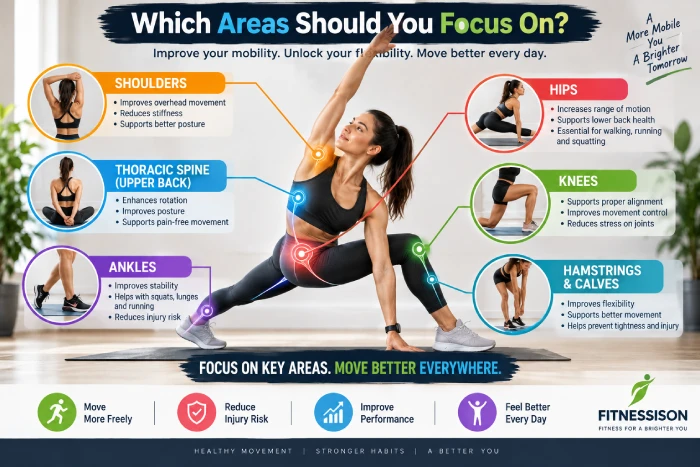
A comprehensive mobility routine doesn’t mean working each joint equally. Your requirements will depend on your activities, your technique, your build and your restrictions. There are a few parts that tend to need regular work because they do so much of the work of your everyday and athletic movements.
Ankles
Ankle motion for walking, running, lunging and squatting. A simple ankle mobility exercise could be to slowly sink the knee over the foot with the heel planted. The knee should move forward over the toes in a slow, controlled manner.
Hips
The hips will need to be moved in different directions, forward and backward, back to front, backwards and forwards, and rotation and circling. The natural flexibility of the hips can impact on actions such as squatting, lunging, running as well as rising from the floor.
Thoracic spine
The thoracic spine requires sufficient extension and rotation for frequent daily and sports activities. Thoracic mobility is particularly important for reaching, rotating and overhead motions.
Shoulders
The movement of the shoulder does not work alone. Depending on how high the movement has to be over the head the shoulder blade, upper back and shoulder joint will all be involved in the movement.
Hamstrings and calves
Commonly targeted After all, this is a common area where people focus a lot of stretching. But tightness doesn’t always indicate that the muscle needs a hard stretch. It can also be a matter of strength, control, tiredness or just spending too long in one position.
Key takeaway
Target the two spots that are truly restricting you, not a haphazard routine of stretches.
Practical example
A runner could focus on ankles, hips and calves. A person that spends a lot of time at a desk may focus more on hips and thoracic movement. A person lifting weights regularly should consider movement prep for squat, hinge, press and pull patterns.
Mini summary
Mobility has to be person- and movement-specific.
Read next: Exercises for Mobility of the Hips, Exercises for Mobility of the Shoulders and Exercises for Mobility of the Ankles.
How to Build a Safe Mobility Routine
A mobility routine does not have to be 1 hour. For most people a daily 5 to 15-minute mobility movement routine is more practical than a complex mobility routine.
Step 1: Start with easy movement
Start with the warm up.
Examples include:
- Walking
- Easy cycling
- Stand in place and march you feet.
- Arm movements
- Development with light body-weight movements Gentle body-weight exercises.
This gets you from driving to moving.
Step 2: Move the major joints
Use controlled movements on the muscles you will be training.
For a lower-body workout, you might include:
- Ankle rocks
- Hip circles
- Bodyweight squats
- Controlled lunges
For an upper-body session:
- Shoulder circles
- Thoracic rotations
- Wall slides
- Arm movements within constraints
Step 3: Add strength through comfortable range
Mobility is not just movement without resistance. Using a weight or bands can improve your control over the ranges you have. Harvard Health mentions resistance training specifically can increase your mobility and can be done with weights, machines, bands or simply body weight.
Step 4: Use flexibility work when appropriate
Most of the time, if muscle and other tissue has limited flexibility which acts to prevent movement, then stretching can help. Static stretching is much better adapted to be a session on its own or. in some cases. after training rather than before which requires the best force or speed.
Step 5: Keep the movements controlled
Do not bounce into end range aggressively. Travel so slowly that you have a feeling as to the action of the body.
Step 6: Progress gradually
Once a movement becomes comfortable, you can gradually increase:
- Range
- Repetitions
- Control
- Resistance
- Complexity
You do not have to upscale everything simultaneously.
Beginner 10-minute framework
– Minutes 1–2: Marching up and down. Easy pace.
- Minute 3: ankle mobility.
- Minute 4: Hip circles
- Minute 5: Bodyweight squats
- Minute 6: Lunging series (controlled)
- Minute 7: Thoracic rotations
- Minute 8: Shoulder circles or wall slides
- Minute 9: Full body controlled movement
- Minute 10: Gentle stretch or breathing.
This is a guideline, not a prescription. If a specific motion causes pain, find an alternative movement.
Key takeaway
Simplicity beats complexity.
A routine you can actually complete 2-3 times a week is more beneficial than a complex workout you don’t complete more than a few times.
Mini summary
Begin with lower levels and learn to make it small 0, under control and then as you develop progressively increase range and strength.
Read next: How do I practice safe mobility?
When Should You Train Flexibility and Mobility?
It all depends on what you‘re going for.
Before a workout
Warm-up is typically beneficial for getting the body ready to move.
Think:
- Joint movement control
- Bodyweight squats
- Lunges
- Arm movements
- Sport-specific drills
Your aim isn‘t to really overwork oneself.
It‘s to get ready.
After a workout
More gentle stretching placed after training can work effectively. As you have already been working hard it is also a good opportunity to improve your flexibility as you are already warm.
On recovery days
A brief mobility practice can be a great way to get active on those days where you’re not doing a heavy workout. Yoga, light mobility flows, walking and some steady-paced bodyweight movements are excellent options.
During the workday
No need to wait until a workout. If you’ve been sitting for hours, get up and move.
Try:
- Walking
- Shoulder movements
- Hip movements
- Gentle rotations
- Calf raises
Breaking movement up into smaller segments can help to sustain mobility training.
Key takeaway
There‘s no one “best” time. The “best” time will depend on whether your ultimate goal is: to prepare your body for movement, to gain more flexibility, to relax/for recovery, or to cut down on “dead” time.
Mini summary
Utilize mobility everywhere you are throughout the day not only on your mat.
Common Flexibility and Mobility Mistakes
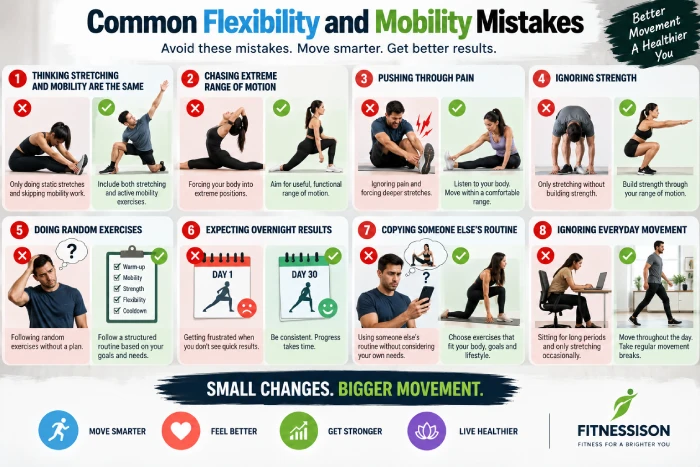
Mistake 1: Thinking stretching and mobility are the same
Stretching may be included in a mobility program, but mobility is more than just stretching.
Improved approach: Flexibility of the most appropriate kind for the patient, in conjunction with active movement and stronger movements.
Mistake 2: Chasing extreme range of motion
You don’t have to do the splits to have good mobility. More isn’t always better.
Better approach: develop the range that you need for your activities and manage/control it well.
Mistake 3: Forcing painful stretches
A stretch can be uncomfortable but pain that is sharp or getting worse is not good.
Better approach: (From any point, go within a manageable or optimal range.)
Mistake 4: Ignoring strength
A joint can possess a large amount of passive range of motion but poor active control. Improved technique: Development of strength in optimal ranges.
Mistake 5: Doing random exercises
“Collection of stretches’ shouldn‘t be mistaken with program.
Ideal way: Determine the restriction of the movement.
Mistake 6: Expecting overnight results
Repeated practice leads to improvements in mobility.
Better approach: Can take this a step further and analyze data on a week-by-week basis instead of session to session evaluation.
Mistake 7: Copying another person’s routine
Your mobility requirements might be entirely different from those of a professional athlete or fitness influencer.
Better approach: Modify the movement to suit your body and work-out objectives.
Mistake 8: Ignoring pain
Mobility training is not an excuse for you to work through unexplained or chronic pain. If pain, swelling, weakness, numbness or injury is present, please consult a physical therapist or medical professional.
Mini summary
Train for the quality of movement, not the presentation of the shape.
Flexibility and Mobility Myths vs. Facts
| Myth | Fact |
| They are identical in terms of mobility. | They overlap but describe different qualities |
| More flexibility is always preferred | Range and control are more important than maximum range |
| Is stretching solving all the mobility problems? | Some are: Power, quality and range of movement, coordination and motor control. |
| Top 5 Climbing Gym Pricing questions 1. Can I cancel my pay as you go Membership at any time? | Practical movement is necessary daily. |
| You require a long routine | Concise and regular sessions might be useful |
| Mobility is giving joints their maximum range of motion | Good mobility means controlled motion |
| Weight training causes you to be stiff | Mobility can be aided by properly done strength exercises |
| You have to be stretching for hours every day. | Consistency and correct dosing are far more important than extremes of volume. |
Medical News Today also finds that flexibility and mobility are related, but different, and that training both can be helpful.
How to Know Whether Your Mobility Is Improving
Don’t depend on only a test of flexibility. Instead, track movements that matter to you.
Track functional movements
For example:
- Q: Can you squat more comfortably?
- Is it possible to reach overhead without compensation?
- Are you able to turn your upper body with greater freedom?
- Are you able to sit on the floor and get back up?
- How can we help you perform your exercise with more control?
- Walk or run easier?
Compare left and right
Imbalances are useful information. For instance, one shoulder might feel different from the other in an overhead position, and that is not to say there‘s necessarily a problem, but you now know where to direct your awareness.
Don’t force symmetry
Bodies are not symmetrical. You are not aiming for uniformity in all movements. You‘re aiming for appropriate and sustainable, comfortably controlled movement.
Key takeaway
This can be measured in function, not by that flexibility-test data.
Mobility for Different Fitness Goals
For strength training
Mobility can support you in reaching the positions your exercises may necessitate. You want a level of movement freedom to manage the demands of squats, deadlifts, presses and lunges. That said, mobility is not a substitute for good form or graduated loading.
For runners
The same parts of the body are used repeatedly by runners feet, ankles, knees, hips and trunk. We often do mobility work that isn’t relevant to a specific movement restriction.
For yoga
Yoga is also a mixture of flexibility, mobility, balance and strength and body awareness, which depends on the style, and movements used. Flexibility can help you support specific poses while active control allows you to move into and hold these positions.
For HIIT
Mobility can be part of a warm-up prior to the main sets of movement, provided you are aiming for preparation as opposed to fatigue.
For beginners
No complex drills for newcomers. beginning simply you can control course of action and observe what really feels comfortable.
For older adults
Mobility deals specifically with independence and normal movement. Strength, balance and mobility may often combine to maintain physcial functioning. Harvard Health emphasizes that strength training is one way to enhance mobility.
Mini summary
Mobility is not a conditioning category of its own. It complements the movements you already do.
What If You Feel Tight Even Though You Stretch?
This is a typical frustration. You feel like you are always stretching but haven‘t felt much change. There are a few different possibilities.
You may need active control
If you can reach a position passively but not actively, there might be some other limiting factor at play here.
You may be sitting too much
A few minutes of stretching can‘t undo a whole day‘s worth of no action. Moving matters all day.
You may need strength
Strength through a range can be reassuring in being able to use position
Your anatomy may limit certain positions
All individuals possess various joint combinations & ratios. Two individuals executing the same movement can do so quite differently without either of them being technically wrong.
You may be overdoing it
More stretching doesn‘t mean better . All your body needs is a different approach if you continually push into areas where you are uncomfortable.
Mini summary
When stretching doesn’t reduce stiffness, don’t just stretch more. Take a big picture of the movement.
A Simple Weekly Flexibility and Mobility Plan
Combine flexibility and flexibility into your current workout.
| Day | Suggested focus |
| Monday | Warm up (Strength + short mobility) |
| Tuesday | Homework / additional information 10 – 15 minute mobility session |
| Wednesday | HIIT and/or cardio + movement prep |
| Thursday | Flexibility-focused session |
| Friday | More 4 Gaining strength + mobility |
| Saturday | – Yoga, Walk or Lower impact mobility |
| Sunday | Rest and mobility |
It does not need to be permanent. If you already have a routine, simply add 2 mobilisations to your week, rather than changing your entire programme.
Example
Someone doing three strength workouts could add:
- Before training:5–10 minutes of dynamic mobility
- Immediately following training: Purposeless 10-minute flexibility session
- Rest days: 5-15 minutes gentle mobility/ walking.
It may be sufficient to form a sustainable practice.
When Should You Get Professional Help?
Mobility drills are designed to elicit movement, not identify an injury.
Consider professional guidance if you have:
- Unbearable or deteriorating pain
- Significant swelling
- Recent injury
- Joint instability
- Lack of sensation or a pins and needles sensation
- Significant weakness
- A sudden inability to move
- Pain that always precludes normal activity
The fitting physical therapist, medical professional or expert|specialised fitness professional of this stretching workout can determine if a limitation to motion issues flexibility, strength, rhythm, injury or another problem.
Key takeaway
This ‘pain ain‘t a mobility score’.
Don‘t regard ongoing pain as just something to get over with by stretching.
The Future of Flexibility and Mobility Training
Mobility training is ‘just starting to be mainstream in the fitness world and not something the minority accessed through yoga classes or rehab.’
Future fitness programs are likely to focus more on:
- Testing for individual mobility
- Special strength through a very defined range of motion:
- Functional movement
- • In brief •• Mobility Training Yoga studies have indicated that concentrated mobility work, lasting more than 10 seconds at a time, can increase the range of certain joint motions.
- Personalized training
- Active recovery
- Movement quality
- Age-specific programming
Wearable devices could also help track body movement and training consistency. But technology will not replace the basics. Keeping active, gradually building strength and movement ranges, and listening to your body will continue to be significant.
Mini summary
The future of mobility isn’t about a magic exercise. It’s about building quality movement into everyday fitness.
Frequently Asked Questions About Flexibility and Mobility
Is flexibility the same as mobility?
No.
Joint flexibility usually refers to the available range or tissue extensibility, especially during passive movement. Mobility may be defined as the ability to use the available range actively and controlled.
Which is more important, flexibility or mobility?
Both should not be averaged. They are aimed at different objectives and complement each other. Your training should be based on your limitations and what you want to get out of it.
Can you improve flexibility and mobility at the same time?
Yes.
A program can include stretches, dynamic movement, strengthening, and controlled articular motion through use of proper ranges.
How often should I train mobility?
It can be feasible to start with a brief routine a few times a week. Others find that taking a short movement break during the day is helpful. You do not need to develop the most complicated routine.
Should I stretch before or after a workout?
This also depends on the type of stretching and workout. During warm-up exercises we can use often dynamic movement. Longer static stretching can be added to the end of the workout or in a dedicated stretching session when our goal is improved flexibility.
Can strength training improve mobility?
Yes.
Strength training in adequately graded ranges will assist in physically capacity and future active control. Harvard health finds resistance training such as strength training a way to benefit mobility.
Why am I flexible but not mobile?
You could potentially have enough passive range, but if you don‘t then have the strength, co-ordination, stability, motor control, etc, to actively achieve that range that is another fundamental difference between the two terms.
Can mobility exercises help with stiffness?
Some individuals find that a gentle movement can help to ease stiffness, especially if they‘ve been sitting for a long time. Do not, however, automatically prescribeexerciseif the stiffness is chronic.
Do I need equipment?
No.
Numerous entry level mobility exercises are performed on body weight. Some additional aids, such as bands, blocks, straps etc, are useful but not necessary.
Can older adults improve mobility?
Yes.
Mobility is trainable at a variety of ages and fitness levels.
Final Takeaway
That motion has two arguments for it, both of which seem to require it: mobility and flexibility.
Flexibility gives you the range that your body is capable of. Mobility then allows that range to be utilized and controlled. The most effective approach isn‘t to focus on lengthy stretching sessions to reach an extreme level of flexibility, but rather, finding a balanced, consistent routine of the above, including strength and movement in the weights room, and being aware of the motions you perform for daily functioning and movements you enjoy. And if a movement feels consistently painful, don‘t just push through it. A well thought out flexibility and mobility program should be reducing pain, and increasing control, comfort and stability in your movements, rather than stretching to the bottom of a stretch.