

Mohd Arbaaz is an Editor and Writer at Fitnessison.com with 5 years of experience in SEO and digital content creation. He creates informative, reader-focused content covering fitness, workouts, nutrition, health, healthy lifestyle, technology, and computers.

Shashi Teja is a Reviewer at Fitnessison with over 6 years of experience in SEO, content strategy, digital publishing, and content optimization. He reviews content for clarity, research quality, topical relevance, readability, structure, and overall usefulness to readers.
Last Updated: September 24, 2026
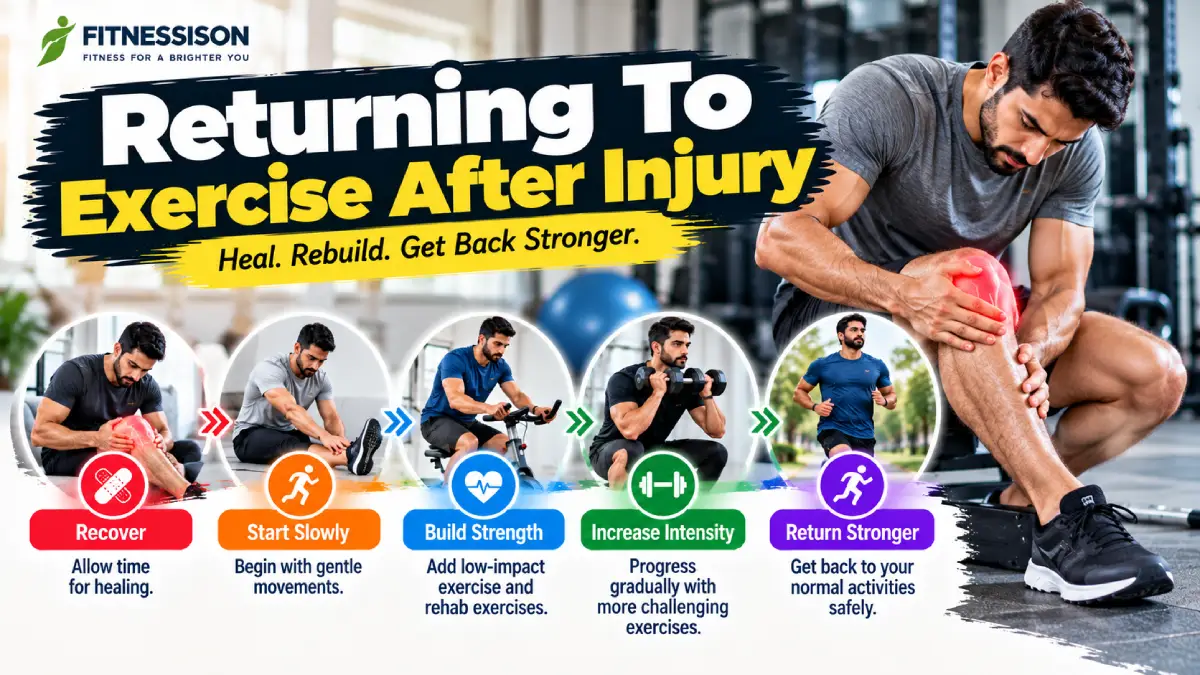
Getting back to exercise after an injury can be particularly exciting when you are eager to return to your normal activity. However, attempting to regain your fitness too quickly by rushing straight back into your pre-injury level of activity can lead to problems. Instead, see your return to full activity as a process of rebuilding. Your strength, movement, confidence and ability to tolerate exercise can all need time to get back to their pre-injury state. Whatever the injury, there is no one-size-fits-all timetable to returning to exercise.
When Can You Start Exercising Again?
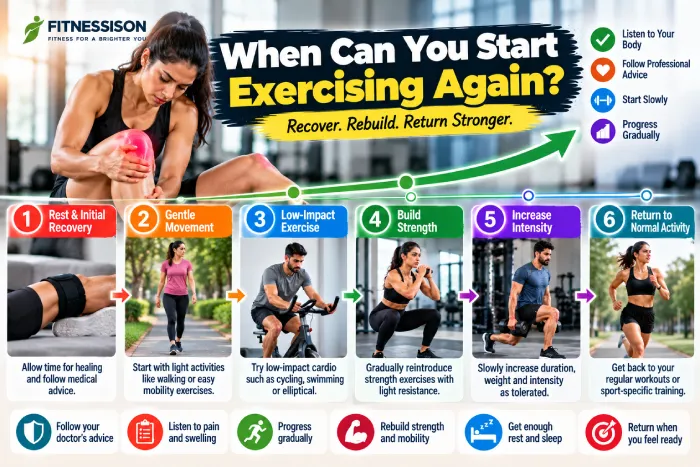
It really depends upon what your injury is. If you have a relatively mild injury involving only a muscle or joint, you may be able to return to gentle activity quite rapidly, whereas with a fracture, the need for surgery, a major ligament injury, or other significant problem you may need a particular program of rehabilitation. Before returning to strenuous activity you need to ask; can I easily perform the most fundamental movements for the training I want to do? For some injuries you may be advised on regaining movement, strength, balance, and control before returning to full training. If you have been told you have an injury, or know an instructed course of rehabilitation, then please proceed to the guidance provided by your doctor or physical therapist.
Start With What You Can Control
My recommendation is to avoid the temptation to have your first workout after injury be an indicator of how much fitness you have lost, and instead to use it as a starting point. Select movements that you are able to perform well with good control and that do not exacerbate your symptoms.
Depending on the injury, this might include:
- Walking
- Gentle cycling
- Light mobility exerciseo Rest for 12 hours afterwards, elevate limbs with a pillow after aerobic training. Use moist heat pack for 20 minutes. However, daily activity and exercises should be continued.
- Bodyweight movements
- Low-impact cardio
- Rehabilitation exercises
- Light weight resistance training
The correct activity will be highly dependent upon the injury. An individual with an ankle injury may start with walking and balancing exercises, while an individual with a shoulder injury may be able to do cardio using the lower body.
Use a Gradual Return-to-Exercise Approach
The other is progression. Do not jump from rehabilitation exercises straight into your toughest workout.
Instead, think of your return as a series of steps:
Gentle movement –> light exercise <–medium training <–sport-related activity—regular/normal training
You should tolerate one stage before you come back down to the next. Most health care advice recommends progressive though not dramatic increases in activity rather than a step increase.
Pay Attention to Pain and Swelling
Some injuries can cause minimal pain as you recover however you should pay attention if symptoms worsen or persist. A good way to monitor your symptoms is by observing how you feel during the activity and once you‘ve finished. For instance, if an activity feels like it is manageable while you‘re doing the activity but causes your symptoms (pain and inflammation) to increase by a lot afterwards you possibly advanced too quickly. Certain NHS advised Rehab programs advocate stopping activity if and when symptoms worsen significantly then building back up gradually. It also suggests ‘sharp, worsening or odd pain should not be just ignored and ‘tramped down’.
Rebuild Strength Before Returning to Full Intensity
An injury and inactivity can result in loss of strength and conditioning. It may not be realistic to strive to return to the same old resistance levels so start low and work your way up.
For example, if you previously performed heavy squats, you might first return to:
- Bodyweight squats
- Supported squats
- Light resistance
- Moderate resistance
- the difference in load much.
Exactly how this sequence should go will be specific for your injury and rehab schedule. Strength and movemement control are important aspects of getting ready for more intensive activity.
Don‘t Forget Mobility and Movement Quality
In addition to your strength, your flexibility/balance/coordination/ confidence can change from time to time after having sustained an injury. Make sure you incorporate good mobility exercises if they are included in your program/ rehabilitation.
For example, someone returning after a lower-body injury may need to rebuild:
- Ankle movement
- Hip mobility
- Single-leg balance
- Leg strength
- Walking/Running ability or dynamics
Getting back to the quality of your movement allows yourself to ready for high-intensity training.
Return to Your Favorite Activity Gradually
Resuming regular exercise doesn‘t necessarily mean going straight to your hardest session. For instance, if you play football, you may return to walking at first, progress to light jogging, then running, then running with changes of direction, and finally practice routines specific to the game. If you run, you can begin with brisk walking and short spells of light jogging, progressing in the same way. If you‘re weight training, take gradually heavier loads during training until you are climbing back to your usual regime. Sports rehabilitation advice frequently suggests increasing from general or basic activity to specific training prior to resuming high-level sport.
Avoid the “Too Much, Too Soon” Trap
Taking things too quickly is one of the easiest mistakes to make. Feeling almost back to normal in a day or two you think the old session to the max is a good idea, but your body may not.
Instead:
Implement a “Do less” strategy Pause and assess your response Recover Move forward
Working this way can prevent you from going through the process of over-doing it, then worsening, taking a few days off, and repeating the entire process.
Give Recovery the Attention It Needs
Getting back to exercise is not just what occurs within the gym. Recovery as well.
Make room for:
- Adequate sleep
- Rest days
- Balanced nutrition
- Hydration
- Mobility work that is suitable
- Stress management
If your body is not recovering between sessions, then up regulatings your training load may not be your logical next step.
When Should You Get Professional Advice?
If you think you haven‘t recovered yet and that you are not yet ready to go back to exercise then your best option is to get some professional advice.
Get medical advice if you experience:
- Pain which is severe or increasing in severity
- Significant swelling
- Remission from weakness
- Numbness and Tingley.
- Weight bearing.
- Decreased mobility which is not enhancing
- Repeated occurrences of symptoms as activity is increased
Consult a doctor, as well as a physical therapist or other healthcare professional to discuss which activities are appropriate for you.
A Simple Return-to-Exercise Checklist
Before increasing your training, ask:
- Is there a control to the movement?
- My strength has increased in this year?
- The extent to which I am able to move adequately?
- Using the question “Can I do my exercise without my symptoms increasing significantly?’”
- Do I recover reasonably well afterward?
- Am I only training one or two of the training stresses I need to at a time?
If you can answer “No” to those questions, it might be time to take a step back and talk to your doctor about how you’re doing.
Final Thoughts
Getting back to exercising after an injury should not be a race to getting back up to your previous exercise intensity. Do what you can do, stay in control of what you are doing, rebuild strength and mobility and carefully note what is happening as you go along so that you can increase intensity gradually. Old fitness levels do not mean necessarily that you can jump straight back into where you left off. Give yourself time.