

Mohd Arbaaz is an Editor and Writer at Fitnessison.com with 5 years of experience in SEO and digital content creation. He creates informative, reader-focused content covering fitness, workouts, nutrition, health, healthy lifestyle, technology, and computers.

Shashi Teja is a Reviewer at Fitnessison with over 6 years of experience in SEO, content strategy, digital publishing, and content optimization. He reviews content for clarity, research quality, topical relevance, readability, structure, and overall usefulness to readers.
Last Updated: September 24, 2026
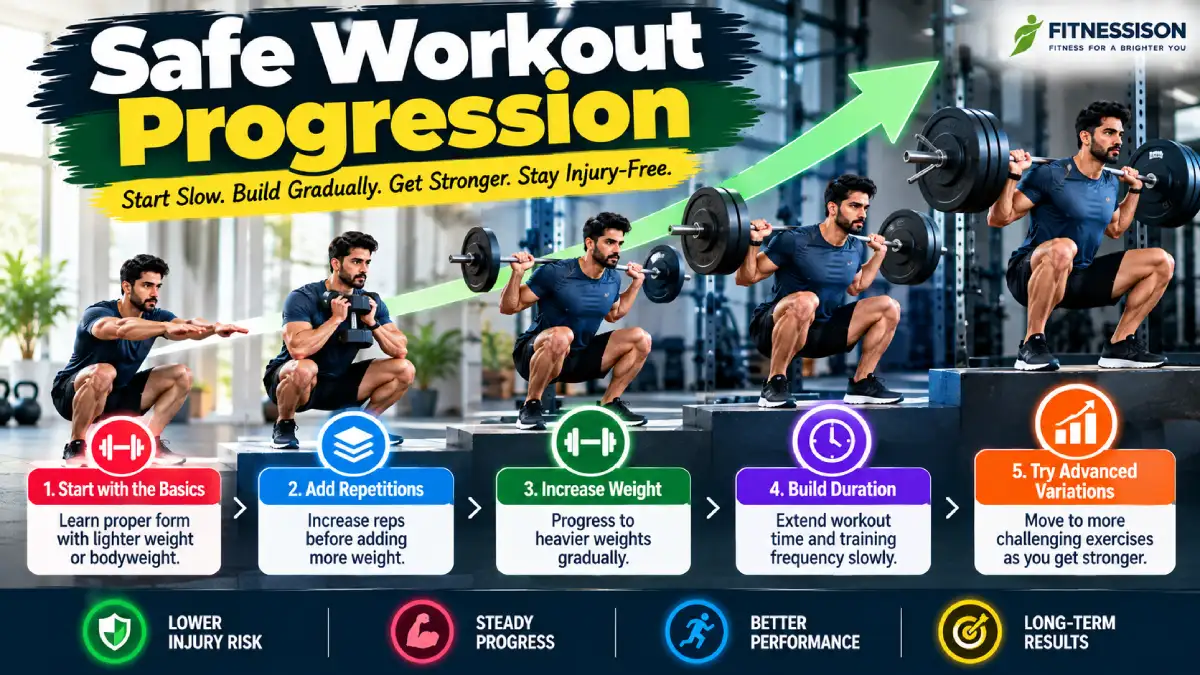
Safer progression for workouts is about progressing the workout and training session gradually, through making the exercise or activity more difficult, while still allowing the body enough time to adapt to the new demand. If you are new to training or have been away for a period of time then simultaneously progressing everything will be too much for your body to handle. Progression doesn‘t necessarily mean lifting more weight. What you can do is add to your repetitions, time, better form, range or motion or simply become more consistent.
The idea is this: make your body work hard but not go faster then you can recover.
What Is Workout Progression?
Progression is simply working your way up toward your goal. For instance, if you can complete 10 body weight squats easily, the progression would be to do a little more.
Progression can involve:
- More weight
- More repetitions
- More sets
- Workout duration.
- More ROM (range of motion)
- Improved movement control
- Higher training volume.
- More difficult exercise variations.
You don‘t have to increase each variable on a daily basis. Increasing only one aspect per workout can be more beneficial to understanding your body‘s reaction to it.
Why is important gradual progression?
It takes times for your muscles, connective tissue, cardiovascular system and nervous system to adapt to higher training volumes. If you suddenly intensify or increase the volume of your workout, the body may not be capable of handling it. For instance, if you normally walk for 20 minutes you should not immediately start running for an hour each day. The body needs time to adapt to this increased workload and to reach a new, higher level of fitness. This step by step development can lead to better training habits compared to working at maximum effort every session.
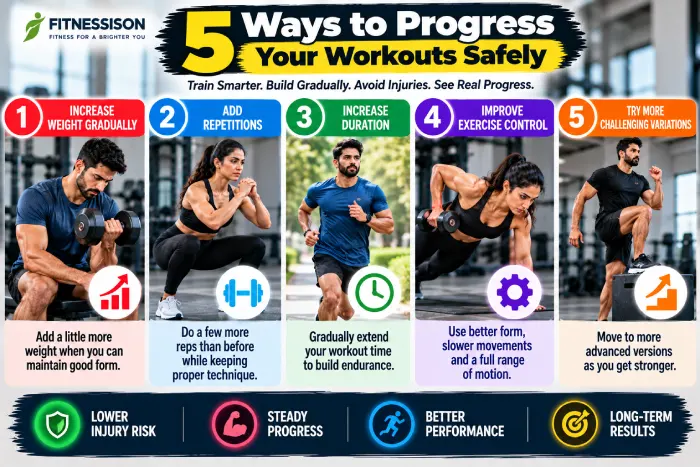
5 Ways to Progress Your Workouts Safely
1. Increase Weight Gradually
One of the most apparent methods of progression in strength training is by increasing the resistance. However, heavier does not necessarily mean better. Before increasing the weight, ensure you are able to execute the exercise with good controlled technique. If form drops significantly on the addition of weight, go back to a comfortable load.
A simple progression might look like:
Light weight 10 controlled repetitions 20 results Each subsequent repetition builds on the previous one, resulting in a heavier weight.
There‘s no need to make a significant leap in between sessions.
2. Add Repetitions
You can also add more repetitions to make a workout more difficult. For instance, if you find you can do 8 repetitions of an exercise easily, keep increasing the repetitions until you reach 10, 12 or the number that works for you. This may be worth doing for a beginner who learning the movement pattern. the repetitions should be kept controlled rather than just increasing the numbers.
3. Increase Training Duration Slowly
For cardio activities (such as walking, biking or jogging), time can be another way to progress. If you already exercise for 20 minutes then instead of jumping to 40 minutes right away you might try slowly increasing the amount of time. Watch how you feel after each session; if a longer session results in longer recovery time for more than a couple days you may be progressing at too fast a rate.
4. Improve Exercise Control
Progress does not have to be quantified through statistics. progress through improved control is valid progress.
You might improve by:
- Making use of a less intermittent movement
- The ability to keep a more even and consistent balance.
- Controlling the descent stage To maintain an even descent while using a variable descent rate. On ¾9/12 the tension of the rate of descent line should be controlled to hold the descent rate constant.
- Relative to a comfortable range of motion.
- Minimizing excess momentum
To a novice, developing good technique may be much more important than an increase in resistance levels.
5. Introduce More Challenging Variations
Having acquired a basic movement, it can then be progressed to a more challenging variation.
For example:
Wall push-up→ inclined push-up→ knee push-up→ regular push-up
Or:
Chair squat→ bodyweight squat→ goblet squat Yes, I am aware that they are different. They are at different levels of difficulty for the thighs and piotr.
The progression is highly individual and will vary with your strength, mobility, experience and goals.
The “Too Much, Too Soon” Problem
One mistake is modifying a number of factors.
Imagine someone who starts exercising after a long break and immediately:
- Includes five days of exercise
- The time of workout related to doubles; this object can for example, be used to find out the average time of session for doubles in general.
- Increases weights
- Starts running
- Adds short but intense anaerobic work.
Every change added up is bringing additional training stress. These modifications together could possibly make an additional workload that is easier to recover from. An approach to these modifications should be to implement an incremental change and taylor it to see how your body reacts.
How do you know when to advance?
There is not one general rule.
Before increasing the difficulty, consider whether:
- Your technique is sound.
- You can finish your current workout.
- Anyone who experiences difficulty recovering between sessions should have this monitored.
- You do not have ongoing pain; the pain comes and goes.
- You generally have average energy levels.
- The current system is no longer intense enough.
If a few of these are applicable, then a small progression might be appropriate. If you are having difficulty recovering, maintaining the technique or completing your current workload, then do not complicate things yet.
What Happens if You Miss Several Workouts?
Don‘t overreach and attempt to double up your next workout, if you‘ve been away from training for a period of time due to travel, sickness, a hectic schedule, or whatever, then it is often wiser to ease back into a normal routine. Take a reduced version of your regular session and then work your way back to your normal workload. Your previous levels of fitness do not automatically equate to your body being prepared to handle normal training again.
Safe Progression for Beginners
If you‘re starting a new exercise routine, it might be advisable to keep the first couple of weeks fairly straightforward. Concentrate on learning the movement patterns first.
A beginner strength session might include:
- Squats
- Push-ups or an easier version of them.
- Hip-hinge movements
- Rows
- Core exercises
Begin using low resistance and concentrate on technique. When an exercise feels familiar then increase repetitions or resistance or difficulty in stages; you do not have to push yourself too hard every day.
Listen to Your Recovery
Recovery is a stage along the journey.
Pay attention to patterns in:
- Sleep
- Muscle soreness
- Energy
- Motivation
- Workout performance
- General fatigue
Just because you‘ve had a hard workout, doesn‘t mean you require more rest, but if you continually find yourself not recovering then this may be reason enough to think about dropping volume or intensity for a few days/weeks. Do not ignore unusual or chronic pain as ‘nothing special’ during progression;
Safe Workout Progression vs Pushing Your Limits
It can be helpful to the right extent to train hard, even though not every workout needs to be max. Finding a program which doesn‘t push you to the max all the time allows you to adapt to plenty of effort and still have a recovery window for next time. Imagine progression as a very long-term process. By slowly exploring new places, combining them with known ones. First integrating it to adapt to the new experience, then intensifying it, so the trainees get assaulted, and then recover and go on. That‘s often easier than trying to achieve more all the time.
Final Thoughts
Safe progression is where you make training more intense very gradually, within the safe parameters of control, recovery & appropriate execution. You can progress by increasing weight, reps, time, range of motion or advanced movements. You don‘t need to build everything up over night. Begin where you‘re at, do your basics well & take baby steps as your body adapts.