

Mohd Arbaaz is an Editor and Writer at Fitnessison.com with 5 years of experience in SEO and digital content creation. He creates informative, reader-focused content covering fitness, workouts, nutrition, health, healthy lifestyle, technology, and computers.

Shashi Teja is a Reviewer at Fitnessison with over 6 years of experience in SEO, content strategy, digital publishing, and content optimization. He reviews content for clarity, research quality, topical relevance, readability, structure, and overall usefulness to readers.
Last Updated: September 24, 2026
Some of the typical workout injuries are what happen to beginners and to advanced exercisers. They can be caused by having to much resistance, progressing too fast, overtraining, lack of variety, lack of rest, poor movement patterns/technique, or just doing to much to fast. However many exercise related injuries can be mediated by careful progression, learning proper movement patterns/technique, adequate rest, and being aware of the body‘s feedback.
What Are the Most Popular Workout Injuries?
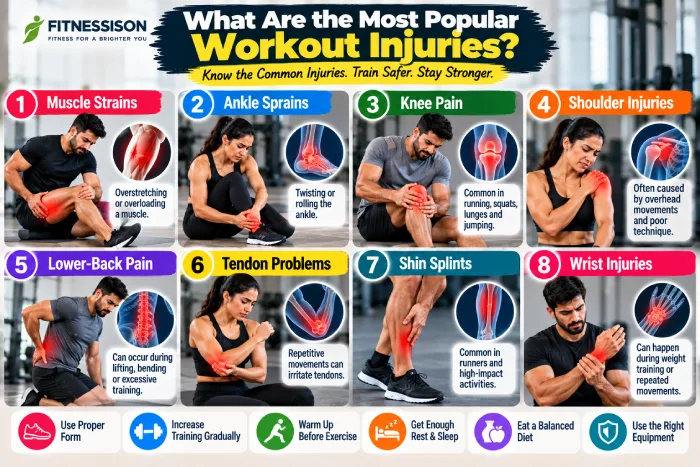
Work out specific injuries may strain various muscles, joints and connective tissues throughout the body:
Some commonly reported issues include:
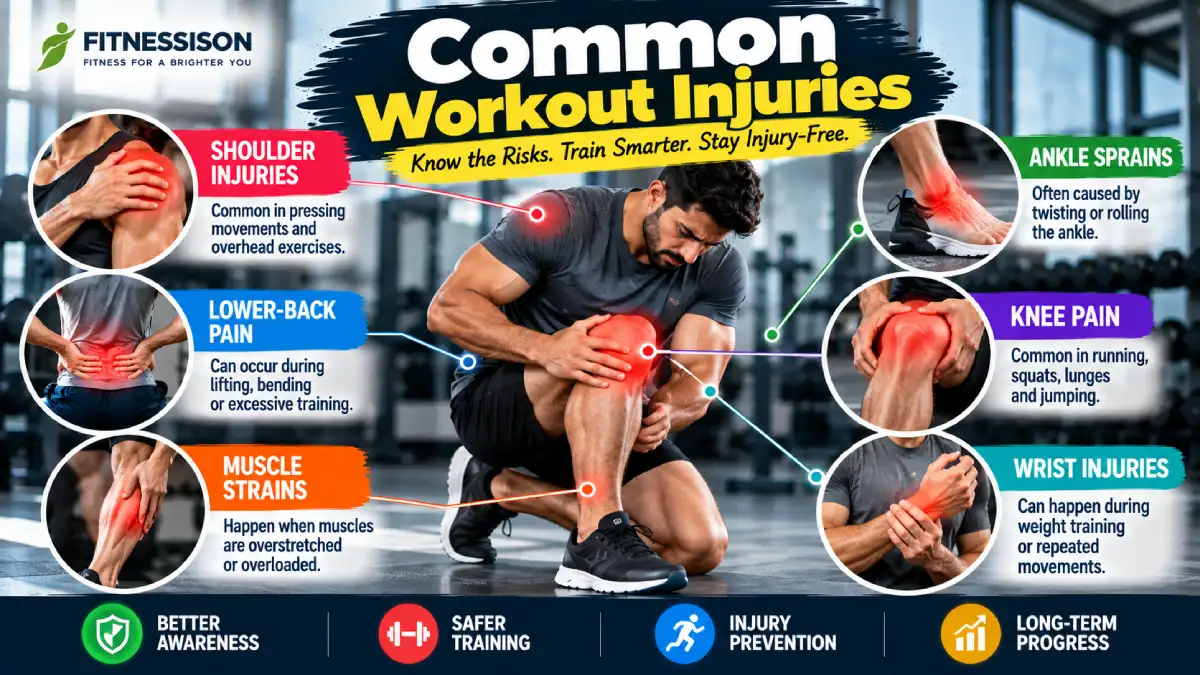
- Muscle strains
- Ankle sprains
- Knee pain
- Shoulder irritation
- Lower-back pain
- Tendon-related problems
- Shin pain
- Wrist discomfort
The type of problem you experience usually depends on the exercise, the amount of exercise, technique, equipment and other individual differences. For instance, running rubs the legs repeatedly and weight training places more or less strain on certain muscles and joints depending on the exercise.
Muscle Strains
Muscle strain: overuse or overstretching of a muscle or joint. Usually occurs through lifting, running, jumping, or any activity that heavily relies upon a particular muscles.
Common areas include the:
- Hamstrings
- Calves
- Lower back
- Groin
- Shoulders
Any sudden pain, tenderness, weakness, or the inability to function in the area may be a sign of something more serious
How to Reduce the Risk
Progress slowly with your training. Do not add weight or increase the intensity of your workouts suddenly; a warm-up and the correct form of your exercise are also of great help to develop the power that is required in more demanding movements.
Ankle Sprains
An ankle sprain is an injury that happens when an ankle turns or twists in a unnatural way. They tend to happen when people are running, jumping, changing direction quickly or walking on uneven ground. Symptoms include pain, swelling, bruising and sore ankle.
How to Reduce the Risk
Engage in activity 3 to 4 times a week working on balance, lower-body strength and controlled motion. Use the proper footwear for the activity and be aware of the type of surface you are on. If ankle pain prevents walking and/or there is severe swelling or deformity, seek professional medical attention.
Knee Pain
Knee pain is a popular complaint among exercisers. You may experience knee pain during a squat, while running, Lunging, Jumping or Climbing. There are many reasons as to why your knee may be in pain so don‘t assume that one particular exercise is always the cause of it.
How to Reduce the Risk
Concentrate on controlled movement and select repetitions that you are comfortable with. Strengthening of the pelvic girdle and lower limb musculature may be incorporated into a well-rounded exercise program. If pain is experienced during a specific movement, then minimize the exercise load or change the exercise rather than ‘pushing on through’.
Shoulder Injuries and Irritation
Shoulder is a joint utilized in performing lots of exercises such as presses, pull-ups, push-ups, swimming and throwing; it is also affected by overuse of overhead activity or high training volume.
How to Reduce the Risk
Don‘t increase resistance, faster than can be controlled. Make sure to put in exercises that build up upper-body strength, but still have overall balance across movement patterns. Keep key presses and pulls technique in mind, and work not constraining painful ranges of motion.
Lower-Back Pain
Pain in the lower back The lower-back region may be affected by strength training and every day activities. Range of movement or force production through the trunk is compromised in exercises involving flexion, extension, loading or lifting of the trunk if the mechanical technique or fatigue factors are not taken into consideration and/or training volume becomes excessive.
How to Reduce the Risk
Master the movement pattern before loading up with loads of weight. Progress slow with all hip hinge movements including deadlifts. Don‘t expect your lower back to be able to make up for a lack of control in other parts of the movement. If back pain persists or is severe, also accompanied by symptoms such as numbness or weakness,seek medical advice.
Tendon Problems
Tendons attach muscles to bones and may become inflamed by continuous exposure of their tissues to loads above what they are already capable of withstanding Certain conditions can have, or may develop from, one contributory factor or event that is not immediately clear. For example: tendon problems.
Common areas include the:
- Achilles tendon
- Patellar tendon
- Elbow tendons
- Shoulder tendons
How to Reduce the Risk
Refrain from abrupt jumps in volume. If you‘ve been out of the gym for a significant time, build your training volume steadily instead of jumping straight back to what you were doing before.
What causes injuries to occur during workouts?
Usually there is not one sole cause.
Several factors can contribute to exercise-related injuries, including:
- Pushing too hard: Working very hard during sessions without sufficient recovery can leave the athlete more tired.
- Advancing too rapidly: Sudden large increases in the resistance, speed, or intensity may be difficult to tolerate.
- Incorrect technique: When an exercise is performed incorrectly, so that the control of the exercise is lost, the way the load is distributed is affected.
- Inadequate recovery: Through sleep, diet/rest and recovery you can have a significant impact on your training tolerance.
- Repeated movement (like doing the same hard work over and over): Repeating a strenuous activity can cause repeated trauma to the same tissues.
What action should you take when you encounter an injury?
Don‘t automatically attempt to “push through” pain. Immediately halt the motion if the pain becomes sharp, sudden or increases.
Depending on the situation, you may need to:
- Stop the operation which gave rise the problem.
- Minimize symptoms by avoiding movements that make them worse. This includes not moving the shoulder in an abnormal way.
- Choose a easier exercise variation.
- Give time for recuperation
- If this is thought safe and appropriate based on the expertise of the enquirer and their assessment of the situation.
If an individual experiences severe or prolonged symptoms, consultation with a healthcare practitioner, who can identify any underlying factors, would be advisable.
Ways to Avoid Frequent Exercise Injuries
You can‘t totally remove injury risk, but you can make your training more logical.
A practical approach includes:
- Warm up prior to exercise that is challenging.
- Learn proper exercise technique
- Initialize training incrementally
- Where have you experienced the
- Add strength and mobility work.
- Rest days are important.
- Build enough hours of sleep.
- Eat sufficiently to sustain your activity.
- Provide replacements for damaged or unsuitable equipment.
- Be alert to continuing pain
It‘s not that your training needs to be easy. You want hard enough to bring about change but not so hard it leaves your body floundering.
When do you need to go for professional help?
Minor aches may settle and respond to rest and sensible modification, but don‘t be fobbed off when it comes to these symptoms.
Seek medical evaluation if you experience:
- If you experience extreme or increasing pain
- Significant swelling
- A conspicuous deformity
- Difficulties at weightbearing
- Persistent weakness
- Numbness or tingling
- Symptoms that persist
- A condition which impairs living and working in the ordinary manner.
Getting proper advice is more likely to be beneficial than self diagnosing an injury.
Final Thoughts
Typical workout injuries are strains, tears, pulls, knee pains, shoulder irritations, lower back pain and tendonitis.. They can arise for different reasons so there can‘t be a one size fits all way to prevent injury. The basics are simple; warm up properly, learn correct exercise technique, progress gradually, take adequate time to recover, and don‘t ignore pain or symptoms which are unusual or unexplained. Consistent training doesn‘t necessarily mean [It doesn‘t have to be] machine-gunning flat-out every time. The most sensible part of training could be knowing when to lower the weight a little, try a different exercise, or have a recovery day.