

Mohd Arbaaz is an Editor and Writer at Fitnessison.com with 5 years of experience in SEO and digital content creation. He creates informative, reader-focused content covering fitness, workouts, nutrition, health, healthy lifestyle, technology, and computers.

Shashi Teja is a Reviewer at Fitnessison with over 6 years of experience in SEO, content strategy, digital publishing, and content optimization. He reviews content for clarity, research quality, topical relevance, readability, structure, and overall usefulness to readers.
Last Updated: September 23, 2026
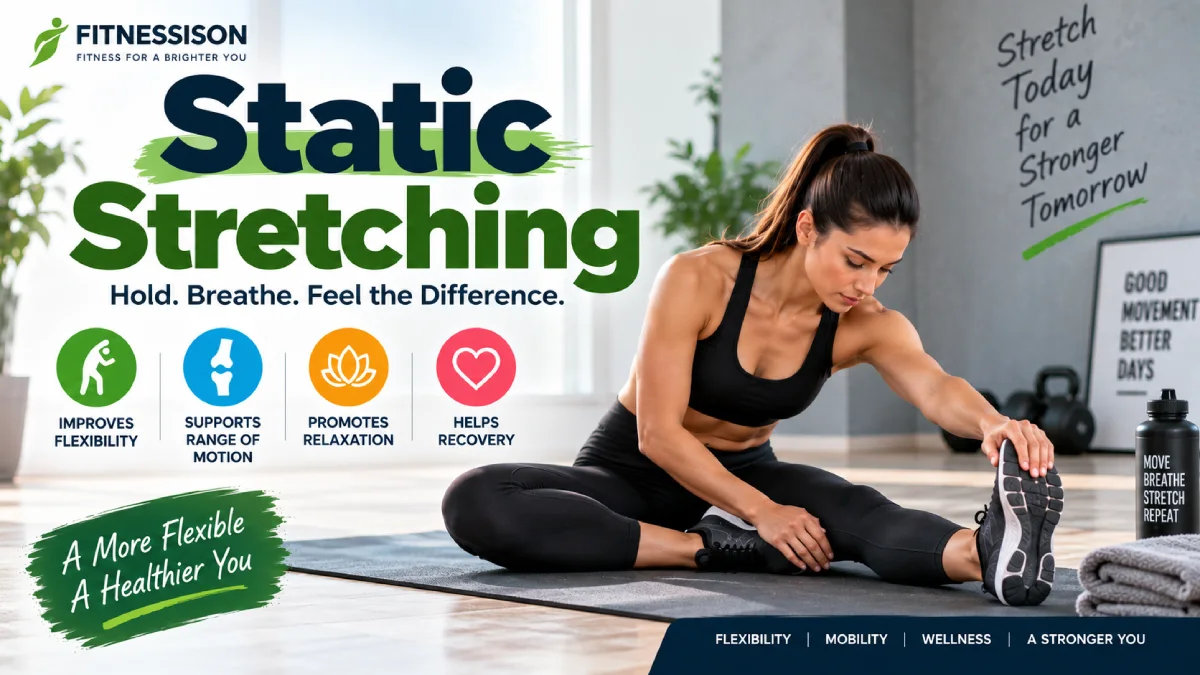
Static stretching is, arguably, the most popular type of stretching. This involves extending a muscle to a position in which the individual is comfortable and holding it in that position rather then repeatedly performing the movement. This type of stretching may be an element in a workout following an exercise session, within the context of a yoga flow, or as part of a dedicated flexibility practice. When applied properly it can be an effective choice for practicing flexibility and movement efficiency, however static stretching is different from mobility training and may not be the best choice for every part of a workout.
What Is Static Stretching?
Static stretches involve staying in a position without bouncing or changing positions. For example sit on the floor with your legs extended and slowly reach towards your toes. When you feel a stretch on the back of your legs stop and hold the position.
Common static stretches include:
- Hamstring stretch
- Calf stretch
- Quadriceps stretch
- Hip-flexor stretch
- Chest stretch
- Shoulder stretch
- Triceps stretch
You should not trying to stretch yourself into the deepest position you can. A static stretch should always stay within a comfortable, manageable feeling.
How Does Static Stretching Work?
When you are in a stretch, the muscles and tissues that the stretch isolates are relaxed gently and placed under stretch. With consistent stretching training over the long term, you can learn to comfortably utilize a greater range of motion. Individual differences make a significant impact on flexibility and every person‘s current flexibility is highly dependent on their body composition, activity levels, stretch training history, age, and individual stretch tolerance. This is one of the reasons why two people can perform the same stretch and have vastly different ranges of motion.
Benefits of Static Stretching
1. Supports Flexibility
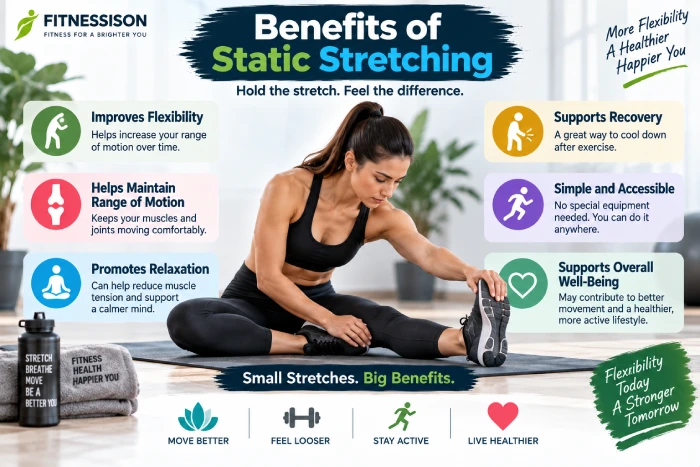
The primary reason I use static stretching is for mobility. With consistent practice of effective stretches I will become better adapted to moving through some ranges of motion.
2. Helps Maintain Range of Motion
Maintaining your range of motion may be useful when performing workouts or everyday activities. Stretching may be added to a total body program for maintaining your flexibility,
3. Simple and Accessible
No costly equipment is required for the majority of static stretching. The majority can be done with nothing more than your body weight and a small minimum space on the floor. A wall, chair, towel, or strap can sometimes help perform some static stretches more efficiently.
4. Useful After Exercise
The use of static stretching normally fits best as part of a cool down or a stand-alone flexibility session. After you finish your workout you often already have some time planned for recovery activities, a few stretches could simply be added to your existing schedule.
5. Supports a Regular Mobility Routine
Static stretching is not a mobility training in itself but it can be added to active mobility work. For instance, you can do dynamic mobility in your warm-up, then work and finished with static stretching.
Static Stretching vs Dynamic Stretching
What is the difference? movement.
| Static Stretching | Dynamic Stretching |
| Hold a position | Move continuously |
| Typically performed slowly | Aims to control movement. |
| Corpis frequently used for properties of flexibility | Commonly utilized for warm-ups |
| No repeated motion required | The joint actively goes through a full range of movement. |
| Helpful after workout or independent session | Use for movement warm-up |
No need to treat either as a substitute for the other; different types of stretching suit different workouts, goals and time of day.
Best Static Stretching Exercises
Standing Calf Stretch
Put your hands on a wall, step one foot behind the other, keep the back heel on the ground, step forward then strectch through the calf. Hold the stretch then repeat on the other leg.
Seated Hamstring Stretch
Seated Position, One or Both Legs Standing. Keep your back in a comfortable position and slowly reach toward your foot where you feel mild tension behind your leg. Do not strain to touch your toes.
Standing Quadriceps Stretch
Prepare by holding onto a wall or a steady object for support. Bend your right knee and grasp your heel in your right hand. Draw your heel toward your right glute while holding onto your ankle. Keep your knees fairly close together and at a comfortable width.
Hip-Flexor Stretch
Step into a supported half-kneeling position. Lean your hips gradually forward, while maintaining control of your torso. Gentle tension should be felt in the front of your hip joints rather than trying to pull your lower back into an over-arched position.
Chest Stretch
Place your forearm against the wall or doorway and gently revolve your body away. This stretch can be comfortable across the chest and front of the shoulder.
How Long Should You Hold a Static Stretch?
There isn‘t an ideal amount of time or amount of stretch for everyone. The general recommendation is simply to hold the position comfortably, then focused on the stretch yet not so long that pain results. New practitioners could try hold for shorter durations initially, then adjust the duration as they get used to it, according to their overall aims and training schedule.
When Should You Do Static Stretching?
In another stretching session after exercise, or at a different time of day altogether. If your warm-up is in preparation for speed, power, or force production then the warm-up session should be best implemented with an emphasis on increasing activity appropriately and controlled dynamic movement over static elongation. For instance, walking or light jogging before running then a series of slow controlled movements such as high knees and butt kicks. After running you could then do a few gentle static stretches, if applicable.
Common Static Stretching Mistakes
Forcing the stretch
The key Word is “more”. More depth is not the same as better!
What was better of approach: getting comfortable, in the comfortable range, and not trying to push the position.
Bouncing
It is also designed to be held, not just flung into the end range.
Better approach: Maintain the position stable and controlled.
Stretching through pain
Sharp or worse pain should not be endured.
Sounds great, but the best way to end it is: 4. lower the range/stop the exercise.
Comparing yourself with others
There is a huge variation in the flexibility of individuals.
Better way: in the second page, (greater attainable) set with your own progress, try to reach my first number that shows on the page that is your own section.
Ignoring strength and mobility
I shall not go into details of stretching, since there are many other factors involved.
Improved strategy: When possible, seamless integration of flexibility, strength and active mobilization training.
Static Stretching and Flexibility Training
However, static stretching is useful as part of a flexibility program, only if used as step three.
A balanced routine might include:
- Dynamic movement
- Static stretching
- Strength training
- The mobility program for the active exercises:
- Between physical activity (over 150 minutes/week of moderate ) and obesity.
This power pack can be used to develop both available range and the ability to utilize your available range.
Final Thoughts
Static stretching is a basic and fairly accessible form of exercising with flexibility. By taking a comfortable position in a stretch and remaining stationary rather than bouncing, like in many other kinds of stretching or training with flexibility, you can incorporate it in your regular post-workout flexibility training or in a specific stiffness session. Avoid going to very extreme positions and do not see pain as a sign that you are succeeding. Instead focus on moving deliberately, being consistent and practice gradually.