


Mohd Arbaaz is an Editor and Writer at Fitnessison.com with 5 years of experience in SEO and digital content creation. He creates informative, reader-focused content covering fitness, workouts, nutrition, health, healthy lifestyle, technology, and computers.

Shashi Teja is a Reviewer at Fitnessison with over 6 years of experience in SEO, content strategy, digital publishing, and content optimization. He reviews content for clarity, research quality, topical relevance, readability, structure, and overall usefulness to readers.
Last Updated: September 21, 2026
Rest days are also an essential component of a balanced workout routine. Exercising exerts a physical stress that your body has to recover from, and a rest day is nothing to be embarrassed about. Sometimes planned rest can be just what you need to get back on track for your next workout with more readiness, energy and focus. How much rest is “enough” will depend on how hard your workout is, how fit you are, what your goals are, as well as your sleep, diet and training schedule.
What Are Rest Days?

A rest day is scheduled time off from vigorous exercise. This involves no longer having to sit in bed on your days off, although some low level activity and mobility work may help those who stay at home. Some clients may wish to have a full day off, while some may choose to keep moving!4 Rest days are used to shake up training stress and allow maximum recovery. For instance, an athlete doing serious strength sessions a number of times per week might have one or more days with no ROM. The aim is to achieve a degree of balance between workload and rest.
Why Are Rest Days Important?
Exercise presents a training stimulus. It takes time for your body to adapt to that stimulus. Overtraining can occur if you are continually training hard without adequate recovery resulting in fatigue and a decline in performance.
Rest days can help you:
- Alleviates accumulated fatigue
- Support muscles rehabilitation
- Restore energy
- Keep workout quality. If you are making less than 1 lb. of muscle gain per week, then you are not eating enough. When you don‘t have quality workouts, it is likely that you are just not eating enough.
- Rest the joints and connective tissue.
- Maintain long-term consistency
- Minimize the likelihood of overdoing it in the early stages.
When you add more days, more repetitions, longer duration or higher levels of effort to your program, rest becomes the most important element.
How Many Rest Days Do You Need?
Everyone is different, so there isn‘t a specific number of rest days that is suitable for all. A novice might require more rest between high-intensity sessions than someone who‘s been training hard for years. Your routine may also vary depending on what activity you‘re doing. So, for example, an individual doing high intensity resistance training might need greater recovery following a hard leg workout, whereas the individual taking easy walks may be able to remain active on all days. Rather than adhere to some arbitrary rule, listen to your body and monitor your performance.
Signs You May Need a Rest Day
There are signs from your body that may help you if your training load is becoming unmanageable.
Consider taking additional rest when you notice:
- Overuse injuries, such as chronic muscle soreness.
- Unusual fatigue
- Poor sleep
- Decreased performance during exercise.
- Lack of motivation
- Heavy/tired muscles. This is due to musclepump 14.produced during exercise. This muscle pumping effect is caused by an increase in blood flow, forcing blood to be pumped around the body.
- Irritability
- Struggles to get through workouts that would usually be easy to complete
- Persistent pain, twinges, or discomfort
A single hard session does not necessarily mean quite a few days off. Investigate to see whether you notice which patterns persist over different days.
Rest Days vs. Active Recovery
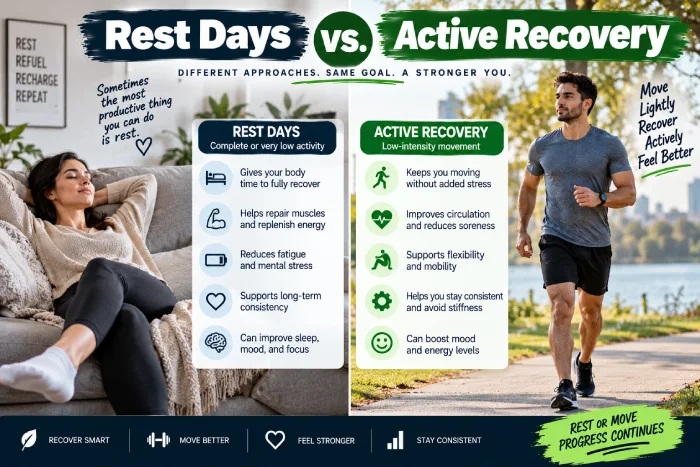
Rest day and active recovery are not the same however. Rest days involve cutting back or stopping formal exercise. An active recovery day may include walking, gentle cycling, stretching or mobility work. Both can be good. If you just feel a bit tight but reasonably charged then a gentle walk may be right for you. If you feel totally drained of energy and perhaps more sore than usual, then complete rest may be better. The key is to avoid turning every rest day into another hard session.
What Should You Do on a Rest Day?
A rest day, not surprisingly, is a good time to get a little more productive. Skip the exercise bit and concentrate on contributing to your recovery.
Prioritize Sleep
When you get quality sleep, your body can rest and recover from emotional and physical stress. Do not change the bed time too much and try to find comfort to the best of your ability.
Eat Balanced Meals
You still need good, healthy food on your rest days. Protein for muscle maintenance, carbs for energy and all other foods for their vitamins, minerals, fiber and good fats. Don‘t assume you need to cut down your food intake significantly just because you aren‘t exercising that day.
Stay Hydrated
Drink fluids all day long. How much fluid you need can vary with the temperature outside, how active you are, your size and how much you sweat.
Move Gently
If you find yourself becoming tight from absolute rest, try an easy walk or mobility session. Keep things simple and do not train.
Rest Days for Different Fitness Goals
There are few, if any, of us who don‘t have a different relationship with rest based on what we‘re hoping to get out of it.
Rest Days for Muscle Growth
Muscle tissue needs training, eating and resting. Giving those over trained muscles plenty of time to rest and recover can help you get back to your next training session ready to train again.
Rest Days for Weight Loss
You don‘t have to work out on a daily basis to lose weight. Days off can help you keep the routine manageable and keep your fitness routine from feeling too intense. It is your overall calorie balance, diet, activity and regularity that counts, not a lack of all resting days.
Rest Days for Beginners
New to an activity? Beginners usually get better results if the difficulty of their training gradually progresses rather than training hard every day. By intelligently planning recovery, it will be easier to become accustomed to the new routine without being overwhelmed.
Common Rest Day Mistakes
Others find it hard to rest as they feel ashamed of having a break.
Common mistakes include:
- Thinking rest results in either immediate or future regression}
- Having working out hard everyday
- The chronic nature of fatigue.
- Going through the pain to reach the pain54: viewing sore as a sign of needing to work the body hard, similar to a sign of pain, though more of an action point. Feeling sore, and guiding students through the soreness to the pain55.
- Not eating a healthy breakfast/training on a rest day.
- Remaining entirely inactive if at all possible until comfortable movement is achieved.
- Back to heavy training before recovering:This suggests to start again back to heavy workout before recovering, which would decrease muscle efficiently.
Rest is not the opposite of training. Rest is the training.
When Should You Take an Extra Rest Day?
Your schedule doesn‘t need to dictate your daily program. If you get out of bed and you feel extremely tired, you‘re very sore, or you seem to be performing poorly compared to 2 days ago, then you may want to alter your workout. One extra rest day isn‘t going to cause you to regress. However, continually training through extreme fatigue is much more likely to negatively affect your ability to stick with a schedule. You‘ll get the hang of knowing when to take a break.
A Simple Rest Day Routine
A rest day can be simple:
- Morning: Have a nutritious breakfast and drink plenty of fluids.
- Day time: Walk comfortably and enjoyably, if you are fine;
- Meals: Ensure a good balance of protein, carbohydrate, vegetables and fruit. Other nutrient-dense foods should be included.
- Evening: Minimize unnecessary stress and ready yourself for high-quality sleep.
You do not need complex recovery routine. The idea is to rest your body from training stress and maintain healthy lifestyle.
Final Thoughts
Rest days are not “off days”. Rest allows your body time to recover and recover from training and to ready itself for the next sessions. The best schedule is different for everyone depending on your level of fitness, the severity of your training, your goal, and your ability to recover. Practice absolute rest when you need it and it feels right or even light activity when a gentle movement feels good. Most important; keep in mind that without rest days you will never progress, working out is a combination of training and resting. Rest days should become a regular feature of your exercise regime in order to maintain a sustainable training routine.