


Mohd Arbaaz is an Editor and Writer at Fitnessison.com with 5 years of experience in SEO and digital content creation. He creates informative, reader-focused content covering fitness, workouts, nutrition, health, healthy lifestyle, technology, and computers.

Shashi Teja is a Reviewer at Fitnessison with over 6 years of experience in SEO, content strategy, digital publishing, and content optimization. He reviews content for clarity, research quality, topical relevance, readability, structure, and overall usefulness to readers.
Last Updated: September 8, 2026
If your goal is to shed some pounds then knowing your calorie deficit is one of the most important pieces of knowledge you can learn. It is just like it sounds; You eat less calories a day then your body gets rid of naturally. As a result your body will begin to utilize stored fat as fuel.
Most individuals under-eat calories without knowing what their body actually needs. This also normally results in under eating, muscle breakdown or an inability maintain the results long term. Once your calorie deficient has been calculated properly, you will be able to determine realisitc goals for fat loss.
In case this is all new to you. We also have a Complete Calorie Deficit Guide in order to introduce you to the concept of calorie deficits before you even learn about how to calculate them.
What Is a Calorie Deficit?
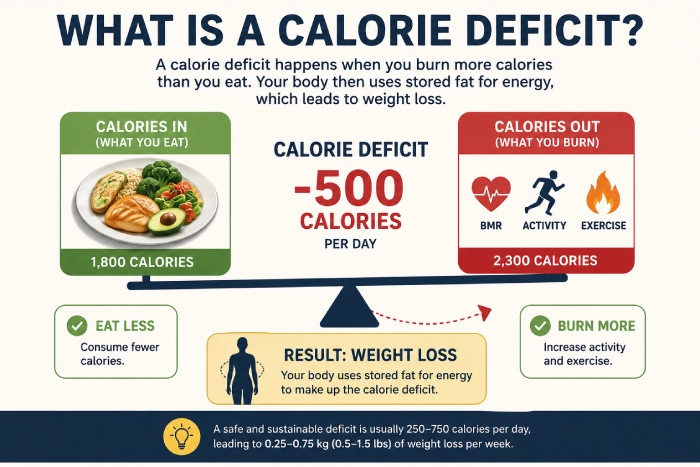
A calorie deficit is when your body is using more calories than being taken in from your food and drinks.
For example:
- Food intake Calories eaten: 2,000
- Calories exhausted: 2 500
Calorie deficit= 500 calories.
As your body still needs the energy it cannot get from this, it will start to use some of the body‘s fat stores.
The duration over which this deficit is maintained determines weight loss:
Think of it like a bank account:
- Consuming calories= Depositing money
- Burning Calories = Spending money. Sadly it is also true!
When you spend more than you deposit, your balance decreases. If you take in more calories than you burn then you body fat will increase.
Why Should You Calculate Your Calorie Deficit?
The number of calories one needs to eat is varied to each individual.
Factors that affect your daily calorie requirements include:
- Age
- Gender
- Height
- Current weight
- Muscle mass
- Activity level
- Metabolism
A person who weighs 75 kg (160 Ibs) may still have very different caloric requirements, if one just sits at a desk all day and the other works in sedentary labor.
Calculating your calorie deficit helps you:
- How to reduce weight safely
- Avoid having too few calories.
- Implication number one: Preserve existing muscle, maintain current strength. The goal is not to increase, but to help maintain existing strength and functionality. Keep the muscle you have!
- Enhance performance in the gym
- Achieve long-term weight loss
Understanding Energy Balance
Your body actually burns calories all the time to sustain its basic processes-in your sleep so being inactive doesn‘t mean you don‘t have an energy deficit.
These calories are used for:
- Breathing
- Circulating blood
- Digesting food
- Brain function
- Walking
- Exercise
- Daily activities
In terms of your body weight, it is the difference between calories burned and calories ingested.
| Energy Balance | Result |
| Eat more than you burn. | Weight gain |
| Eat exactly what you burn | Weight maintenance |
| Consume fewer calories than you use. | Weight loss |
Step 1: Calculate Your Basal Metabolic Rate (BMR)
When calculating a calorie deficit, the first thing to do is work out your Basal Metabolic Rate (BMR).
Basal Metabolic Rate (BMR) is how many calories your body requires on a daily basis, just to keep you alive.
This includes:
- Heartbeat
- Breathing
- Brain activity
- Organ function
- Human physiology has evolved to actively control our body temperature. The body is maintained at an average of approximately 37°C, with the core‘s temperature ranging from 36°C to 38°C.17
E If includes activities such as smoking, drinking alcohol and other leisureactivities.
Mifflin-St Jeor Formula
This formula is said to be one of the most accurate formulas used by nutritionists.
For Men
BMR = (10 x weight in k.g.) + (6.25 x height in) – (5 x age in) + 5
For Women
Where BMR is Basal Metabolic Rate, Kg is the weight in kilograms and Cm is the height in centimeters.
Example (Male)
Age: 30 years
Gender:Male. Weight:80kg. Age:30years.Gender and Weight: Well-matched in terms of genders. So no adjustment needed. In terms of Age: 15 years less than the initial calculation. So this number should be increased by 9.7%.
5’ 9”: The measured height is 175 cm.
Calculation:
(10 times 80) + (6.25 times 175) 5 (times 30) + 5
= 800 + 1093.75- 150 + 5
= 17490calories/day I arrived at this figure by multiplying 0.568 calories/day by the number of levels: 308 to get calories/day for level 2 (3.3), then by 606 for level 3, then 278 for level 4, then 73 for level 5, and then by 17490 for level 6.
Which means the body takes about 1,749 kcal out to breath, live and so on.
Example (Female)
Age:28 years.
Weight: 65 kg
Height:(165cm)
Calculation:
(10 × 65)+(6.25 × 165)-(5 × 28)-(161
= 650 + 1031.25 – 140 – 161
= 1,380 calories/day=1,380 calories/day.
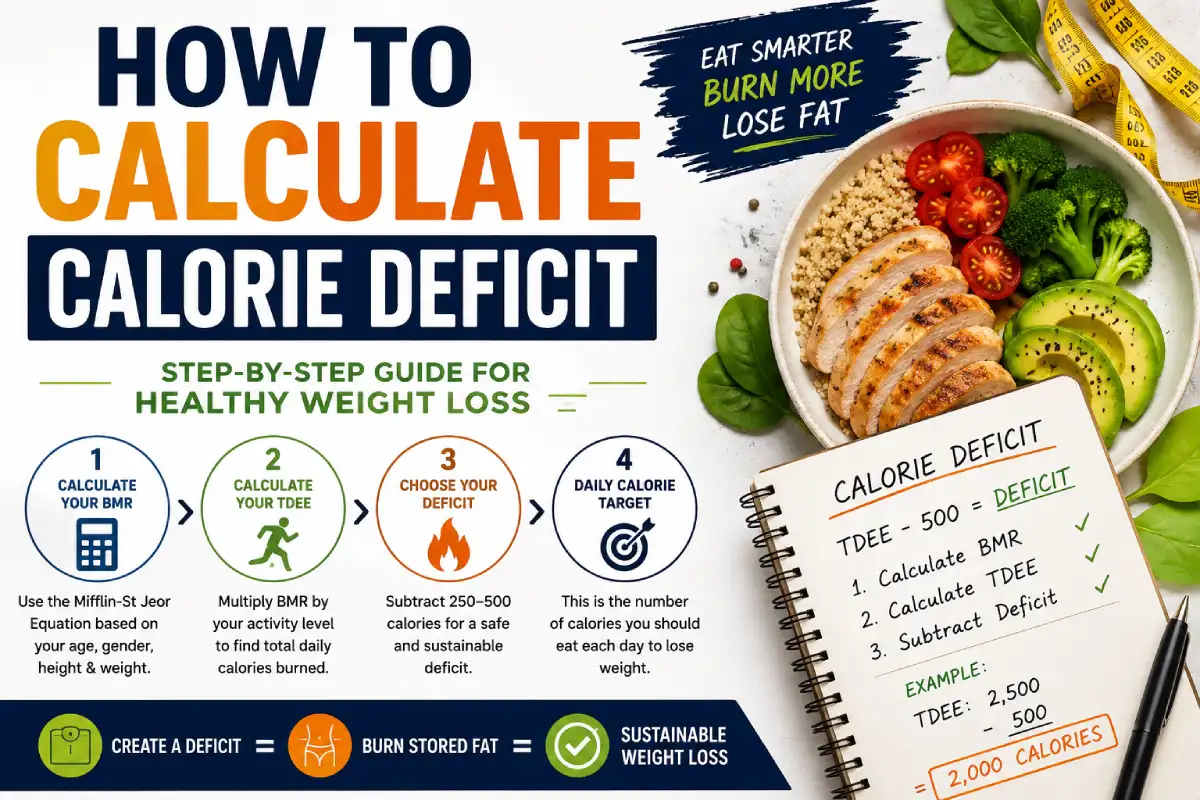
Step 2: Calculate Your Total Daily Energy Expenditure (TDEE)
Your TDEE (Total Daily Energy Expenditure) is the total amount of calories your body uses in a day everyday activities included.
TDEE= BMR*Activity Factor; is a total of your TDEE2.
Activity Multipliers
| Activity Level | Multiplier |
| Sedentary (very low physical activity level) | 1.2 |
| Light exercise (1–3 days/week) | 1.375 |
| Using advice from actual practice, moderate exercise (3–5 days/week) | 1.55 |
| Intensive (6–7 days/week) | 1.725 |
| Extra active (physical job + exercise) | 1.9 |
Example Calculation
Suppose your BMR is:
1,749 calories
And you train four times a week.
Activity multiplier:
1.55
TDEE:
1,749 % 1.55=
= 2,711 calories/day.
This equates to burning around 2,711 calories daily, factoring in exercising and all other daily activities.
This is also known as your maintenance calories, since eating around this number would often keep your weight the same.
Step 3: Choose Your Calorie Deficit
So, you know your TDEE. Great, now how much less are you going to eat?
Your rate of weight loss depends on how much of a calorie deficit you are in.
| Daily Deficit | Estimated Weekly Weight Loss | Best For |
| 250 calories | Approximately 0.25 kg. | Novice or lean people. |
| 500 calories | On the order of 0.5 kg | Most people |
| 750 calories | Hover. About 0.75 kg | Rapid fat loss (a relatively short period of time) |
| 1,000 calories | Throughput is about 1kg (equates to 0.4 m3). | Just with expert help |
A daily deficit of 500 calories is often suggested because it provides a good way of balance between a slow but steady fat loss and the retention of energy reserves and muscle bulk.
Example
TDEE = 2,711 calories. This means that the person should consume this amount of calories in order to gain 1 lb a week.
Target deficit = 500 calories
Daily calorie target:
2,711 minus 500 is 2,211 calories/day
If you are to eat roughly 2,211 calories on a regular basis at the same level of activity, then fat loss will occur at a slow but sustainable rate.
Can You Create a Calorie Deficit Without Eating Less?

Yes. A calorie deficit can be created in three ways:
- Consume less calories at the same level of activity you currently have.
- – Increase your physical activity as a means of burning more calories.
- The best option would be: a moderate reduction in calories combined with consistent exercise.
For example, instead of dropping 500 calories from your diet, drop 250 from your diet and then use some of that energy to walk, strength train or cycle away the other 250. This may be more sustainable for many, while maintaining muscle and health.