


Mohd Arbaaz is an Editor and Writer at Fitnessison.com with 5 years of experience in SEO and digital content creation. He creates informative, reader-focused content covering fitness, workouts, nutrition, health, healthy lifestyle, technology, and computers.

Shashi Teja is a Reviewer at Fitnessison with over 6 years of experience in SEO, content strategy, digital publishing, and content optimization. He reviews content for clarity, research quality, topical relevance, readability, structure, and overall usefulness to readers.
Last Updated: September 21, 2026
Although they will be able to land, on some simple beginners yoga poses to start off with, it will be clear to them that they are in fact healthy ways of the muscles, relieving stress and getting a healthier lifestyle. Whether you are a first timer or an experienced yogi re-familiarizing yourself with your body, beginning with beginner friendly poses will be an ideal introduction.
Advantages of yoga No much equipment required Practice as frequently as possible Practice anywhere. Just a continuous flow of exercise can help beginners to enhance posture, mobility, balance and mental health along relieving strain and pressure.
If you‘re looking to see; The best yoga poses for beginners, How to do them, who they are right for, and how to create a easy home practice. For the overarching strategy, read our complete guide on yoga asanas.
Why Beginners Should Start Practicing Yoga
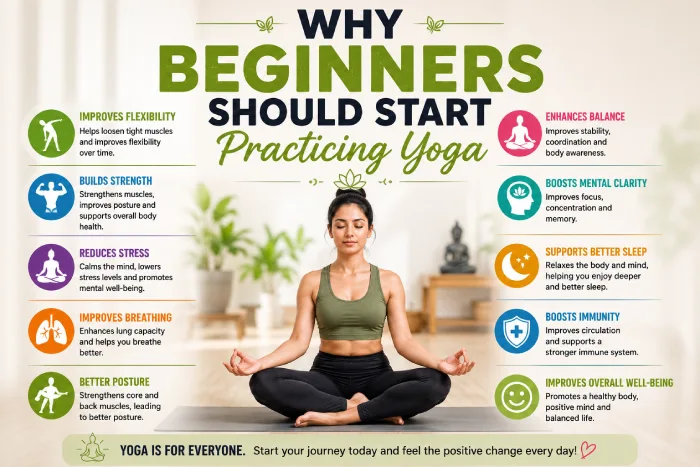
Yoga brings many positive benefits to our body and mind for everyone and all age groups and fitness levels.
Improves Flexibility
Most novice can reach a good level of flexibility within just a few weeks of instruction.
Builds Strength
Yoga. Yoga uses the weight of the body as a form of resistance to build up muscles all over your body.
Enhances Balance
The topic of a lot of poses, because increases balance and sensation of body.
Reduces Stress
Yoga is a practice that involves movement and breath holding which helps to calm the mind.
Improves Posture
Maintenance repetition will build up the muscle that pull the body up into good or proper postures.
Supports Better Sleep
Yoga induces relaxation and relaxation helps sleep.
Essential Orders Before Starting Yoga
Here are a few beginner tips to think about earlier you start practicing yoga:
Wear Relaxed Clothing
Select somewhat to wear to feel relaxed and express yourself. It should not be restrictive.
Use a Yoga Mat
A yoga mat adds comfort and stability;
Focus on Breathing
Breathing is an integral part of yoga practice.
Move Slowly
Fresh poses should be taken slowly.
Listen to Your Body
Never try to go outside what your body feels happy doing.
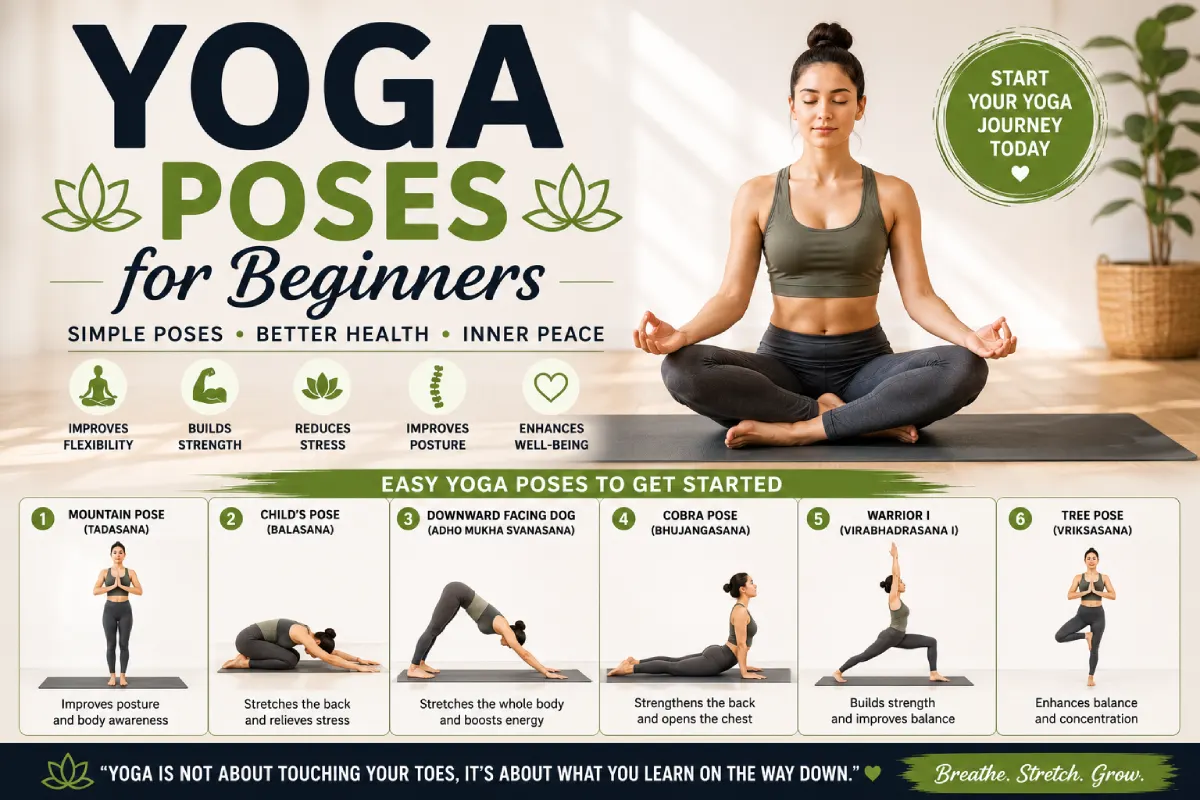
Mountain Pose (Tadasana)
Tadasana or the Mountain Pose is careful to be the basic pose of all standing poses.
How to Perform Mountain Pose
- Stand with feet together or slightly apart.
- Evenly distribute the weight over both feet.
- Relax shoulders, hands.
- Use your muscles… (use your core muscles)
- Lengthen your spine.
- Breathe deeply.
Benefits
- Improves posture
- Enhances balance
- Builds body awareness
- Helps develop strength in your legs and core
Yes, simple. Mountainpose is good for understanding proper alignment and breathing.
Child’s Pose (Balasana)
Child‘s Pose relaxes into a slouch position.
How to Do Child’s Pose
- Get down on your hands and knees.
- Sit on your heels.
- Stretch your hands in visible of you.
- Bring your chest closer to the deck.
- Place the forehead on the mat.
Benefits
- Relieves stress
- Softly stretches the hips and back
- Promotes relaxation
- Reduces tension
This pose is being performed as a save position for yoga classes.
Cat-Cow Pose (Marjaryasana-Bitilasana)
Cat-Cow is a combination of two motions bringing movement to increase mobility of the spinal segment.
How to Perform
Cow Pose
- Arch your back.
- Lift your chest.
- Look a little lower.
Cat Pose
- Round your spine.
- Tuck your chin in toward your chest.
- Pull it in.
Alternate slowly from one position to the other.
Benefits
- Enhances flexibility of the spine
- Eases back stiffness
- Enhances posture
- Heats up the body
Descending Facing Dog (Adho Mukha Svanasana)
Definitely, one of the best-known yoga asana.
How to Perform
- On hands and knees.
- Bring hips up.
- Maintain as much straightness in your legs as possible.
- Use your hands to press down into the mat with force.
- Relax your head.
Benefits
- Stretches hamstrings and calves
- Put tones on the shoulders and arms.
- Improves circulation
- Enhances flexibility
Novice physicians may wish to maintain a very small bend at the knees.
To take the next step, see our detailed guide on yoga poses names.
Cobra Pose (Bhujangasana)
The cobra pose grows the back as well as opening up the chest.
How to Perform
- Over normal stool.4 Have the patient lie with his or her face down.
- Place hands under shoulders.
- Gently press into your palms.
- Lift your chest of the floor.
- Maintain elbows a little flexed.
Benefits
- Back massager/efficiency to strengthen the back
- Improves posture
- Opens the chest
- Improves spinal flexibility
- Never put excessive pressure on the lower part of the lower back.
Warrior I (Virabhadrasana I)
The posture of Warrior I. is called to tone, strengthen, invigorate and help build strength and stability.
How to Perform
- STEP one foot back.
- Bend your front knee.
- Hand Forming your hands into a fist with your thumb wrapped around the outside then lifting them directly overhead.
- Keep your chest lifted.
- Put a hand in front of your face and breathe.
Benefits
- Strengthens legs
- Improves balance
- Builds endurance
- Enhances focus
This asana grows both physical and mental strength.
Warrior II (Virabhadrasana II)
Warrior II is very beginner-friendly standup pose.
How to Perform
- Place feet meters apart.
- Bend your front knee.
- Hold out arms so that they are parallel to the floor.
- Please have a look at your front hand.
Benefits
- Develops the strength in your legs.
- Improves balance
- Enhances stability
- Increases endurance
Tree Pose (Vrksasana)
Tree pose – A challenging balance pose that helps develop attentiveness.
How to Perform
- Stand tall.
- Transfer your body weight onto one leg.
- Put the second foot on your ankle or calf.
- Clasp your hands together in front of your chest.
Benefits
- Improves balance
- Strengthens legs
- Enhances focus
- Builds coordination
Stand near the wall to help balance.
Bridge Pose (Setu Bandhasana)
A bridge position is good for strengthening the lower back, tummy and lower body.
How to Perform
- Lie flat on your back.
- Kneel forward.
- Rest your feet with the soles flat on the floor.
- Lift your hips up.
- Hold briefly.
Benefits
- Strengthens glutes
- Enhances core stability2
- Is used to open the chest
- Supports spinal health
Seated Forward Fold (Paschimottanasana)
This pose bounces the back of the body.
How to Perform
- Sit with legs stretched out.
- Reach for your feet.
- Maintains a good length in the spine.
- Relax into the stretch.
Benefits
- Improves flexibility
- Relieves stress
- Stretches hamstrings
- Promotes relaxation
Easy Yoga Routine for Beginners
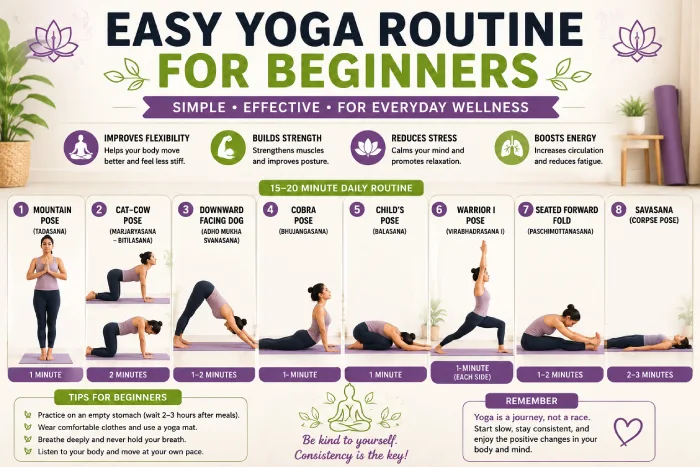
Here‘s an easy 15-minute yoga stream for beginners.
Warm-Up (3 Minutes)
- Mountain Pose
- Cat-Cow Pose
Main Practice (10 Minutes)
- Downward Dog
- Cobra Pose
- Warrior I
- Warrior II
- Tree Pose
- Bridge Pose
Hold a stretch in each location for around 20 30 seconds.
Cool Down (2 Minutes)
- Child’s Pose
- Seated Forward Fold
This routine reinforces, stretches, and boosts confidence.
Common Mistakes Beginners Should Avoid
Holding Your Breath
Breath must be slow and even.
Comparing By hand to Others
Everyone changes at your own pace.
Forcing Flexibility
Flexibility is developed bit by bit.
Skipping Warm-Ups
A warm-up prepares our muscles and joints for drive.
Practicing Inconsistently
Practicing frequently gets you better results.
Benefits of Practicing Yoga Regularly
When practiced reliably, yoga can provide:
- Better flexibility
- Increased strength
- Improved balance
- Reduced stress
- Better posture
- Improved mobility
- Enhanced focus
- As an indicator of improved sleep quality
As little as 10–20 minutes of daily yoga practice can have an impact.
Final Thoughts
Yoga poses for beginners is the perfect way to begin your journey towards holistic health. Having beginner level poses including the traditional Mountain Pose, Child‘s Pose, Downward Dog, Warrior Poses and Tree Pose allows new practitioners to smoothly work on developing flexibility, balance, strength and confidence.
Of course yoga is a personal journey. It will take patience, consistency and practice but it is more about progressing than mastering. Just be. Loosen up. Loosen up, relax, relax and enjoy the feeling of feeling authorized, healthier and more energized.
FAQs
How often should beginners practice yoga?
Applications can be started among 2 and 4 days a week by the beginners and the development occurs as an individual rate.
Is yoga good for weight loss?
Yoga is indeed linked with weight loss. This can be achieved to increase exercise and movement,Decreasing stress levels,Lead to long-term healthy behaviors.
What is the easiest yoga pose for beginners?
Mountain pose and child‘s pose are (one of the) most accessible poses.
Can I do yoga every day?
Yes. The massive majority of people can do yoga as often and as much as they like, every day and in a very gentle form (e.g beginners yoga).
How long should a beginner yoga session be?
Nearly everyone beginners, 15-30 minutes will be a very good selection.