


Mohd Arbaaz is an Editor and Writer at Fitnessison.com with 5 years of experience in SEO and digital content creation. He creates informative, reader-focused content covering fitness, workouts, nutrition, health, healthy lifestyle, technology, and computers.

Shashi Teja is a Reviewer at Fitnessison with over 6 years of experience in SEO, content strategy, digital publishing, and content optimization. He reviews content for clarity, research quality, topical relevance, readability, structure, and overall usefulness to readers.
Last Updated: September 8, 2026
A myriad of other vitamins and supplements are readily available, everything from multi-vitamin tablets to vitamin D injections, miracle supplements to herbal remedies, and sports nutrition. But does more choice actually make nutrition simpler?
For most people the main question is ‘is it right for me to be taking the supplement?’ rather than ‘which supplement should I take?’ Nutrients such as vitamins and minerals are found naturally in a diet and are necessary in only small quantities to perform many simple functions. A supplement can be formed from vitamins, minerals, herbs, botanicals, amino acids or other ingredients and is not intended as an alternative to wholesome nutritious food.
For the majority of healthy subjects a balanced diet should be the first choice, but the use of supplements can be regarded as justified if no other choices are available, a deficiency is confirmed, a certain type of food should be avoided, there is a malabsorption or the practitioner recommends supplements to achieve a certain aim.
This guide shows you how vitamins and supplements can form part of a healthy lifestyle, what you should be aware of, what mistakes to avoid and when you might need more help.
Note: This page is for informational purposes only and should not replace the personal guidance of your individual health care provider. The need for supplements may change over time, with pregnancy, pregnancy, health problems, medication changes, lab work or changes in diet..
What Are Vitamins and Supplements?
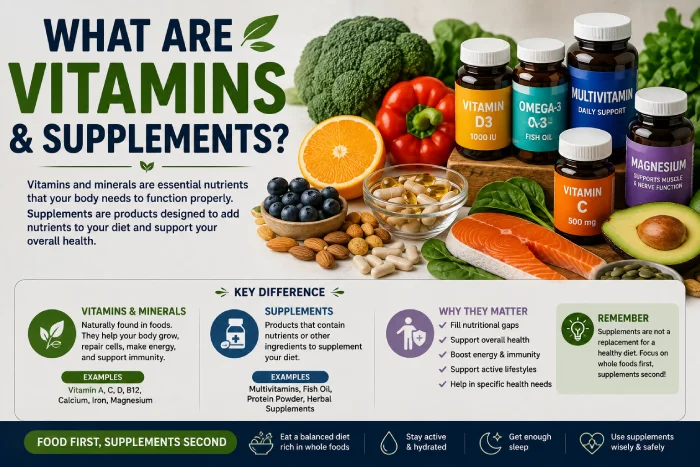
Vitamins: Organic compounds we require for our bodies to work. For example, Fat-soluble vitamins play a critical role in cell function as they help improve our body‘s ability to resist infection and help repair damaged tissues. Minerals: Inorganic elements necessary to our bodies, from blood production and healthy bones down to enzymes and fluid levels.
Dietary supplement – a product which:v are intended to augment one diet by adding nutritional ingredients to it; and/or Clinicians will surely not be surprised to know that dietary supplements come in many different forms including:
- Tablets
- Capsules
- Powders
- Liquids
- Gummies
- Softgels
- Chewables
The NIH Office of Dietary Supplements provides a definition of supplements as ‘diets containing one or more of the following dietary ingredients: vitamins, minerals, herbs or botanicals, amino acids, enzymes, and other ingredients’.
Vitamins vs. minerals
A simple way to remember the difference. The rest of the vitamins are organic compounds.
Minerals are elements.
Both are necessary, but they have different modes of action.
Vitamins are commonly divided into:
Water-soluble vitamins
- Vitamin C
- B vitamins
Fat-soluble vitamins
- Vitamin A
- Vitamin D
- Vitamin E
- Vitamin K
Fat soluble vitamins can be stored in the body hence excess supplementation may be a concern.
Key takeaway
Vitamins and minerals are nutrients you don‘t need to take them, the body produces a lot of it already!
Their significance simply stems from providing the body with all its needs rather than the maximum dose possible.
If you would like to investigate further, the next cluster of Essential Vitamins and Mineral should break down each nutrient individually.
Why Do Vitamins and Minerals Matter?
Magnorogens than those obtained from dietary sources. The micronutrients are involved in hundreds of biochemical pathways.
Depending on the nutrient, they may contribute to:
- Energy metabolism
- Bone development
- Erythropoiesis
- Immune function
- Normal vision
- Nerve function
- Muscle function
- DNA production
- Wound healing
- Antioxidant systems
This doesn‘t mean that to get the same benefits you would need to keep taking more vitamins.
In nutrition, finding the right amount is more important than going overboard.
For instance, correcting a deficiency in a nutrient is important, but obtaining a megadose of a nutrient in this way when you already get an adequate amount may be of little benefit and can be counterproductive.
Cleveland Clinic points out, “Inadequate or too much of the vitamins and minerals can create health issues.”
Practical example
Think of two individuals. A Person A is on a mixed diet and has no known deficiency. B has evidence of a nutrient deficiency. Supplements often have very different importance for Person B than for Person A.
That‘s why the question should not simply be:
‘Best vitamin? ’
A better question is:
What is the true deficiency? Which nutrient, if any, am I truly lacking?
The Food-First Approach to Vitamins
One of the fundamental rules of dieting and nutrition is eating food, before supplementation. [Whole foods] deliver not just single nutrients like vitamins and minerals. Fruits, vegetables, legumes, grain, nuts and seeds, dairy, egg,fish etc provide nutrients, fibre, protein, fat and other nutritive substances in certain blends.
The NIH emphasis on the inconspicuous substitution of the balanced diet can be supplied by multivitamin/ mineral supplements as foods have fiber and other constituents along with those. Another means to get vitamins and minerals according to Harvard Health is to “Begin with food. This is how nature built our food supplies and so it should be our primary strategy”.
A practical food-first plate
Break away from the old question of which pill to purchase. Instead, examine your meals.
Try to regularly include:
- Colorful vegetables
- Fruits
- Whole grains
- Oils and fats: Livestock including milk and milk products Obeans and other legumes.
- Nuts and seeds.
- Lean proteins
- Fish/seafood where appropriate
- Dairy or fortified substitutes
- Healthy fats
Example
Consume vitamin C containing foods such as citrus fruit, strawberries, green and red peppers, broccoli and many more in place of purchasing vitamin C tablets straight away.
Mini summary
Supplements in the gaps. They shouldn‘t serve as a cop-out from the foundation of your diet. Next to explore: Link to Natural Food Sources of Vitamins for a comprehensive food-by-food guide to nutrients.
When Might You Need a Vitamin or Supplement?
This becomes more personal.
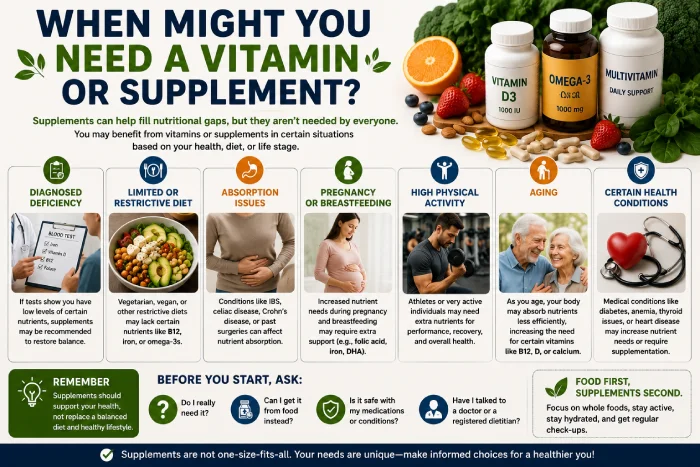
A supplement may be appropriate when someone:
- Has a definite deficiency;
- Cannot meet the requirement of the nutrient from the foods.
- The diet he/she adheres to is very strict;.
- Has an intestinal absorption disorder.
- Has an increased nutritional requirement.
- Is pregnant or considering pregnancy
- Has been recommended to have additional supplements by a medical practitioner.
Mayo Clinic states that taking supplements can be beneficial when a person does not consume a diet consisting of healthy foods, is on a limited diet due to an allergy or intolerence, or has an illness that impacts the amount of nutrients he or she consumes or absorbs.
Restrictive diets
Certain types of diets might need to careful planning.
For instance, vitamin B12 should be monitored in vegan diets as it is naturally present in animal-based foods, though fortified foods and supplements would offer an additional source.
Pregnancy
Pregnancy is also an example where requirements change.
Folic acid is most significant prior to conception and in early pregnancy due to the significance of adequate intake in preventing neural tube defects. The USPSTF makes the specific recommendation of folic acid supplementation in people planning to conceive or capable of conceiving.
Medical conditions
Some nutritional deficiencies can result from other digestive disorders, surgical procedures, drugs, or other medical conditions.
This is, where supplement advice should not be given in isolation from health history.
Key takeaway
Importance is what makes it useful.
What is right for one person may not be suitable or is perhaps even contraindicated for someone else.
Essential Vitamins and Minerals: What Should You Know?
None. What? There is no “most important” vitamin.
The body is also very dependent on many vital micro nutrients. There are a variety of different functions that these perform.
Here is a simplified overview:
| Nutrient | General role | Starchy foods and fruits and vegetables. |
| Vitamin A | Suggestion of subject.Impact of vision and immune system. | Including eggs, dairy, and colorful vegetables |
| Vitamin B1 | Energy metabolism, nerve function, | Whole grains, legumes, pork |
| Vitamin B2 | Energy metabolism | Dairy, eggs, meats |
| Vitamin B3 | Energy metabolism | Articles of food such as poultry, fish, meats, grains. |
| Vitamin B6 | Metabolism of proteins, nervous system | Poultry, fish, potatoes, bananas. |
| Folate | DNA & cell division. The information needed for cell division is stored within the DNA. Cell division involves a complex series of DNA replication, formation of the spindle apparatus and mitotic spindle, and segregation of the chromosomes. This process is assisted by several cell cycle checkpoints to ensure accuracy. | Include vegetables such as: Leafy greens, beans, fortified grains |
| Vitamin B12 | Blood and nervous system | Meat, fish, eggs, dairy, fortified foods. |
| Vitamin C | Formation of collagen, Antioxidant properties | Citrus, berries, peppers |
| Vitamin D | Calcium is involved in: Bone health and formation. | Fatty fish, omega-3 fish oils, foods fortified with omega-3, such as milk,spread,eggs,margarine,and sports and energy drinks; vegetable foods high in omega-3, tinned and fresh green beans, dandelion leaves, dandelion root, tinned and fresh French beans; seeds and nuts, such as walnuts, pecans; supplements, which will be beneficial for applicants who require improvement in skin, hair, or nails; and cod liver oil which is essential for those who need enhancement in eyesight. |
| Vitamin E | Antioxidant functions | Such as; nuts and seeds, vegetable fats and oils |
| Vitamin K | Blood clotting and its function in bones | Leafy greens |
| Calcium | Bones, mus~els, nervesDid you Know That? | Dairy and fortified foods, such as some greens. |
| Iron | Oxygen transport | Meat, beans, lentils, enriched grains |
| Magnesium | Muscle, nerve and enzyme functions. | Nuts, seeds, legumes, (whole grains), |
| Zinc | Cellular and immune functions | Meat, fish & seafood, milk & dairy, beans. |
| Iodine | Produc tion of thyroidhormone: | Iodised salt, fish and shellfish, milk… |
These are broad educational descriptions, not diagnoses or specific treatment recommendations.
Why food sources matter
The same nutrients may also be present in different foods. It allows a certain degree of flexibility in there. For example, if you don‘t consume dairy, then calcium and vitamin D would be another consideration. If you‘re not eating animal products. Be sure you are getting enough B12 and other nutrients that depend on the entire diet.
Best Natural Food Sources of Vitamins
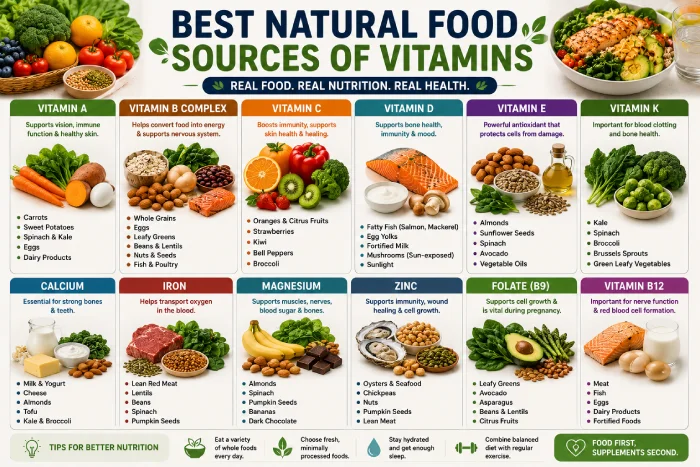
The following is one of the most reliable would be to increase the variety of foods consumed.
Vitamin A
Look toward:
- Carrots
- Sweet potatoes
- Leafy greens
- Eggs
- Dairy foods
Vitamin C
Try:
- Oranges
- Kiwi
- Strawberries
- Bell peppers
- Broccoli
Vitamin E
Useful sources include:
- Almonds
- Sunflower seeds
- Peanuts
- Vegetable oils
- Avocado
Vitamin K
Useful sources of these are leafy green vegetables.
Examples:
- Spinach
- Kale
- Collard greens
- Additional dark green vegetables
B vitamins
B vitamins are found across many food groups, including:
- Whole grains
- Beans
- Meat
- Eggs
- Dairy
- Fish
- Leafy vegetables
- Fortified foods
Vitamin D
Food sources include:
- Fatty fish
- Egg yolks
- Fortified milk
- Compressed plant drinks
- Other fortified foods.
Vitamin D status may be modulated by some factors other than food such as the exposure to sun radiation and the personal features.
Practical strategy
Eating a variety of foods throughout the week is more beneficial than attempting to remember sources of all nutrients: Come up with a variety of foods over the week rather than trying to remember the sources of all the nutrients.
A brightly-colored plate. This is probably a more effective strategy than envisioning your diet centered around some “superfood”.
Signs of Vitamin and Mineral Deficiency
Individuals often look up symptoms such as tiredness, hair loss, muscle cramps, difficulty in concentration or feeling weak and ask whether they have vitamin deficiencies.
The root of the problem is, many deficiency symptoms are nonspecific.
For instance, fatigue may be caused by a number of different factors.
It may be related to:
- Poor sleep
- Stress
- Calorie intake too low.6 There are several proteins and amino acids lacking in the weak and insufficient vegetarian diet. And missing proteins can cause fatigue in the body.2
- Dehydration
- Iron deficiency
- Other deficiencies of nutrients
- Medical conditions
- Medication effects
- Other lifestyle factors:
This means that the symptoms alone will generally not tell you which nutrient is deficient.
Possible deficiency clues
Depending on the nutrient and severity, deficiencies can be associated with symptoms such as:
- Fatigue
- Weakness
- Pale skin
- Alterations in nerve function
- Changes in mouth/tongue.
- Bone problems
- Muscle symptoms
- Alterations in blood: countsir Hematological: The blood parameters are generally normal, although may show abnormalities; on!may reveal anemia, neutropenia or thrombocytopenia.
However, symptoms alone are not sufficient to identify the deficiency.
The better approach
If you suspect a deficiency:
- Step 1: Examine what you eat.
- Step 2 : risk factors; Blood pressure; Age; Smoking; History; Ethnic; Fasting; Family history of Fatal MI-5; E/C; AED-8; Prior MI-14; Diabetes; PMID: 15479678: hypertension1; serum cholesterol: LDL, must be moderate and/or evidence from trial data; Total: Triglycerides triglycerides:; (Bilo): 950 526 25
- Step 3: Consult your healthcare professional about ongoing symptoms.
- Step 4: Order suitable laboratory testing if it makes sense in the context of the presentation.
- Step 5: If you are taking a multiple supplement this is a good time to stop and treat the original problem instead.
Why this matters
It is not advisable to see your doctor for the purpose of taking an iron supplement just because you are feeling tired, if iron deficiency anemia has not been confirmed.
The more, the worse.
The next step is to probe further into your cluster page on Signs of Vitamin Deficiency by clicking on individual symptoms and self tests. Follow the links on causes, treatments, and when to see your health care professional.
Vitamins by Age and Gender
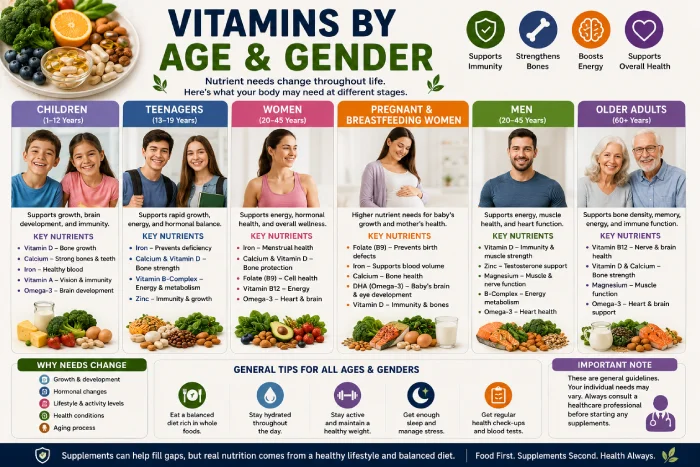
Nutrient needs change and are not the same life long. Conditions which may alter nutritional requirements are age, sex, pregnancy, lactation, diet, activity level, and the presence of illness.
Children and teenagers
Children and growing bodies have different dietary needs to adults.
Children‘Supplements should be used with caution in children as doses administered to adults may not be suitable for children.
Adults
In most healthy adults the primary recommendations should be to optimize diet(general eatery pattern).
Supplements should be decided for and used on the basis of nutritional requirements, rather than marketing hype.
Older adults
Age can also influence nutritional requirements.
According to Harvard Health, “elderly patients are more likely to have deficiencies in other nutrients such as B12 or vitamin D whatever their predicament”.
Women
Nutrient needs can change during:
- Menstruation
- Pregnancy
- Lactation
- Perimenopause
- Menopause
As far as iron is concerned, people who bleed in the course of menstruation should be specifically considered. Folate is most relevant in the context of pregnancy.
Men
Men also have their own nutritional recommendations to a certain extent, but there is no definitive list of what supplements all men should be on.
The same principle applies:
Evaluate individual‘s performances before a card score excellent, and after a card score fair.
Supplements for Fitness and Exercise
The Health and Fitness industry has created a rich market for the proliferation of supplements.
Some examples of popular marketing for active people are Protein powders, Creatine, Electrolytes, Pre-workout, Amino-acids, Multivitamins etc.
But doing exercise does not necessarily mean you will have to cart around a huge supplement stack.
Start with the basics
Before supplements, focus on:
- Adequate calories
- Protein
- Carbohydrates
- Healthy fats
- Hydration
- Sleep
- Training
- Recovery
- Micronutrient-rich foods
A supplement may be useful if it helps to overcome a nutritional or performance deficiency.
Example
Anyone who has trouble eating enough protein might find a protein supplement very helpful.
This doesn‘t imply the protein supplement were better than an ordinary diet.
It‘s just another form of protein intake.
Another important distinction
Convenience is not equal to necessity.
Supplements are not necessary but do not need to be avoided and while being convenient can be beneficial.
Vitamins and Supplements for Weight Loss
These are among the foody considerations on which consumers should stay alert.
Simply put, there is no such thing as a one wonders treatment to get fat off your body.
Numerous items sold under the banner of “fat burning,” “metabolism enhancing,” or “quick-kill” (i.e. fast weight loss) and that appear to make reasonable assertions, warrant closer examination.
A healthy weight-loss strategy generally centers on:
- Sustainable calorie limitation.
- Adequate protein
- Fiber-rich foods
- Fruits& Vegetables Fruits and vegetables are high in vitamin c, vitamin b group, vitamin a along with several minerals. Which reduces the risk of cancer, heart diseases, eye sight, cardiovascular diseases, bad cholesterol. As well as a variety of other health benefits.
- [Engaging] in regular physical activity
- Sleep
- Stress management
- Consistency
Supplements are not substitutes for those basics.
The USPSTF has given an I recommendation for multivitamin supplementation and the majority of vitamin/mineral supplementation in healthy adults who are not pregnant for the prevention of cardiovascular disease or cancer. It gives a D recommendation for the aforementioned supplementation for the prevention of cardiovascular disease and cancer, excluding beta-carotene and vitamin E.
Better question
Instead of:
What supplement is best for burning fat?
Ask:
What the “nutritional”/“behavior” factor inside me blocks me from pursuing a sustainable diet plan?
That change can be easier on the bank account, and cut down on unnecessary supplement consumption.
Supplement Safety: What You Need to Know
Many people automatically assume that supplements are safe as they are available OTC. That assumption, perhaps, can be false.
According to the FDA, ‘Dietary supplements are not approved by the Food and Drug Administration (FDA) for safety and effectiveness before they reach the consumer… manufacturers are responsible for ensuring that their dietary supplement products are safe and that any claims made are not false or misleading…FDA oversight over dietary supplements is limited to postmarket surveillance and enforcement.’
Hence making an informed purchasing decision is, therefore, all the more critical.
Read the Supplement Facts label
Look for:
- Serving size
- Quantity for the purpose of each serving.
- Active ingredients
- Other ingredients
- Daily Value percentages
- Suggested use
- Manufacturer information
- Warnings
The Supplement Facts panel is a part of the label which lists the ingredients and quantities supplied by the product.
Dosage: Why More Is Not Always Better
One of the most popular supplement errors is thinking that a higher dose gives better results. That‘s not how the nutrients work. Certain nutrients can be problematic if taken in excess. This applies especially to fat-soluble vitamins, certain minerals and high-dose supplements.
Understand the terminology
RDA Recommended Dietary Allowance The average daily amount of a nutrient that is sufficient to meet the needs of nearly all healthy individuals in a life-stage and sex group.
AI Adequate Intake
Applied where insufficient evidence exists to set an RDA.
UL Tolerable Upper Intake Level
The level of intake in this section was that which had an average daily intake that was probably not to cause adverse health effects in most individuals.
DV Daily Value
An indicator value present on food labels and supplement labels. These are not mutually replaceable. The NIH states that day-to-day recommendations are different for sex and age, while labels use Daily Values.
Practical rule
Something in the recipe has very high levels of several nutrients. Don‘t take it for granted that it is therefore a good choice. High‑dose formulas need to be examined more carefully.
Can Supplements Interact With Medications?
Yes. Some supplements interfere with medications or other supplements. This is one of the key reasons you should inform you health care provider of everything you are taking.
That includes:
- Prescription medications
- Over-the-counter medications
- Vitamins
- Minerals
- Herbal supplements
- Sports supplements
- Energy products
The FDA Drug Administration recommends that consumers consult a doctor, pharmacist, or other healthcare professional before taking any dietary supplements as some may interact with medicines or other supplements.
Before starting a supplement, ask:
- Is this a necessary evil? Now obviously I am encouraged to think of my own blog, so by the general persuasion, do I really need this? I personally think that you wouldn‘t need this, I think a lot of people would, but you don‘t need it.
- Valuable safety information. Might it have adverse interactions with my medicine?
- Is the dose correct?
- How long should I consume it?
- Is there anything I should be keeping an eye on?
These questions are particularly important if you:
- Taking medicines several time.
- Are pregnant
- Are About to Undergo Surgery
- Have kidney or liver disease: any-one with pre-existing is severely at risk from taking amiodarone, particularly if it is used over long periods.
- Have a long-term health problem
- Are deficiency is being treated.
How to Choose a Better Supplement
So if you‘ve concluded that a supplement is a good idea, don‘t settle for the first product you come across.
Look at the ingredient list
Don’t jump to the conclusion that working with more ingredients will achieve a better formula. Sometimes the most simplified product, easier to use your brain to get what you‘re taking.
Check the dose
Compare each amount per serving to the nutrients recommendation where appropriate.
Look for credible quality controls
Third-party tests may offer extra information in relation to product identity and quality. Nevertheless certification is not an indication that the supplement is right for you.
Be skeptical of dramatic claims
Be cautious with products promising:
- Rapid weight loss
- Disease cures
- Hormone fluctuations assured.
- “Detoxification”
- Overnight results
- Miraculous energy
- Unlimited muscle growth. Type 5 is considered ultra-muscular. Therefore growth of muscle is..absolute. Assuming the genetic factor for each individual was close to 100, then growth of muscle would be..absolute. This doesn’t sound like the case.
According to the FDA the supplement is not intended to diagnose, treat, cure, or prevent disease.
Think about transparency
A product where the ingredients and quantities are openly provided is a lot easier to assess than a proprietary mix where the quantity of the individual nutrients are obscured.
Multivitamins: Are They Worth Taking?
Multivitamins are a commonly used supplement. Multi-vitamins/minerals are a supplement that may contain a variety of vitamins and minerals, from many different sources. However, the form of the pill can vary widely, and the ingredients and amounts are completely up to the manufacturer. For some people, taking a multivitamin may be helpful in improving overall nutrition, but for others, they may have only an insignificant effect. Harvard Health indicates that evidence supporting health benefit from routine supplementation in healthy adults is very limited.
When a multivitamin may make sense
It may be worth discussing with a healthcare professional if:
- Your dietary intake is regularly restricted.
- Food isn‘t providing you with sufficient amounts of nutrients to meet your needs.
- You get particular nutritional risks.
- Your primary care provider suggests1
When it may not be necessary
If you eat an already diverse diet, and have no specific minerals or vitamins that you are deficient in, there is likely no point taking the high dose multivitamins merely on the argument that it provides “insurance”.
Water-Soluble vs. Fat-Soluble Vitamins
This understanding clarifies why we care about supplement safety:
Water-soluble vitamins
These are vitamin C and the B group vitamins. Most water soluble vitamins are not stored in the body in the much the same way as fat soluble but there are exceptions and there are varying rates of absorption and storage for the individual water soluble vitamins. That does not mean that you can take as much as you like without any side effects as a large dose can lead to problems.
Fat-soluble vitamins
These include:
- Vitamin A
- Vitamin D
- Vitamin E
- Vitamin K
These can be stored in the tissues of the body. Too much supplementation can sometimes put the individual at higher risk of building up.
Key takeaway
“It‘s a vitamin” should not be taken to mean “take as much as you want.”
Myth vs. Fact: Vitamins and Supplements
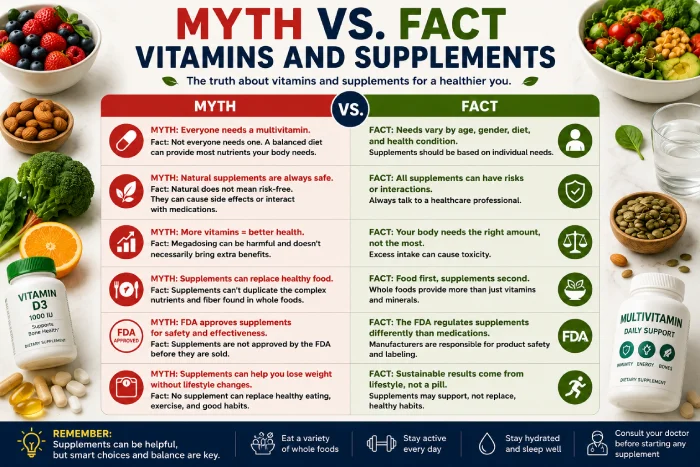
- Myth: Everyone needs a multivitamin.
- Fact: Not everyone needs one. Your nutritional needs are different, one healthy diet can consist of a variety of foods to supply all the necessary nutrients.
- Myth: Natural supplements are automatically safe.
- Fact: Natural doesn‘t mean safe. Supplements are not free of side effects and can interact with other remedies.
- Myth: More vitamins mean better health.
- Fact: nutrient requirements are expressed as ranges. More may be worse.
- Myth: Supplements can replace vegetables.
- Fact: No supplement can mimic all of the components found in whole foods. For example: fiber and many other nutrients cannot be supplied with supplements.
- Myth: FDA-approved means the supplement was proven effective.
- Fact: FDA is not approved dietary supplements for safety and effectiveness in advance of marketing.
- Myth: A supplement can fix an unhealthy lifestyle.
- Fact: No supplement can compensate for good nutrition, physical activity, rest and other healthy habits.
Common Supplement Mistakes
1. Taking supplements without a reason
Buying a supplement because everyone online is talking about it – not a nutritional strategy.
2. Taking multiple products with overlapping ingredients
You may unwittingly be ingesting the same nutrient from more than one product.
For example:
Multivitamin + immune supplement + beauty supplement + fortified drink
May also result in considerable overlap.
3. Ignoring food intake
Supplements should be just that, a supplement and not the main focus of nutrition.
4. Trusting influencer recommendations
What works for an influencer might not work for you as well.
5. Ignoring medications
Keep in mind possible drug interactions.
6. Using symptoms as a diagnosis
Fatigue or muscle cramps have a number of causes and are not necessarily an indication that you require a specific supplement.
7. Taking high doses indefinitely
The purpose and length of a supplement should be clear when ever possible.
8. Assuming expensive means better
This does not make quality dependent on price.
A Simple Supplement Decision Framework
Here is five-step approach you can apply to when you are out shopping in a mall or browsing on the Internet.
Step 1: Identify the reason
What are you taking the supplement for? Be specific. What does “Well done” mean? “Good health” is a term that we can not precisely define. The one “I‘m on a restrictive diet and not getting enough B12” would be more helpful.
Step 2: Look at your diet
Might the nutrient have reasonably derived from food? If required, then enhance diet first wherever appropriate.
Step 3: Consider evidence
Seek out reliable, accurate information from reputable healthcare organizations including NIH, FDA, academic medical centers or healthcare providers
Step 4: Check safety
Look for:
- Dose
- Side effects
- Interactions
- Contraindications
- Quality information
Step 5: Reassess
Some supplements are designed to be taken indefinitely; others are not. Don‘t make the assumption that every supplement is on for life.
Ask periodically:
Is there still any reason to take this?
A Practical Daily Nutrition Foundation
Get the foundation in place before finalizing any supplement stack.
1. Eat a variety of foods
Does diversity broaden the nutritional park?
2. Include vegetables and fruits
Use a variety of colors and types.
3. Eat adequate protein
Include foods such as:
- Eggs
- Fish
- Poultry
- Dairy
- Beans
- Lentils
- Tofu
4. Include healthy fats
Examples include:
- Nuts
- Seeds
- Avocado
- Olive oil
- Fatty fish
5. Choose quality carbohydrates
Examples:
- Whole grains
- Potatoes
- Oats
- Beans
- Fruit
6. Stay hydrated
Water is an integral component of healthy eating.
7. Sleep adequately
Nutrition is a part of the recovery process.
8. Exercise regularly
A supplement cannot stand in for physical activity.
Mini summary
A supplement stack compensating for a poor diet is still a poor foundation. A nutritious baseline makes supplementation much easier to assess.
How to Organize Your Supplements
If you use several supplements, neatness counts.
Create a simple list containing:
| Supplement | Dose | Reason | When taken | Notes |
| Supplement A | — | Nutritional gap | — | — |
| Supplement B | — | Healthcare recommendation | — | — |
| Supplement C | — | Dietary support | — | — |
Take this list with you when you go to the doctor. This will hopefully make it easier for your doctor or pharmacist to spot possible interactions or duplication.
What About Gummies?
Gummy vitamins might be easier to take for certain groups of people such as those who find it hard to swallow tablets. However, conveninece isn‘t the sole factor that makes them better.
Consider:
- Nutrient dose
- Any added sugars/sweeteners.
- Number of doses; the administration levels of the C8 aromatics in terms of the number of doses.
- Ingredient overlap
- Storage
- Child safety
According to Harvard Health, there have been issues raised over aspects such as gummy vitamins being very sweet, and the possibility of them being similar to candy in addition to health/tooth considerations. Remember the importance of keeping all supplements away from children.
What About “Natural” Supplements?
The term natural is very strong in supplement marketing.
But natural does not mean:
- Automatically safe
- Automatically effective
- Suitable for all.
- Is they have no adverse side effects.
- No interactions between medication and other compounds.
The use of herbs and botanicals can produce biological effects that are active.
In addition, the National Institute of Health (NIH), Office of Dietary Supplements offers authoritative evidence-based information of herbs and botanicals, in addition to taking care of vitamins and minerals.
The same decision framework applies:
- What do I want to get out of it?
- Is there evidence of use?
- What are the dangers?
- Any other way it could interact with anything else?
When Should You Talk to a Healthcare Professional?
Professional guidance is especially important if you:
- Possesses a diagnosed medical problem
- Use pills from doctors16251 To take prescriptions from doctors.
- pregnant or planning pregnancy
- Are breastfeeding
- Suffered nutrient deficiencies previously
- History of kidney or liver disease
- Experiencing problems with digestion or absorption.
- Has a clear understanding of the benefits, risks, and limitations of surgery.
- Are contemplating taking large amounts
- Would you give a baby supplements
- Experience side effects from using a supplement
The FDA in particular suggests consulting with a doctor, pharmacist, or another health professional prior to taking a supplement.
What If a Supplement Causes Side Effects?
If you have any worrying signs and symptoms, stop and get suitable medical advice.
FDA lists serious supplement-related reactions that can include:
- Severe allergic reactions.
- Chest pain
- Difficulty breathing
- Fainting
- Irregular heartbeat
- Repeated/violent vomiting and diarrhea
- There has been considerable abdominal pain
- Dark urine
- Yellow-colored skin or eyes
- Unusual bleeding
Any of these signs could be caused by a number of other problems; they should be regarded as real medical symptoms rather than something that can be put down to taking supplement. Seek immediate medical attention for severe or emergency symptoms.
The Future of Vitamins and Supplements
Meanwhile, the supplement industry is developing.
Consumers are increasingly seeing:
- Personalized nutrition
- At-home testing
- Subscription supplement services
- AI-assisted recommendations
- Vitamin packs that are tailored to individual needs
- Wearable-paired nutrition programs
- Functional foods
- Sports nutrition products
- Targeted formulations
Though these trends will likely lead to an increasingly personalized approach to nutrition, personalization does not guarantee accuracy. In the future, what we need from supplementation is probably better evidence, better labeling, greater quality assurance and more personalized judgment. More products might not be the answer.
How to Think About Supplements in 2026
Today the market for supplements is so large it can often seem like there is a pill for all possible ends. However, the availability of products should not be directly linked with the number of products you are taking.
A better approach is:
The goal of supplementation, leading to nutritional requirement, supported by evidence of effectiveness and safety, guides the decision of what product and what dose is to be used. Reassessment is the final, essential, step.
This is more helpful than chasing trends.
Quick Reference: Food First or Supplement?
| Situation | First step |
| Wholesome & Balanced diet | If the focus continues on food 13, the limitation will be around her passion for baking. She is an avid baker and has many recipes; this does not pose an issue as baking provides her with a lot of pleasure as do most of her hobbies. |
| Suspected/56+6` 12 deo999dh00ficiency | Discuss evaluation with a professional |
| Confirmed deficiency | Refer to appropriate treatment guidance |
| Restrictive diet | Pinpoint potential nutrient deficiencies: |
| Pregnancy | Adhere to prenatal nutritional guidelines. |
| Medication use | Check interactions |
| Athletic training | Check diet, checking recovery before. |
| Weight loss | Emphasis on nutrition and exercise sustainability |
| Multiple supplements | Look for ingredients that appear multiple times |
| High-dose product | Obtain Expert Advice |
| Child supplement use. | Contact your childs doctor |
FAQs About Vitamins and Supplements
Q1) What are vitamins and supplements?
Micronutrients can be defined as vitamins (organic small molecules needed in very small quantities) or mineral ( inorganic, small molecules required in small quantities). Dietary supplements are defined as food or food product taken to supplement one“s diet.
Q2) Do I need to take vitamins every day?
Maybe not. The affectiveness of a supplement depends on your diet, your age, health, nutritional status et c. It may not be particularly good for you if you have a healthy diet.
Q3) Can supplements replace healthy food?
No. Supplements will provide certain nutrients, but the wide variety of nutrients found in a varied diet are usually absent in a supplement. Food is also a source of dietary fibre and many other nutrients.
Q4) What vitamins should everyone take?
No single list of supplements is appropriate for all people, the needs of any one person should be individually determined.
Q5) Are multivitamins necessary?
Not for everyone. While they may be able to provide benefit in certain situations, evidence shows that there are no overall preventive advantages for all healthy adults from the consistent consumption of multivitamins.
Q6) What are the most important vitamins?
No one vitamin is the “most” important. The body requires many different vitamins and minerals, all of which have many different functions.
Q7) What are the signs of vitamin deficiency?
Syndromes are variable for each nutrient, and can be such as fatigue, weakness, changes in blood counts, neurological symptoms and/or bone abnormalities. Often the effects are non-specific and if deficiency is suspected the patient may need to be re-assessed and investigated.
Q8) Can I take several supplements together?
Moderation may be excessive for certain nutrients or interactions if stacking occurs. Be sure to talk to a health care provider with the full list of ingredients as needed.
Q9) Are vitamins safe?
Vitamins are normally safe in recommended doses, excess is dangerous. What is safe is dependent on whatever the nutrient is, the dose, time period, the person, health and so on. Including factors like drug treatment.
Q10) Are supplements FDA approved?
The Food and Drug Administration (FDA) does not pre-approve dietary supplements for safety and effectiveness before they are sold. Producers are held accountable to make sure their products follow all safety and labeling laws. The FDA monitors them during the post market phase.
Q11) Should I take supplements for weight loss?
Supplements are certainly no substitution for good eating, exercising, resting, and balancing calories. Stay far away from any product that promises rapid and/or effortless fat loss.
Q12) Should athletes take vitamins?
Causing deficiency is not a routine outcome of training, but necessitate changes in nutrient consumption. The recommended first action to nutrition changes is to maintain a balanced diet. Supplementation should be used if there is a known deficiency.
Q13) Are natural supplements better?
Certainly not. Many natural ingredients can cause side effects and interactions just like any pharmaceutical. You need to look at the evidence and balance safety, efficacy and quality needs together with your own.
Q14) Can I get all vitamins from food?
Even though the wide range diet provides most needed nutrient, individuals still may need supplement for nutrition because of restriction, stage of life, ill state, lack of any nutrients, or etc.
Q15) When should I take vitamins?
Timing will vary from nutrients, products, food intake and drugs and the reason for supplementation. Always adhere to the directions on the product or consult a professional, do not assume you should take every vitamin in the morning.