


Mohd Arbaaz is an Editor and Writer at Fitnessison.com with 5 years of experience in SEO and digital content creation. He creates informative, reader-focused content covering fitness, workouts, nutrition, health, healthy lifestyle, technology, and computers.

Shashi Teja is a Reviewer at Fitnessison with over 6 years of experience in SEO, content strategy, digital publishing, and content optimization. He reviews content for clarity, research quality, topical relevance, readability, structure, and overall usefulness to readers.
Last Updated: October 1, 2026
Work-life balance is having a healthy separation of your work and the rest of your life. It does not necessarily mean evenly splitting each day between work and non-work hours. Rather it requires enough coverage for your health, relationships, sleep, physical activity, hobbies, and recovery so that work does not always feel like it is chasing you. That‘s easier said than done. An ‘easy’ email after dinner becomes 30 minutes of work. One you-open-that-G mail remains open just a little longer and tomorrow‘s meeting already has your mind racing. Even on the weekends, you may still have some concentration on work. If this is you, you do not have to overhaul your balance instantly, but just a few reasonable lines in the sand will be a noticeable improvement.
What Is Work-Life Balance?
Work-life balance refers to the ability to juggle work demands, yet leave adequate time and energy for one‘s health, family, friends, rest, and leisure.
Everyone has a slightly different version of the right balance. An employee that works from home often will find it difficult to distinguish between work and home. A parent may require accommodating hours to meet family commitments. Shift workers will not work from 9 to 5 like a corporate worker.
A better question is:
Is what I am doing now sustainable, and will I look back in 20 years and say, Oh, yeah, that was definitely worth it?
Is work-life balance important for?
But if work keeps taking over evenings, weekends, mealtimes and sleep, recovery gets tougher.
You might notice that you‘re:
- No working on personal time: thinking about work while there are not at work.
- Skipping workouts
- Having a lie-in ( waking late than anticipated)
- When the meal is consumed at your desk
- Cancelling plans
- Continuously checking messages
- Mental exhaustion even during times that you are not working
Eventually, that should be some way toward relieving everyday stress; in the meantime, negotiation of easier boundaries might be seen as an element of overall stress reduction.
7 Ways to Improve Work-Life Balance
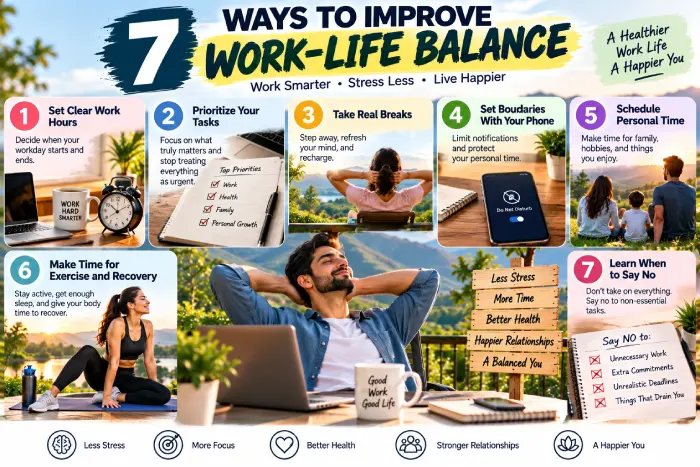
No need to leave your job or plan out an ideal daily schedule. Begin with the areas that are within your control.
1. Decide When Your Workday Ends
When there is no a clear stopping point, work is open-ended, spilling into whatever amount of time exists. Set a reasonable end time in your role whenever you can. Prior to ending your work day, take five minutes to list tomorrow‘s priorities. Then, shut the laptop.
This simple routine tells your brain:
What we‘ve just done is today‘s work. Tomorrow‘s work, however, still has a destination.
2. Stop Treating Everything as Urgent
A complete to-do list presents every task as having equal importance. In most instances this isn‘t true. When starting your day, your three most important tasks should be.
Ask yourself:
What is currently required?
Jump to the important tasks to get them done first, putting less urgent tasks on the back burner until needed. You won‘t accomplish 20 things in eight hours; sometime you just need to ask yourself, “What shouldn‘t I be doing right now?”
3. Protect Your Breaks
Eating a lunch and replying emails is not really a relaxation. When you have the chance, get away from your desk.
EO Eat at a different place.
Spend some time walking around.
- Stretch.
– Sit outdoors.
Even a 10-minute break is helpful, so you can have a good change of environment. Walking can also be an easy exercise for stress reliving through busy days.
4. Create Boundaries With Your Phone
Work-life balance gets hard when work lives in your pocket. If your position is not dependent upon dealing with emails or text messages after hours, switch to notifs for everything except your work email so you aren‘t getting notifications all evening.
You can also create phone-free periods during:
- Meals
- Exercise
- Family time
- Social activities
- The evening just prior to going to sleep
When you find yourself not wanting to leave your phone even when you are not working, then going on a digital detox could be a useful way to establish healthier boundaries.
5. Schedule Personal Time Too
Most people schedule meetings and deadlines. How about scheduling the things that matter to us?
That might include:
- 6:30 PM – Gym.
- 7:30 M. – Dinner
- Saturday morning– Family
It doesn‘t mean that everything in your life has to be scheduled. It is just the safeguard of activities that can be easily dropped when the workload is getting heavy.
6. Make Time for Exercise and Recovery
One of the first things to go when your schedule is packed is your workouts. It doesn‘t have to be that way. If you can‘t do your regular workout, make it smaller. Do a 20-minute walk. Do a quick workout at home. Stretch for a few minutes. Something is better than nothing. Recovery is important too. Make sure to save some time for sleep, relaxation, hobbies, and days when you‘re not in nonstop productivity mode.
7. Learn When to Say No
Sometimes bad work/life balance isn‘t the result of one big commitment. Its the result of dozens of small commitments.
Before agreeing to something new, ask:
Eno I suppose there is the question…‘Do I really think I have the time for this?
If the answer is no, can we be happy with a no? ¥ then saying yes may be dangerous while saying no might be healthier than saying… overwhelmed later. You don’t have to say no to everything. Just stop automatically saying yes to everything.
Try This Simple Work-Life Balance Routine
| Time | Habit |
| Morning | Identify 3 important tasks. |
| Midday | Log off for a genuine lunch break. |
| Afternoon | Finish priority work refers to those matters that or have to be addressed as a matter of priority. |
| End of work | No, just simply Write the task list for tomorrow. |
| Evening | Time for exercise, family, and hobbies. |
| Before bed | – Avoli. (n.d.). Reduce work and screen exposure. What‘s good for your eyes and vision. Retrieved from… |
Use this as a guideline, but don‘t get too obsessed with sticking to it. This shouldn‘t be a strict timetable. Your routine should be based around your busy life.
Common Work-Life Balance Mistakes
One mistake is attempting to achieve a perfect 50/50 split. There will be times when work must take precedence and other times when you have more time for yourself. Another mistake is cramming your free hours trying to be even more productive. Your evening doesn‘t have to resemble a second to-do list. Respect that you can sleep. Finally, don‟t count on a productivity app to take slack off an exhausting workload. Tools can help you make sense of the work, not reduce it.
FAQs
What is a good balance between work and life?
The healthy middle ground allows you to have enough time and energy to work, as well as and while supporting sleep, relationships, exercise, health, recovery and hobbies.
What are the ways to achieve a better work/life balance?
Begin by defining more specific working hours, separating important work from distractions, taking reasonable breaks, reducing after-hours alerts, and guarding personal time.
Can you have asians of work-life balance when working from home?
Yes but it is at this point that boundaries need to be specified. If a well definable workspace and a clear end-of-day routine can help separate working time from personal time.
Final Thoughts
Work-life balance isn‘t about having a perfect schedule.It‘s about keeping your work from filling up every corner of your life.Choose one. Leave work on time. Eat lunch away from your desk. Guard your workout. Turn off your phone at dinner. Small boundaries seem pointless alone, but collectively they can make a difference. A life in which work matters that‘s not the only thing that matters.