

Mohd Arbaaz is an Editor and Writer at Fitnessison.com with 5 years of experience in SEO and digital content creation. He creates informative, reader-focused content covering fitness, workouts, nutrition, health, healthy lifestyle, technology, and computers.

Shashi Teja is a Reviewer at Fitnessison with over 6 years of experience in SEO, content strategy, digital publishing, and content optimization. He reviews content for clarity, research quality, topical relevance, readability, structure, and overall usefulness to readers.
Last Updated: September 26, 2026
Stress meditation Don‘t feel like you have to sit in silence for 60 minutes or somehow clear your mind of all thoughts. In fact, as little as five minutes of focused breathing might be enough to stop your mind in its tracks. And that’s good, because stress doesn‘t take a break.
It can show up anywhere: as you answer your e-mails, on the way home from work, when you‘re trying to get to sleep, thinking about all of the things you have to do tomorrow. Meditation is not going to get rid of those things. It can, however, give you a moment off from reacting to them constantly. And you don‘t even need to be “good” at meditation to get started.
How Can Meditation Help With Stress?
Your attention can become trapped on the problem when you‘re stressed out. You recall the last conversation. You think about the deadline you have tomorrow. You then worry about something entirely unrelated. Suddenly you‘ve spent twenty minutes trying to think about five things at once. Meditation provides your attention with a much simpler destination.
Often, that’s your breath. The point isn’t to push away stressful thoughts or random distractions. It’s that you identify when your mind wanders, and pause long enough to redirect your focus. Eventually, this may help you more quickly identify stressful thoughts when they arise, without getting caught up in each and every one of them. Meditation can be part of a comprehensive stress management strategy, including sleep, exercise, recovery, connection, and getting to the root of your stress.
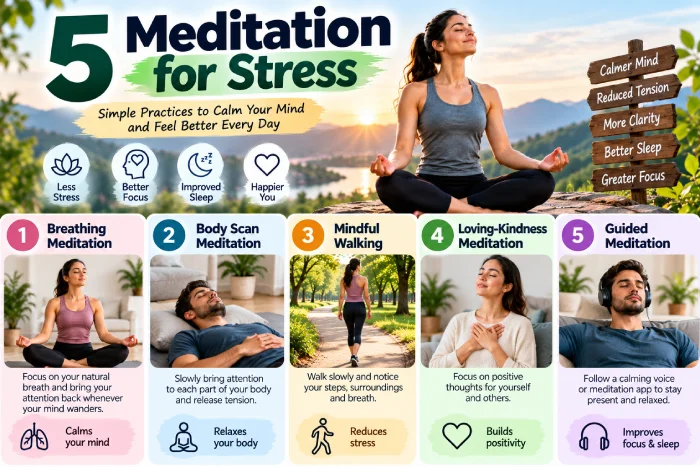
5 Meditation for Stress
1. Start With Five Minutes
One of the worst ways to abandon meditation is to plan on a huge first session. You don‘t need to meditate for 30 minutes the first time. Meditate for five. Find a comfortable place. Sit on a chair, couch, floor cushion or yoga mat. If closing your eyes makes you comfortable, do that. Breathe normally. Feel your breath in. Feel your breath out. That‘s all you need to do. Your mind is likely to wander. When it does, return it to your breath.
2. Try a Simple Breathing Meditation
I find breath meditation especially helpful at the beginning, as your breath provides a natural anchor. Find a comfortable sitting position and allow the shoulders to be relaxed. Breathe in the nose, without any forcing.
Pay special attention to where it is most prominent to you.
- Possibly you have got a nose!
- Possibly in your chest.
- According to your stomach maybe.
- Remain with that feeling.
If that‘s useful, count each exhale from one to five, then start again. How about breathing exercises? If you‘d like to work through some structured breathing exercises, take a look at our guide to breathing exercises for stress.
3. Practice a Body Scan
Certain stressful days are more physical than psychological Your shoulders are tight Your jaw is clenched. Your back is stiff. A body scan allows you to discover those areas. Lie down or sit in a comfortable position. Start by bringing your awareness towards your feet. Then slowly bring your attention to your lower legs, thighs, stomach, chest, back, neck, face and shoulders. You are not attempting to identify any particular issues, just notice to how the various parts of your body are feeling, and gently let go of any tensions that arise.
4. Take Meditation Outside
Meditation can be done just about anywhere. If you‘re sitting in a relatively comfortable location just open yourself up a little bit. Don‘t think about your breath. Think about your surroundings. Feel the breeze. Listen to the chirping of birds, or to the traffic in a far off distance. Feel how cold or how warm it is. Watch the wind blow the trees. The idea is to focus on the current moment rather than hop mentally back and forth in time.
5. Try Walking Meditation
Can‘t sit still? Don‘t make yourself. Walking can be a meditation practice too. Find a safe place where you don‘t have to keep watching out for cars or other hazards. Walk at your own pace. Feel the contact of your feet on the ground. Feel your breath. Feel your surroundings. When your mind drifts back to the work problem or some other worry, see it, acknowledge it, and let it go as you focus your awareness on walking. Another simple way to combine meditation and exercise!
Meditation Doesn’t Mean “Stop Thinking”
One of the greatest misbeliefs about meditation: All you do is sit down and, BOOM suddenly you’re a thousand words into a blog post about work, about what to make for dinner or that time you said that thing five years ago.
You think:
I suck at meditation.
You‘re not. Thoughts will come. The practice is just to realize your attention got away and bring it back. You may do that dozens of times in a session. That‘s still meditation.
A Simple 10-Minute Stress Meditation
Feel this way after a long day at work, or perhaps just through a stressful Friday afternoon.
- Minutes 1–2: Rowlaxy Breathe (Retain Chair) Get comfy and turn your attention to the breath.
- 3–5 min: do as many inhalations and exhalations as you like, without significantly altering them.
- Minutes 6–8: Be aware of tightness in the shoulder, teeth, hands, and stomach.
- Minutes 9–10: no control of your breathing, any new needs ahead.
Perhaps you need dinner; Maybe you need a walk; Perhaps you need to stop checking email for the evening. Meditation makes space. It’s what you do with that space that matters as well.
Common Meditation Mistakes
Don‘t expect to meditate perfectly you don‘t have to. Don‘t be compelled to sit in a position that feels awkward. Don‘t be convinced that longer practices are preferable. And don‘t rely on meditation to escape issues that require attention. If your busy schedule is causing your stress, meditation may provide some relaxation; you could still need to find a different schedule. Use meditation alongside tried-and-trusted ways of relieving pressure, rather than relying on one practice to solve all your problems.
When Should You Meditate?
There is no one right time. Morning meditation may help you start the day consciously. In the middle of the day, it may break you up. Meditation after work may establish a little distinction between work and entertainment. During, before falling asleep, it may relax you. The best time is that when you will repeat it most likely.
Final Thoughts
The meditation for stress doesn‘t have to be complicated. You don‘t need special gear, total silence, or hours of preparation. Five minutes is fine to begin. Concentrate on your breath, use a body scan, meditate in nature, or use a peaceful walk as a way to stay aware.
There will be days when your mind is a peaceful place. It won‘t stop wandering on other days. That’s normal. Meditation is not about building a blank mind. It is about exploring where your mind has wandered, then returning home. When balanced with daily exercise, sleep, boundaries, nurturing friendships, and other stress-reducing techniques, those few minutes of silence can become a welcome addition to your everyday life.