


Mohd Arbaaz is an Editor and Writer at Fitnessison.com with 5 years of experience in SEO and digital content creation. He creates informative, reader-focused content covering fitness, workouts, nutrition, health, healthy lifestyle, technology, and computers.

Shashi Teja is a Reviewer at Fitnessison with over 6 years of experience in SEO, content strategy, digital publishing, and content optimization. He reviews content for clarity, research quality, topical relevance, readability, structure, and overall usefulness to readers.
Last Updated: September 30, 2026
Exercise as a stress buster It is very easy to use movement as a simple technique to cope with normal day-to-day pressure, ease out stiffness and provide a break from stressful situations. You don‘t have to go to the gym for an aerobic workout. Walking, stretching, yoga, cycling or even a quick body conditioning workout can easily be incorporated into a healthy lifestyle. Reflect upon your experience after a hard day‘s work. Your shoulders feel clenched, your brain is still rushing, and there‘s no place you‘d rather be than on the couch scrolling through your phone. The best reset is sometimes to just move your body.
Effectively Explain How Does Exercise Help With Stress?
Stress doesn‘t just occur in your mind. You might also feel agitated, tense, tired or unable to unwind. Movement gives a different things to concentrate on. For example, while walking you can focus more on your surroundings, breathing and footfalls than on replaying the conflict. Exercise can be integrated into a regular stress management program, along with sleep, relaxation, nutrition, and nurturing relationships. The point is not to use exercise to help solve all problems. An exercise session can‘t take care of a demanding deadline or a financial crisis, but it can provide a helpful pauser before proceeding.
5 Best Exercises for Stress Relief
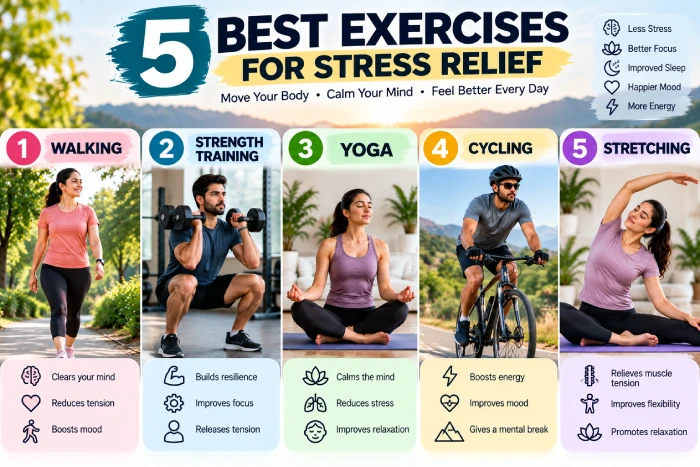
One perfect exercise doesn‘t exist. If you are a beginner, you will want to use one and if you are more experienced you‘ll want to choose the best one for you based on your fitness level and time available as well as what you actually enjoy doing.
1. Walking
Walking is one of the simplest things to do to become more active. Get outside for 10–20 minutes. Put your phone away in your pocket if possible, and keep aware of your surroundings. Walk quickly if you have loads of energy, or slow down after a day feeling knackered either is fine.
2. Strength Training
Strength training has you directed rather than thinking about work, you‘re thinking about your reps, breathing, and form.
A basic workout might include:
- Squats
- Lunges
- Push-ups
- Rows
- An activity which involved the use of light dumbbells.
All workouts don‘t have to be a personal best. If you‘realready exhausted, lower the intensity.
3. Yoga
Yoga- Movement in time with breathing and thinking. 10 minutes in after that boring conference call can make me really relaxing. No need for advanced yoga poses. Do easy and comfortable movements and stretching. Also combine yoga with breathing practice brings relaxing stress relief.
4. Cycling
Cycling is another activity where you may wish to achieve more than walking. You can cycle outside in a safe environment or on a stationary bike. It is not necessary to perform a race. An enjoyable 20 minutes cycle can be time away from your daily routine.
5. Stretching
All stressful days don‘t have to end in a long workout. All it takes is ten minutes of stretching. Focus on the commonly tight areas of shoulders, upper back, hips and legs. Use gentle stretches and never force through pain.
For how long should you exercise to relieve stress?
You do not necessarily have to spend an hour on each. If you do not have the time, do not do it for that long. Cross-reference each with the time you have available.
| Time | Exercise Idea |
| 5 minutes | Walk or stretch |
| 10 minutes | Walking fast or moving around. |
| 15 minutes | Yoga/bodies weights (exercises that do not require any equipment). |
| 20 minutes | A cycling or strength circuit |
| 30+ minutes | Completes workout or spends time outdoors (i.e., plays tennis/soccer/golf, goes hiking, uses park/dog track, MTB or is active on the farm). |
In terms of general health, U.S. guidelines suggest that adults should try to accumulate 150 minutes or more of moderate-intensity aerobic activity per week along with muscle-strengthening exercises at least two days a week. However, don‘t be discouraged to think that if you couldn‘t pull together a full hour, that a ten-minute session wouldn‘t do any good.
Try This 15-Minute Stress-Relief Workout
A bit pressed for time?
Warm up for three minutes by walking or marching in place.
Then complete comfortable rounds of:
- 10 body-weight-sqauats
- Share 8 wall or traditional push-ups
- 10 reverse lunges which alternate between right and left, again using a weight.
- 30 seconds walking in place.
Run on the spot for about 7 minutes and take a rest break as often as required. Use the last five minutes for a slow pace, gentle stretch of your legs, shoulders, and back. It is not meant to wear you out; the purpose is just to exercise.
Exercise and Meditation Can Work Together
With one activity you get movement and with the other you rest. How about going for a walk 15 minutes then going for five minutes of stress-relaling meditation? You‘ll get the physical movement of the walk and the quieting relief of the meditation. Might be especially effective after work when you‘re dying for some movement but your mind is like a rat and your body is spent.
Common Exercise Mistakes When You‘re Stressed
One of biggest mistakes is to think that the more intense the work-out, the better it is. If you are tired and you can‘t sleep well, doing an extremely intense work-out might not be appropriate. Listen to your body and decide what you should do based on how you feel. Another mistake is to do exercise that you hate because you‘ve been told it‘s the “best” one. If you hate running, don‘t run. Walk, swim, go cycling, dance, do yoga or lift weight. Lastly, don‘t stress about the work-outs that you miss, the less stress you have, the better.
FAQs
Which exercise is optimal for stress reduction?
Walking, yoga, strength training, cycling, stretching and other fun activities are all good options. Find one that is right for your age and fitness level.
Is walking beneficial for the stress?
Walking is an easy way to be active and also gives you some time away from stressful circumstances. If you walk outside you may find it to be a refreshing change of scenery.
Is 10 minutes ofExercise sufficient?
Any shorter sessions also? Even ten-minute ones can be considered physical activity. Ten minutes may be a reasonable goal for a hectic or sluggish day.
Can exercise cause or intensify the problem?
Intensively training with inadequate rest can cause fatigue. Balance vigorous trainingwithrest with sleep, nutrition, rest, and easier activity.
Final Thoughts
You don‘t need a costly gym membership or fancy training programs just to use exercise as an effective way to relax. Just go for a walk. Do some lifting. Stretch out. Get on the yoga mat. Go cycling. Do the activity you love, and scale up or down the effort according to how much steam you‘re brimming with. Exercise might not solve all your stressful issues, but it can at least give you a healthy method of movement, time to clear your mind, and have a little breathing room before you have to figure out what to do next.