

Mohd Arbaaz is an Editor and Writer at Fitnessison.com with 5 years of experience in SEO and digital content creation. He creates informative, reader-focused content covering fitness, workouts, nutrition, health, healthy lifestyle, technology, and computers.

Shashi Teja is a Reviewer at Fitnessison with over 6 years of experience in SEO, content strategy, digital publishing, and content optimization. He reviews content for clarity, research quality, topical relevance, readability, structure, and overall usefulness to readers.
Last Updated: September 20, 2026
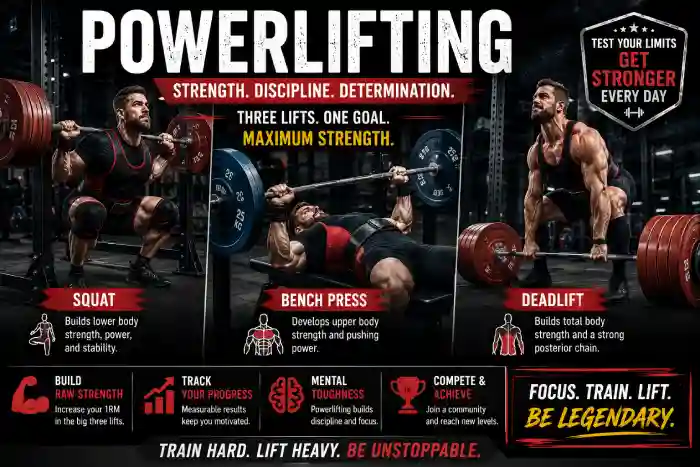
Power lifting is one of the most widespread strength sport. Power lifting promotes intensity of three lifts rather than image of the muscles. People measure power lift by strength maximization in the three lifts. These are squat, bench press, dead lift.
Or if you want to make maximum strength for powerlifting competitions without equipment or simply to be stronger in the gym, then analyzing how powerlifting works will enable you to make those huge feats of strength in the bench, squat and deadlift.
In this course you will learn the Concept of power lifting, it is an alternative form of lifting than Olympic lifting, it includes perfect programs for beginners, how to support your lifts, and why you have to learn the squat, bench press and deadlift. Powerlifting from our strength training guide.
What Is Powerlifting?
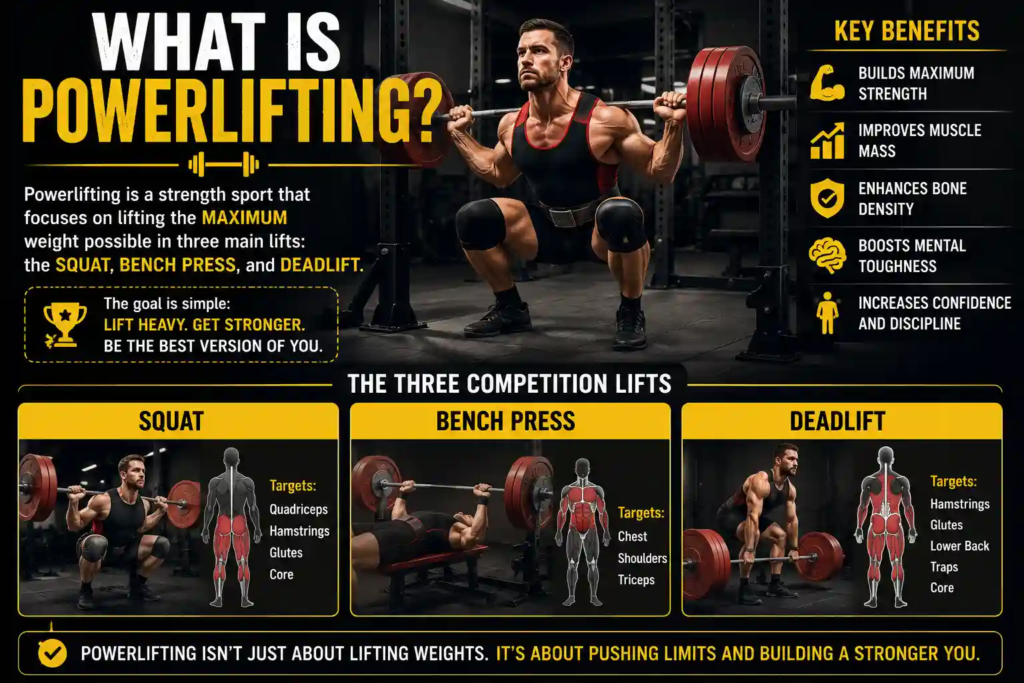
Powerlifting is a strength sport centered around three main lifts:
- Squat
- Bench Press
- Deadlift
Athletes are scored on the heaviest weight they can lift in a single repetition in each lift. The score is the sum of the athlete‘s best squat, bench and deadlift.
Powerlifting focuses on:
- Maximum strength
- Progressive overload
- Technical efficiency
- Consistent training
Powerlifting, however, is somewhat of an exception among fitness programs. Progress is easily measurable because of concrete performance parameters.
The Three Competition Lifts
Squat
The squat evaluates the strength of the lower body and overall stability.
Bench Press
The bench press tests upper-body pushing strength.
Deadlift
The deadlift measures the pulling power of the entire body and strength of the posterior chain.
According to these three lifts, we will build up every program of powerlifting.
Benefits of Powerlifting
Builds Exceptional Strength
Powerlifting is one of the most effective methods of training to develop total body strength.
Increases Muscle Mass
Heavy compound lifts give a reason to train all muscles together. Heavy compound lifts can all be done together!
Improves Bone Density
Heavy weights build your bones and connective tissue.
Boosts Confidence
Getting better at your lifts on a regular basis delivers a feeling of achievement and confidence.
Enhances Athletic Performance
However, many athletes use powerlifting rules to enhance speed, power and performance.
Provides Measurable Progress
Having numbers to track for your squat, bench and deadlift provides undeniable proof of your progress.
All three lifts are compound exercises.
Powerlifting Squat Deadlift Bench
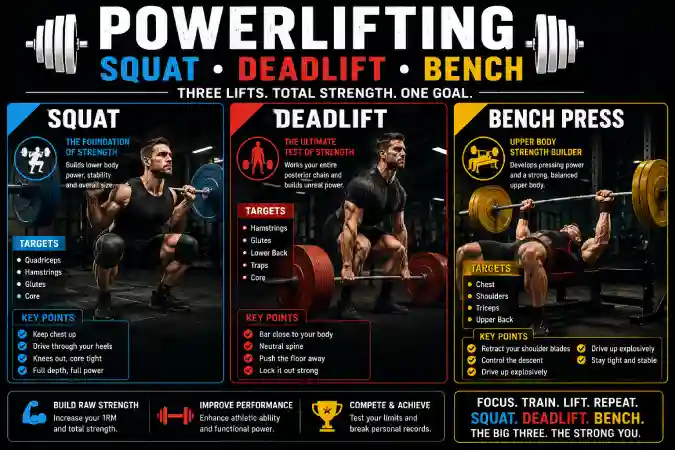
The squat, deadlift and bench press are also known as the Big Three in powerlifting.
Powerlifting Squat
The squat is crowned the king of lower-body exercises.
Primary Muscles Worked:
- Quadriceps
- Glutes
- Hamstrings
- Core
Key Squat Tips
- Keep your chest up.
- Engage your core muscles prior to placing yourself on the downward stroke.
- Push through your heels.
- Maintain proper knee alignment.
Powerlifting Bench Press
The bench press is the most dominant strength movement for upper body.
Primary Muscles Worked:
- Chest
- Shoulders
- Triceps
Key Bench Press Tips
- (Maintain your grip.) Clutch tightly.
- Create upper-back tightness.
- Controlled lower.
- Force the bar up explosively into the bar path.
Powerlifting Deadlift
Deadlift is usually the biggest lift in powerlifting.
Primary Muscles Worked:
- Hamstrings
- Glutes
- Lower Back
- Traps
- Core
Key Deadlift Tips
- Maintain the bar close to your body.
- Maintain a neutral spine.
- Engage your lats.
- During the lift, push off the ground.
Getting comfortable with these three lifts is the best way to ensure your success as a powerlifter over the long term.
Powerlifting vs Olympic Lifting
Couple of people get the two mixed up, but these are very different sports.
| Powerlifting | Olympic Lifting |
| Focuses on maximum strength | Emphasize four development of strength, speed and power. |
| Squat, Bench Press, Deadlift | Snatch and Clean & Jerk |
| Slower movement patterns | Highly explosive movements |
| It‘s easier for a beginner to learn, I‘m sure: | Requires advanced technical skill |
| Measures maximum weight lifted | Measures explosive lifting ability |
Powerlifting Goals
Powerlifting is about lifting as much weight as you can in the squat, bench press and deadlift.
Olympic Lifting Goals
Olympic lifting requires speed, coordination, mobility and explosiveness.
Both sports improve strength but demand contrasting methods of training.
Olympic Lifting Techniques
Despite being different sports, a lot of athletes use Olympic lifts to assist in powerlifting.
The two Olympic lifts are:
Snatch
The snatch is a lift in which a barbell is lifted from the floor to the overhead position in one single explosive movement.
Benefits
- Improves power output
- Enhances coordination
- Develops speed and mobility
Clean and Jerk
The clean and jerk consists of two separate movements:
- Clean (barbell to shoulders)
- Jerk (barbell overhead)
Benefits
- Develops full-body power
- Improves athletic performance
- Enhances explosive strength
Key Olympic Lifting Techniques
- Maintain proper posture.
- Develop hip explosiveness.
- Focus on mobility.
- Practice movement patterns consistently.
- Start with lighter weights.
A good number of powerlifters include “olympic lifting techniques” like power cleans into their routine in order to have a more athletic training and develop explosive strength.
Powerlifting Program for Beginners
Beginners do not have the strength to perform all the exercises so they are focusing on how to perform each lift using the best form possible.
In the first several months you need to lay strong foundations.
Day 1: Squat Focus
Barbell Squat
- 4 Sets 5 RePFSause the term set to refer to the (first) set of 5 RePes.
Walking Lunges
- 3 Sets of 10 Reps Per Leg
Plank
- 3 Sets × 30 Seconds
Day 2: Bench Press Focus
Bench Press
- 4 Sets × 5 Reps.
Dumbbell Rows
- 3 Sets 10 Reps
Push-Ups
- 3 sets, 12 reps.
Day 3: Deadlift Focus
Deadlift
- 4 Sets 5 Reps
Romanian Deadlifts
- 3 Sets×8 Repetitions.
Hanging Leg Raises
- 3 sets of 12 repetitions
Weekly Schedule
Monday
- Squat Day
Wednesday
- Bench Press Day
Friday
- Deadlift Day
This allows beginners time to recover as well as build strength in all three competition lifts.
Progressive Overload in Powerlifting
Progressive overload is the basis of any successful powerlifting program.
To continue getting stronger, gradually increase:
- Weight lifted
- Training volume
- Training intensity
- Exercise difficulty
For example, this would mean adding (on average) 2.5–5lbs/week to a lift which over the long term of course results in very large strength gains.
Actually it‘s not about jumping 2.5kg. Because that push and if you can earn 5kg in a few weeks all the better. It‘s about consistency and how often you‘re achieving these gains.
Common Powerlifting Mistakes
Poor Technique
Wrong technique limits improvement and increases likelihood of injury.
Training Too Heavy Too Soon
Novices will want to focus on their form rather than their 1 rep max.
Ignoring Recovery
The only time we gain strength is between sessions, not during the session.
Skipping Accessory Exercises
Augmentation is used to compensate for weakness and to assist a performance.
Inconsistent Programming
Sticking to a set plan is the key to long-term success.
Nutrition for Powerlifters
Prioritize Protein
Protein helps with rebuilding and enlarging muscles.
Good sources include:
- Chicken
- Fish
- Eggs
- Greek Yogurt
- Lean Beef
- Tofu
Eat Enough Carbohydrates
Carbohydrate support energy requirements of demanding training.
Examples include:
- Rice
- Oats
- Potatoes
- Whole Grains
- Fruits
Stay Hydrated
Hydration. Staying hydrated is essential for optimal performance and recovery.
Don’t Fear Calories
Powerlifting needs energy. Your intake of plenty of calories can help you to promote strength progress and general recovery.
Is Powerlifting Safe?
The safe practice of powerlifting. If it is executed correctly and progressively programmed, powerlifting is largely safe.
To reduce injury risk:
- Learn proper form.
- Warm up thoroughly.
- Use appropriate weights.
- Allow sufficient recovery.
- Listen to your body.
Another benefit of training with an experienced coach is that it can lead to faster learning and less risk.
Final Thoughts
Powerlifting is a great method for developing strength and muscle as well as an eye opening one for cardiovascular performance. Training to lift the deadlift, bench press and squat will develop good measurable strength as well as tremendous functional strength
Regardless of the level you‘re at whether just learning the basics or competing if a guide is followed a structured powerlifting program along with good nutrition and recovery will allow anyone to acheive an sets of goal.
Start with good technique. Be consistent and do some harder and harder exercises. Over time you will develop the strength, confidence and discipline to make powerlifting one of the most enjoyable training disciplines. Eat for strength with our strength training nutrition guide.
Frequently Asked Questions
What is powerlifting?
Powerlifting is a strength-related sport and as the name suggests three main lifts are competed in; the deadlift, squat and bench press
Is powerlifting a good thing to start training if you‘re a beginner?
Yes. Powerlifting programs are a good starting point for beginners wishing to use a structured training program.
What s the difference between powerlifting and Olympic lifting?
Powerlifting trains for strength, while the Olympic lifts trains for speed. powerlifting trains specifically for the amount of strength needed for the ‘big three’, the squat, bench press and dead lift, while the Olympic lifts measure the power continually generated by means of the snatch and the clean and jerk.
What training frequency should be scheduled for the novice?
Authors concluded that for 90% of beginners, three sessions weekly would be optimal.
Can powerlifting build muscle?
Definitely. Intense compound lifts are going to induce a considerable amount of muscle hypertrophy along with general strength gains.