


Mohd Arbaaz is an Editor and Writer at Fitnessison.com with 5 years of experience in SEO and digital content creation. He creates informative, reader-focused content covering fitness, workouts, nutrition, health, healthy lifestyle, technology, and computers.

Shashi Teja is a Reviewer at Fitnessison with over 6 years of experience in SEO, content strategy, digital publishing, and content optimization. He reviews content for clarity, research quality, topical relevance, readability, structure, and overall usefulness to readers.
Last Updated: September 20, 2026
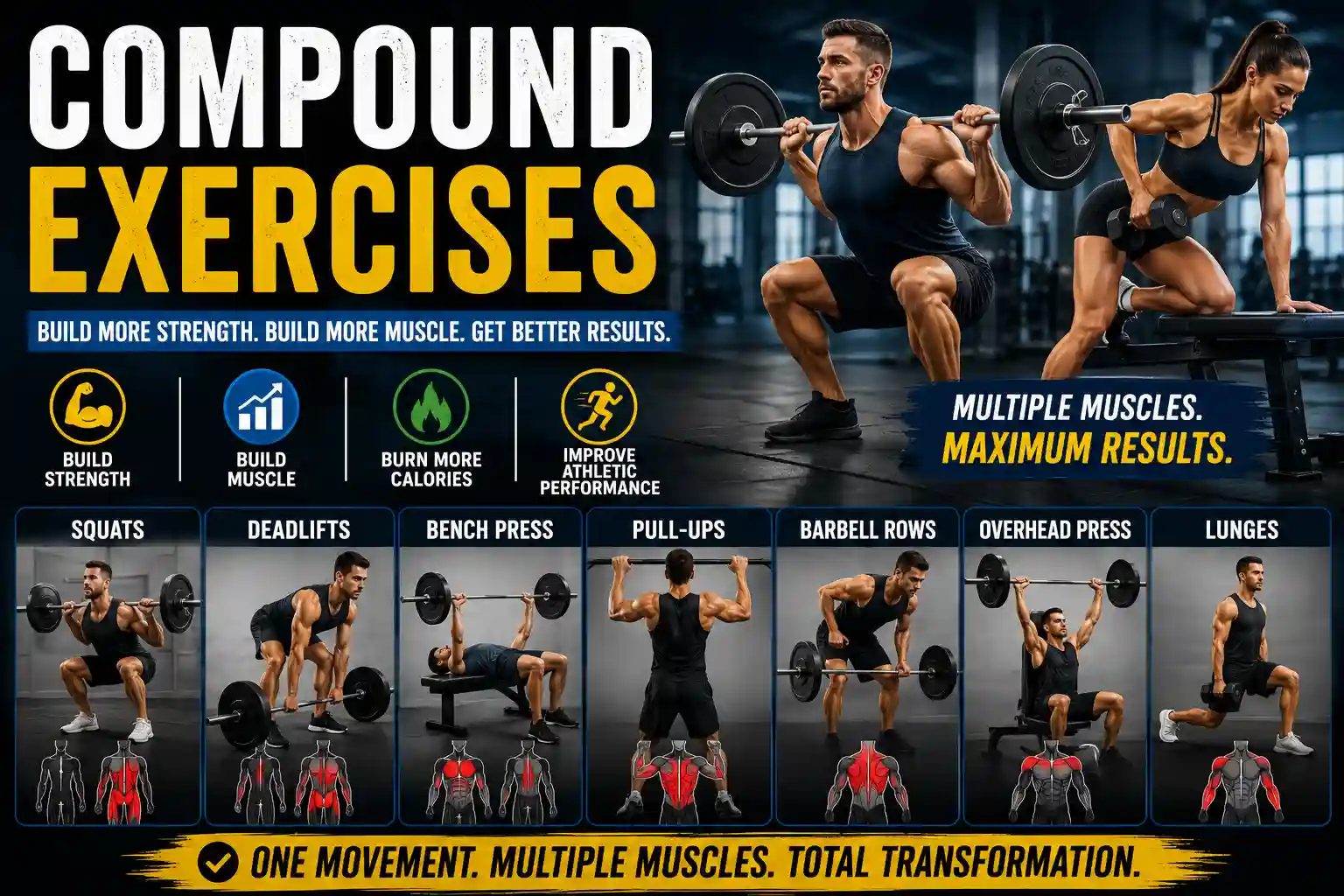
You will find compound movements to be some of the best movements you can do in just about any program. If you are trying to add size, strength, burn calories, or just improve your overall athletic performance, compound movements should be a cornerstone of your workouts.
Compound movements involve more than one muscle group and joint they are a more efficient workout because you get more done in less time.
In this article you‘ll learn what compound exercises are, why they‘re so important, the best compound exercises to build strength, how they stack up against isolation exercises, and an easy workout routine for a novice to get you started. Compound lifts from our strength training pillar.
What Are Compound Exercises?
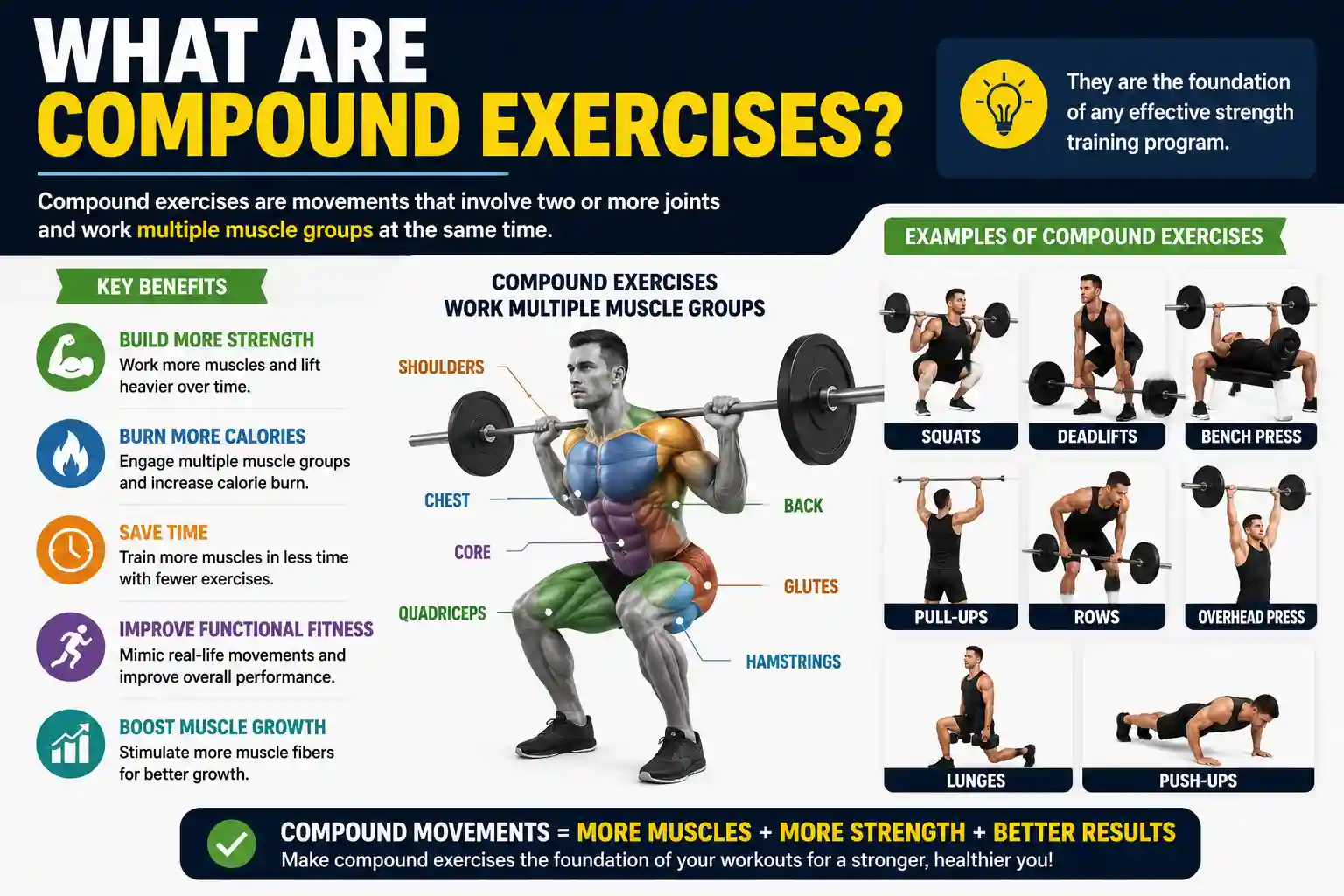
Compound exercises are defined as exercises that use two or more joints and have action involving two or more muscle groups at a time.
For instance, while your hips, knees and ankles have to move when completing a squat, so do your quadriceps, hamstrings, glutes and core muscles, who have to work together.
As compound movements work more than one muscle group at the same time, you can use much greater weights and develop national strength mass more effectively than in most single joint movements.
Some of the most common compound exercises include:
- Squats
- Deadlifts
- Bench Press
- Pull-Ups
- Rows
- Overhead Press
- Lunges
- Push-Ups
These exercises follow the movement patterns of life by increasing your functional fitness, so that you have less stress or strains in your daily task.
Benefits of Compound Exercises
Build More Strength
You will be able to use heavier weights when doing compound exercises because several muscle groups are contributing to the lift. This will result in a greater level of overall strength.
Increase Muscle Growth
Compound movements involve more than one muscle operating at the same time and will, therefore, produce a greater anabolic (muscle-building) reaction than many forms of isolation movements.
Burn More Calories
Burns more calories when training muscles groups.
Save Time
Compound exercises are used to work other region and multiple muscle groups at the same time, rather than doing different series of exercises for different muscles, one is using compound exercises.
Improve Functional Fitness
Compound or multi joint exercises trains muscle groups most often used during life such as lifting, carrying,pushing and pulling.
Enhance Athletic Performance

In general, compound training is useful for athletes, because it increases coordination, strength, balance and general strength of the body.
Best Compound Exercises for Strength
For a strength track you should be including these in your program.
1. Barbell Squat
The squat is often termed the ‘king of exercises’ as it is effective in building both lower-body strength and athletic performance.
Primary Muscles Worked:
- Quadriceps
- Glutes
- Hamstrings
- Core
Benefits:
- Builds leg strength
- Improves balance
- Enhances mobility
2. Deadlift
The deadlift is arguably the most powerful total body exercise.
Primary Muscles Worked:
- Hamstrings
- Glutes
- Lower Back
- Core
- Traps
Benefits:
- Develops total-body strength
- Improves posture
- Increases pulling power
3. Bench Press
The bench press is an essential strength exercise for the upper body.
Primary Muscles Worked:
- Chest
- Shoulders
- Triceps
Benefits:
- Builds upper-body muscle
- Improves pushing strength
- Enhances athletic performance
4. Pull-Ups
Pull-ups, are one of the best bodyweight compound exercises.
Primary Muscles Worked:
- Latissimus Dorsi
- Biceps
- Upper Back
Benefits:
- Improves back development
- Enhances grip strength
- Builds upper-body endurance
5. Overhead Press
The overhead press. This exercise develops the strength and stability of the shoulder.
Primary Muscles Worked:
- Deltoids
- Triceps
- Core
Benefits:
- Strengthens shoulders
- Improves posture
- Enhances upper-body power
6. Bent-Over Row
Rows counteract pushing exercises by strengthening the back muscles.
Primary Muscles Worked:
- Upper Back
- Lats
- Rear Delts
- Biceps
Benefits:
- Improves posture
- Strengthens pulling muscles
- Supports shoulder health
7. Walking Lunges
Lunges develop lower-body strength with the added benefit of developing good balance and coordination.
Primary Muscles Worked:
- Glutes
- Quadriceps
- Hamstrings
- Core
Benefits:
- Corrects muscle imbalances
- Improves stability
- Enhances athletic performance
Compound vs Isolation Exercises
Knowing about the differences between compound and isolation exercises will help you create a better work out plan.
| Compound Exercises | Isolation Exercises |
| Use multiple joints | Use one joint |
| Work several muscles | Target one muscle |
| Burn more calories | Lower calorie burn |
| Improve overall strength | Improve specific muscle development |
| Save workout time | Require more exercises |
| Better for functional fitness | Better for muscle refinement |
Examples of Compound Exercises
- Squats
- Deadlifts
- Pull-Ups
- Bench Press
- Lunges
Examples of Isolation Exercises
- Bicep Curls
- Leg Extensions
- Tricep Pushdowns
- Lateral Raises
- Hamstring Curls
Which Is Better?
Both are equally effective. A lot of the best training programs in the world use them both.
The majority of your workout should be made up of compound movements for maximum utility. Isolation movements are then useful for working specific muscle groups or correcting weaker areas.
A good rule of thumb is:
- 70–80% Compound Exercises
- 20–30% Isolation Exercises
This structure ensures optimal strength, muscle development, and workout efficiency. New lifters: read strength training for beginners first.
Compound Exercises for Beginners
Novices need to first perfect movement patterns rather than how much weight they lift.
The following compound exercises are ideal for newcomers:
Bodyweight Squats
A copy of a video that gives a hands-on guide to squat form and developing stability.
Push-Ups
Using your own body weight, work on developing chest, shoulder, and tricep strength.
Glute Bridges
Increased strength of the posterior chain and improved stability of the hips.
Dumbbell Rows
Rebuild power while correcting posture.
Walking Lunges
Enhance balance, coordination and strengthen leg muscles.
Dumbbell Shoulder Press
Safely familiarizes the novice with overhead pressing.
Assisted Pull-Ups
Assist in developing your upper body pulling strength before you climb on the real thing.
Beginner Tips
- Focus on technique first.
- Start with light weights.
- Increase resistance gradually.
- Rest between training sessions.
- Stay consistent.
When you begin lifting weights, go for consistency rather than the amount you‘re lifting.
Compound Exercise Workout Routine
This workout plan is very beginner friendly and works all the major muscles groups. It can be done three times a week.
Workout A
Bodyweight Squats
- 12reps-3 sets
Push-Ups
- Three sets of 10 repetitions
Dumbbell Rows
- – 3 Sets x 12 Repeats
Plank
- 3 Sets x 30 Seconds
Workout B
Walking Lunges
- 3 Sets x 10 Reps Per Leg
Dumbbell Shoulder Press
- 3 sets of 12 reps
Glute Bridges
- 3 Sets x 15 Repetitions
Assisted Pull-Ups
- 3 sets of 8 reps
Weekly Schedule
- Monday: Workout A
- Wednesday: Workout B
- Friday: Workout A
The following week:
- Monday: Workout B
- Wednesday: Workout A
- Friday: Workout B
This schedule provided sufficient training stress and adequate recovery.
Common Mistakes to Avoid
Using Too Much Weight
Poor form with excessive weight raises risk of injury.
Skipping Warm-Ups
A thorough warm-up enhances performance and prevents injury.
Ignoring Recovery
Muscles will grow and repair after a workout.
Poor Technique
Before adding resistance, do mastered technique.
Neglecting Progressive Overload
Progressively make it harder, and you will keep improving.
Final Thoughts
In terms of building strength, muscle and general fitness, nothing is better than compound movements. Using this kind of work out you will be using more muscle groups at once which means you can get your work done in less time.
Whenever you become more advanced or more experienced, just include some compound movements(squats, deadlifts, presses, rows, lunges) at the tail end of your workout and see yourself grow taller, use more energy and boost your functional fitness level. Ready to compete? See our powerlifting guide.
Frequently Asked Questions
Q1) Which have more benefits (compound/exercises isolated?)
Overall, compound exercises are more demanding for you to use more muscles.
Q2) Is it about right to claim that a novice will be able to perform compound exercises?
Yes. Its vital that they work on the basics of compound movements so that they can develop the strength and stability to move on in the years to come.
Q3) There is a lot of misunderstandings and I m gonna teach you the right amount of compound excercises you will be doing?
Most of the workout will involve between 3–5 multi-joint workout muscles groups.
Q4) Beyond the burning calories: Do compound exercises burn more than isolation?
Yes. Compound tend to be more calorically demanding since they engage many muscles and joints.