


Mohd Arbaaz is an Editor and Writer at Fitnessison.com with 5 years of experience in SEO and digital content creation. He creates informative, reader-focused content covering fitness, workouts, nutrition, health, healthy lifestyle, technology, and computers.

Shashi Teja is a Reviewer at Fitnessison with over 6 years of experience in SEO, content strategy, digital publishing, and content optimization. He reviews content for clarity, research quality, topical relevance, readability, structure, and overall usefulness to readers.
Last Updated: September 9, 2026
If you‘ve been considering strength training as one of your workout options but have yet to try it on your own and can‘t tell if its for you even if you have, this is the guide you want.
Any type of exercise in which you work against a resistance to strengthen muscles, increase muscle size and that of course improve muscular endurance is called strength training. Resistance can be from the weights (dumbbells, barbells, machines and resistance bands) or from your own body weight.
And it‘s not just for bodybuilders or gym veterans. Of all forms of exercise, strength training has been the best studied. Established have been benefits for fat loss, bone density, metabolism, posture, mental health and length of life (at all ages, at all levels of fitness).
The American College of Sports Medicine recommends that most adults strength train at least twice a week. Despite this, surveys continually reveal that less than 30% of Americans are doing it. People simply don‘t know how to begin or are misinformed in their efforts to be physically active.
This guide fixes that. You’ll get the full picture here — and deep-dive resources for every topic through the cluster guides below.
Strength Training Resource Center
Explore our complete collection of strength training guides covering beginner workouts, compound exercises, home training, strength training for women, powerlifting, and nutrition.
How Strength Training Actually Works
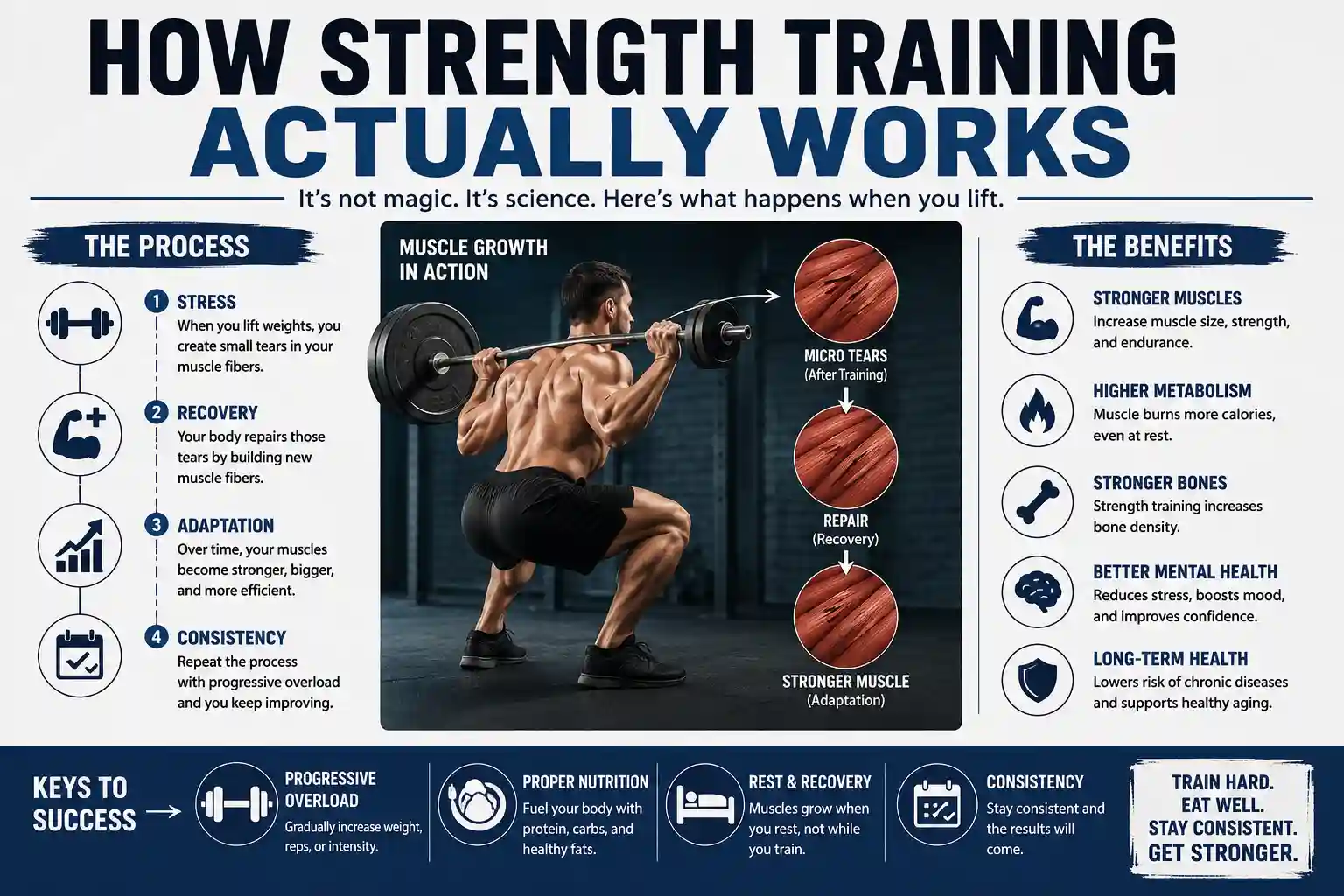
Understanding the mechanism behind strength training changes how you approach it. It’s not magic — it’s biology.
The Muscle-Building Process
Everytime you lift a weight or create resistance to a muscle you are causing microscopic damage in the muscle fibers. Your body repairs those fibers and makes them marginally bigger and better than they were – so they can withstand that stress in the future. That process is called muscle protein synthesis.
Two things drive this process:
- Mechanical tension — the force applied to the muscle during a lift
- Metabolic stress — the metabolic byproducts (like lactate) that accumulate during high-rep sets
What Is Progressive Overload?
Progressive overload is the single most important concept in strength training. This would be to progressively overload the muscles; that is, increasing the workload to your muscles over a period of time by more weight, more repetitions, more sets or less rest.
If you do not work on progressive overload your body will adapt and stop changing. This is the cause of the (newbie gains) affect where novice populations will gain strength rapidly but then will require a specific plan to continue to progress.
In practice:
- Week 2: bench press 100 lbs.3×8. (3 sets of 8 reps)
- 3:Bench press100 lbs3x83/week: 3 x 8, 100 lbs.3/
- Week 6: Bench press 105 pounds × 3 sets x 10 repetitions
Continuous small increments over time result in significant progress.
Compound vs. Isolation Exercises
| Type | Definition | Examples | Best For |
| Compound | Multi-joint movements | Squat, deadlifts, bench press, pull-ups, rowing | Strength general, abdominal muscles, backbone, general backbone strength, thigh muscle Specifications 5 p≥ 4 p  |
| Isolation | Single-joint movements | Bicep curl; Leg extension; Lateral raise. | Muscle specificTraining that targets certain muscles, hands of correction of imbalances. |
For the beginner compound movements provide the most bang for your buck; you work more muscles simultaneously eliciting a greater hypertrophy response.
Major Point: Continuous use of progressive overload overload overload is how strength will be gained. Coumponds first then heavy weights.
The Benefits of Strength Training (Backed by Research)
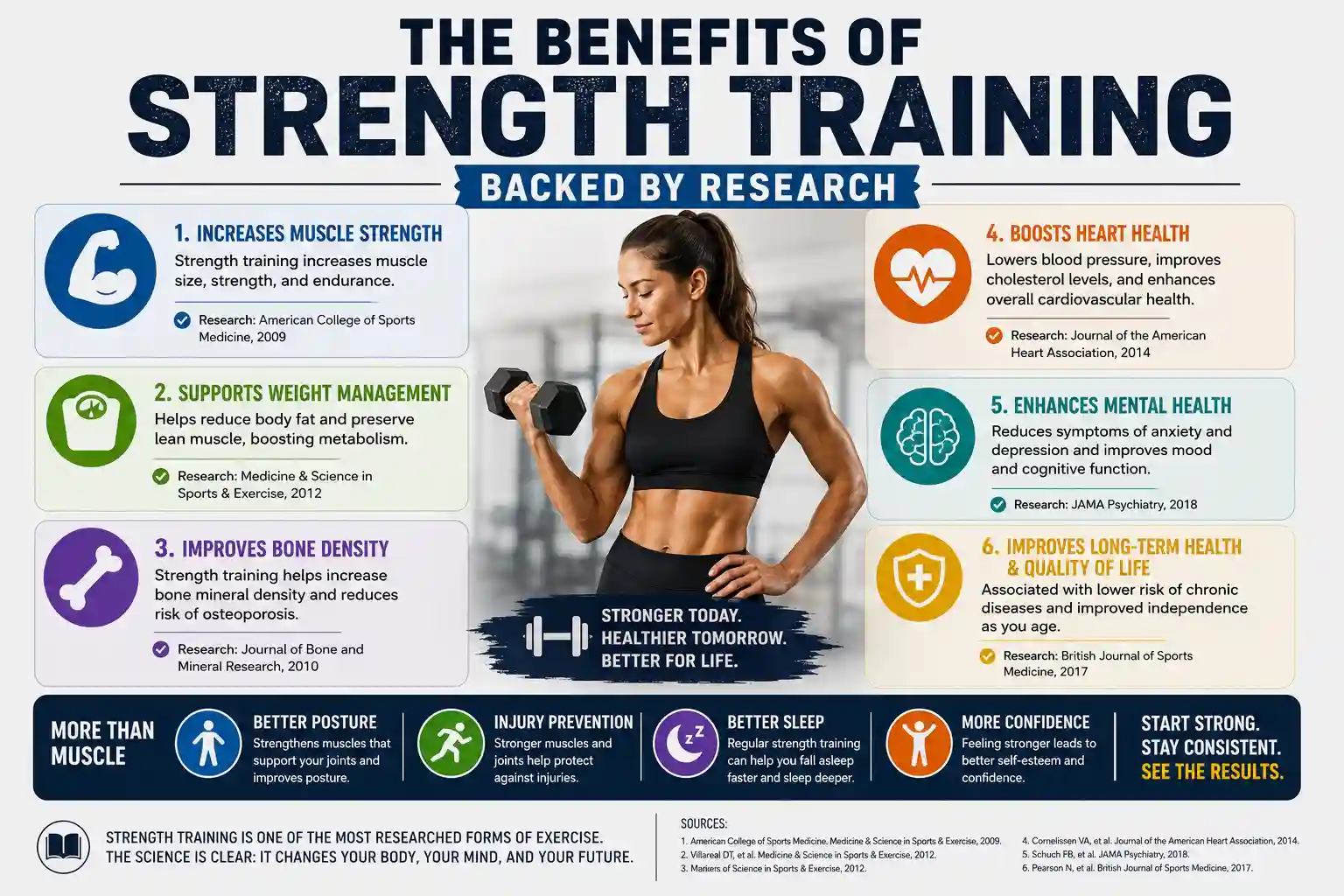
Strength training does far more than build muscle. The research on its health benefits is among the most robust in all of exercise science.
Physical Benefits
- Gain muscle strength: Each additional 10 years after age 30, adults lose 3-8% of muscle mass (called sarcopenia). Strength training can directly prevent this age-related decline in strength.
- Improved bone density: Forms of weight loading exercise activate bone forming cells. A meta-analysis by the Journal of Bone and Mineral Research showed that strength training increases the density of bone mineral by 1–3% crucial for fighting osteoporosis.
- Increased resting metabolism: Muscle tissue burns more calories at rest than does fat tissue. More muscle =greater resting energy expenditure =easier to control weight long-term.
- Fat loss without cardio only: The EPOC (Excess Post-Exercise Oxygen Consumption) effect means your body continues to burn up to 24 48 hours after a strength training session.
- Improved posture and injury reduction: Engaging the posterior chain (glutes, hamstrings, back) and core directly alleviates lower back pain one of the most common complaints in the US.
Mental and Cognitive Benefits
- Strength training reduces symptoms of depression and anxiety — a 2018 meta-analysis in JAMA Psychiatry found resistance training significantly reduced depressive symptoms across all populations studied
- Improves sleep quality
- Boosts confidence and self-efficacy
- Related to decreases in cognitive decline among elderly
Long-Term Health Benefits
- Decreases risk of type 2 diabetes by enhancing insulin sensitivity
- Lowers blood pressure
- Reduces all-cause mortality risk — people who meet strength training guidelines have a 23% lower risk of premature death in major longitudinal studies
- Supports healthy aging, mobility, and independence into older age
Mini Summary: Strength training benefits every system in your body — not just your muscles. The research is clear: it’s one of the highest-return health investments you can make.
Read More: A complete breakdown of every physical, mental, and long-term health benefit with full research citations — see our dedicated guide to the benefits of strength training.
Strength Training for Beginners: Where to Start
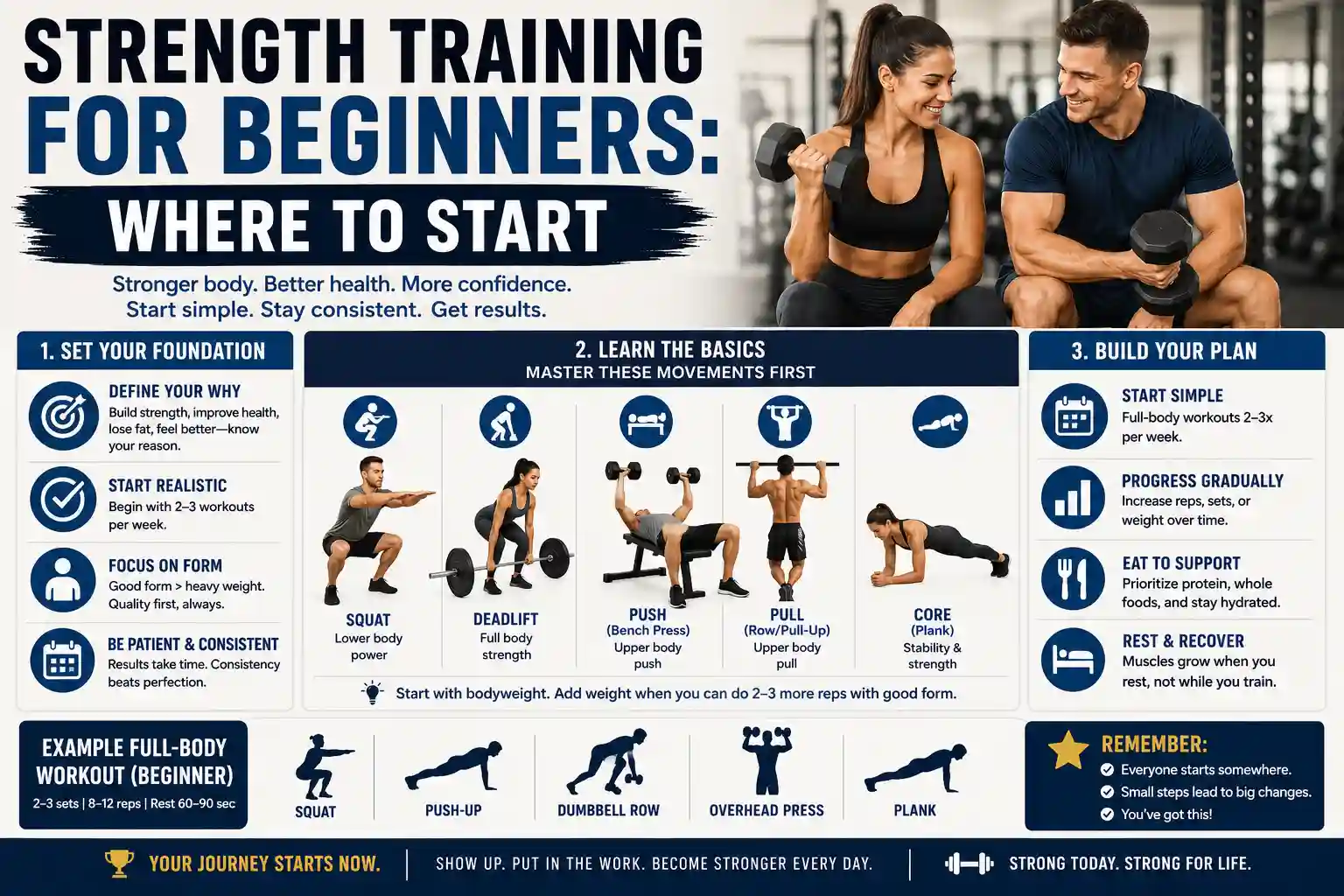
The number one mistake many first timers make is to lift too heavy, too fast (or, check out someone else‘s program for advanced or intermediate lifters). This will generally lead to injury, burnout, and quitting.
Here’s the right approach.
The Beginner Advantage
Beginners experience something called “newbie gains” — a phase where the neuromuscular system adapts rapidly, allowing significant strength improvements in the first 3–6 months without needing complex programming. Beginners can gain strength faster than experienced lifters, which is motivating when you start correctly.
The Beginner Strength Training Framework
Phase 1 (Weeks 1–2): Learn movement patterns Focus entirely on form. Use very light weight or bodyweight. . Master the squat, hinge (deadlift), push, pull and carry patterns.
- Phase 2(Weeks 3 8): Strength training (3 days/week). Full body routines increasing the weights/reps weekly with a goal of progression each week.
Phase 3 (month 3+): Add in splits (or simply more volume for upper/lower or push/pull/legs splits). Add more weekly volume for each muscle group.
Sample Beginner 3-Day Full-Body Routine
| Exercise | Sets × Reps | Rest |
| Goblet Squat | 3 × 10 | 90 sec |
| Romanian Deadlift | 3 × 10 | 90 sec |
| Dumbbell Bench Press | 3 × 10 | 90 sec |
| Dumbbell Row | 3 × 10 each | 90 sec |
| Overhead Press | 3 × 10 | 90 sec |
| Plank | 3 × 30 sec | 60 sec |
Key Takeaway: In the beginning, your focus should be on the skill of form. Because it‘s the first month, make yourself work on form- it‘s a skill you‘re trying to accomplish, not maximum strength.
Mini Summary: Before people who have not done strength training become accustomed to the effect of strength training, you have an advantage. Use compound lifts, focus on good form and overloaded overload in your program.
Read More: Beginner program, beginner for free first time, and a printable s starter program our full strength training guide for beginners.
Strength Training Workouts: Types and Weekly Structures
There’s no single “best” workout structure — the right one depends on your schedule, goals, and training experience. Here’s how the main approaches compare.
Main Workout Structures
| Program Type | Sessions/Week | Best For |
| Full Body | 3 | Beginners, time-limited schedules |
| Upper / Lower Split | 4 | Intermediate, balanced development |
| Push / Pull / Legs (PPL) | 6 | Intermediate to advanced, more volume |
| Body Part Split | 5–6 | Advanced, specific hypertrophy focus |
| 2-Day Minimalist | 2 | Busy professionals, maintenance |
The Big 5 Compound Lifts
Every complete strength training workout should be based on a handful of these five movement pattens:
- Squat quad, glute, hamstring (back squat, goblet squat, front squat) dominance
- Hip Hinge posterior chain dominant (deadlift,Romanian deadlifts,kettlebell swing)
- Horizontal Push chest, shoulder, tricep (bench press, push-up, dumbbell press)
- Horizontal Pull that is to say, back, bicep (barbell row, dumbbell row, cable row)
- Vertical Pull lat, bicep (pull-up, lat pulldown)
Master these five patterns and you can build a good program with practically anything you have that can be called equipment or nothing at all.
Mini Summary: The structure of your training does not matter as much as a consistent presence and slowly overloading your training. Spend a few minutes and find one that fits into your lifestyle, then do that for a minimum of 12 weeks before assessing.
Read More: Full-body, upper/lower and PPL workout plans with exercise listings, sets, reps and weekly plans see our full strength training workouts guide.
Strength Training for Weight Loss: The Fat-Burning Truth
And here‘s a quirk: for sustained fat loss, strength training may actually be more advantageous than cardio.
Finally, cardio and strength training both burn calories through the activity itself. Cardio and strength training will burn calories while you are working out and can also elevate your metabolism for up to 48 hours after.12
Strength vs. Cardio for Fat Loss
| Factor | Cardio | Strength Training |
| Calories burned during session | Higher | Lower–Moderate |
| Calories burned post-session (EPOC) | Low | High (24–48 hrs) |
| Effect on resting metabolism | Minimal | Significant (more muscle = higher BMR) |
| Muscle preservation | Low | High |
| Long-term fat loss | Moderate | High |
| Body composition change | Can lose muscle + fat | Lose fat, preserve/gain muscle |
The most effective approach: combine strength training with a calorie deficit. You will be burning fat but keeping — or even adding to — your lean muscle tissue. This gives the “toned” look most people really want.
How Strength Training Creates a Fat-Loss Environment
- Increases muscle mass which persistently elevates resting caloric expenditure
- EPOC: elevated metabolism following end of workout
- Enhances insulin sensitivity directs body to muscle first for nutrients, instead of adipose tissue
- High protein intake for muscle building also increases satiety and thermogenesis.
Mini Recap:Strength training is the only form of exercise that burns fat and builds muscle(1). It is the most effective method to changing body composition in the long-term and leave Cardio in the dust as an only method.
Read More: How to make a fat-loss strength training program, strength or cardio? What is most effective?, and How often should I train? [ our complete training guide to weight-loss strength training]
Strength Training at Home: No Gym Required
Not everyone has access to a gym and the good news is that you don‘t have to in order to get real strength. You can do effective strength training at home with little or no equipment.
Levels of Home Training
– Level 1: Zero equipment (body weight only) like; push-ups, body weight squats, lunges, glute bridges, pike push up, dips (using a chair), pull-ups (from a bar or tree branch). Quite surprisingly good.
Level 2: Resistance bands Incorporate additional variable resistance during any bodyweight exercise. Bands are cheap, portable and can simulate most training equipment found at the gym. A complete set of bands only costs 30.
- Level 3: Dumbbells or kettlebells One set of adjustable dumbbells can access just about every station in a gym. Powerblocks, Bowflex SelectTech, such as dumbbells maximum space-efficient clumps a wide range of weight.
Level 4: Home gym setup a barbell, rack, plates and a pull-up bar (or other overhead-weight device) makes a full home gym which could execute any professional program. The initial cost would be $500–$1,500; in the long run, it is more economical than a gym membership.
Sample Bodyweight Home Workout
| Exercise | Sets × Reps | Target |
| Push-Up (hands wide) | 3 × 12–15 | Chest, triceps |
| Bodyweight Squat | 3 × 15–20 | Quads, glutes |
| Hip Hinge / Good Morning | 3 × 12 | Hamstrings, lower back |
| Inverted Row (under a table) | 3 × 10–12 | Back, biceps |
| Reverse Lunge | 3 × 10 each | Glutes, quads, balance |
| Plank | 3 × 45 sec | Core |
Mini Summary: Home strength training is an entirely feasible route. Use your own body first, then resistance bands, then dumbbells. The amount of equipment that you have is less significant than your ability to stick at it.
Read More: No-equipment workouts, dumbbell home workouts, and get a full home gym guide check out our entire strength training at home guide.
Strength Training Programs: How to Pick the Right One
A program is a predetermined plan instructing you on what to lift, how many reps, how frequently and how to advance. If you are doing a written program then everything is much better than “winging it” in every session as you are steadily applying the principle of progressive overload.
How to Choose a Program
Match program type to your situation:
| Situation | Recommended Program Type |
| Complete beginner | 3-day full-body (StrongLifts 5×5, Starting Strength) |
| 3 months experience | Upper/Lower 4-day split |
| 6+ months experience | PPL or Upper/Lower with more volume |
| Goal is fat loss | Higher rep ranges (10–15), shorter rest, more frequency |
| Goal is max strength | Lower reps (3–6), heavier weight, longer rest |
| Goal is muscle size | Moderate reps (8–12), controlled tempo, higher volume |
What Makes a Good Strength Training Program?
Any well-designed program will include:
- Clear exercise selection — focused on compound lifts
- Defined sets, reps, and rest periods
- A progressive overload mechanism — either adding weight each session or each week
- Adequate frequency — each muscle group trained at least 2× per week
- Planned deload periods — programmed rest to prevent overtraining
How Long Before You See Results?
| Timeframe | What Happens |
| Weeks 1–2 | Neuromuscular adaptation — strength improves even before muscle grows |
| Weeks 3–6 | Noticeable strength increases, slight muscle definition changes |
| Months 2–3 | Visible muscle changes, body composition improving |
| Months 4–6 | Significant physique changes, strength well above starting point |
| 1 Year | Transformative results when consistent with training and nutrition |
Mini Summary: The “best” program is the one you‘ll actually do. Select a program that is structured, appropriate to your goal and skill level, and gives yourself at least 12 weeks before drawing conclusions.
Read More: Complete beginner-to-advanced program guides, 12-week progressive programs and applying progressive overload check out our entire strength training program guide.
Strength Training for Women: What‘s Different (And What Isn‘t)
Here‘s the truth that most fitness stuff beats around the bush of: strength training basics for men are the same for women. Progressive overload, compound lifts, adequate protein, recovery — none of that changes based on gender.
What does differ:
- Hormonal environment: Women have significantly less testosterone than men, which naturally limits the upper ceiling of muscle mass (not muscle strength). This is precisely why women do not “get bulky” from lifting weights — it’s physiologically very difficult without pharmaceutical assistance.
- Starting point: Women generally have less upper body musculature so it may be wise to give more emphasis to upperbody training.
- Hormonal cycle: Women experience fluctuations in energy, recovery, strength performance at different stages of the menstrual cycle for some women, having a stimulus that varies during the month can be advantageous.
- Bone density: Women are more prone to osteoporosis; therefore resistance training is very important in their aging process.
The “Bulky” Myth Settled
The biggest obstacle to women working out their strength is the fear of “bulking up” from lifting weights. Well, this is what really happens:
- Building significant muscle mass requires a caloric surplus, years of consistent heavy training, and high testosterone levels
- Women typically see strength gains and fat loss simultaneously when they start lifting — creating a leaner, more defined physique
- The “toned” look everyone wants IS muscle under lower body fat — you get there by building muscle, not avoiding it
Mini Summary: Women benefit from strength training just as much as men — often more, given the unique advantages for bone density, body composition, and hormonal health. The bulk fear is a myth.
See also: women only programs, strength training for women over 40, the hormonal cycle in relation to strength training, and common myths check out our full guide to strength training for women.
Strength Training Nutrition: Fueling Results
Lifting heavy and eating like s**t: Another reason people fail to get results, this is very common. Remember your nutrition is not a stand alone thing when it comes to your strength training, it is part of it.
women only programs, strength training for women over 40, the hormonal cycle in relation to strength training, and common myths check out our full guide to strength training for women.
The Three Nutritional Pillars of Strength Training
1. Protein — The Foundation
Muscle protein synthesis necessitating sufficient intake of dietary protein. The research consensus for strength training individuals:
- Personal recommendation: 0.7–1.0 grams of protein per pound of body weight per day
- Hence, a 160 lb person will require P70.
- Divided into 3–5 meals for optimal muscle protein synthesis.
Top sources of protein: chicken breast, lean beef, eggs, Greek yogurt, cottage cheese, salmon, tuna, lentils, tofu
2. Carbohydrates Your Training Fuel
Carbohydrates are the main source of energy for bouts of strength training, so if they are excessively restricted you will experience suboptimal performance, recovery and hypertrophy.
- Pre-workout: 1–2 hours before: complex carbs (oats, rice, sweet potato)
- After exercising: rapid-absorbing carbs + protein after 1-2 hours (banana + prot shake, rice + chicken)
3. Caloric Context Depends on Your Goal
| Goal | Caloric Approach |
| Build muscle | Moderate caloric surplus (200–400 calories over maintenance) |
| Lose fat | Moderate caloric deficit (less than 300–500 calories below maintenance) |
| Recomposition | Calories for maintaining weight (works best for beginners and for those doing a break) |
Common Nutrition Mistakes in Strength Training
- Consuming too little protein (by far the most frequent mistake)
- Fat-loss that kills your performance and recovery! Overly restricted carbohydrate intake with heavy training destroys performance & recovery.
- Being under-eating in general muscle gain cannot occur in a significant calorie deficit
- Missing the post-workout window of nutrition being into anabolic mode (the most important window in training is within two hours of your workout)
Mini summary: Nutrition is the other half of your strength training gains. Keep the focus on a high protein intake, eat carbs before workout, and keep overall caloric intake in line with your goal.
Read More: Complete pre- and post-workout nutrition plans, protein calculatorsand a full strength training diet guide see our strength training nutrition guide.
Common Strength Training Myths — Busted
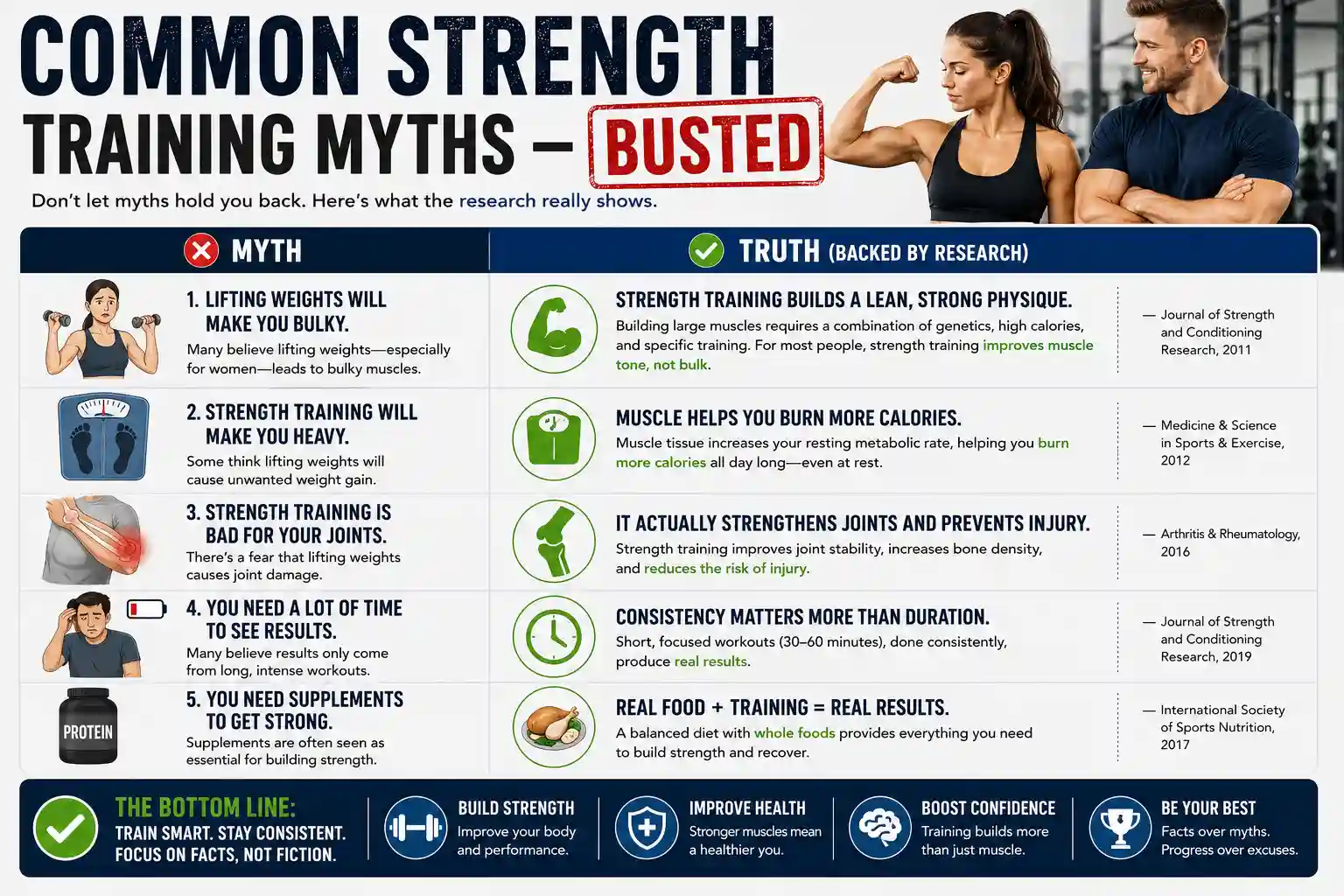
Myth vs. Fact
| Myth | Fact |
| “Lifting makes women bulky” | Women lack the testosterone levels required for significant muscle bulk — lifting creates a lean, defined physique |
| “You need to feel sore to know it worked” | DOMS (delayed onset muscle soreness) is not a reliable indicator of workout effectiveness or muscle growth |
| “Cardio burns more fat than lifting” | Strength training raises resting metabolism permanently through muscle building — superior for long-term fat loss |
| “You need to train every day to see results” | Muscles grow during rest, not during training — 2–4 sessions per week with proper recovery is optimal |
| “Light weights with high reps tone; heavy weights bulk” | “Toning” and “building” use the same biological process — progressive overload with appropriate resistance |
| “Older adults shouldn’t lift heavy” | Research shows resistance training at appropriate loads is safe and highly beneficial for adults 60+ |
| “You need supplements to build muscle” | Whole food nutrition with adequate protein is the foundation — most supplements are optional and secondary |
How to Avoid the Most Common Strength Training Mistakes
Even motivated people make these mistakes early on:
- Not warming-up 5-10 minute drill A full body warm-up, such as 5–10 minutes of light cardio, leg swings and arm circles, greatly decreases the risk of injury. Cold muscles tear easier than warm ones.
- Ego-Lifting/weight shoveling: Using a heavier load than your technical ability with sloppy form leads to compensatory injuries that can set you back for weeks or even months. Ego-lifting prevention is a legitimate training discipline.
- No structured program Randomly performing workouts lacks of progressive overload. Design one written for at least 12 weeks.
- Not enough time resting between sessions : Muscles grow after training sessions when they are resting (48 72 hours later). Working a muscle group on a daily basis does not allow it to repair completely.
- Forgetting your legs Almost all beginners especially men neglect training their legs. Your lower body consists of the biggest muscles in your body. Performing squats and deadlifts produce more overall muscle gain and hormonal release than any upper body movement.
- No nutritional support. ” Training hard and not eating enough protein or total calories is like trying to build a house with no materials”.
Strength Training for Different Goals: Quick Reference
| Goal | Training Focus | Rep Range | Frequency | Cardio? |
| Build strength | Heavy compound lifts | 3–6 reps | 3–4 days/week | Optional |
| Build muscle (hypertrophy) | Compound + isolation | 8–12 reps | 4–5 days/week | Light, separate |
| Lose fat | Compound lifts + calorie deficit | 10–15 reps | 3–4 days/week | Yes, complement |
| Athletic performance | Explosive movements | Mixed | 3–5 days/week | Yes, integrated |
| General health / longevity | Full-body compound | 8–15 reps | 2–3 days/week | Optional |
| Beginner (any goal) | Full-body, master basics | 8–12 reps | 3 days/week | Light, optional |
FAQs: Strength Training
Q1: What exactly is strength training?
Strength training refers to any workout that applies resistance (whether it be with weights, bands, machines, or one‘s own body weight) against muscles to induce growth and strength over time. The basic concept is repeatdelevpionevolving between muscle fatigue and the application of more demand to gain strength and size.
Q2: Without the need for steroids, five days a week.
For beginners 3x full body/week is a great place to start. As you improve you graduate into a 4 day upper/lower split. Once you become an advanced trainee chances are you will be doing 5-6 days. You cant train less than 2 days/week unless you want to regress, anything more than 6 days/week with no refresh days is useless.
Q3: How long does it take to notice results from strength training?
Gains in strength occur within the first 2 weeks as a result of neuromuscular adaptions.Changes in muscle size and body composition are seen over months 2–3 with adherence to training and nutrition.Changes are seen in months 6–12.
Q4: can I do strength training at home without equipment?
Yes. Using your own body weight (push-ups, squats, lunges, glute bridges, dips, pull-ups) offers an excellent strength stimulus, even for the experienced. Resistance bands and dumbbells can also be used, increasing the potential. A well-equipped gym is not essential to provide quality strength training.
Q5: Will I lose weight if I do weight training?
Strength training actually promotes fatloss in a variety of ways. Increased muscle mass will lead to increased resting metabolism, and an EPOC effect from training will also increase the amount of calories burned. Additionally strength training will improve insulin sensitivity, which will contribute to fatloss. The latter effects will only be seen if a proportionate nutrition plan is followed, including a modest calorie deficit.
Q6: Is strength training feasible for older adults?
Extensive research backs the use of strength training programs for adults age 60 and older. It is one of the most effective interventions available to maintain not only muscle mass, but also bone density, balance, and independence in daily function as one ages. Begin with lighter weights and work on form, but use the same principles. Always seek any necessary medical consult before beginning.
Q7: Is there any need of protein powder in strength training?
No. Protein powder is an easy way to supplement your diet. It is not necessary. If you‘re consuming enough protein through whole foods, you don‘t need any extra supplements. Protein powder is only beneficial if you are unable to get the necessary protein in through whole foods.
Q8: Elucidate the distinction between strength training and resistance training?
The two terms are often synonymous. Resolution training, by definition, is a general term that can apply to nearly any exercise that involves resistance. Strength training, by comparison, always refers to training, “for the purpose of increasing your maximal strength (how much force you can exert by the muscles in a given movement, how much weight you can lift)”.