

Mohd Arbaaz is an Editor and Writer at Fitnessison.com with 5 years of experience in SEO and digital content creation. He creates informative, reader-focused content covering fitness, workouts, nutrition, health, healthy lifestyle, technology, and computers.

Shashi Teja is a Reviewer at Fitnessison with over 6 years of experience in SEO, content strategy, digital publishing, and content optimization. He reviews content for clarity, research quality, topical relevance, readability, structure, and overall usefulness to readers.
Last Updated: September 29, 2026
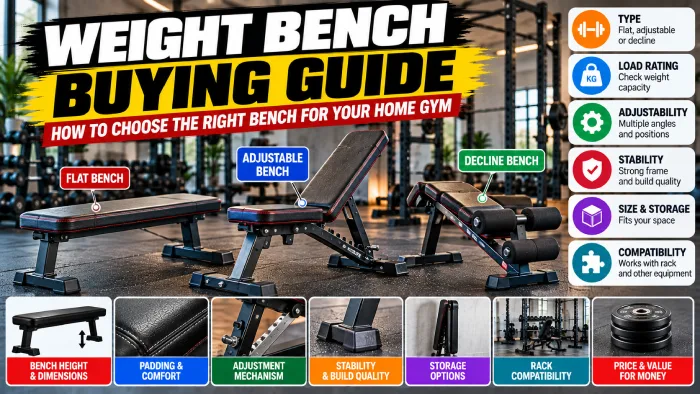
Adding a weight bench to your home gym can provide a huge amount of new workout possibilities. A good bench will allow you to perform dumbbell presses, seated shoulder movement, rows, split squats, and so much more. But choosing a weight bench isn‘t about selecting the most robust looking Bench. In this weight bench buying guide I will introduce the core considerations when buying your bench, including bench type, load rating, measurements, adjustability, stability, storage requirements, and anything else you might need when using with other strength training equipment.
What Is a Weight Bench?
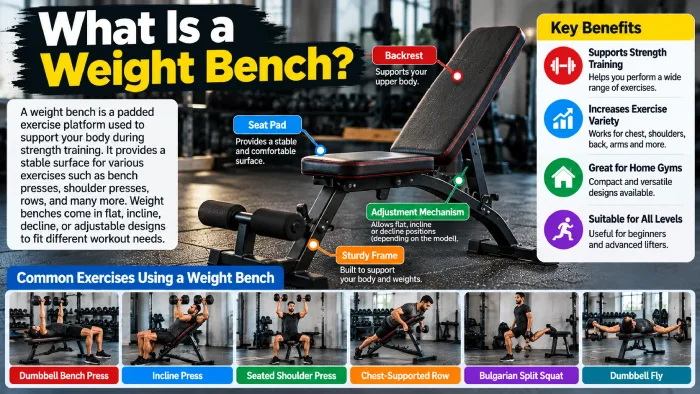
A weight bench is a padded platform that provides support for the body during the execution of strength exercises.
Depending on its design, you may use it for:
- Dumbbell bench presses.
- Barbell bench presses. Time. Once clients have been on the program for 4 weeks, it is time to increase the challenge. The same exercises on some of the fitness programs can be repeated, or you can choose to add new ones, such as the barbell bench press.
- Seated shoulder presses
- Chest-supported rows
- Dumbbell fly variations
- Split squats
- When not contraindicated, step-ups
- Other supported exercise
Weight benches can be just a platform to lie on, or a multi-position backrest that can be set at a number of different positions. Exactly what style you should select for your home gym totally hinges on what exercises you will be doing.
Flat vs. Adjustable Weight Bench
Your first considerations involve the type of model you require – flat or adjustable.
Flat Bench
Flat Bank The flat bank is integrally flat and has no adjustable part. Because of its table structure, there are generally fewer adjustment parts, and the flat bank is suitable for pressed and supported simple exercise. It may also be relatively easy to pick up and store.
Adjustable Bench
An adjustable bench is one that allows the back (and sometimes seat) to be adjusted to multiple positions.
Depending on the model, this can support:
- Flat presses
- Incline presses
- Seated shoulder presses
- Incline curls
- Chest-supported exercises
Some models also have decline positions. An adjustable bench allows more exercises, but it may be bigger, heavier, and more difficult to use than a flat bench.
Check the Load Rating
The load capacity is one of the most critical specifications to look at. Never just look at bench frame and assume strength. Read the manufacturers rated capacity carefully and understand what it means. It may be a supported load or perhaps something else entirely, depending on who its from.
A good example is during a dumbbell bench press; the bench is providing support for both the body and external resistance. Select a bench with the specifications suitable to your activity and do not overreach the limits set by the manufacturer.
Look for Good Stability
When you are sitting, lying down, or exercising, the bench should not tremble. The bad motion becomes distracting with more resistance.
Consider:
- Base width
- Foot design
- Frame construction
- Floor contact
- Adjustment mechanisms
A bench can be small, but it should not feel unsteady. If you can, try it on a level floor, before you buy, and look at the manufacturer‘s measurements if you are buying online, rather than just the picture.
Bench Height and Dimensions Matter
If a bench is not at the correct height; it can alter the effectiveness and ease of some exercises. To perform a bench press effectively it is good to be able to find a comfortable position with your feet as at.
Also consider the bench‘s:
- Overall length
- Pad width
- Backrest dimensions
- Seat dimensions
- Total height from the bottom of the base
Body size counts. A bench that is too big for some may be too narrow or too short for others. Use the available workout space as a guide to cut size before you buy particularly if your new product will be inside a rack.
Check the Adjustment Mechanism
If you are selecting a model with adjustable positions, note how the positions are adjusted. Typical adjustment systems utilize either a ladder type support or pin based system. Make sure whatever type you select can be locked into the desired position.
Ask yourself:
- Is it easy to tune?
- Is it distinctly articulated?
- Can you lock it and it still be secure?
- Can I make changes of places without fighting with the mechanism?
More adjustments through the angle does not necessarily mean that you will be able to have a better bench. Having a few useful positions may be sufficient to your training.
Consider Rack Compatibility
Should you already have a squat or power rack or consider getting one in the future see if the bench will comfortably fit inside it; consider not only equipment sizes but room to work in.
You need enough room to:
- Position the Bench.
- Adjust the bench.
- Chalk the bar.
- But in the meantime }); otherwise, you may risk approaching the rack.
- Dismantle the bench if required.
This is one of the most important points, especially in a small home gym. Your bench and rack should have a system, they shouldn‘t be just two lonely items.
Think About Storage
Weight benches may be awkward to store from time to time. If you plan on using your workout area as a bedroom, garage or an office, storage needs are greater.
Some benches:
- Stand vertically
- Fold
- Transport wheels 1 Conveying wheels
- Include Handles for Convenient Travel
Moreover you should only keep a bench vertically that is intended to be placed in such orientation if the manufacturer says so. A small, lightweight bench may be more practical than a large one with a lot of unnecessary options.
Common Weight Bench Buying Mistakes
One of the most common mistake is that of buying only for the price or for looks.
Other mistakes include:
- Load ratings are ignored. Forgetting to bait the room
- Unnecessary selecting adjustment positions. Disregarding the height of the bench
- Purchasing a bench that doest not fit the rack
- Overlooking storage
- Ignoring stability
- Ineffective assessment of adjustment adjustment
Identify beginning with your training needs.
Weight Bench Safety and Maintenance
Check your bench from time to time. Do this especially if it is in a position to be adjusted.
Check for:
- Loose hardware
- Frame damage
- Worn padding
- Unstable feet
- Got the shifting mechanisms knackered
- Unusual movement
Retain the bench clean and follow all advice provided in the manufacturer‘s instructions regarding tightening, maintenance, storage and replacement components. Discontinue use of the bench if any structural damage or defective locking mechanism occurs.
FAQs
Is a flat or adjustable bench better?
Neither is 100% superior. Flat bench=less-to-learn, but Adjustable bench=more position for 2 more efficacious exercises.
Do beginners need a weight bench?
Not always. A beginner can do the majority of exercises without it, although it can open the door to lots of potential dumbbell and barbell variations.
Can I use a weight bench inside a power rack?
Frequently Yes, but measure and compatibility should be confirmed prior to offering.
What should I check before buying a weight bench?
Take into account: load level, stability, dimensions, height of bench, adjustability, ability to pair with rack, storage, type of build and instructions on the side.
Conclusion
Your weight bench buying guide should highlight quality over a large number of adjustment positions. Look for a best bench that suits your environment for weight capacity, size, stability, most useful adjustment points, and support. With all other types of gym equipment such as dumbbells, barbells and other ways to add resistance to your workout, a good weight bench is a great addition to any home gym and enhances your actual workout.