

Mohd Arbaaz is an Editor and Writer at Fitnessison.com with 5 years of experience in SEO and digital content creation. He creates informative, reader-focused content covering fitness, workouts, nutrition, health, healthy lifestyle, technology, and computers.

Shashi Teja is a Reviewer at Fitnessison with over 6 years of experience in SEO, content strategy, digital publishing, and content optimization. He reviews content for clarity, research quality, topical relevance, readability, structure, and overall usefulness to readers.
Last Updated: September 29, 2026
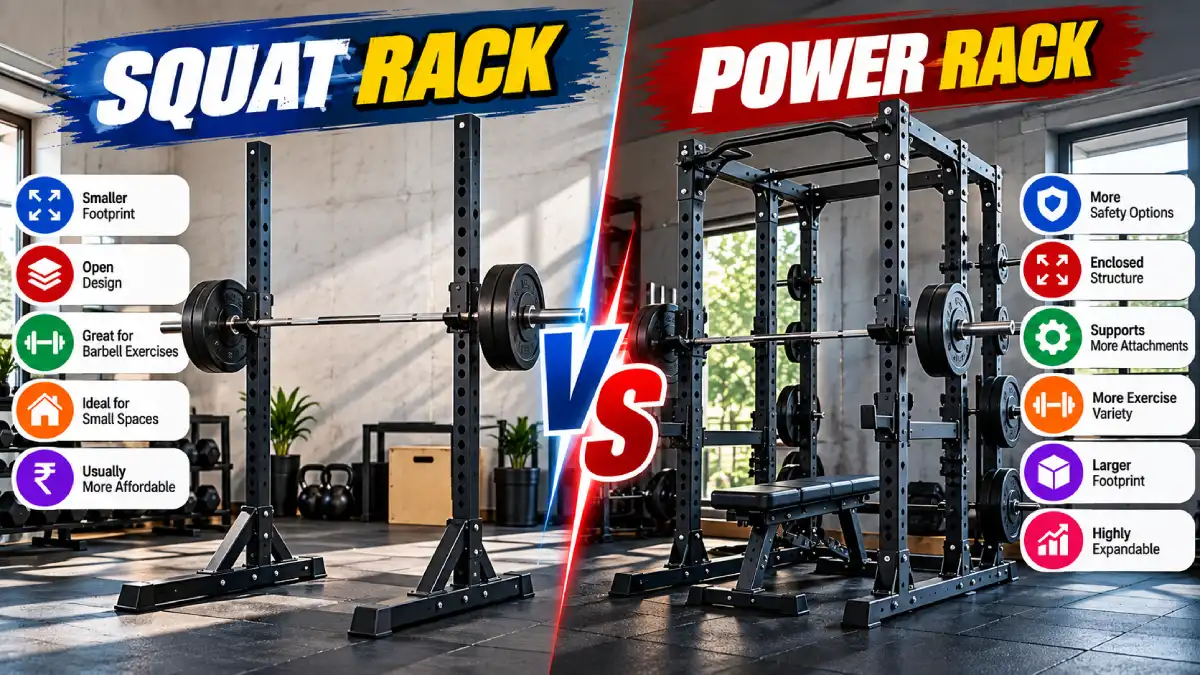
Deciding between squat rack vs power rack is an important consideration for your home strength training system. They both can hold a barbell at a comfortable starting height and support squat and press movements, but they vary in dimensions, shape, safety options, adaptabilities, and footprint. A squat rack can be a functional space saver, whereas a power rack encloses your lifts and is typically more adaptable to options. It all comes down to the art of weighing what your needs are for your workouts, the available space you have on hand, the loads you anticipate using, and your targeted budget.
What Is a Squat Rack?
A squat rack, also called a power rack, is a piece of strength training equipment designed mainly to hold a loaded barbell. The term can refer to various designs, including squat stands and bigger rack systems. Most utilize a pair of vertical posts with several J-cups that are positioned at various heights to hold the barbell.
This allows you to position the bar appropriately for exercises such as:
- Back squats
- Front squats
- Overhead presses
- Apparatus set up for bench presses
Certain squat racks are also equipped with safety arms, a pull-up bar, plate storage or various other accessories. As there are many different designs, consult the specifications and safety features of the particular model you choose.
What Is a Power Rack?
A power rack – sometimes called a power cage – is a larger structure which normally is constructed from four or more vertical posts to form an enclosed or semi-enclosed area for lifting.
A typical power rack includes:
- Uprights
- J-cups
- Crossmembers
- Safety pins, straps or spotter systems.
- Pull-up bar
Various attachments may be available depending on the manufacturer, for dips, cables, landmine work, plate storage etc. The larger frame implies that it will normally take up a greater space than a basic squat stand.
Squat Rack vs Power Rack: Main Differences
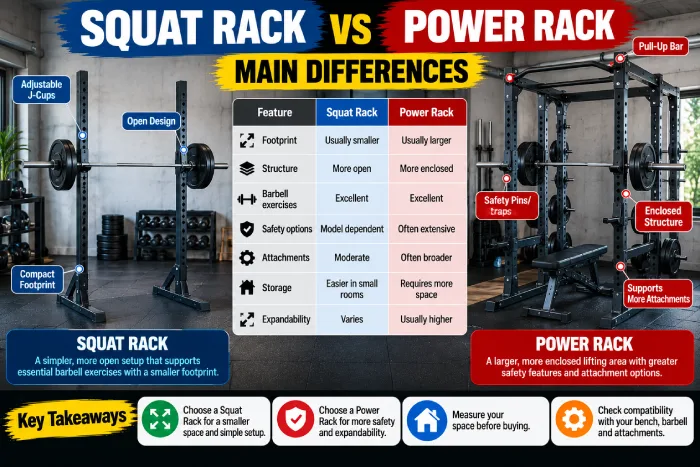
Here is a simple comparison:
| Feature | Squat Rack | Power Rack |
| Footprint | Usually smaller | Usually larger |
| Structure | More open | More enclosed |
| Barbell exercises | Excellent | Excellent |
| Safety options | Model dependent | Often extensive |
| Attachments | Moderate | Often broader |
| Storage | Less difficult in small rooms | Needs additional discussion space. |
| Home gym usage | Excellent | Excellent |
| Expandability | Varies | Usually higher |
broad brush strokes absolute The more deluxe, even for squatting, might be feature rich than a simply rack.
Which Takes Up Less Space?
If you don’t have much room to train, a squat rack often comes out ahead. Smaller stands and racks can be stored in the corner of your garage or spare room, or in some corner of the house dedicated to training. Power racks also tend to have greater depths, since a lifter will often train inside or around the frame.
You also need enough room to:
- Load weight plates
- Get Around The Bar
- Place a bench
- Perform exercises
- Access attachments
- Store plates away safely.
Trying to find whether the rack is technically large enough? Simply measure your whole training space.
Which Offers Better Safety Features?
Safety will also be dependent on the individual rack, configuration and how it will be used. Power racks will usually incorporate safety pins or straps which will be set between the uprights and will be adjusted by the exercise and manufacturer. Many of the squat racks will also support spotter arms extending from the uprights.
Before buying either design, check:
- Present safety system
- Manufacturer load ratings.
- Adjustment range
- Attachment compatibility
- Installation requirements
Any safety system that you use when training alone should also be of interest to you. Do not assume, only because you place part A on part B, that the attachment will actually work.
Which Is Better for Exercise Variety?
Both are capable of supporting the majority of a power barbell-based training program. Combined with a weight bench and the necessary weights, using a squat rack can fulfill most goals of an introductory strength program. Power racks tend to have more potential for growth.
Depending on the model, compatible attachments may include:
- Dip handles
- Cable systems
- Landmine attachments
- Pull-up handles
- Plate storage
- Resistance-band pegs
This would enable a single rack to be the cornerstone of a greater home gym. But more attachments are only really useful if you use them. Don‘t pay for expandable ecosystem just because it looks cool.
What Should You Check Before Buying?
Dimensions
Measure height, width and depth. Check ceiling clearance so there is adequate room if the rack has a pull up bar.
Load Rating
Verify the rated capacity of the rack, J-cups, safety system and any other related attachments using the manufacturer‘s specifications. Do not guesstimate capacity‘s by the frame look.
Hole Spacing
The rack holes establish how close the J-cups and safeties can be placed. Tighter spacing in key areas might make it easier to find a comfortable setup.
Upright and Hardware Size
These sizes influence things like attachment compatibility. Accessories of different rack systems are not automatically compatible.
Anchoring Requirements
Certain racks are to be secured to the floor or otherwise mounted as indicated. Refer to the manufacturer‘s installation requirements.
Bench Compatibility
For bench press, check that your bench comfortably fits in the rack while providing the correct bar position.
Common Buying Mistakes
You are one of the biggest mistakes that everybody buys a rack before even measuring the room.
Other common problems include:
- The y axis I‘m graphing the impact of no ceiling height.
- Forgetting: barbell clearance2.0026.003 times known; 3.01. This is at an outdoor ceiling height of 3443mm.55], (removed at 3514 mm that the forearm measures at, 3814 mm to the rig, and at an outdoor ceiling height of 4515 mm.).
- Failure to check safety features
- If attachments are universal4
- Not considering rack load ratings.
- Accessories wasteful wasteful accessories
- Forget plate storage
- Deciding solely on price
Imagine looking at a subject‘s entire workout area instead of one machine.
Squat Rack or Power Rack for a Home Gym?
Decide by your priorities. If your goal is to have a more compact footprint, an open lift space, and easy support for barbell-based lifts, it may make more sense to go with a squat rack. If your goal is to have more remaining space at a gym and will benefit from a closed-in lift space, more available attachments, and expansion room, a power rack may make more sense. Neither is truly “the best”. The right rack is the one that will support your training without encroaching a fitness space that is not feasible in the given investment.
FAQs
Is a power rack safer than a squat rack?
Power racks often have a large safety system but safety depends of the specific equipment, the setting, its mounting and usage.
Can you bench press with a squat rack?
Most squat racks work great for bench pressing if you don‘t mind using a suitable bench with it, and safety equipment. Look for what the manufacturer has recommended for the equipment you will be using with it.
Do beginners need a power rack?
Not at all. Equipment requirements depend on the training program. Inexperienced lifters can use dumbbells, resistance bands, or basic barbell arrangements.
Does a power rack take up more space?
Yes, to a degree. Most of these are enclosed structures that will require a bit more room than the more squat style stands or racks.
Conclusion
So, between a squat rack and a power rack, what do you choose? It all depends on the space you have available, safety considerations, variety of exercises, potential for expansion, and your future training goals. The squat rack can be a space-efficient and useful starting point for a barbell training system. The power rack tends to have a larger area for lifting with more potential for safety features and attachments. To decide between the two, measure your room and check equipment specifications, consider how you actually train, and avoid buying features you will never use. Whichever option you choose, a properly selected rack can become a central part of your strength training equipment setup for years to come.