

Mohd Arbaaz is an Editor and Writer at Fitnessison.com with 5 years of experience in SEO and digital content creation. He creates informative, reader-focused content covering fitness, workouts, nutrition, health, healthy lifestyle, technology, and computers.

Shashi Teja is a Reviewer at Fitnessison with over 6 years of experience in SEO, content strategy, digital publishing, and content optimization. He reviews content for clarity, research quality, topical relevance, readability, structure, and overall usefulness to readers.
Last Updated: September 29, 2026
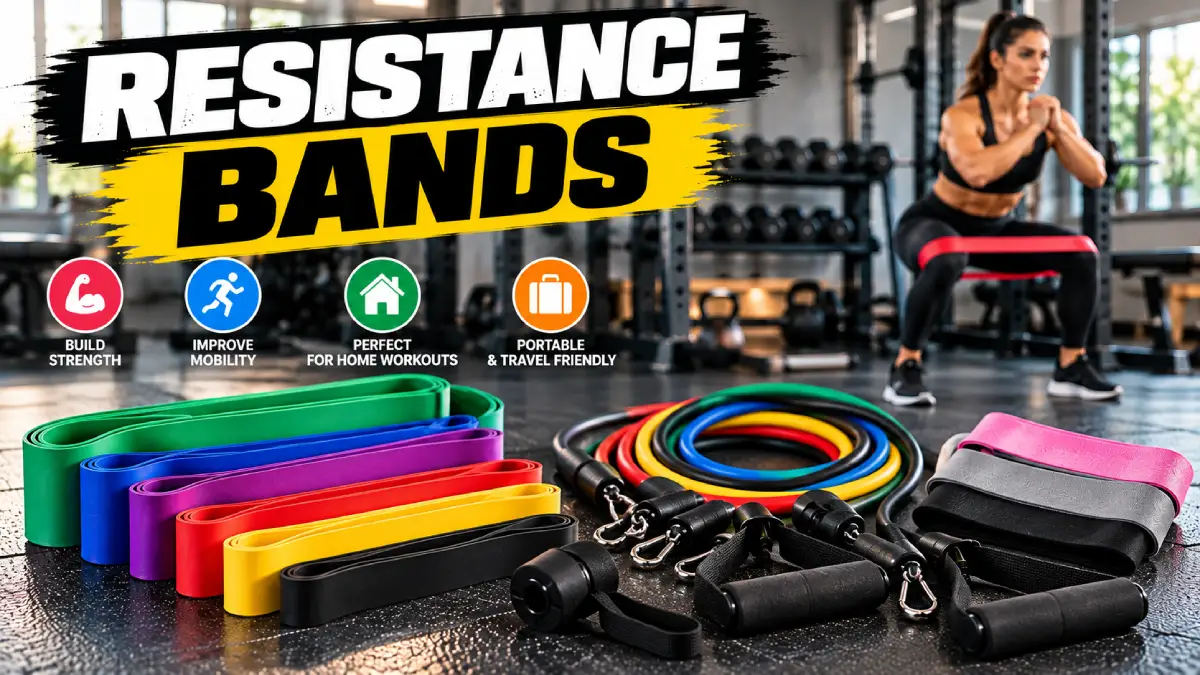
Resistance bands are inexpensive, portable strength training devices that are versatile for use at home, at the gym, or on the go. Small in size, available in various resistance levels, and capable of supporting almost all of the large muscle groups, the versatile bands can be an ideal workout addition. In contrast to free weights such as dumbbells and barbells, bands work against your muscles by providing resistance through stretching. The further some bands stretch toward their range of motion the greater the resistance.0
What Are Resistance Bands?
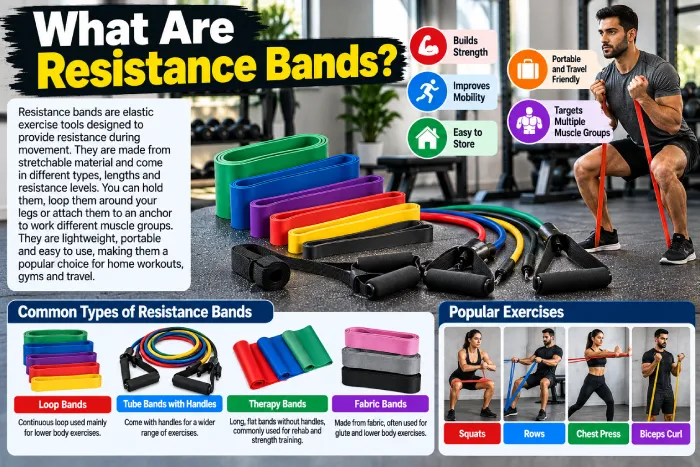
Resistance bands are elastic exercise equipment to create either resistance or assistance in various movements. Resistance bands can come in various sizes, shapes, materials and resistances. While some can be held in the hands or hooked around the legs, others can be stood upon or anchored to a suitable object.
They can be used for exercises such as:
- Rows
- Chest presses
- Squats
- Biceps curls
- Triceps extensions
- Shoulder exercises
- Glute exercises
- Lateral walks
Because of their small size bands are among the most portable and portable of all the strength training equipment.
Types of Resistance Bands
The first step to picking the right band is to become familiar with the basic designs.
Loop Bands
Loop bands are in the shape of a complete circle. Short loop bands are usually placed around the thighs and lower legs during exercises like lateral walks, glute bridges, and squat variations. Longer loop bands can also be used to perform an increased number of strength training exercises.
Tube Bands With Handles
Tube bands generally feature handles at both ends. During exercises like rows, curls, shoulder presses and chest presses these can make them feel more like conventional gym equipment. Additional accessories such as door anchors are sometimes supplied with tube band systems.
Therapy-Style Bands
These are long, flat bands of elastic material with no handles. They are lightweight, simple to store and come in a variety of resistance levels.
Fabric Bands
Fabric resistance bands are often used for lower-body movements around the legs. They may be felt differently from bands made of latex-style material and are often used for movements like lateral walks and movements targeting the hips.
Benefits of Resistance Bands
Easy to Store
Bands are not bulky; you can store several resistance levels in a drawer, bag, or in a small storage container. They are great for use in apartments and small home gyms.
Portable
Resistance bands are small and portable. If you are away from home quite a lot, they can be a good form of resistance training as they are small and require no difficult-to-transport gym equipment.
Multiple Resistance Levels
Bands are available in different resistance levels. This enables you to choose a lighter resistance for some exercises and a heavier band for other exercises.
Exercise Variety
A handful of bands can also enable upper-body and lower-body movements. Variations in stance, grip, band length, or safe anchor location will also alter the sensation of an exercise.
Useful With Other Equipment
You don‘t have to substitute a resistance band for your dumbbells, kettlebells, or barbells. In fact, they can really be an addition to your equipment arsenal. For instance, if you already own adjustable dumbbells, you could spend a session doing some lateral walks, pull-aparts, or accessories.
How Does Band Resistance Work?
Tension is different from free weights when using resistance bands. With a dumbbell, the outer weight is constant throughout a movement. With a rubber band, tension usually varies as the band is stretched. For example, a band curl may be easier near the starting position and harder at the end position. Exact resistance then varies depending on the design of the band and how it is used. Never use color as a sole indicator to estimate resistance, as different companies use different color codes. Find the manufacturer‘s resistance data.
How to Choose Resistance Bands
Consider Your Exercises
Begin by deciding what you want to do. Short loop bands could be effective for lower body accessory movements and longer bands or tube bands will give you more variety for rows, presses and curls.
Choose Multiple Resistance Levels
One resistance level may not be suitable for every exercise. Your legs may be able to handle a band of too great a resistance for a shoulder exercise. A set of a few levels can give you more options.
Check the Material
May be latex, synthetic, or fabric. Look at specifications of product if possible, especially if you have sensitivities to materials.
Consider Handles and Anchors
If you‘re fond of cable type exercising tube bands with handles may be more comfortable. When working with anchor ensure it is suitable for the item and is fitted or placed side to side with manufacturer instructions.
Resistance Band Safety
Bands need to be checked on a regular basis since elastic will deteriorate over periods of time.
Before exercising, look for:
- Cracks
- Cuts
- Tears
- Fraying
- Damaged handles
- Loose connections
- Worn anchor points.
Do not continue using a band if it has become excessively worn or damaged. Do not overstretch the band beyond the limits specified by the manufacturers. Place the band on a secure fixed point that is appropriate for the desired exercise before applying tension. Do not presume that furniture, doorways, railings or other household objects are valid anchors.
Common Resistance Band Mistakes
The one mistake is selecting what is too heavy. If the resistance band is limiting your ability to control the movement, a lighter band should be used. Another mistake is assuming that bands are uniform with respect to their colors. A red resistance band from one manufacturer may have a differing resistance from a red band from another manufacturer.
Other mistakes include:
- Replaced by using broken bands.
- Poor anchoring
- Expanding bands too wide
- Permitting the band to release and catastrophically snap back
- With just 1 resistance level.
- Deadministration by the manufacturer: Manufacturer instructions result in too much of the drug being administered.
Even simple equipment needs to be sensibly used.
Are Resistance Bands Good for Beginners?
Yes. They are portable, versatile and have many options of resistance that can make them good for beginners.
A simple home setup could include:
- Resistance band kit
- Exercise mat
- Adjustable dumbbells
As strength and training goals develop, you can include a bench, kettlebells, or other equipment as required. There isn‘t need for a huge range of equipment straight away.
FAQs
Can resistance bands build muscle?
Such bands can be used to create muscular resistance and be incorporated into strength training. Correct resistance, progression, exercise selection, and adherence can be important.
Are resistance bands better than dumbbells?
Both have their advantages. Bands are more portable and compact, while dumbbells offer a different kind of resistance. Many exercises can work either.
Which resistance band should beginners use?
For those new to exercise, selecting a resistance that they can control movement and exercise technique. Where there are multiple resistance values that align with different exercises.
How long do resistance bands last?
Life span depends on type of material, how often you use it, how you store or stretch it and how you take care of it. Always check your equipment for damages and replace it if broken.
Conclusion
Resistance bands are a cost effective, space saving, versatile method of adding resistance to workout programmes undertaken at home, in the gym and whilst traveling. Select band strength appropriate to the exercises being performed and individual resistance tolerances, as well as type, material, handles and anchoring options. As they are inexpensive, it is wise to frequently check their condition and use as directed by the manufacturer‘s instructions. Resistance training equipment need not replace traditional weights, but all the same use of resistance bands, dumbbells, kettlebells, benches etc. can be a useful feature of a comprehensive strength trainer‘s set of equipment.