

Mohd Arbaaz is an Editor and Writer at Fitnessison.com with 5 years of experience in SEO and digital content creation. He creates informative, reader-focused content covering fitness, workouts, nutrition, health, healthy lifestyle, technology, and computers.

Shashi Teja is a Reviewer at Fitnessison with over 6 years of experience in SEO, content strategy, digital publishing, and content optimization. He reviews content for clarity, research quality, topical relevance, readability, structure, and overall usefulness to readers.
Last Updated: September 29, 2026
The barbell and weight plates are two of the most popular strength training tools. They are used in most strength exercises, including the squat, deadlift, bench press, bent over row, overhead press, and others that make use of differential increments in weight. Flexible strength means having the appropriate amount of weight when your strength increases without having to purchase all new equipment. All bars and plates are not created equal. Several factors including diameter, construction, weight capacity, plate style, and compatibility must be taken into account when supplying equipment to a home or commercial gym.
What are Barbells and Weight Plates?
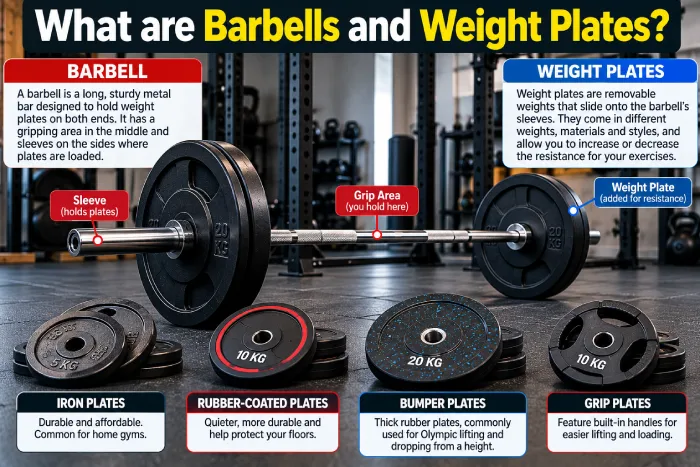
The barbell is a long metal bar that has weight plates on either end. The middle section is gripped by the user during exercise, with the sleeves on each end holding the plates in place. Weight plates are the removable weights that attach to the sleeves and form a very basic adjustable resistance source. For instance, as an exercise gets easier, more weight can be added. Barbells are great for training with progressive increases in strength. Barbells come in various lengths and weights, different sleeve diameters, and various designs so it is important to triple check the manufacturer’s specifications for each bar and plate configuration.
Common Types of Barbells
You will probably need to decide on to right bar according to your main plans.
Olympic Barbells
The basics about Olympic Bars Olympic bars have been a favorite for strength training and weight lifts. They utilize a pair of rotating sleeves for the Olympic-size plates. There are various models of them, each modeled to serve a specific purpose, so don’t assume every bar is identical in design.
Standard Barbells
Standard bars tend to be smaller in diameter, with plates that have a smaller central hole than Olympic equipment. They may be suitable for the basics of home strength training, but their plates are not usually compatible with Olympic bars.
Specialty Bars
Some gyms also use specialty equipment such as:
- Trap bars
- Safety squat bars.
- Curl bars
- Swiss or multi-grip bars.
These may be helpful to certain exercises, but beginning lifters can do without having multiple specialty bars at the start.
Types of Weight Plates
The weight plates are available in a variety of styles.
Iron Plates
Classic iron plates. Plays simple and stable. Offers the advantage of storing more plates in a small space while providing for basic lifting needs.
Rubber-Coated Plates
These have an outer coating of some kind which could possibly help dampen the noise and also direct the metal contact. This type can be seen in home gyms and most commercial gyms.
Bumper Plates
Bumper Plate: Bumper plates are manufactured with a “thicker” rubber design. They are generally used in blocks that allow for equipment where drops are permissible per the general facility and/or manufacturers directions. They tend to take up more sleeve space than a thin “iron” plate.
Grip Plates
Grip plates have the advantage of holes which may facilitate the grab, carry and load. Which one you purchase will depend on your training style, storage, sleeve length on your bars, flooring and budget.
Benefits of Barbells and Weight Plates
Easy Progressive Loading
The main benefit one of the biggest benefits is that of the ability to progress the resistance incrementally. Rather than purchasing a new machine altogether, you can simply look at adding suitable plates as your strength progresses.
Suitable for Major Strength Exercises
Barbells are commonly used for compound movements such as:
- Back squats
- Front squats
- Deadlifts
- Bench presses
- Overhead presses
- Barbell rows
This motion can exercise on a lot of groups of muscle simultaneously.
Wide Resistance Range
A barbell will handle quite a high range of loads, giving the fact to be based on the bar, plates, rack, and any other equipment used. This may be useful as strength develops past lighter dumbbells.
Long-Term Expandability
You don‘t need to buy all the plates right away. All a home gym needs initially is a bar and some small plates, it can then be increased when greater resistance is required.
Olympic vs. Standard Weight Plates
Compatibility is checked as well when buying plates.
| Feature | Olympic Plates | Standard Plates |
| Center hole | Larger | Smaller |
| Typical use | Home or commercial strength gyms. | Fundamental residence configurations |
| Equipment selection | Broad | More limited |
| Heavy strength setups. During those times, heaving strength may be utilized using a machine. Many equipment would include the heaving strength to work on biceps, triceps, and chest. | Common | Less common |
| Compatibility | Olympic bars | Standard bars |
thing, ensure the diameter of the sleeve and the opening of the plate are also specified by the supplier. A plate that appears similar in a internet photograph may not be compatible with your bar
How Much Weight Should You Buy?
No one size fits all. Your collection of plates should fit your current strength and the exercises you do. A novice to barbell training can train with much less total weight than a seasoned lifter.
Instead of guessing, consider your current working weights for:
- Squat
- Deadlift
- Bench press
- Overhead press
- Row
Then step back and give some room to progress: buying significantly more weight than you really need costs more money and storage space, but buying too little, makes it very easy to purchase other plates almost immediately.
What to Check Before Buying
First, verify compatibility. The bar, plates, collars, and rack must all work as designed. Second, verify loading capacity or load rating indicated by manufacturer for the bar and rack, not guessing by appearance, floor standing units found the most difficult. Third, consider the bar length, that is distance from end to end of the bar. The longer the bar, the more open space needed around the rack to load plates safely.
Don’t neglect value. When comparing several options, the most economical choice may be the thicker bumper plates, which use up more sleeve space than most iron plates. Finally, consider storage. When not in use, weight plates scattered on the training area floor contribute to clutter. Use a plate tree or an appropriately rated rack-mounted storage method to reduce clutter in the workout space.
Common Barbell Training Equipment Mistakes
A big mistake is purchasing plates before checking them for size with the bar. Another is concentrating solely on total weight and ignoring the space for working out.
Other common mistakes include:
- Forgetting collars
- Say you don‘t take rack comparisons into consideration
- Buying Unnecessary Specialty Bars
- Inappropriate Stack the plates must have been stored improperly.
- Current overload of equipment ratings
- By employing broken equipment.
- If all bars are to be dropped, we should favor the following ones.
Please check your equipment regularly and adhere to the instructions of use and maintenance given by the manufacturer.
Are Barbells Good for Beginners?
Yes bars can have their place for beginners when the movements are learned with a good technique, the resistance is appropriate and safety arrangements are in place; however to start out with strength training a barbell is not necessary. In fact some individuals may have started with adjustable dumbells or resistance bands or bodyweight before investing in a barbell set. Your equipment should evolve as your needs do.
FAQs
What is the difference between a barbell and weight plates?
The bar bell is the long bar you are holding during an exercise. Weight plates are placed on the the sleeve to provide the additional weight.
Are bumper plates better than iron plates?
There is no “better” option. Bumper plates and iron plates are made differently, have unique and varying thicknesses and sound properties, as well as differing purposes.
Can you build muscle with barbells?
Yes. Can supply progressive resistance for a broad range of the exercises commonly performed for programmes to build muscle.
Do weight plates fit every barbell?
No. Plate openings and bar sleeve diameters are different. Please always check the equipment specifications before placing the order.
Conclusion
A barbells and weight plates are one of the best, most modular strength training systems. Short of an advanced/areospace workout, they can handle everything from simple pressing and rowing all the way up to heavier squats and deadlifts. Before you put together your barbell and plate setup, decide if they are compatible with your other equipment, what type of plates you want, how much space and storage you have, and what your training goals are. Buy what you need now, and as you get into it and develop your goals buy more. used properly, a plate and barbells and set of plates can be the backbone of a permanent strength training equipment setup, without cluttering up your gym with useless gear.