

Mohd Arbaaz is an Editor and Writer at Fitnessison.com with 5 years of experience in SEO and digital content creation. He creates informative, reader-focused content covering fitness, workouts, nutrition, health, healthy lifestyle, technology, and computers.

Shashi Teja is a Reviewer at Fitnessison with over 6 years of experience in SEO, content strategy, digital publishing, and content optimization. He reviews content for clarity, research quality, topical relevance, readability, structure, and overall usefulness to readers.
Last Updated: September 8, 2026
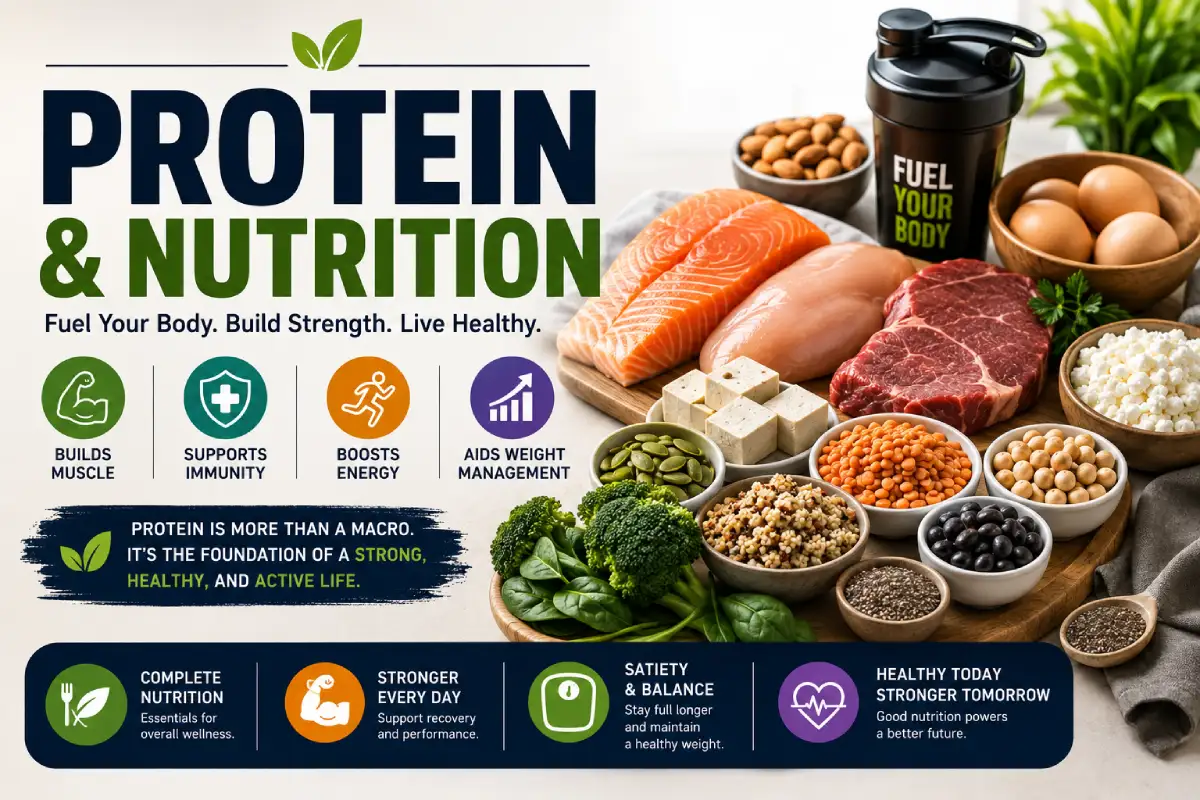
Protein & Nutrition. Important 1. Your body needs food (energy & nutrients) such that it can… build and maintain muscle, repair tissues, carry out normal functions, recover from exercise. You know nutrition is important; but you want to know how much do I need, what sorts of foods are good sources, are plant proteins adequate, when should I consume protein, do my needs alter if I want to loose weight or gain muscle? Then the real questions..
The average adult should be consuming 0.8g of protein per kilogram of body weight per day (= 0.36g per pound). It is the minimum amount to fulfill basic nutritional needs, but the optimum intake is dependent on activity level, age, body size, health, calorie consumption and naturally, your goal.
This guide presents the overview of the world of protein without making it an equation of numbers. Have it as the fitnessison protein and nutrition hub overview and then delve down into the cluster guides for individual goal targets.
What Is Protein and Why Does It Matter?
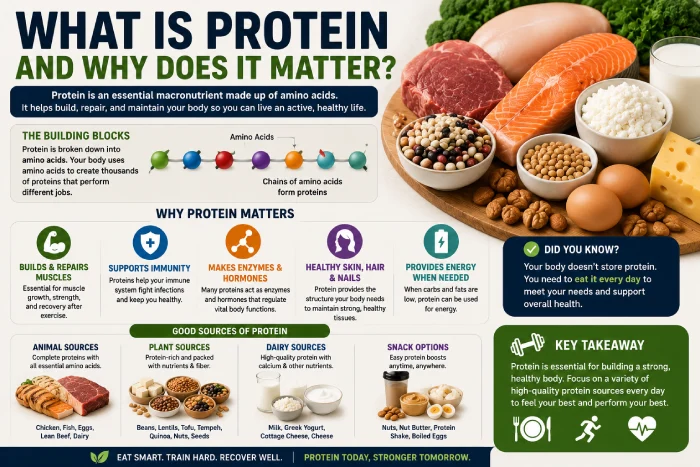
A macronutrient, protiens, comprises amino acids. When dietaryprotein is consumed, the body‘s digestivesystem decomposes it into amino acids which are used by individual body to constituting and sustenance of proteins. These are present in muscle, skin, connective tissue, enzymes, hormones, immune system and literally million other biological processes. Protein is therefore much more than a “muscle food.” The body uses over 20 amino acids with nine of these classified as essential (must be taken from the diet).
The simple way to think about protein
During your entire life proteins are constantly being broken down and rebuilt in your body. You only supply theraw materials through the food you eat. Exercise, particularly resistance work, supplies the stimulus for your muscles to adapt by rebuilding themselves in response. Recovery supplies the window of opportunity for your body to repair and rebuild. Hence the reason that protein once again is most effective as part of a system nutrition, training, sleep and recovery.
Key takeaways
- Protein supplies amino acids that your body requires.
- Protein does a great deal more than just build muscle.
- You body requires protein in everyday.
- The benefits of exercise and protein go hand in hand.
- Too much protein is not necessarily an advantage.
Practical example
A breakfast of eggs, Greek yogurt and toast provides protein, carbohydrate, fat and other essential nutrients. A serving of a tofu-and-vegetable pancake pack, for example, supplies protein from soy, as well as fiber and micronutrients. A protein shake can be quick and easy, but doesn‘t have to replace a healthy dinner.
Mini summary: Protein is needed for the building and maintainance of your body not a magic muscle-building ingredient.
Proceed further: Read the next Daily Protein Requirements cluster for an elaboration of protein goals.
How Much Protein Do You Need Every Day?
This depends on what you mean by, in the above context.
For a healthy sedentary adult in the US, the reference intake is approximately 0.8gkg/day. Harvard starts at 0.8gkg/day as well and is aware that needs differ with activity, pregnancy, lactation and so on.
For a numerical example, someone who weighs 165 lbs. (pounds) is approx. 75 kg. (kilograms). 75 × 0.8 = 60g of protein per day
Of course, that‘s a useful starting point perhaps not the best goal for anyone who hits the weights a few days every week though.
Protein needs can increase
Recreational athletes may need excess protein above that of a minimum RDA. Present sports-nutrition research generally estimates protein consumption for exercisers at about 1.4 2.0 g/kg/day depending on training level and context.
Cleveland Clinic‘s current consumer recommendations specify that the amount of protein depends on the body weight, activity level and goals. A key notion is not that suddenly everyone should consume 2 grams per kilogram. The bottom line is that one protein number does not work for everyone.
A simple framework
| Situation | General approach |
| Sedentiary healthy adult. | Begin with the basic RDA. |
| Regular exercise | Now, imagine a higher intake |
| Strength training | Protein can help support training adaptation9 10 |
| Weight loss | If you are consuming insufficient protein, this could lead to the maintenance of only lean tissue and the sensation of fullness increases. |
| Older adulthood | The more protein is needed to gain muscle. |
| Large volume of training | Identified need. |
| Medical conditions | Someones entry may requre individual guidance. |
They are planning concepts, not personal prescriptions.
Mini summary: Your protein goal should mirror your body, activity and aim.
Keep diving deeper: For body-weight calculations and examples specific to your goal, refer to Daily Protein Needs.
Complete vs. Incomplete Proteins: What Is the Difference?
“Complete” and ” incomplete” protein describe amino-acid composition of protein source. A complete protein supplies all 9 essential amino-acids. Animal product like meat, chicken, fish, Eggs and dairy are all complete proteins. Whole soy products such as Tofu, tempeh and edamame are complete proteins. Many plant foods have protein but in lesser quantities of one or more Essential amino-acids. This doesn‘t make them inferior protein sources.
Plant protein can absolutely be part of a healthy diet
Beans, lentils, nuts, seeds and grains provide protein and also fiber, minerals and other valuable nutrients.
Consuming different plant proteins all day gives your body the individual amino acids it needs. MedlinePlus and Mayo Clinic Both of these sources focus on eating a diverse range of foods instead of viewing incomplete proteins as anything lesser.
Example combinations
- The reaction is really menthol in the reflux.
- Hummus, combined with whole-grain pita
- PB + WG bread
- Lentils + quinoa
- Tofu + Grains (whole grains preferred where practical)
It is not absolutely necessary to put complementary proteins in the same mouthful or even in the same meal. A variety over the day will do just as well.
Key takeaway
Consider your whole diet and not each single plant food being ‘complete’.
Mini overview: Protein quality is important but it‘s not everything. The variety of the diet is also important.
Follow up further: Expand on Complete vs. Incomplete Proteins for a nutrient by nutrient emphasis on protein quality and plant eating.
Best Protein Sources: Food First
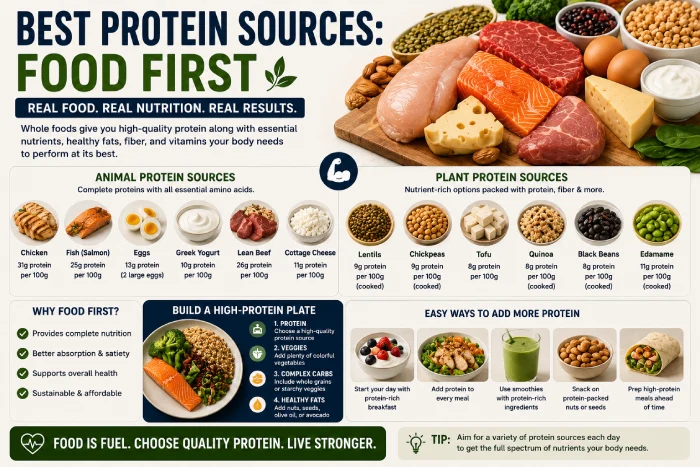
The best protein source will be different for everyone, as it will be based on nutritional requirements, taste, overall expenditures and preferences. A source of protein is not measured solely by the amount of grams of protein. It‘s the whole food package that you‘re considering.
The table below shows the various types of foods that are recommended to snack on.. For example, salmon provides both the protein and omega-3 oils. Greek yogurt provides both the protein and the calcium. Lentils ( vegetable protein + high fibre). Nuts provide both the protein and the healthy oils but are high in calories.
It is always better to think of the ‘whole nutritional package’ that protein foods offer.
Animal protein sources
Good options include:
- Eggs
- Chicken
- Turkey
- Lean beef
- Fish
- Salmon
- Tuna
- Greek yogurt
- Cottage cheese
- Milk
Plant protein sources
Useful options include:
- Lentils
- Black beans
- Chickpeas
- Edamame
- Tofu
- Tempeh
- Peas
- Quinoa
- Nuts
- Seeds
- Whole grains
Easy high-protein meal formula
Try building meals around:
Protein + veg/fruit + good carb + healthy fat
Examples:
- Breakfast: Greek yogurt + berries + oats + nuts
- Lunch: Chicken + brown rice + veggies + avocado
- Dinner – Salmon + potatoes + broccoli
- Vegetarian dinner: Tofu + quinoa + mixed vegetable + tahini
- Snack: Cottage cheese + fruit
Mini summary: The optimal power source is one you like, can afford, can metabolize well and is more or less added to a balanced diet day to day.
Go deeper: [See] Best Protein Sources for food comparisons, high-protein meals and cheap options.
Protein Timing and Absorption: Does When You Eat Protein Matter?
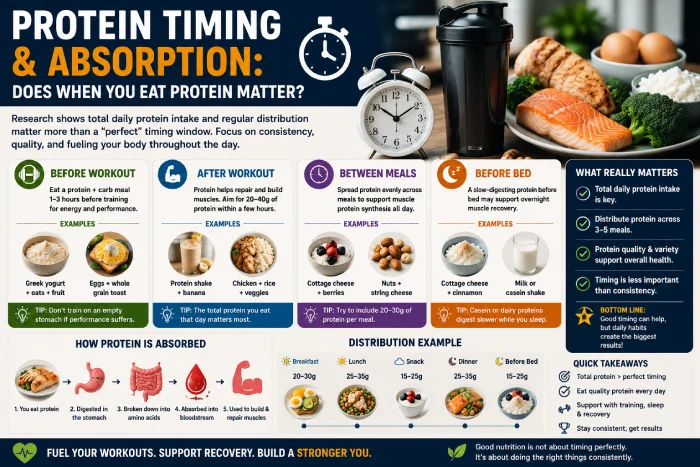
Protein timing does matter, but it often end up being too much to think about. Number one, make sure you get enough protein over the whole day. Number two, spread your protein intake from meal to meal instead of snacking on all your daily protein at once. Number three, focus on how to time your intake relative to your workout.
People who eat higher amounts of protein combined with training through resistance exercises experience an increase in muscle protein synthesis according to data from the International Society of Sports Nutrition. Protein feedings at various times of the day have been shown to sustain training and recovery processes.
Before a workout
A meal with carbs and protein could be used before training.
For example:
- Greek yogurt + banana
- Eggs + toast However, one nutritionist said: “Don‘t eat eggs [and] high-fat foods without a lot of fibre”.
- Chicken + riceI am going to eat chichen with rice it would take 4minutes; 22seconds6.05 for 200g.
- A protein-based smoothie and fruit can also add oats to make the drink more filling0
After a workout
You do not have to panic if you are not able to hit the shake straight after your last set.
Consuming a meal with protein after exercise is another realistic way to promote recovery.
Examples:
- Chicken / rice How to: [method: Boil the rice together with a chicken and then prepare a dressing for it.]
- Previously, for the combination of Salmon and potatoes. This combination got three compliments.
- Greek yogurt and oats
- Tofu and quinoa.
- Protein smoothie with fruit.
What about protein before bed?
A high protein snack before bed, may be beneficial for those who do not reach the mark in the course of a day. Easy options include dairy foods like Greek yogurt or cottage cheese.
The bigger picture
Think:
Total daily→ normal food→training nutrition
rather than:
“I have 30 minute exactly to drink my shake.”
Mini summary: Regularity trumps infatuation on the best timing.
Go further: Study Protein Timing and absorption for post-workout and meal-distribution.
Protein for Weight Loss vs. Muscle Gain
Protein can help with either goal, but the nutrition strategies will vary:
Weight Loss
When in a state of weight loss, the usual aim is to spare body fat reduction while minimizing lean tissue loss as much as possible. Protein can be helpful due to it being relatively filling as it is used to maintian muscle tissue as Cleveland Clinic 3 states ‘protein is slower to digest and can help you feel full, so can be a helpful addition to a weight-management diet’. However, protein cannot counteract calories. A high protein diet can still be overly calorific.
A practical weight-loss plate
Try:
- A large protein source.
- A variety of vegetables
- A moderate amount of carbohydrates9.
- A decent quantity of healthy fat.
For example:
Chicken grilled + vegetables baked + potatoes +olive oil
The goal is not to cut out carbs or fats.
It is to help you to establish a satisfying diet that you want to adhere to.
Protein for muscle gain
It takes more than just protein to build muscle.
You also need:
- Sufficient total calories.
- Adequate protein
- Sleep
- Recovery
According to sports-nutrition research, an intake of approximately 1.4 2.0 g/kg/day would be adequate for the majority of individuals engage in exercise who are wishing to maintain and build muscle.
The common mistake
Someone begins to use the weight of lifting and in the same moment doubles his protein intake and train almost never.
This reverses the priorities.
Training provides the stimulus. Protein supplies the building blocks. Recovery enables the body to adapt.
Body recomposition
When attempting to lose fat and preserve or build muscle, one of the benefits of protein that is most relevant is in conjunction with resistance training and an intelligent calorie approach.
Mini summary:Protein helps with losing fat and gaining muscle. However, it all depends on your own whole lifestyle.
Keep going in more depth: Check out Protein for Weight Loss vs. Muscle Gain if you want goal-targeted advice.
Protein Powder: Do You Actually Need It?
No Protein powder is a convenience food though, it is not required in order to be healthy or to build muscle.
The individual can achieve their protein requirements through the consumption of foods. Dietary and sports nutrition studies have shown that supplementation is an immediate alternative when athletes or physically active individuals are unable to cope with the quantity of food necessary to meet the ideal intake.
When protein powder can help
It may be convenient when:
- There is insufficient time at your disposal to prepare food.
- You are not meeting your protein needs.
- Have to have a portable post workout,.
- You don‘t have much of an appetite.
- You are on a diet which makes it hard to get enough proteins.
When it may not be necessary
If you already consume adequate protein in your diet for your specific goals then having multiple shakes may just be a wasted expenditure or addition of excess calories.
Simple rule
Use your protein powder as a solution to one of your problems, not a solution to a problem you do not even have, because the advertisements tell you that without it you will never be able to make any progress.
Mini summary: Protein powder, if needed, could be useful. However, can still do well without but I haven‘t listed it under the must; it is more of a bonus.
Continue deeper: we can further support future content by any of the following: Whey vs. Plant Protein, How to Choose Protein Powder, Protein Powder Safety.
Protein for Different Types of Diets
Proteins don‘t require us to adopt one specific way of eating.
Omnivorous diets
To some extent, consumption of meat, fish, eggs and dairy can simplify the task of getting enough protein. Nonetheless, the flavor of foods is important. No single burger is comparable, in terms of flavor, to mixing it up with fish, beans, greens, brown rice etc.
Vegetarian diets
Vegetarians can use:
- Eggs
- Dairy
- Greek yogurt
- Cottage cheese
- Tofu
- Tempeh
- Beans
- Lentils
- Nuts
- Seeds
Vegan diets
A vegan diet can be very high in protein, providing access to a whole range of beans, soy products, grains, nuts & seeds. Provides such a great variety of plant foods as they all contain varying amino-acid profiles.
The practical lesson
You do not need to ask:
“Which diet contains the ideal protein?”
Ask:
Does my overall diet contain adequate amount of protein and is there a variety of nutrient dense foods?
Protein and Nutrition for Older Adults
The importance of protein increases with aging as maintenance of muscle and physical function. Pressures to take in protein should also be considered in addition to resistance training, balance, mobility, the amount consumed and overall diet quality.
Mayo Clinic has also stated that protein requirements tend to increase with aging as people strive to preserve muscle mass and lessen the effects of age-related muscular degeneration.
Practical strategies
Older adults who struggle to eat enough may benefit from:
- Protein-rich breakfasts
- Greek yogurt
- Eggs
- Fish
- Dairy
- Tofu
- Beans
- Protein-rich snacks
There are not only three times a day, nor is eating three times a day. Having three moderate protein meals and a snack or two that is high in protein may be more manageable than attempting to consume a large quantity at dinner.
Mini summary: If need to stay mobile / independent, the protein becomes essential.
Common Protein Mistakes
Even the greatest health conscious individual can make some basic errors:
Mistake 1: Eating almost all protein at dinner
If there is very little in the breakfast and hardly anything in the lunch, it doesn’t seem the most suitable pattern to try to “catch up” at night.
Better: Have some form of protein with each main meal.
Mistake 2: Treating protein as a replacement for vegetables
Protein is important, but leafy greens, fruit, whole grains, and so on offer nutrients that are absent from other foods.
Mistake 3: Assuming more protein always means more muscle
Increase in Muscles. To increase muscle cells, there needs to be a training stimulus and recovery, so the stimuli can have an effect.
Mistake 4: Ignoring calories
Even though it is not recommended to abuse them, that you can eat as much as you like, protein foods are not counted. They are still things called calories.
Mistake 5: Depending heavily on processed protein products
Bars and shakes may be handy, however whole foods should mostly make up the diet.
Mistake 6: Avoiding plant proteins
All of beans, lentils, tofu, tempeh, nuts and seeds are able to make a positive contribution in a healthy diet.
Mistake 7: Chasing the perfect protein timing window
Daily weght and can alete being equally important.
Mini summary: Balance, balance, balance!Good protein nutrition is about balance and not about having to be on extreme high or low intakes.
Myth vs. Fact: Protein & Nutrition
Myth: Greater protein intake will lead to increased muscle mass.
Fact: While protein supplies amino acids, as the muscle grows, it also needs an adequate training overload stimulus and recovery.
Myth: Plant protein is useless for muscle. Seventh-Day Adventists are the largest bunch of muscle-obsessed protein freaks you will ever set eyes on (Gorbach et al, 1962). Flora is perhaps the best source in the world of biotin, zinc and magnesium, as well as a healthy supply of amino acids (Gorbach et al, 1962).
Fact: Plant foods can be entirely sufficient for a 100% protein derivation; with a wide variety and an overall appropriate intake.
Myth: Every meal should be “complete” proteins. Not necessary. When eaten in a day, vegetarian meals can total to several days’ worth of essential amino acids. Or if not, all you need to do is have dairy, or eat a few extra nuts.
Fact A varied diet throughout the day can supply the necessary amino acids.
Myth: You require a protein shake after each session.
Fact: Protein powder is optional but convenient.
Myth: consumption of protein is only needed when you are bodybuilding.
Fact: Protein underpins tissue and normal body processes for everyone.
Myth: Carbohydrates help build muscle. For years now people have been told that eating a diet rich in carbohydrates will help gain muscle mass. This is actually quite the opposite.
Fact: Carbohydrates can be a useful source of fuel for training. This can be provided as part of a balanced diet – protein, carbohydrates and fats.
Some mini summary: MINIMUM statelineis/most healthy statelineisisnever the top choice.
How to Build a High-Protein Day
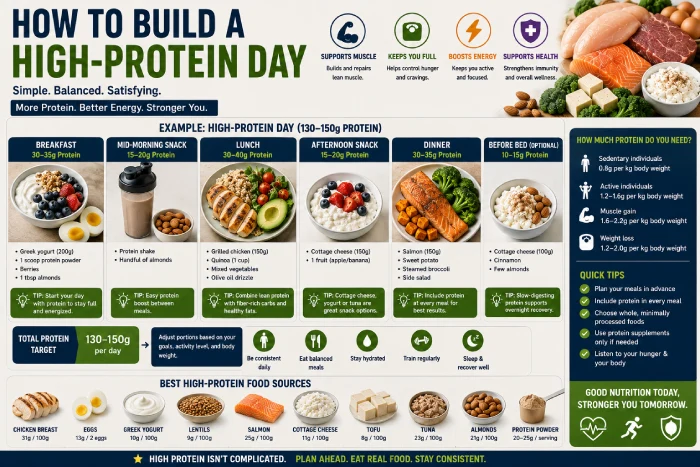
You don‘t have to complicated recipes. Begin by including one trusted protein source per meal.
Breakfast
Choose one:
- Eggs
- Greek yogurt
- Cottage cheese
- Milk
- Tofu scramble
Add the fruit and whole grains, if needed.
Lunch
Choose:
- Chicken
- Tuna
- Turkey
- Tofu
- Lentils
- Beans
Add Vegetables and a carbohydrate to the mixture.
Snack
Try:
- Greek yogurt
- Cottage cheese
- Milk
- Edamame
- Nuts
- Protein shake
Dinner
Build around:
- Fish
- Chicken
- Lean meat
- Tofu
- Tempeh
- (Beans or lentils)
Next, include vegetables and a good carbohydrate.
A simple rule
If you look at your plate and see almost no protein, ask:
“What might I include?
No need to overhaul your entire diet.
A Step-by-Step Protein Planning System
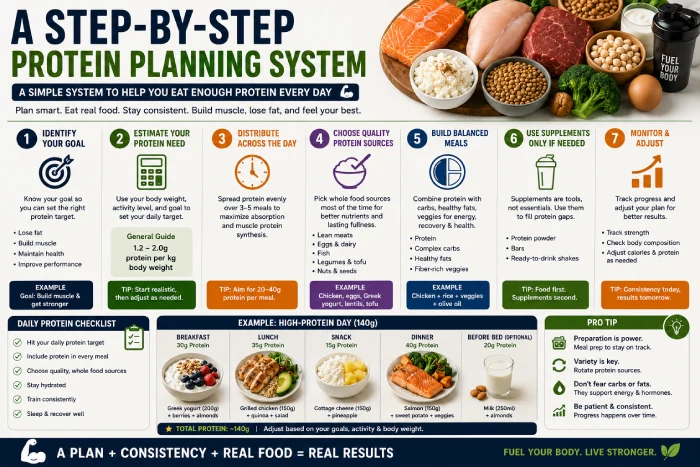
Step 1: Identify your goal
Are you trying to:
- I will stick to a healthy lifestyle: eat well, get a good rest, keep fit, and exercise.
- Losing Body Fat?
- Build muscle?
- How to enhance athletic recovery?
- Preserve muscle as get older.
Step 2: Estimate your baseline requirement
Take the basic 0.8 g/kg/day guideline as a baseline recommendation for healthy adults; then decide if you should aim slightly higher or lower for your activity and goals.
Step 3: Divide protein across the day
Rather than putting almost everything into one meal, have multiple chances to eat protein.
Step 4: Choose foods you actually enjoy
A theoretically perfect food is of no value if you don‘t ever actually eat it.
Step 5: Build meals around protein
Think:
Protein+ fruits and vegetables + carbohydrate + healthy fat
Step 6: Use supplements only when useful
If you are getting everything you need from your diet, then perhaps there is no point in adding in a protein supplement.
Step 7: Monitor results
For fitness goals, track:
- Strength
- Body weight trends. Statistically significant increases in body weight were observed in the BLK, HLP, and PHI groups from baseline to the 6 week time point. Notably, the HLP group showed a trend for weight gain (p=0.052); while the BLK and PHI groups experienced significant weight gain.
- Measurements
- Recovery
- Hunger
- Energy
- Training performance
Don‘t even take one reading of the scale after one day, cast your judgment upon your nutrition.
What If You Are Eating More Protein but Not Seeing Results?
This is an everyday troubleshooting issue. If your protein intake has increased but you‘re not progressing onwards, have a look at the bigger picture.
For weight loss
Ask:
- Is the total calories acceptable?
- Are the liquid calories piling up?
- Is the portion size bigger than anticipated?
- Are the weekends’ shaking every day?
- Are you exercising enough?
- Getting enough sleep?
For muscle gain
Ask:
- Are you gradually making the training harder?
- Are you consuming an adequate amount of total calories?
- Protein every single day okay?
- Are you getting over?
- Are you getting enough sleep?
- Has too much time gone into training? Has in been long enough for results?
Proteins form only part of the system.
Example
Makes two protein shakes a day but gets nowhere because doesn‘t do any weight training and only sleeps 5 hours. The introduction of a third shake will not automatically take away the problem.
Mini summary: To break a plateau, look at the whole nutrition-and-lifestyle picture before going deeper into the protein path.
How Protein Fits Into Overall Nutrition
Don‘t let protein take up too much of your plate.
A balanced diet also needs:
Carbohydrates
Useful sources include:
- Potatoes
- Oats
- Rice
- Whole grains
- Beans
- Fruit
- Vegetables
They can be broken down for energy for both exercise and daily living.
Healthy fats
Examples include:
- Avocado
- Nuts
- Seeds
- Olive oil
- Fatty fish
Fiber
Found primarily in:
- Vegetables
- Fruit
- Legumes
- Whole grains
- Nuts
- Seeds
Micronutrients
Vitamins and minerals are involved in many body processes. This is why a high-protein diet still needs to be heavily loaded with nutrients.
Mini summary: Protein is, yes, very important, but it is not everything in the way of nutrition.
Protein and Nutrition for a Sustainable Lifestyle
The ideal protein strategy is the one you can stick to. A diet of six daily home-cooked meals could be ideal for one individual, and completely unsuitable for someone else. The trick is…rather than… follow the steps we can repeat.
Keep easy protein foods available
Examples:
- Eggs
- Greek yogurt
- Cottage cheese
- Canned tuna
- Rotisserie chicken
- Frozen edamame
- Canned beans
- Lentils
- Tofu
- Milk
Meal prep strategically
All three of you can share the same seven meals. Cook separately protein, carbohydrate and vegetables. And then mixed them in various ways during the week.
Make breakfast count
Eating a protein feeding at breakfast doesn‘t need huge servings at night for you to hit your target.
Keep emergency options
If life gets hectic, keeping Greek yoghourt, eggs, tinned fish or a protein shake in the house means a fast-food doesn‘t have to be your only choice.
Mini summary: Consistency is a skill for nutrition.
The Future of Protein & Nutrition
The days are gone of “g per day” for all protein nutrition.
Future nutrition strategies are likely to pay more attention to:
- Body composition of each person.
- Training volume
- Age
- Dietary patterns
- Protein quality
- Muscle health
- Metabolic health
- Personalized nutrition
- Improvement in food logging
- Health-related data collected via wearables’
- More accurate evaluation of diets on an individual basis.
In the future, tailoring to individual needs may provide a better understanding of how people respond differently to comparable diets. However, the fundamentals are probably here to stay. Consume a sufficient amount of nutritious food.
Mini summary: Even with technology a strong understanding of fundamentals is key.
The Bottom Line on Protein & Nutrition
The focus of Protein & Nutrition is not on the amount of protein you consume. It is a matter of taking in the right amounts of protein through a balanced diet that contributes to your goals. Begin with your total daily intake. Select many sources of high-protein foods. Spread protein intake throughout the day. Use resistance training if you want to build muscle, and apply a dietary strategy that focuses on protein and calorie reduction if you want to lose weight.
And don‘t forget: a protein shake is a means to an end not a necessity. What is the most effective nutrition strategy? The one that provides your body with all the nutrients it needs and is sustainable in your lifestyle. For most individuals, that involves whole foods first, consistent sufficient protein, supplements when helpful, and no unnecessary extremes.