

Mohd Arbaaz is an Editor and Writer at Fitnessison.com with 5 years of experience in SEO and digital content creation. He creates informative, reader-focused content covering fitness, workouts, nutrition, health, healthy lifestyle, technology, and computers.

Shashi Teja is a Reviewer at Fitnessison with over 6 years of experience in SEO, content strategy, digital publishing, and content optimization. He reviews content for clarity, research quality, topical relevance, readability, structure, and overall usefulness to readers.
Last Updated: September 27, 2026
Life can start to feel like just a long to-do list. When we just wake up and think about work, when we read the emails on the way to breakfast, when we bring our phones to the dinner table, and when we feel so overwhelmed we just jump from task to task, and even when we sit down we can‘t slow our busy mind. And this is what mindfulness at the beginner‘s level is about. Mindfulness simply means observing in the present, without hurrying to evaluate it. You need nothing more than yourself. No expensive equipment, no costly courses
What equals Mindfulness? (How is Mindfulness)
You may remain aware in this activity by feeling the heat of the mug in your hand, smelling the aroma of the coffee, the sensation of taking each sip. The own actions are in fact still the same. Your attentions are directed differently. Mindfulness can also be part of meditation but the two are not exclusively the same thing. Meditation offers on the subject‘s part simply one way to focus oneself toward Mindfulness. There are also other avenues of mindfulness to be found in, even, the most mundane daily tasks:
Benefits of Mindfulness for Beginners
Through the extensive use of mindfulness practices, individuals will be able to preserve their psychological well-being and if utilized properly it will also greatly enhance the individual‘s ability to cope with the minor daily hassles that we all encounter.
Some potential benefits include:
- Stress control: Awareness of stressful thoughts, relaxing without reacting immediately.
- Improved Concentration: Rehearsing re-focusing your attention onto the game when you start to think about other things.
- Emotion recognition in: The ability to identify emotion in yourself and others before reacting orbehavingí automatically.
- Relaxation: Built-in times to take a breather on hectic days.
- Better knowledge of oneself understanding one‘s own behavior, reactions, and thought processes.
Mindfulness is not a silver bullet a panacea for all psychological ailments, mental health conditions, or other human problems. It is a healthy addition to a healthy lifestyle, and a supplement to proper professional treatment.
How to Practice Mindfulness for Beginners
You don‘t really have to start with a 30-minute meditation. Start with just 5 minutes.5 minutes is the minimum to start learning.
Step 1: Find a Comfortable Place
Choose a cozy spot that you can remain in for a short while in a space where you are unlikely to be distracted. You may sit in a chair, on a sofa or cushions or even on the ground. Sit in a comfortable relaxed state neither tense or stiff. You need not sit upright.
Step 2: Notice Your Breathing
Observe your natural breathing. Feel how the air enters into and out of your nose, or see the subtle movement of your chest and stomach. You don t have to breathe deeply or consciously alter your breath. Just look at it.
Step 3: Allow Your Mind to Wander
Eventually, your mind begin to drift. Perhaps you‘ll think of something that you haven‘t completed yet, or perhaps you‘ll ask yourself what should I have for dinner tonight? This is perfectly normal. Mindfulness is not about stopping thedistract8;
Step 4: Gently Return Your Attention
Whenyou realize your mind has wandered, gently say to yourself”, return to the present moment and to your breath.” Be compassionate with yourself. Each time you bring your mind back you are practicing mindfulness.
Step 5: Finish Slowly
Try to be aware of your bodily sensations after 5 minutes. Observe the environment you are in, move your limbs if you like and resume your daily activities. You do not need to be totally relaxed for this exercise to be completed.
5 Simple Mindfulness Exercises for Beginners
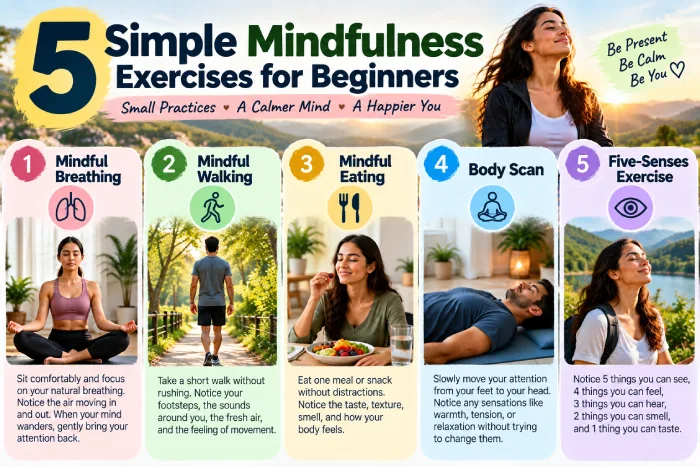
1. Mindful Breathing
Sit comfortably and: Maintain your normal breath awareness for the next 2-5minutes. If your mind wanders, then please return to your breath.
2. Mindful Walking
Walk for a few minutes without feeling that you need to walk faster. Feel the air around you and the air moving past you. Observe your footsteps and noises. Feel the sensation of moving through space.
3. Mindful Eating
As a one-off exercise, eat one meal or snack mindfully. Observe the sensory experience of eating, the taste, texture and odour of the food as well as the sensation within your body.
4. Body Scan
Proceed slowly with your attention from your feet to your head. Observe sensations like warm, tight, relaxed, or no sensation until they pass through you.
5. Five-Senses Exercise
List five things that you see, four that you are able to touch, three that you are able to listen to, two that you can smell and one thing that you can taste (bless yourself in every way you are thankful for!). Adapt this to your surroundings.
A Simple 7-Day Mindfulness Routine
SpeakReinforcing new habit? The more you believe it to be needed to begin with, the easier to start with it, just start small.
| Day | Mindfulness Activity | Duration |
| Monday | Mindful breathing | 3 minutes |
| Tuesday | Mindful walking | 5 minutes |
| Wednesday | Body scan | 5 minutes |
| Thursday | Mindful eating | One snack |
| Friday | Five-senses exercise | 3 minutes |
| Saturday | Breathing meditation | 5 minutes |
| Sunday | Select your preferred tactic. | 5–10 minutes |
Feel free to do these every week change them up fit your schedule.
Common Mindfulness Mistakes to Avoid
I can‘t clear my mind:This is a common concern. Simply become aware of your thoughts and gently notice without getting caught up in them. It is common to want quick results: Mindfulness is a learned skill and takes time and practice to master. Only trying it when you are anxious: Regular brief periods of practice will help you get more familiar with the technique. Allowing yourself to continue: Cease or try another technique if meditation adds to anxiety. A doctor‘s advice may be helpful.
FAQs About Mindfulness for Beginners
Q1) How many times a day or week should beginners practice?
Beginning with 3-5 minutes each day. Continue time if comfortable.
Q2) Is it possible to practice mindfulness without engaging in meditation?
Yes. Just know yourself in anything you do and your life is a practice immediately. Just walk, drink water, listening, do anything you want and make it as a mind training.
Q3) When is the most appropriate time to practice mindfulness?
There is no optimal time at all. Morning, lunch time, and sleeping time may be appropriate times. Select a time that matches your current routine.
Conclusion
Mindfulness beginner is simply learning to become aware of the present without being on yourself for everything. Begin in a few minutes of mindful breathing, walking, or eating. Allow your attention to drift, softly notice it, and return it. Take your time.