


Mohd Arbaaz is an Editor and Writer at Fitnessison.com with 5 years of experience in SEO and digital content creation. He creates informative, reader-focused content covering fitness, workouts, nutrition, health, healthy lifestyle, technology, and computers.

Shashi Teja is a Reviewer at Fitnessison with over 6 years of experience in SEO, content strategy, digital publishing, and content optimization. He reviews content for clarity, research quality, topical relevance, readability, structure, and overall usefulness to readers.
Last Updated: September 27, 2026
Emotional health is not about being happy. It‘s about knowing how to be happy when the feeling is overwhelming, being able to deal with a bad day, and knowing when you need help. We all have our bad emotional days, our feeling angry days, sad days, worried days, disappointed days, even bored.
Emotional wellness allows you to become aware of such feelings without every difficult day comprising those around you. You can take care of your emotional wellness much like your physical fitness, daily habits are enough. This is not about developing the ideal routine, but simply altering your sleep, activity, relationships, stress management and awareness in just small ways can make an enormous difference to how you feel.
What Is Emotional Wellness?
Emotional health is the ability to recognize, identify, express and manage ones emotions in everyday life stress. This doesn‘t mean suppressing negative emotions. Let‘s say you get criticized for something at work. You may instantly feel ashamed, angry, defensive. Emotional health won‘t stop that feeling. It can, however,enable you to recognize that you are feeling this way, stop yourself from reacting immediately and choose a response.
Emotional wellness may involve:
- Normalising your feelings
- Showing one‘s feelings in an appropriate manner.
- Dealing with daily stress, like arriving at work anxious from a bad night or managing workload overload (including being informed of being reported under high workload)
- Dealing with setbacks
- Having a good social network (social support)
- Establish good boundaries Too little boundaries encourages people to push and manipulate. (Hutchinson, 2013) An internal boundary is the limit which a person sets for oneself, with regard to ones personal behavior, emotions and beliefs. These limits can be internalized. Healthy boundaries are important for the protection of the individual. (Beatty)
- What is good about you?Able. You ask for help whenever you need it.
It‘s supposed to be emotional balance, not happiness all the time.
Why Is Emotional Wellness Important?
Your emotions are involved in countless parts of your daily routine. They influence what you say and how you say it, the choices you make, how you deal with pressure, the way you connect with your family, whether you exercise and how well you keep yourself on a healthy track. For instance, upon returning home after a hard day, your first instinct may be to skip going to the gym, stay up late browsing Facebook, or turn inward to avoid others. Mindfulness can help you become aware of this pattern so that you can make a better choice. For instance, you may: take a brisk walk, call a friend, eat dinner, and let yourself unwind. And your emotional health still includes challenging days. But it provides healthier ways through them.
Signs of Healthy Emotional Wellness
No one test to determine if someone has sound emotional health. Rather an overall picture.
You Recognize What You Are Feeling
Instead of thinking “I feel bad”, you‘ll improve at naming the specific emotion that you‘re feeling disappointment, loneliness, frustation, fear, fatigue. Naming an emotion helps with understanding what you need next.
You Accept Difficult Emotions
don‘t have to suppress your pain or pretend to feel good and healthy You might tend to acknowledge painful feelings, although you know for sure that these feelings are changeable.
You Recover From Setbacks
Resilience is not about not being affected by problems. It is about coping and getting somewhere around them. The bad workout, the stressful week, the argument, the disappointing result, may cut through you but not define everything that comes after.
You Maintain Healthy Relationships
Mental health can also have an impact on your communication. If you are feeling emotionally well, you are more likely to listen, assert your needs, respect others’, say sorry when appropriate and ask for support.
7 Ways to Support Emotional Wellness
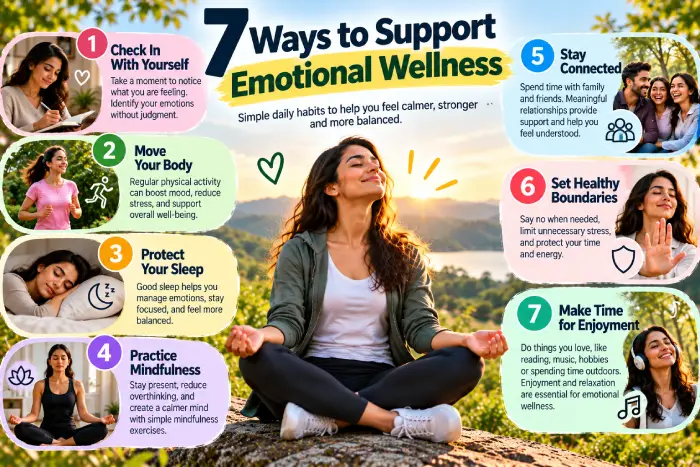
Just do them. You don‘t have to do each process all together. Pick the one that you think is most relevant to your life today and try that.
1. Check In With Yourself
Spend a minute asking:
What is it that I am feeling at this?
Try to name the emotion first without judge the feeling (this tiny trick can really scale the high wall of emotional confusion).
2. Move Your Body
Physical activity may also be an enjoyable component of a healthy lifestyle. Keep moving by walking, strength training, doing yoga, riding a bike or swimming. Or just find something you like to do that takes your mind off being stressed out while benefiting your health. Use movement for enjoyment, not punishment.
3. Protect Your Sleep
Emotional stability seems to be more difficult to maintain when you are constantly tired. Establish a practical sleep routine and avoid excess input that can be avoided close to bedtime. Now‘s not the time for elaborate rituals. Stick to some basic consistency.
4. Practice Mindfulness
Being present. Sit quietly for five minutes and focus on your natural breathing. Observe when your mind wanders. Allow thoughts to come and go and return to your breath. Our beginners guide to mindfulness includes simple practices for Newcomers to the practice.
5. Stay Connected
You don‘t have to go through every crisis alone. Talk to someone you trust. An hour talking with a friend or family can offer you a break, support, guidance or just some breathing room.
6. Set Healthy Boundaries
Saying yes all the time can sap your energy. Good boundaries could be switching off work alerts when you‘re not working, cutting back on your screen time, getting more sleep, or practicing saying no to things you can‘t possibly fit into your real life. Boundaries are about regaining control of your time & energy, not ducking your commitments.
7. Make Time for Enjoyment
Your day shouldn‘t be just about work. Reading, cooking, listening music, going out, playing a sport, watching something you love or simply restarting an old hobby -sometimes you need to rest. Pleasure and relax are important factors.
Common Emotional Wellness Mistakes
One error is believe to avoid painful feelings. If you ignore a feeling, you may not solve the underlying issue. Another is inform yourself to stay positive continually. Striving for positive emotion all the time can turn about ordinary feelings feeling like failures. Do also not comparison your feeling and experience you have with others on the basis of what you see on the Internet. People representations are not the same as life which they are experiencing actually. At last, lifestyle approaches wise have their place.
When Should You Seek Support?
Self-care will not help with every emotional and/or mental-health issue. Remember- if you are feeling- or your emotional state becomes- very negative or persevering, is becoming worse, or is interfering with your work, relationships, sleep, eating, school work, or other daily activities-talk to a licensed health-care and/or mental-health professional. Getting professional support does not mean your wellness habits didn‘t work. Seeing a professional is just another way to care for your health.
Conclusion
Emotional wellness refers to learning to better relate to your emotions when you are already feeling bad. Begin with the basics: become aware of how you‘re feeling, move your body regularly, preserve your rest, practice meditation/mindfulness, lean on strong relationships, practice boundary setting and leave space for fun. Sure, you‘ll have stressful, hard days. That‘s not what we‘re shooting for. It is simply to cultivate the knowledge, habits, relationships and supports that allow you to respond more healthily, more thoughtfully to all of the day‘s stressors.